|
|
| |
|
|
| |
"Oh
you shut up!"
"Please don't mind it."
These are the dialogues that signify a shift of mood in Urdu
films. Watch cable late night on television and invariably one
of the characters will suddenly shift to English to use these
stock phrases.
Why they do so is really interesting, because it's a reflection
of cinema mirroring society accurately. Imagine this, you get
into an argument, the lingo of discourse is Urdu, but the moment
things start to get heated you shift into English.
Why does this happen? Is it because English is the language
of anger, bourne of a history of colonialism and war? Not really,
all languages are really good at expressing anger because it
is so innate to the human experience.
|
 |
|
| |
Actually,
in Pakistan the use of changing from English from Urdu within an argument
usually signifies "Group Association". Arguments are about
winning by dialogue, but when the argument starts going nowhere, the
first thing to do is establish power in an attempt to silence the
other. The easiest way to do that is to change gears in the conversation
by using English.
The ability to speak English in this country has many connotations
based on the inequalities we find rife. It starts not only with the
connotation that people who speak English have more wealth and by
extension greater power, but is also based on the starting point on
our systematic educational apartheid where the medium of education
is a determinant of your fate.
|
 |
| |
| So
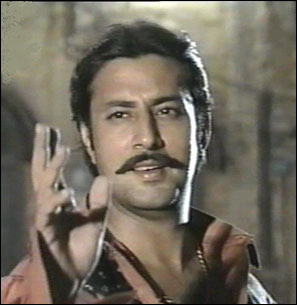
whenever Reema says to Babar Ali in a film "Oh you shut up!",
that's the first cue that the story of a rich girl, poor boy romance
is starting to take place. At the same time, whenever someone says
"Please don't mind it", it's a cue that there is a reprimand
based on an invocation of power outside the argument itself. |
| |
You
can see this every day, on an airline recently when I was travelling,
a younger man starting nudging an old man to make his way down the
aisle to the exit of the plane. They started arguing, and the first
few verbal jabs were delivered in Urdu. But when the argument started
getting out of control, the old man (who was bearded and in kameez
shalwar, the young man was clad in jeans) shifted his counter arguments
into English to establish equity as an equal in the argument.
|
 |
| |
Probably the best use of this "Group Association" in media
has been the most recent Dr. Aur Billa video 'Soneeye' (probably their
most stunning work ever, but sadly played very little on the channels
despite great performances by Faisal, Mani and Jawad).
The central premise of the video is the character of Javed Bashir
who is dejected over the marriage of his friend played by Mehreen
Raheel, who he loves, getting married to the character of Faisal Qureshi.
Faisal knows of Mehreen's friendship with Jawad and the moment Faisal
and Jawad meet, Faisal says, "I have heard a lot about you."
That's perfect, the use of English in the opening dialogue between
the two signifies the power of one over the other, otherwise "Me
ne app ka bohat suna hai" would have done as well.
So was the interaction between Faisal and Jawad sincere without the
other connotations I have suggested? My foot. |
| |
|


