|
|
| |
instep
analysis
Build brands, not a house of cards
With fashion gradually infusing life at large, it has become
imperative for mass-retail stores in Pakistan
to synergize with designers. And only by diluting their designs
and marking down price
tags can fashion labels build into brands, icons and industries
By
Aamna Haider Isani
|
| |
Pakistan's
fashion revolution has shifted into second gear, evident by the increasing
number of designer stores mushrooming all across the cities. Stalwarts
like Amir Adnan, HSY, Maheen, Sonya Battla, Deepak Perwani and Karma
have enjoyed retail presence for a long time; but now, even designers
like Nomi Ansari, Sara Shahid, Saman Arif (Nayna) and Zara Shahjahan
who have been eyeing the market skeptically, are throwing caution
to the wind.
They have realized that the numbers are getting big and the money
game bigger. And now when the industry has decided to shake off the
stigma of made-to-order bridals, it's time to dive into the mass market
head-on and prepare to invest in inexpensive ready to wear, made available
in retail aisles of mass market stores. It's the need of the hour
and that should become the order of the day. |
 |
| |
Pakistan does
not have an H&M or Target but the equivalent here lies in places
like Chen One, HKB, Sanaullah and the like. These stores have been
stocking garments under the label of 'fashion' but it's hardly fashionable
clothing that you see on the racks. They do create a link between
designer collections and clothes manufactured in the garment industry,
but that link is a very weak one. To kick off branded clothing, these
stores need to begin stocking diluted collections created by established
designers.
A 'Chen One summer collection', for instance, will never manage to
get the same response as a 'Karma for Chen One collection', will.
Imagine being able to buy a simple ladies' kurta, manufactured in
accordance with the current international trends by a renowned designer,
for an affordable price. That's exactly what Karl Lagerfeld did with
his collection for H&M and Isaac Mizrahi for Target. And that's
the trend that needs to be promoted in Pakistan now. |
 |
| |
Bareeze
has put up a great example by teaming up with HSY but the collaborations
should not end there. All textile manufacturers, especially those
who are aware of fashion branding and marketing such as Gul Ahmad
(with its high end store Ideas), should bring designers on board to
create simple and affordable ready-to-wear clothing with the fabric
they manufacture. It would be a match made in heaven.
High end stores like Labels, Men's Store and The Designers have offered
unprecedented services in creating a market for ready-to-wear fashion.
Designers have benefited tremendously by the space provided to them
as have the consumers. However, Labels and The Designers equate to
Saks or Bloomingdales in a very small, yet relevant way. By housing
different brands they provide accessible space to the consumer but
it's sold at more or less the same price as those clothes would be
available at a flagship store. Ditto for western labels at Men's Store. |
| |
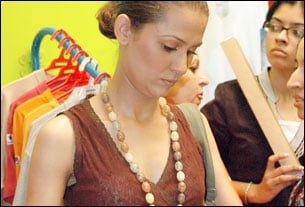
| Bringing in Maheen
Khan, Maheen Karim, Zara Shahjahan and Saman Arif (Nayna) in preparing
of launching the new season at Labels, Karachi, owner Zahir Rahimtoola
speaks to Instep about the essential steps he believes the industry
must take. "We'll be stocking all these labels along with Labels'
own," he comments, "but yes, designers will be selling at
their own prices. They need to dilute their designs if they wish to
target a mass market. I feel that in Pakistan a lot of designers don't
want to dilute their products. They feel that would be bringing them
a notch down. But the sooner they do it the better for the growth
of the industry." |
 |
| |
"Fashion
is about the glitz and the glamour," he adds, "but also
about the dollar and the cent."
Not entirely prepared to take on a retail environment in any significantly
big way, designers must go for the mass populous to bring fashion
to the streets and for that to happen, the synergy between the designer
and the mass manufacturer/retailer must happen. They have to realize
that designing for the average woman – who does not belong
to high society or front rows at fashion shows and who wears a medium
to extra large size – is the only way to build their value
as high as their worth.
"I agree with the concept," says veteran designer Maheen
who has impressively branched out of her label Maheen into Gulabo,
that is more mass-oriented, "but the deal has to be structured
in such a way that established designers lead teams. If a company
like Chen One commissions me to design a seasonal collection, I'd
want to head a team of young designers and promote new talent. That's
the way it's done at Gulabo."
But isn't the brand identity that comes with a well reputed fashion
label what the company would need more than anything else?
"It would, but it has to be learning/teaching process as well.
Relevant industries need to come forth; they need to be making offers.
I don't think there would be an ego problem at all. If designers
like Rizwan Beyg and Sana Safinaz, Karma and HSY could design for
lawn, then why wouldn't they design for lifestyle stores?"
The fact is that fashion was first introduced to Pakistan's mass
market with designer lawns. That's when Rizwan Beyg, Sana Safinaz,
Karma and HSY became household names. Their prints were exhibited
in the aisles that displayed the hundreds of other varieties of
summer lawns being woven and churned out in the Punjab. They cost
more or less the same as ordinary prints and were available at every
outlet that was selling lawn, may that be Liberty or Anarkali in
Lahore and Clifton or Bahadurabad in Karachi. Throw in Faisalabad,
Multan and Hyderabad and you'll get a clearer picture to the level
of market penetration they achieved. Amongst an oceanic choice of
cottons, voiles and lawns available, it was the credibility that
came with their names that made the prints they designed a total
sell out.
Vinnie took it step further. By lending her identity to Mohammad
Farooq Textiles and putting her face to the brand, she lent it a
stature that had women scrambling to get hold of the prints she
was designing for them. With a beautiful, successful and intelligent
face they could identify with, V9 became a bigger success than anything.
Awareness is setting in and though the mass consumer in Pakistan
may not be as trendy or fashion savvy as that in America or Europe,
the learning process has kick started. It won't be long before women
develop their own styles and head towards fashion stores to mix
and match labels to create individual looks of their own. Snob shoppers
who prioritize labels will always exist but volume will be generated
by mass consumers.
Market versatility should be the new strategy and designers should
aim for high end, low end and everything in between. It's the only
way forward and definitely the only way up. Stores and designers
who are unprepared to move out of comfort zones can then prepare
to meet competitive brands like Next that are gradually seeping
into their market. It's a 'do or die' situation and we hope to see
our fashion industry survive.
|
| |
|