



|
|
|
|
 |
 |
  
|
issue review
The show goes on A Case of
Just when did the shifting of GHQ to Islamabad become a part of the capital's master plan and how is it going to affect the civilian population living around? By Nadeem Iqbal As the new political government is being put in place and the military appears to be on the retreat from the civilian domain, the four-year old simmering controversy over the relocation of Army headquarters from Rawalpindi to Islamabad has resurfaced. Pakistan Peoples Party has been consistently saying it will reopen the case. Media quoted former PPP senator Farhatullah Babar as saying: "We will stick to our previous stand and if we deviate from it, media will be justified to criticise us." When contacted by TNS to know the modalities of how the party intends to reopen the case, Babar said the process is detailed that "will be shared with TNS later". The ground-breaking of the
new GHQ was done in Sept 2004 despite the fact that the revised Farhatullah Babar, then a Senator, questioned the shifting on the floor of the house in Dec 2006 in the backdrop of media reports saying that the Capital Development Authority (CDA) had suffered a loss of approximately Rs504 billion by providing an additional 870 acres of land for the construction of General Headquarters (GHQ) in Sector E-10. The land had been offered on the demand of the military authorities at a cost of Rs200 per square yard. However, the market rate in the area close to the E-10 sector is stated to be Rs110,000 to Rs120,000 per square yard. While submitting a joint adjournment motion in the Senate against the GHQ project Pakistan People's Party, Pakistan Muslim League-Nawaz, Muttahida Majlis-e-Amal and the Awami National Party pleaded that they wanted the money spent on public welfare schemes. The adjournment motion stated: "It is very astonishing that CDA has sold another 870 acres to the military in E-10 Sector at a throwaway price of Rs200 per square yard for the building of GHQ, whereas the CDA has auctioned land in the nearby areas at the rate of Rs. 110,000 and Rs120,000 per square yard." The CDA had previously allotted some 1,400 acres in E-10 sector for the GHQ Complex. The 870 acres given for the GHQ, however, is in addition to E-10 sector already allotted by the CDA for the purpose. According to the CDA, the additional land was only needed for the security of the premises (GHQ). It was of the view that it would not develop the land, which falls in Zone-III national part where construction could not be carried out. As per the CDA version, the GHQ was offered land much earlier on the directives of the government and the price of the land had been settled in line with the rate charged from other government departments and institutions which had to pay much lower than the commercial/auction value. Reacting to the politicians' criticism, a military spokesman rejected the dubbing of new GHQ as 'eighth wonder of the world' as 'ludicrous propaganda' and said that new GHQ building would focus on the "improvement of functioning rather than providing luxury". According to the details released by ISPR, though 2,400 acres of land had been acquired in sectors E-10 and D-11 for the purpose, the Defence Services Complex will cover about 1,500 acres only. Offices of Ministry of Defence, Joint Services Headquarters and all services headquarters would occupy 206 acres and the GHQ will utilise only 99 acres. The remaining area would be used for building flats, houses, schools and hospitals for over 17,000 employees of all grades. Much of the remaining land would retain its pristine nature, with 870 acres providing a security belt and some 350 acres would be covered with woods and running streams. The military dispelled 'allegations' by the politicians and 'impressions' created by the media that the complex would cover 2,450 acres, and that 17,000 luxury flats were planned and lakes would be created in the complex grounds. On different occasions ISPR spokespersons have claimed that the master plan of Islamabad provided for the establishment of the defence services headquarters and the decision to shift GHQ from Rawalpindi to Islamabad was taken by Zulfikar Ali Bhutto in 1972. CDA allocated land for the purpose in 1981. Seventy per cent of the barracks of the present GHQ complex in Rawalpindi were constructed in 1852 when the site was selected as Sub Area Command of the British Army and was never designed to contain as big an installation as GHQ, the military spokesperson reminded. The areas where the new GHQ is being located is at the foothills of picturesque Margalla Hills and is the prime land of Islamabad. Islamabad main sectors are broadly divided into E, F, G and I series. These are respectively referred to as 'elite', 'feudal', 'general public' and 'industrial workers'. The price of land is determined by closeness to Margalla Hills. By the end of next decade the residents of the sectors of G and I series are going to lose the Margalla view after the construction of commercial Blue area between middle class and rich sectors. Recently CDA has revised the capital's master plan expanding the city boundaries. But the details of the revised plan are not shared with the public so it is not clear if the objections over shifting of defence establishment that were raised during the 1987 revision of Master plan have been addressed or not. The 'Review of Islamabad Master Plan 1987', whose copy is available with TNS noted that sectors E-8, E-9, and E-10 had been converted from public/government employees residential sectors to armed forces (military, air force and Navy) residential cum establishment areas which was going to overburden the communication system between the twin cities and had created public restricted areas in Islamabad's residential areas. "According to the original master plan concept, all army uses were assigned to Rawalpindi, where a special zone was defined for this purpose along the proposed Soan Highway and where the army has an access to the free area south-west of the city for further expansion," the 1987 review added. The 1987 review further stated: "Location of defence establishment in the middle of the civilian sectors has its own complications as it can not be treated as a separate entity for planning and development. No comprehensive planning and development is possible as the major roads networks have to be linked across these sectors. No expansion of the area will be possible as it will be surrounded by non-defence sectors. In case of emergency, mobilization will be difficult and the presence of defence establishment will constitute a serious hazard for the civilian populations that will be living around them." Some of these concerns were attempted to be allayed by President Musharraf at the time of the ground-breaking by saying that Services Headquarters, being at one place, would provide more personalised and intimate touch in preparation of plans and in understanding each other's style of working and constraints. He said that facilities developed must be located in a manner that the residents of the neighbouring sectors could share the same. In no way the moving of the Headquarters should increase the load on the existing facilities of Islamabad, such as schools and hospitals. The president expressed the hope that this project would be able to generate major economic activity that would be beneficial for a wide spectrum of the working class. review Depicting reality in painting requires a lot of effort and rigorous training. Yet, in his recent work at Rohtas 2, Moeen Faruqi has taken it upon himself to portray his subject in a realistic manner By Quddus Mirza There, within, inside my head, The tree speaks. Come closer -- can you hear it? -- 'A Tree Within', Octavio Paz This image, of a tree
growing inside a human head, also appeared in the work of Moeen Faruqi. In a
painting from his last solo exhibition at Croweaters Galleries, Lahore,
branches and trunk of a tree In his recent work, the tree does not grow inside the human head; instead making full use of 'poetic licence' a combination of visuals overlap in human torsos. In his solo exhibition at Rohtas 2, Lahore, a number of fiberglass casts are painted with multiple images along with two torsos covered in plain blue and red colours. This manner of wrapping his painting on a round form (instead of spreading it on a flat canvas) is an important addition in his aesthetics -- indicating the painter's urge to find an appropriate narrative. The narrative reflects the private world of Moeen Faruqi: A place populated with unusual characters and strange creatures. Cats, fish, birds, dogs exist in the same space, where men in shirts or just in ties and women in formal dresses cohabit. They live side by side, drinking, smoking, making telephone calls, playing guitars or sitting on chess boards. All these people, places and activities allude to an urban situation and the associated alienation experienced by most of us living in cities -- individuals interacting with each other but with a sense of distance or superficiality. One example is the small talk at parties made only as a social gesture. Or even within families people spending their lives interacting with other human beings, without the desire or the drive. The discontent (or alienation) of society is visible in a general nihilist and destructive attitude. Even the most sophisticated gadgets like ipods, cellular phones and internet do not help in overcoming this sense of alienation. A man busy with his computer, enjoying the ipod or calling on his mobile may consider himself connected to a large public, but in reality he is confined to his own room or imaginary space. The loneliness of people
appears to be the real concern of Moeen Faruqi. His world consists of
characters who breathe side by side but are strangers in reality. Often
couples, men and women or just men, survive in unpleasant environments. The
interior -- with tables and glasses, fans, With this new body of work (displayed from March 24-April 5, 2008) Moeen is moving ahead, in more ways than one. His earlier choice of vocabulary is now being modified into a more restrained and realistic rendering. Clear outlines of figures, proportionate depiction of bodies, and carefully drawn postures are all signs of him opting for a rather realistic mode of representation. Actually, in the beginning, the naive manner of painting was an apt choice for Faruqi's forms because his subject demanded a fantastical depiction of imagery. The unreality of pictorial substance demanded an imaginative mode of expression. Now the content remains the same; only the method of portraying it is different, rather difficult, due to its overt realistic scheme. Actually the difference between realistic and imaginative rendering of a subject in visual art is significant for many reasons. Before studying it though, it may be apt to make a comparison of the verbal and visual arts. In fiction and literature, it is easier to give a realistic account of events rather than to fabricate a convincing world out of one's imagination and fantasies. In most cases, one has to narrate reality without much of an effort. In visual arts, on the other hand, particularly in painting, it is more convenient to work with the imaginative content/form (as most beginners and untrained artists do). Depicting reality in painting requires a lot of effort and rigorous study. The ability to work in a realistic manner is acquired after years of training. Once attained, the artists may not necessarily continue with it, like Pablo Picasso who mastered the realistic art at an early age but shifted to other forms such as Cubism, Surrealism etc. It seems that Moeen Faruqi has taken it upon himself to portray his subject in a realistic manner. Contours of his models, outlines of objects and tonal variations signify a realistic preference. This is a new development in the art of Faruqi, along with his obvious shift in imagery which is now focused on male relationships. This was missing in his earlier body of work, though this subject is often favoured by many painters in the country, most prominently Anwar Saeed. There can be many reasons for Moeen to move to this specific subject. Probably it has its root in the works of other artists actively pursuing this theme (not only in their art, but also in their lives). In fact it may be apt to deduce that the male-oriented imagery was borrowed from his contemporaries' works, because an intelligent artist like Moeen Faruqi is always open to other influences and practices. It is apparent that in today's art world nobody can survive without 'consciously or unconsciously' copying others. A happy state of affairs, because as Picasso said "copying others is necessary, but what a pity to copy oneself!" The Festival of Folk Puppetry and Crafts held recently at the Puppet Museum in Lahore was meant to bolster this very indigenous form of entertainment By Sarwat Ali The revival of folk
puppetry has been the dream of Peerzada brothers since their impassioned
involvement with the marionettes more than three decades ago. Such a revival
in India had also A number of folk groups still perform. Named after their chief puppeteer like Muhammed Abdullah, Bashir Dhamalli, Noor Din, Billo Mai, Lally, Bahadurrah, Muhammed Shafi, Khalid Hussain, Bahadur Ali, Muhammed Afzal, Muhammed Siddique and Muhammed Bashir, these groups are the traditional exponents of the craft. Hailing mostly from Rajasthan, they acquired the art of both playing and making the puppet from their elders. The oral transmission of knowledge had ensured a much closed-door familial environment where the secrets of the professional had been passed on from generation to generation. Over the past few decades this art has been on the decline. The craft of making wooden puppets too is almost extinct as only the puppets made of yore are repaired, while the craft of manipulating the string puppets too is left with only a very few practitioners. The dialect in which the tales were narrated has been replaced by a more contemporary idiom and the traditional songs with rich musical input has been substituted by songs based on current film tunes. The old instruments too have been replaced by more recent gadgets and it is not long before computer-generated sounds and electronic manipulations take over. Folk Puppetry is an old and
traditional form of marionette that can be traced back many centuries. Called Pakhiwaas or gypsies, a nomadic lot who have roamed from place to place taking part in puppetry or singing mostly the vast repertoire of folk songs in various dialects of the language spoken in the length and breadth of Rajasthan, they have been part of the history of this area since times immemorial. They probably migrated to Bangla Fazil in district Ferozepur (now in Indian Punjab) some time in the past and from there migrated to the new country Pakistan in 1947. The Museum of Puppetry was established to focus on the rich tradition of puppetry in the world with a particular emphasis on the puppets and art of puppetry in this region. Since the last ten years or so, on most days of the week puppet shows are held and a large number of people attend these shows which has encouraged everyone that perhaps the old art of traditional puppetry has a chance not only to be saved but to be made more vibrant. In the International Puppet
Festivals held under the aegis of the Rafi Peer Theatre Workshop folk
puppetry has formed an integral part and in the year 2006, with the holding
of the first Folk Puppet The art of puppetry will only survive and survive well if the practitioners have a regular income and that can only happen if the shows are held regularly. The traditional puppet groups have survived by staging shows on invitations on a fee decided before the show. Earlier they used to roam in the streets of the villages and cities hawking for children to see the show. As they found an audience, they would immediately put up their simple set and start to perform to a group of people, not more than a few dozen. They would then be paid by the audience. It was a kind of ticketing system, the value of tickets was pre-decided, quite inexpensive though, which the children of localities not housing the rich could afford. These days they are usually invited by people to their houses on occasions like birthday parties of the children or, even more rarely, a marriage ceremony. But all this brings back a
pittance. One primary reason, of course, is poverty for they have never The festival was also given a folk colour as other traditional items belonging to various regions of the country were also put on display. Earthenware, pottery, hand woven cloth, khaddi cloth, items produced in cottage industry and other trinkets which form the list of shopping in a mela were also on sale. Because of the expansion of the Museum there is plenty of land to do much more and the Peerzada brothers are hopeful that this Festival will continue to grow. Dear all, A few weeks ago I read a friend and a colleague's forthcoming novel 'A Case of Exploding Mangoes' and it left me with a sense of deep sadness. To anybody who has lived
through the dark days of General Zia's rule, the title will immediately evoke
the incident that finally freed Pakistan -- the Bahawalpur plane crash of
August 17, 1988 when the presidential C-130 fell out of the sky and killed
everybody on board, including the Muhammad Hanif's book relives that era of political repression and oppressive ideology: An age when Pakistan's top army brass helped 'save' the free world from the Soviets who had invaded neighbouring Afghanistan, and enriched themselves considerably in the process; a time when General Zia brought Islam to Pakistan and jailed and publicly flogged dissenters among political activists and journalists; an age when it was almost a sin to be a woman, and where the state acted increasingly ruthlessly to silence any protest against it or its 'ideology'; a time in which the Americans gave us the gift of 'Mujahideen' and sowed the seeds of jehadi culture in this part of the world. Hanif spins a fiction which culminates in the actual plane crash, and involves a colourful cast of (mostly dubious) characters. The narrator is one Ali Shigri, a young air force pilot, haunted by the question of his father's death and filled with a quiet resolve to avenge that death. The General Zia character is depicted as an increasingly paranoid ruler, surrounded by ambitious generals like the pale faced Akhtar Abdur Rehman or the inscrutable Aslam Beg, and who is regarded with much contempt by his very down-to-earth wife. The Zia character becomes as riddled with parasites as with suspicions, and eventually becomes a victim of the very system of ruthless extermination that he has encouraged and presided over. It is astonishing how a good part of the book is so amusing in such a dark setting. Some of the humour is gruesome no doubt, but there are other wonderful little comic touches that evoke a sense of that time: the constant question of whether one would want to listen to Lata or Asha ('two fat ugly Indian sisters' explains the narrator), the constant references to Reader's Digest, the little cameos of various characters whether in the Lahore Fort or on board an army plane...There are also some less convincing and less amusing cameos like that of the OBL character who appears at a rather surreal banquet, but these little walk-on parts are just diversions in an otherwise intense story, and what I thought was a wonderful depiction of a very bleak period in Pakistan's history. There are very few women in this story; it is set in a man's world -- airforce barracks, army houses or dungeons housing political prisoners --reminding one of the time and the mindset. This novel is going to be published in June and seems to have been rather well-received in the publishing world already. My own assessment may, of course, be considered biased because Hanif has been a friend and colleague for almost two decades, but I think the novel is a wonderful depiction of the twilight of General Zia's rule. There are many passages that I thought conjured up more recent events and images: Omar Asghar Khan's body hanging from a ceiling fan, suitcases filled with dollars being rescued from Afghanistan as the 'free world's' men are ambushed and killed, US officials hobnobbing with Pakistani generals and patronising and consorting with the people getting rich off the 'reconstruction' of Afghanistan... 'A Case of Exploding Mangoes' is funny, sinister and sad --all at the same time... Much like the Zia era seemed to many of us. Best Wishes Umber Khairi
|
|
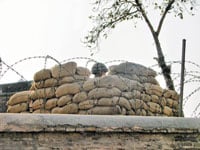 Islamabad
Master Plan, carried out in 1987, had specific objections over the shifting
of defence
installations to the new capital city.
Islamabad
Master Plan, carried out in 1987, had specific objections over the shifting
of defence
installations to the new capital city.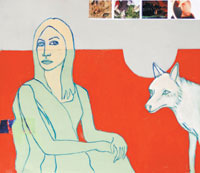 were drawn within a silhouette of human form. This similarity between the
Mexican poet and the painter from Karachi may have been purely accidental.
But it certainly reveals the literary bend of the person who, besides being a
painter, is a recognised writer of fiction and poetry.
were drawn within a silhouette of human form. This similarity between the
Mexican poet and the painter from Karachi may have been purely accidental.
But it certainly reveals the literary bend of the person who, besides being a
painter, is a recognised writer of fiction and poetry.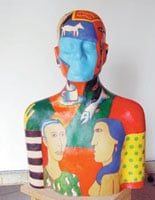 telephones and a minimal presence of furniture -- completes the overall
impression of oddness. The choice of colours, especially the human figures
painted in shades of greens and blues with highlighted white areas and the
background reflecting artificial (in a true sense of the word) lights, convey
a kind of sinister atmosphere.
telephones and a minimal presence of furniture -- completes the overall
impression of oddness. The choice of colours, especially the human figures
painted in shades of greens and blues with highlighted white areas and the
background reflecting artificial (in a true sense of the word) lights, convey
a kind of sinister atmosphere.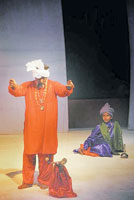 encouraged them and infused new expectation that it was not only a dream that
they were chasing. Their dream of setting up a place for the puppeteers from
where they could work their puppets and be contacted and engaged for a
performance appears closer to actualisation than ever.
encouraged them and infused new expectation that it was not only a dream that
they were chasing. Their dream of setting up a place for the puppeteers from
where they could work their puppets and be contacted and engaged for a
performance appears closer to actualisation than ever.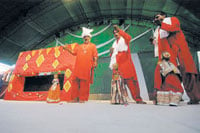 Its recent phase can be mapped more accurately in the last five centuries
through the tales pertaining to the court of Mughal Emperor Akbar along with
some of the most important happenings like the revolt of Dullah Bhatti.
Its recent phase can be mapped more accurately in the last five centuries
through the tales pertaining to the court of Mughal Emperor Akbar along with
some of the most important happenings like the revolt of Dullah Bhatti.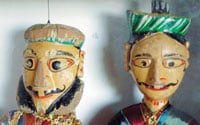 Festival at the Puppet Museum, hopes had been raised that the old traditional
form could be revitalised.
Festival at the Puppet Museum, hopes had been raised that the old traditional
form could be revitalised.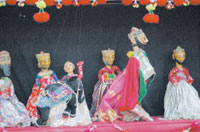 had the resources to build their own houses. Being landless and
property-less, they live in localities which in Pakistani parlance are called
Kachi Abadis. Living a life of poverty on the outskirts of the city in
temporary makeshift settlements, barely eking out an existence with their
younger generation not taking up this profession, is a frightful prospect. It
has been feared that very soon this old craft and form of entertainment will
totally die out.
had the resources to build their own houses. Being landless and
property-less, they live in localities which in Pakistani parlance are called
Kachi Abadis. Living a life of poverty on the outskirts of the city in
temporary makeshift settlements, barely eking out an existence with their
younger generation not taking up this profession, is a frightful prospect. It
has been feared that very soon this old craft and form of entertainment will
totally die out. Pakistani president and the then US ambassador to Pakistan, Arnold Raphael.