



|
|
|
|
 |
 |
   |
The
way we are karachicharacter
city Ajmal Kamal is well-versed on Karachi's history and civic issues which he thinks is essential if one is to understand some of the persisting problems in Karachi By Sabeen Jamil Kolachi: Why do you emphasize on the importance of Karachiites being familiar with the history of Karachi? AK: You can't love
something without first understanding it. Only after having deep
knowledge of Kolachi: What is the misuse of history? AK: History is misused to justify certain acts of the present. For instance In Sarajevo, Bosnia, history was used as a justification to kill present enemies. Turks during the '90s were killed with the justification that they had captured Bosnia during the16th century. A similar practice has been carried out in Karachi for years in the name of ethnicity. A lot of ethnic and
linguistic communities reside in Karachi and compete for provided
resources. Since they don't know the complete history of Karachi, they
hold different perceptions about the ownership of the city. Everyone is
trying to establish his ownership over Karachi justifying it with
historical references, which results in conflicts. A great majority
perceives the history of Karachi as starting only after partition,
forgetting the communities that lived here before that. They also forget
the contributions of Hindus, British, Parsis and other communities that
were residing here before partition Kolachi: Why was Karachi's history misused and how does it add to problems faced by Karachiites? AK: In urban and democratic societies, one has to live amongst a lot of different linguistic and ethnic communities. This implies that no one has the birthright to govern and everyone has an equal right to resources and governance. However in Pakistan, when rural-to-urban-migration began, a lot of people migrated to Karachi. Ironically, authorities couldn't cope with the change. During the process of social change in Karachi, the perceptions of migrants changed, yet the system remained unchanged with it's inability to respond to the changing needs of people. This resulted in scarcity of resources and competition among Karachiites over these resources. Though children of all the migrating communities were facing similar problems of transportation, quality education etc. people with vested interests got a chance to play the politics of ethnicity on the basis of these problems. Therefore when an over-speeding bus runs over a Karachiite we are told "Pathans are reckless", regardless of the fact that public buses are driven by people of other ethnicities as well. With the increasing
number of migrants to Karachi, authorities should have ideally provided
enough This conflict over resources and misuse of history has strengthened ethnic identity and people now value their community affiliations over merit. On the contrary, I think this is an artificial difference and it is unrealistic to continue these differences because children of migrating communities today, unlike their parents, are not that in touch with their native values. Children, generally, no more take pride in their Lucknowi way of speaking for example nor on having come from Delhi. Regardless of their native ethnicities, younger generation of today speak alike, live alike, share a liking for the same kind of Indian movies and share the same problems of jobs, transport etc. Yet, their problems remain unsolved because they were given an incorrect definition. Instead of identifying them as problems of the system they were identified as ethnic ones and have thereforepersisted. The basic problem of Karachi is that the system of the city did not change along with the changing perceptions of people. Kolachi: What do you mean when you say "unchanged system"? AK: Actually the
governance in Karachi did not change along with the changing perceptions
of people. Changes did occur on a grass root level but the system
remaine0d unchanged. For instance, every The same attitude of the government is apparent in the transport sector. As the concept of people in Karachi towards working women is changing and more and more women are traveling through public transport to reach their work places, more spacious buses are needed. But the system fails to respond to this changing perception and women still have only 20 per cent allocation of passenger seats in public buses. Similarly, a great number of people now reside in makeshift houses on footpaths as the concept of the joint family is changing to a nuclear one, which according to one survey has led to older members of families not having a place in the house. Since authorities fail to change by being unable to make retirement/old homes for senior citizens, we see people ending up on footpaths. There is actually a lack of affirmative action on part of authorities. Kolachi: Why is there a lack of affirmative action by authorities? AK: Because they do
not understand change. If you do not understand a change how can you Similarly, when in the1950s people were shifted from Saddar to far-flung areas like North Karachi, their transportation and employment needs were not taken care of. They had jobs in Saddar and had to travel all the way from North Karachi to their workplaces. When Karachi Circular Railway was replaced, they switched to buses and coaches as a mode of transportation. As a result, Saddar became a transit camp with all the buses coming here, destroying the café culture at Saddar. In Karachi, problems are given wrong definitions which gives way to the wrong solutions for them and Karachiites remain unaware of it because generally they themselves do not know and understand Karachi and its problems. Kolachi: What can Karachiites do to understand the problems society of present day Karachi? AK: Societies change with the migration of people from rural areas to urban ones. Karachiites cannot understand Karachi unless they understand the rural-urban migration phenomenon and the problems resulting due to the failure on part of authorities to cope with this phenomenon. Karachiites must know the actual history of Karachi, the background of the civic issues they face at present, along with knowing that they can help resolve these issues. Every Karachiite must know, for instance, about the Orangi Pilot Project to learn the role they can play in bringing about change. You can visit City Press at: 316, Madina City Mall, Abdullah Haroon Road, Saddar, Karachi. --Photos By: Athar Khan Discover Karachi! To help Karachiites get better acquainted with their city, City Press has a library along with a reading room where one can read books on Karachi, without any fee. Beside this, the press screens parallel cinema from around the world, every Sunday. "The idea is to know other societies in the world to gain a world view," Ajmal tells Kolachi adding that the basic motive of such activities is to know about other societies specially those experiencing the post-colonial phenomenon like our society. "This way," Ajmal says, "we know about problems in those societies and solutions they have found for them." A whole room has been spared at City Press's office in Saddar for this purpose. Besides this, City Press publishes translations from world literature in their quarterly Aaj "in order to understand and compare world societies to ours," says Ajmal Kamal. City Press has been screening movies form Indian, Japanese, Swede, French and Iranian parallel cinema since 2000. However, the movie club which started with an audience of 30 people comprising of architects, journalists, lawyers, software engineers, film makers and media professionals has now reduced to just three regular members. "We charged people 50 rupees for watching a movie," Ajmal tells Kolachi. "I think now we would pay them to watch one!" he remarks sarcastically. The library and reading room are no different than the club, hardly ever having any readers. Ajmal believes this might be because the perception of leisure activities among Karachiites has changed or that Karachiites are no longer interested in civic issues. "People are less interested in the city's problems though these problems directly affect them," Ajmal says adding that a sense of relating to Karachi direly needs to be developed among Karachiites. "The history of Karachi should be taught at educational institutes to help Karachiites relate to the city," Ajmal suggests adding that Karachiites need to realize that knowing the background of civic issues is as important as solving them. hyderabadart A softer world: First International Moot on Art and Art Exhibition Sindh celebrated art of the region and country at the inauguration of the Institute of Art and Design at the University of Sindh, by inviting artists from all over the world to participate in a show and conference which provided much food for the eyes and thought. By Adeel Pathan The harsher side of Sindh; the honour killings, kidnappings for ransom and tribal clashes; are better known than the unique culture and creativity the area is steeped in. The province has great potential for the arts which can be encouraged through investment and promotion. An International Moot
on Art and Art Exhibition, diligently organized by the team at the
Institute of Art and Design (IAD), at University of Sindh, headed by
Chairman, Dr Mahmood Ali Bhatti was held at the The work displayed at the exhibition didn't just include work of contemporary artists, but those of old masters as well as the newbies. Artists addressed a variety of concerns through their work; ranging from the purely academic portraiture and landscape to the more abstract, intangible phenomena that exist in society. A lot of paintings were left untitled to engage the audience in dialogue. Abdul Majeed Panhwar, one of the visitors at the exhibition told Kolachi that the exhibition impressed him as, "it was well organized and gave a chance for the international artists' community to interact with each other." The conference was
spread over a period of three days and was organized to celebrate the
establishment of IAD in a new building close to the well-known art
department in the University of "This exhibition was essential in introducing up and coming artists to others in the artists' community," said Abdul Majeed, "and will help put IAD on the map." One cannot deny the important role art plays, it documents, reflects and absorbs trends and tendencies in society, as it has for centuries. Dr Radhe Shyam Mulmi from Nepal, while speaking at the moot pointed out that art is the greatest expression of mankind and is "best expressed in painting and sculpture." And as this moot and exhibition stood as an example of, art has served as a universal language and "remained the greatest link between different civilizations through the history of mankind." Though not ignored in Pakistan, there is indigenous art in different parts of the country which can really flourish through, "considerable investment from the public sector," according to Hussein Haroon, former Speaker for the Provincial Assembly. With more attention and investment, he believes there can be, "revival and rehabilitation of centres of art in Sindh, including at Hala, Nasarpur, Tajpur, Thatta, Khairpur and many other areas." Though one might not consider Hyderabad and interior Sindh to be a hub of art and culture, to put together such an impressive show of huge magnitude simply speaks volumes of the hard work, dedication of artists, not just in Sindh, but all over Pakistan. "Such a huge exhibition to be held in Hyderabad or Jamshoro is a big deal," said Waheeda Bano Baloch, teacher and curator of the show. Waheeda spent almost a month and a half collecting and organizing work for the exhibition. "It was a difficult task," she said, "the entire IAD team worked relentlessly to put this show together and the response we received was beyond our expectations proving that such endeavours are appreciated by people." Mohammed Iqbal told
Kolachi that he came from Karachi just to witness the artwork in his
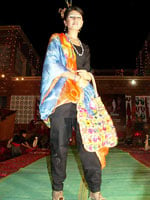
hometown, "Art is a soft yet effective way of addressing global issues and organizing such events will help our society become more tolerant, as well as appreciative of the arts," said one visitor. Apart from the show, which is ongoing from March 25 for two weeks, the conference provided a platform for artists and critics to share their opinions and ideas. Art critics and scholars of the country and abroad including Nilofar Farrukh, Quddus Mirza, Sheherzade Alam, Qudsia Nisar, Riffat Alvi, Dr Ejaz Akram, Shazia Mirza, Maleeha Paracha, Suleman Turman (Turkey), Ragini (Nepal), Michael Rice(Northern Ireland), Lal Mohammed Pathan and Rahat Naveed read papers at the event. The artists present at the event also visited Bhitshah and enjoyed folk music and songs besides attending a fashion show by the students of the institute, modeling their own designs. As Waheeda put it, such events will not just create a space for artists in society, but also allow cultural exchange to take place, broadening horizons and minds of especially younger artists.Not only do art enthusiasts enjoy these shows, encouraging the arts in any country will help portray a softer image of it to the world. --Pictures
by Rashid
Silawat. The way we are So much food, so little time! By Madiha Ansari Karachi, a city of 18 million people is not only famous for its liveliness, but also its food streets. Over the years, Karachi's food culture has flourished tremendously and today, Karachiites are spoilt for choice when it comes to food with various restaurants and road-side dhabas. Though life in the city is often hectic, and over the years has been fallen victim to incidents of violence, Karachiites never lose their enthusiasm for eating out. People from all walks of life throng the famous food streets to add flavour to their day. These streets and restaurants offer great variety and have something for everyone. Be it desi food or continental cuisine, these road side restaurants have won the hearts of the citizens. Most upper end restaurants are either located within one of the major hotels in the city, or in the trendy shopping district of Zamzama, in Defence. Coffee shops are aplenty, with the most trendy being Espresso. There are also several different fast food chains, such as KFC, Pizza Hut and McDonalds in almost every Karachi locality. But usually for those on a more restricted budget, as well as tourists and expatriates there is always Boat Basin, a central neighborhood consisting of open air street restaurants. This indeed has become Karachi's food street, located in Clifton. The famous restaurants which are located in this area includes Karachi Broast, Roll inn, Hanifia beef, Tandoori Hut and others. Boat Basin is where most of Karachi's nocturnal citizens, regardless of social or economic standing end up. No matter what day or time it is, the area pulsates with liveliness. As Mr Abdullah, owner of Karachi Broast said, "I have been working here for 20 years and the number of customers I get is ever-increasing. People usually visit this area during weekends and holidays, but some people are also seen during weekdays. The prices have increased drastically, which has forced us to increase our prices too." Despite this, Karachi Broast attracts it's fair share of customers due to the yummy eatables it has on offer. One customer, devouring his favourite tikka commented, "I come here almost every week, as I love eating such food. I usually come here with family, but also enjoy hanging out with friends and colleagues." Mr Shahzad of Nihari Inn believes Karachi and the Boat Basin food street has a life of it's own. According to him, "whatever happens in the country, might not have any effect on the city and its people. But if something happens in the city, then it has a great impact on the customers." Mr Shahzad is proud of the fact that nihari is extremely popular amongst customers. Faisal, a regular at Boat Basin was of the opinion that over the years, food culture in Karachi has expanded greatly. "I have lived in Karachi for 30 years and during this period things have changed drastically. No one could ever imagine that restaurants and food streets could become part of Karachi in such a big way." However, one restaurant owner was of the opinion that the recent political scenario and inflation has drastically affected the sale of food. "The number of customers has decreased by 40 per cent and we mostly make money on weekends. Due to inflation, the price of chicken tikka has increased by over 20 per cent!" The inflation in prices notwithstanding, one customer was of the view that restaurants have maintained their standard, due to which a large number of people still visit this area. She said, "after Burns Road, Boat basin too has won the hearts of citizens." Being a Boat Basin fan for 15 years now, she still finds it astounding that, "be it six in the morning or past midnight, this city never sleeps. It is called the city of lights and that is very true," one cannot argue with that, keeping in mind the post midnight and five in the morning breakfast crowds at Boat Basin! An expatriate Shamshad visiting the city after almost 10 years was surprised at the way the city has boomed. "I left the city 10 years ago, even then the population was high, but now it has tripled. I am surprised at the way Karachi has exploded. At that time there were very few restaurants, but now there are restaurants in every nook and corner of the city," he said, adding that this confused him as to which place to pick to eat at and which to leave. But he ambitiously declared, "till I go back, I'll try to visit as many restaurants and dhabas as I can!" One Chinese family visiting the area seemed overwhelmed by the variety of food and restaurants in Karachi. Karachi food apparently was their favourite bit of the city as they intend on returning to Karachi just for the food again! "We will visit the city again to try the food we have left. God bless Karachi", was the way they concluded their opinion. Karachiites themselves might be blasé about Boat Basin, but they would never deny the forever bustling and lit up area often adds some extra cheer to their lives! karachicharacter Looking for a silver lining By Saba Ahmed Ali Raza Ansari, a 30-year-old individual from Khairpur District, Sindh, lives with his family in Karachi. Ali is ambitious and dedicated to doing well at his job and supporting his family. Although Ali has his reservations about the direction things are taking in Karachi, he is still optimistic and thinks they will take a positive turn for the city and its people. Ali believes that every storm is followed by bursts of sunshine and clarity which bring hope and strength for everyone. Kolachi: How long have you been living in Karachi? Ali Raza: I have been
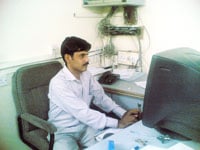
living in this city for the past seven years now. Kolachi: How did you end up moving here? Ali Raza: I had come to meet my uncle in Karachi and to collect my CS Diploma and he got me a decent job while I was here. Kolachi: What is your occupation? Ali Raza: I am Computer Lab Incharge at a local university. I have been doing this for five years now; this is my second job in Karachi and I enjoy it thoroughly. Kolachi: What is your qualification? Ali Raza: I have done my B.Com from Shah Abdul Latif University and a two year Diploma in Computer Science. Kolachi: Do you intend to pursue higher education? Ali Raza: I do want to pursue my Masters in Computer Sciences. Being a technical expert I am interested in widening my skills-base and knowledge on the subject and eventually; my own competence in the field along with my education will help me earn more money. Kolachi: Are you satisfied with your life in Karachi? Ali Raza: To some
extent. I do not want to sound pessimistic at all, but the air of
uncertainty Kolachi: What do you like about Karachi? Ali Raza: This place is the city of opportunities for many. Like many others, the desire to hunt for better opportunities in this city has kept me here for seven years now. Karachi is one city of Pakistan which offers immense employment prospects to people coming in from all other cities of Pakistan. Besides that, it is extremely easy to adapt to this city. Since so many people from different ethnic groups dwell in Karachi, it is not much of a problem for an outsider to adjust to new surroundings. Kolachi: Does anything put you off about Karachi? Ali Raza: Having lived in Hyderabad too, I find that living here can be extremely stressful. The environment in Karachi is not peaceful. One ends up getting mentally, as well as physically burnt out. Kolachi: How do you spend your leisure time? Ali Raza: My leisure time is mostly spent at the entertainment outlets that our government has provided us. I occasionally visit parks; the new park at Clifton is worth praising. Besides that I like the Naval Museum and PAF Museum at Karsaz. I think these are all good entertainment spots according to the infrastructure we have. Kolachi: What changes would you like to see in Karachi? Ali Raza: Being the biggest metropolitan of the country, Karachi has people from various ethnicities and backgrounds moving here. I would like to see all these people live in harmony and work united to promote a bond of humanity, rather than letting ethnic differences create fissures. Most Pakistanis are Muslims and if one is to follow Islamic teachings correctly, then one should refrain from harming another individual. Kolachi: Did you participate in the recent elections? Ali Raza: No, I did not vote this time. Although I would have loved to make a contribution in this regard, not being registered as a Karachi voter refrained me from using my right to vote. The hassle of registration and the problems associated with it were the only reason that with held me back. Kolachi: What expectations do you have from the new government? Ali Raza: I expect lot of progress after change of government. We were in dire need of new resolutions and plans that could help us grow as a nation in the years to come. A change in the foreign policy and control on inflation are two major areas I hope the new government looks into. I am hoping for the best, for things to unfold for the better as days pass by. Ali Raza firmly believes that doing right by others should develop a sense of positivity in Karachiites, aiding them in becoming responsible, helpful members of society. Acknowledging shortcomings, yet remaining positive, such is Karachi's character. |
|
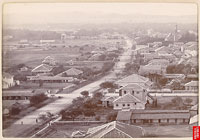 something can you claim your love for it. If one says he loves Karachi
he must first know the phases Karachi went through, the pioneers of
Karachi and the making of Karachi. Unless you know the history well, you
can't even claim ownership of the city. Besides, when we are not
familiar with the history of something, history is misused to exploit
us.
something can you claim your love for it. If one says he loves Karachi
he must first know the phases Karachi went through, the pioneers of
Karachi and the making of Karachi. Unless you know the history well, you
can't even claim ownership of the city. Besides, when we are not
familiar with the history of something, history is misused to exploit
us. and migrated from Karachi later. When we rename McLeod Road as
I.I.Chundrigar Road, we actually erase McLeod and his contributions to
the city from the history of Karachi without Karachiites even realizing
it. Therefore, every Karachiite must know the complete history of the
city to avoid it's misuse. As a result, Karachiites may become more
tolerant of each other, regardless of language and ethnicity and will
help maintain peace in Karachi.
and migrated from Karachi later. When we rename McLeod Road as
I.I.Chundrigar Road, we actually erase McLeod and his contributions to
the city from the history of Karachi without Karachiites even realizing
it. Therefore, every Karachiite must know the complete history of the
city to avoid it's misuse. As a result, Karachiites may become more
tolerant of each other, regardless of language and ethnicity and will
help maintain peace in Karachi.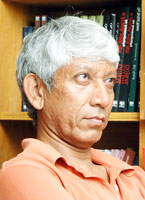 resources to cater to the increasing needs of people, which were
ignored. Thus history was misused, ethnic politics strengthened, and
real solutions to the problems couldn't be found.
resources to cater to the increasing needs of people, which were
ignored. Thus history was misused, ethnic politics strengthened, and
real solutions to the problems couldn't be found.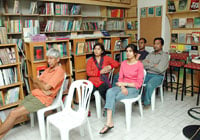 family migrating to Karachi wished to get their children an education
whether they themselves were educated or not. Schools and colleges at
that time were catering to the children of the city only. Ideally more
quality schools should have been made by the government to cater to the
needs of families migrating to Karachi. In contrast, a very low budget
is allocated to the education sector with limited options of quality
government schools resulting in the boost of a sub-standard private
education sector.
family migrating to Karachi wished to get their children an education
whether they themselves were educated or not. Schools and colleges at
that time were catering to the children of the city only. Ideally more
quality schools should have been made by the government to cater to the
needs of families migrating to Karachi. In contrast, a very low budget
is allocated to the education sector with limited options of quality
government schools resulting in the boost of a sub-standard private
education sector.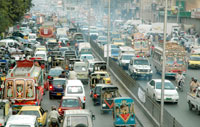 regulate it? Those having the power to make decisions label problems as
ethnic instead of actually understanding that they are a result of
social change. It is said that we have a transport problem in the city
because of the Pakhtun-transporters-mafia and the Mohajir-Pakhtun rift.
However, the problem actually started when Karachi Circular Railway,
which was catering to 70 per cent of residential and professional
commuters in the city was replaced by buses.
regulate it? Those having the power to make decisions label problems as
ethnic instead of actually understanding that they are a result of
social change. It is said that we have a transport problem in the city
because of the Pakhtun-transporters-mafia and the Mohajir-Pakhtun rift.
However, the problem actually started when Karachi Circular Railway,
which was catering to 70 per cent of residential and professional
commuters in the city was replaced by buses.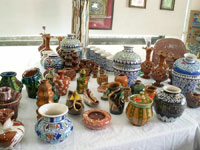 IAD recently, bringing together artists and art critics from all over
the world. The exhibition featuring ceramics, sculpture, handicrafts and
over 400 paintings by over 40 artists from around the globe, was an
effort to rehabilitate art and craft centres in the province.
IAD recently, bringing together artists and art critics from all over
the world. The exhibition featuring ceramics, sculpture, handicrafts and
over 400 paintings by over 40 artists from around the globe, was an
effort to rehabilitate art and craft centres in the province.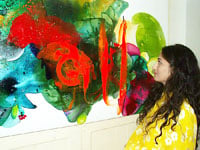 Sindh at Jamshoro.
 Hyderabad, as Jamshoro is very close to the city and found it amazing to
see big names from all over under one roof.
Hyderabad, as Jamshoro is very close to the city and found it amazing to
see big names from all over under one roof.
 prevalent in this city makes the struggle to make ends meet very
difficult. It gets very stressful and tiring for an individual to work
day in and day out to fulfill necessities of life.
prevalent in this city makes the struggle to make ends meet very
difficult. It gets very stressful and tiring for an individual to work
day in and day out to fulfill necessities of life.