|
|
| |
Sabyasachi: A melting pot for fashion
in India
By Suzy Menkes
|
| |
Kurtas
and shirts in sludgy heat-and-dust colors dangled like surreal washing
overhead, while on the runway a conglomeration of colors, textures,
patterns and embellishment tickled the senses.
The Sabyasachi show at Lakme Fashion Week could have been a metaphor
for Mumbai - a city with its sandaled feet in the chaotic traffic,
its clothing a vivid cosmopolitan clash and its head looking out to
the future.
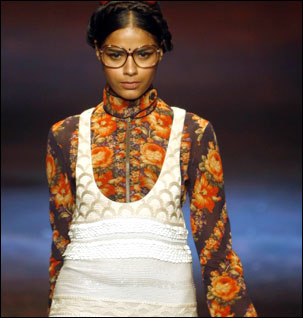
The collection from Sabyasachi Mukherjee was also a shining moment
for the fashion season that closed last week. The designer's style
is the essence of the proverbial melting pot with its meld of sportswear
- a jump suit or a brief skirt - and romantic layers. Each outfit
had an imaginative effect, such as block prints, embellished borders
or conceptual decoration. Even the classic sari was given a twist
by using a rough checked fabric, or with a decorative top under the
drapes or with a bird embroidered at the back.
|
 |
| |
'That's India for you,' said Sabyasachi, who goes by that name, referring
to the global mélange. That included braided hair inspired
from watching "again and again" the "Frida Kahlo"
movie; high-tech fabrics from a diving suit inspiration; a couture
spirit with indigenous Indian craft work; and up-to-the-moment platform
shoes. (This in a season when the choice shoes often let down other
designers.) Giant bags, already on the wane on international runways,
struck a jarring note.
Significantly, Sabyasachi was trained at India's National Institute
of Fashion Technology, NIFT. That experience, his own vibrant imagination,
artistic sense of color and graphic vision enabled him to produced
the ultimate "ethnic" fashion collection, creating "India
lite" as a top and embellished velvet skirt, but also catching
the essence of his country in color and drape.
The concept of using Indian textiles in a modern context is also the
aim of Nachiket Barve, who pointed out a tailored coat where the purple
and gold peacock colors refer subtly to his heritage. With simple
shapes made in textiles he has designed and created, Barve describes
his desire as "to be able to have a vision that is more than
made in India" and rather "designed in India to make a visual
language now that Indian-ness has been so much globalized."
Since so many "Indian" elements from jodhpur pants to Madras
cottons have been used by Western designers, making those trousers
look fresh - even for the Indian market - is a challenge. Nikasha
Tawadey had a delicate, yet streamlined, take on tunics with jodhpurs
and on narrow pants with full-sleeved blouses. Block prints and embroideries
worked effects of light and shade.
A stand-out, if repetitive, collection came from Anuj Sharma, whose
inspiration from the sari produced draped cloth, with never a cut
or seam in sight, edged with eyelets, creating a show that was a creative
tour de force.
"Save the Girl Child" read a backdrop projection, pricking
the conscience about all that happens outside the economical bubble
of a fast growing India. The designer Abhishek Dutta sent out his
own daughter holding the hand of a model and continued on - after
the toddler fell, unhurt, off the runway - to celebrate the beauty
of colorful Indian clothing.
Vineet Bahl was inspired by an Indian winter, which came slowly as
his layered chiffon dresses with wire cutwork patterns morphed into
misty colors of water-washed silk in grays and autumnal browns to
make a subtle collection. Another journey through an Indian landscape
came from Nikasha Tawadey, who made dhoti pants look fresh and used
myriad creative embellishments.
Anil Chopra, vice president of Lakme, the beauty company that sponsors
fashion week and has a 52 per cent share of the Indian beauty market,
summed up the essence of what designers should strive for.
"I am Indian at heart - it is my identity," he said, "But
now I am part of a global world and we can have a big influence."
–
Courtesy International Herald Tribune
|
| |
|