|
|
| |
profile
From Kabul to California:
the incredible journey of Khaled Hosseini
His first novel, The Kite Runner, sold 10 million copies. His
second, A Thousand Splendid Suns, has just won the Richard and Judy
award - ensuring another blockbuster. Meet the Afghan refugee who
became a literary phenomenon
By
Penny Wark |
| |
It is only five years since a doctor called Khaled Hosseini joined
ten people in a small bookshop in Peckham for the British launch of
his first novel. This was an improvement on his tour through America,
where he had been lucky to attract five or six. A little disillusioning,
he remarks gently.
April 2008 is rather different. The film of his bestselling novel,
The Kite Runner, has just opened in Italy, so he has done some publicity
in Rome and come to London to attend the Galaxy British Book Awards,
otherwise known as the Nibbies. There he received the Richard &
Judy Best Read of the Year for his second book, A Thousand Splendid
Suns, which has sold 700,000 copies, making it the bestselling book
in Britain this year. The Kite Runner has now sold 10 million throughout
the world and the second novel is also to become a film. Hosseini,
the first Afghan to write novels in English, has become a phenomenon.
I wasn't at the Nibbies, but having met Hosseini I can say with confidence
that he will have treated the event and its commercial barnstorming
with respectful humility. He doesn't do celebrity culture. "I'm
a homebody. Being with my children and my wife, that's what I really
love. I can't say I ever enjoy the cameras. If you have to achieve
some kind of quasi-fame, being a writer is the best way because you
can be reasonably anonymous."
|
 |
| |
We
are in a chic London hotel near his publisher's offices, though the
publicist relates that when asked about his airline and hotel preferences,
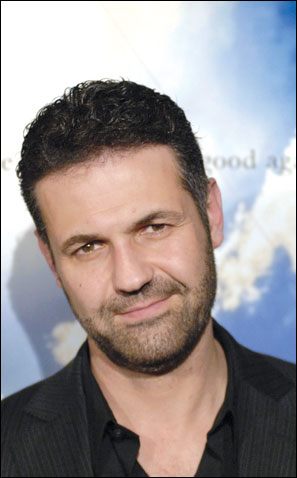
Hosseini had none. I admire his beautifully tailored jacket and he
thanks me - he is unfailingly polite - and, only when prodded, says
he bought it, inexpensively, in Rome. He is trim, very still, and
holds himself upright. His handshake is crushing, his demeanour self
contained.
It seems strange to meet a man whom we know only for his luminous
and compelling writing, and the window he has opened on to Afghanistan
and its internal divisions for those of us who know it largely through
news reports about British troops. How else can that be when 80 per
cent of its people are illiterate and only the elite speak English?
Whether or not our unfamiliarity with Afghanistan contributed to The
Kite Runner's slow start, it succeeded through word of mouth and Hosseini
hasn't been to the UK since the launch. Thus we know nothing of his
character and only the outline of his life.
The eldest child of a diplomat and a school vice-principal, both highly
educated, respected and liberal in their instincts, he was born in
1965 when Kabul was peaceful. He attended the French Lycée
and remembers that the tanks in the military barracks - near his parents'
comfortable home - hadn't moved in 20 years. Socially, life was rich,
full of conversation and gossip: "You know, I don't recall ever
eating dinner alone." In the winters he flew kites every day
with his brother and cousins. He has an almost overwhelming sense
of family, I comment. "There's no such thing as not having a
close family in Afghanistan," he replies. "That's the unit
of life."
He was 9 when his father was posted to Paris. In 1980 the family -
his parents, their five children, an aunt and a grandmother - responded
to the Soviet invasion of Afghanistan by seeking political asylum
in the United States, and swapped a life of privilege for welfare.
Hosseini was catapulted into high school in San Jose, northern California
and, remarkably, went on to study medicine. He worked as a general
practitioner until 18 months after the publication of The Kite Runner.
An instinctive and compulsive storyteller, he has written for his
own pleasure since the age of 8, he explains. "I must have harboured
some kind of secret dream to be a writer but I never allowed that
a chance to blossom into becoming a real-life pursuit. I never felt
I had what one would call genuine talent. The whole notion of creating
a story and putting it down and making a living from it seemed so
outlandish and detached. I was always a very sensible kid: very responsible,
and I was the first born and I chose medicine for those reasons, though
I can't say it was my lifelong passion. It was a choice I arrived
at through rational thought. The idea that I could become a writer
was so ridiculous I never thought about it."
You have to understand, he says, that when his family arrived in the
US they were penniless. They lived in a small house, initially on
benefits, his father worked on an assembly line and then as a driving
instructor, his mother worked in a 24-hour diner. Hosseini had only
a handful of English words but, always a good student, he felt a sense
of responsibility to knuckle down.
"I can't say I enjoyed high school. I ended up making friends
with some Afghans and a lot of South-East Asia refugees. If you don't
speak the language and you're completely foreign to the culture and
the norms of expected behaviour, it's hard. While that was going on
my parents were having their own identity issues because they'd suddenly
lost everything that had given them pleasure and comfort. In Kabul
they were cogs in a big engine. Suddenly they didn't feel attached
to anything, neighbours didn't interact, they had no money. It was
very shameful for them to go to the supermarket and pay with food
stamps. I sensed it, but when you're a teenager you're a terribly
narcissistic creature and so preoccupied with your own bubble that
you don't appreciate the big picture. My father told me recently that
he was seriously depressed. He never showed it to us but inside I
think he was crushed.
"He is part of that stoic generation of men that don't let anything
wear them down. I'm sad to see that generation slowly fading away.
He is a very principled man, very strong mentally, robust. Our relationship
was based on etiquette and respect. He is a very kind and sweet man
but at the same time there was no question as to who was boss. Growing
up, I always wanted him to be very, very proud of me. I still do.
I'm 43 now and he's a central presence in my life. I envied his presence,
I respected it, I responded to it. That hasn't changed."
And his mother? "There's definitely an emotional availablity
with the mother and an immediacy which doesn't always arise with fathers.
She's a classic selfless mom who rarely thinks about anything but
her children. I love her to death."
Hosseini is not a gusher: he is too private and respectful for that,
and it is only when I refer to his mother and his wife - an Afghan
too - that he can't help himself. When I ask about his homeland's
prospects, his tone is measured, his evident love of the place balanced
by his ability to see it both from the inside and the outside. He
went back five years ago and was shocked by the debris he found. Last
year, as a UN goodwill envoy, he met returning refugees - a rewarding
experience, he says, but he does not allow himself to become sentimental.
He hopes for peace but doesn't see an end to the fighting yet, and
as for democracy, he points out that you can't impose a Western political
system on a country that is impoverished, religious, conservative
and tribal. "That doesn't mean that people can't vote within
the confines of that society and its customs and traditions. It's
possible to have a quasi-democracy."
However much he loves creating stories, I feel sure that his personal
history is part of his motivation too, so I ask about the theme of
redemption that colours both his books. "I think most people
want to be good and we're all so fallible, so flawed," he replies.
"I think we've all done something that we're terrribly ashamed
of. Who hasn't? We've mistreated somebody, been unkind, aloof, negligent,
insensitive. There are episodes where we think about how we spoke
to somebody where it's like biting on tinfoil, it just makes you cringe."
That human instinct apart, he regards his life as privileged and recognised
this even as a child: his stories always had a rich guy and a poor
guy whose lives collided, with tragic consequences. "I don't
want to overstate my conscience but I think there were some things
that in a limited capacity as a child I had begun to understand. I
could sit here and be noble and say, yes, I have a sense of mission.
With The Kite Runner I was compelled to write because I had these
two boys in mind, one was troubled, the other was very pure and good,
and that was so intriguing to me. As I wrote I realised I couldn't
tell the story without getting into what happened in Afghanistan,
so that became part of it.
"With the second book I went in with a slight tremulous sense
of mission because I wanted to write about Afghan women, which I felt
was an important and relevant story and so rich a possibility for
story-telling and drama. Life has been exceedingly kind to me. Considering
where I've come from, what could have happened to me and where I've
ended up, it's a miracle. I had the good fortune of leaving Afghanistan
a couple of years before the communist coup and the Soviet invasion.
I always think what might have happened if my father wasn't assigned
to go to Paris. I probably would have been drafted into the army and
I would have been sent somewhere to fight the Mujahidin. I would have
either defected or killed somebody or gotten killed or lost a leg.
Instead I'm here with these two books and my medical career and my
healthy children. I'm alive - life has been more than reasonably kind.
It would be truly petty to ask for more.
"For a lot of people who left behind these homelands entangled
in conflict, and they find much more comfortable lives abroad, there
is that sense of survivor's guilt, that sense that you escaped where
others did not, and is it random? Does it mean anything? Why you?
I don't want to make it sound like a bit of navel gazing - it's pure
genetic lottery, I suppose. It makes you feel terrible. There's the
kind of guilt that gnaws at you and you feel bad and you distract
yourself and there's the kind where you internalise it and turn it
back around and use it as a tool to do something about that which
caused the guilt in the first place. You turn it into a positive thing.
You know, I've tried to do that because I feel I owe it. I haven't
acted out of guilt per se, but there is an element of that - you have
to give back."
He is unquestionably a serious man, earnest, driven, uncomplicated,
I would say. He has no idea how many books he has sold and when I
ask if he has spent the millions he must have made he looks uncomfortable
and replies that his lifestyle in California is a simple one, and
it's good to be able to help his family when there is hardship. His
wife, a successful corporate lawyer, has given up work - just as he
never felt passionate about medicine, so she never felt fulfilled
by the law - and now she runs their lives, he says with evident pleasure.
And no, they are not practising Muslims, though he occasionally joins
his father at the mosque and likes to observe Ramadan because denial
gives him a sense of having nothing, which he regards as empowering,
and he enjoys the familiarity of Islamic culture, which is part of
him, he says.
What distinguishes him, of course, is the quality of his imagination,
yet to see just the exterior of this dignified man you would have
no inkling of his inner life.
"Some people enjoy public declarations of admiration," he
notes. "It happened to me at a good time. At 38 you have a family,
you have kids, you have a reasonable grasp of what's important in
life: what matters and what's fluff. If it all magically evaporates
it's not the end of life either."
-- Courtesy: Timesonline |
| |
|


