|
|
| |
 |
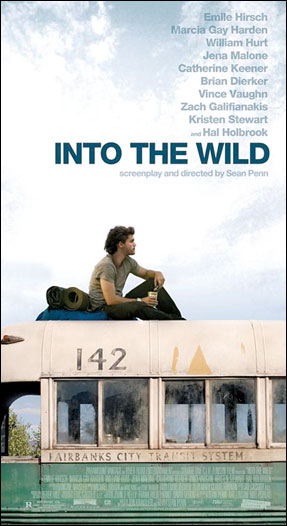
Into
the Wild***1/2
*ing: Emile Hirsch, Marcia Gay Harden and William Hurt
Directed by Sean Penn
|
| |
| Sean
Penn's Into the Wild is the coming of age, true story of a young man
Christopher McCandless with very little of the stereotypes that have
pervaded coming of age tales and biopics being churned out by Hollywood
regularly. Though opinions on the movie will be essentially divided,
depending on whether the viewer agrees or disagrees with its protagonist's
philosophy, but one thing is fairly certain: director Penn has managed
to do justice to a tale in which there are no black and white characters
or situations. |
| |
Christopher
McCandless (Emile Hirsch) a fresh college graduate, turns down his
life of luxury, shedding his worldly goods, donating his college fund
to charity and burning all other possessions and even adopting the
name Alexander Supertramp to pursue a non material path of contemplation
in the wilderness. His journey takes him across beautiful rugged mountains,
golden wheatfields and in stark contrast the cloying repugnance of
an LA shelter, to eventually the wilds of Alaska. For Chris the journey
is more spiritual than physical, a chance to test what he is made
of and a way to uncover the truth of who he really is, inspired in
large part by the writings of Thoreau, Byron and London. His eventual
realization that happiness is only real when shared and that there's
no running from the self (as evidenced in his relinquishing the name
Alexander Supertramp) is heartbreaking and will touch a chord with
all viewers, no matter what their personal worldview.
Other than chronicling his travels, and the people he encounters,
the movie also explores his motivation behind such radical undertakings.
With a voice over from Chris' sister, the viewer is given a glimpse
of Chris' strained relationship with his parents (Marcia Gay Harden
and William Hurt) who fought bitterly and forever tainted his life
with lies and deceit. So much so that he became convinced that one
doesn't need relationships to experience life to the fullest and thwarts
all attempts by the people he meets on the road, to reach out to him
emotionally. However blaming the parents entirely for Chris' worldview
would have been simplistic and very formulaic and the movie mercifully
steers clear of that, which in fact is the movie's main strength.
|
 |
| |
The
script makes no bones about the fact that for all his idealism and
romance, Chris can be at times a stubborn and selfish individual.
His need to indulge in extreme nature and to throw away material
possessions away may be inspirational to some, but we are also shown
the emotional toll it takes on the beleaguered parents and sister
who are not granted so much as a phone call. And yet it is to the
film's credit that it does not gloss over the protagonist's flaws
but paints him in a very realistic and human light. Among its other
accomplishments the film is a remarkable balancing act steering
clear of trite sermonizing and judgments.
One could question some decisions taken by the director to visually
translate Chris' extreme decisions and views onscreen. This includes
structuring the film so that there are three simultaneous narratives
running through it. Moreover Chris' journey has been divided into
various chapters like "Birth", "Manhood" etc.
Agreed the technique encapsulates the spiritual aspects of the journey,
but this realization should have been left to the viewer's intelligence.
Moreover the scenes where Christopher befriends an old war veteran
(Hal Halbrook) get excessively mushy which does not gel well with
the overall tone of the movie.
The movie is greatly shot with some really exquisite landscapes
showing America at its most raw with mountains, deserts, railroads
and other shots made all the more memorable due to Eddie Vedder's
original score. While supplementing scenes with soulful words and
melodies, the score also makes the length of the movie tolerable.
Even then one wishes that the movie had been edited by a good 20
minutes for an even more powerful impact and repeat viewing quality.
Emile Hirsch carries the movie with his standout performance and
uncanny resemblance to the real Christopher McCandless (as evidenced
by a self portrait of McCandless shown at the end) The supporting
characters including Catherine Keener, Vince Vaughan, William Hurt
and Marcia Gay Harden are great, particularly the latter two in
the roles of Christopher's parents.
For all its cinematic brilliance, it is hard to divorce audience's
response to the movie from their perception of Christopher McCandle's.
It is for this reason the movie would elicit mixed responses from
the audience. Some may judge Christopher McCandle as cruel for causing
the deepest sorrow to his loved ones or as naïve inflicting
senseless misery upon himself. Others may not agree with his politics
but might sympathize with him. Still others would relate to the
journey on some level and then there are those who celebrate him
as a rebellious anti-hero who lived and died for his beliefs.
However, from purely a movie lovers perspective, Into the Wild is
a powerful drama with magical moments of quite revelation that aptly
convey the wonder of nature and the limits some will go to discover
it. It is as fitting a directorial debut for Sean Penn as Taare
Zameen Par is for Aamir Khan.
-- Mariam Khurram
*YUCK
**WHATEVER
***GOOD
****SUPER
*****AWESOME
|
| |
|


