


|
|
|
|
 |
 |
  
|
Fur struck
Known for fur processing and manufacturing, mansions and museums, Kastoria is perhaps Macedonia's best offering By Awais Manzur Sumra Tucked away in the midst of rolling hills, overlooked by
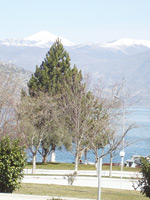
cloud covered mounts, Grammos and Vitsi, in the north western corner of
Greece, a short drive from the Albanian border, lies Kastoria -- a town with
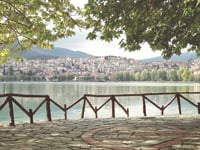
no more than 20,000 inhabitants. Kastoria is perhaps Macedonia's best-kept secret. It lies in the only region of Greece without access to the sea and over 600 kilometres away from Athens. Not surprisingly, therefore, it is located off the beaten track for tourists who mostly aspire for sun and sand on their visit to the Mediterranean country. Even to many Greeks, half of whom live in Athens, Kastoria remains largely unknown. Lying on a peninsula that juts into Lake Orestiados, the town claims world fame for its fur production -- even now it is said to produce 40 per cent of the world's fur, more than the whole of China; for its archontika, mansions of the 17th and 18th century that reflect the wealth of the fur manufacturing families and for over 70 Byzantine and post-Byzantine churches that together constitute a virtual living museum of art. Kastoria has a rich history, with the pre-historic
settlement of Dispilio, dating from around 5,500 BC, lying just to the south
of the town, where residents used to live in huts built in the lake on piled
platforms. Later, the Roman historian Titus Livius mentions the existence of
a city by the name of Celetrum in the region in the 5th century BC. The area
then became part of the Byzantine Empire, in which Justinianos turned it into
a powerful fortress. The occupation of Kastoria by the Turks occurred in 1385
and it lasted for over five centuries until 1912. My two visits to the town came either side of winter, though wintry conditions prevailed during the later visit in March when I attended an introductory conference on western Macedonia. The trees lining the lake, yellowish green during my autumn visit showed no signs of the approaching spring as Vasiliki Kyrkou, the conference organiser, while introducing the town, remarked, "Kastoria is one of the very few places in Greece that actually has four seasons in a year. I love coming here every year, especially in summer, even though the place is known more as a winter destination". Even when the clouds finally cleared later that day, revealing the snow covered mount Vitsi in the distance, glistening in the morning sunshine against the fresh blue sky, the wind blowing in from the north made conditions uncomfortable. But the lake had a bluish hue, perhaps in anticipation of the coming spring, a marked contrast to the brownish green that I had previously encountered. It was, however, on my first visit, more than five months
earlier, that I had the opportunity of exploring some of the town's history
and customs. My first introduction to the town, soon after my arrival, came
through Thomae Papanaoum, who had recently returned after years in the United
States to establish the Chloe Hotel in the northern part of the town. She had
informed me that Kastoria was more popular in the winters, attracting ski
enthusiasts, adventure tourists and droves of Russians who charter flights to
descend on the town for weekends to scoop up the town's fur produce. So, the
myriad fur shops and factories that line the southern road leading into the
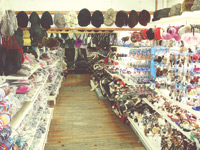
town exhibit more signboards in Russian language than in English. It was during the Turkish occupation that fur manufacturing became a part of Kastorian lifestyle. The fur manufacturing in the town reached its acme in the 16th and 17th centuries, when the Turks loved to wear high quality fur garments and even used fur in army officers' uniform. At that time the fur manufacturing families of Kastoria held positions of high prestige and influence, and their wealth was reflected in the myriad archontika that sprang up along the lakeside. The traditional art of fur processing and manufacturing has since been bequeathed from generation to generation, with mechanisation of the industry taking place in late 19th century, up to the present day when Kastoria continues to feed the world fur markets and has been the host of an international fur exhibition every spring since 1976. The 'Album of Kastoria's Monuments' that Pananaoum gave me
to browse through during my stay at the Chloe Hotel introduced me to the
archontika. One of these, the Nerantzis Aivazis Mansion, built in 1753, is
now the Folklore Museum that was inaugurated in 1975. Credit for the
establishment of the museum goes to the Musical and Literary Society of
Kastoria, which began the recovery of the building in 1963 and successfully
restored it, besides reproducing the outdoor kitchen. Aivazis himself was a
rich fur merchant from Kastoria in the early 18th century who had also
travelled to Jerusalem for business. His descendent, Nerantzis, eventually
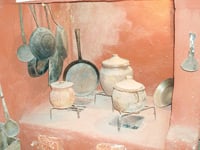
sold the mansion to the city of Kastoria in 1960. My initial search for the Nerantzis Aivazis Mansion was unsuccessful as I got lost in the labyrinth that the inner Kastorian streets are. Lack of proper street signs and the very basic town map available with me did not help much. So I decided to look first for the Byzantine Museum, which I found much more easily atop the Xania hill. The Byzantine Museum, founded in May 1989, stands in Plateia (Square) Dexamenis and is said to be the rarest example of Byzantine hagiography. It exhibits 37 portable icons from Byzantine and post-Byzantine churches of Kastoria dating from 12th to 17th century in one of its three rooms. Having spent some time at the Byzantine Museum, I took the seven kilometres long road -- that skirts the lake, huge plane and willow trees leaning over the water. Admiring the rich vegetation on the lakeside, the idyllic surroundings and the fog-covered hills beyond the lake, I reached the Panagia Mavriotissa Monastery, opposite a plane tree stated to be about 900 years old, which is said to have played an important role in the history of the town. Peace and quite was broken only by the birds' diving and flying over the reeds. About a hundred metres away by the side of the road, a couple of makeshift stalls under leafy trees sold dry fruits and local sweets as a couple of bikers whizzed past. Many of the monastery's frescoes are believed to have been destroyed by the destructions and the repairs done over the centuries. However, paintings, preserved on the eastern and western walls of the church, estimated to be from the end of the 12th century, can still be seen as well as the external frescoes of the monastery that are estimated to be from 1260. Before leaving town, I made another attempt to locate the Nerantzis Aivazis Mansion. Luck was with me as I spotted the sign of Laographiko Museio (Folklore Museum) hung precariously between two wooden windows above a low door on a deserted, stone-paved street. As I entered the damp and dark interior, Alexandra greeted me, and proceeded to brief me about the customs and traditions of the town's fur manufacturing families. Mansions in Kastoria were built like forts or grouped in small settlements in the form of a monastery, with a common courtyard between them to ensure security during Ottoman rule. The stone-paved street from which I had entered the museum used to be the common courtyard of the Nerantzis Aivazis Mansion and its surrounding mansions. The roof of the mansion was made of wood covered with tiles, with rough stones of limestone and mud bricks used as construction material elsewhere. Use of oak and chestnut was common in doors, windows and stairs. The mansion comprises three floors, with a smaller intermediate floor sandwiched between the ground floor and the main floor. There are two extended wings with a small balcony in between. The back garden used to extend down to the lake, making fishing a popular hobby for the mansion's residents. That is no longer the case and now the garden does not extend beyond the outdoor kitchen, opposite which can be seen the roofed well. A decrepit fishing boat adorns the centre space between the outdoor kitchen and the well. While the ground floor was used mainly for storing fuel and food, the intermediate floor consisted of summer and winter rooms where workers sat on low pillows around a worktable and sewed furs. The reception hall, or Doxatos, occupies almost the entire length of the main floor -- the social floor -- with various rooms to its north and in the southern wings. Alexandra explained that important guests were honoured in the luxuriously furnished parlour in the southwestern wing, while women guests were received in the good room. Wedding functions, family feasts, folk singing, and dancing took place in the reception hall, events which could be witnessed by the girls of the family from a gallery on the northern side. The large family had a patriarchal character with even married children living under the same paternal roof. The mansion was custom-built to meet its intended purposes, providing separate spaces for living, storage, fur manufacture and social life. Such traditional lifestyle and method of fur manufacture is now perhaps history even in far off Kastoria, but the tradition of fur processing and manufacturing is keeping Kastoria firmly on the fur map of the world.
The writer can be contacted at amsumra@gmail.com |
|