


|
|
|
|
 |
 |
   |
review Out
of context Emerging
talent A word about letters
I bring peace! The annual report of Committee to Protect Journalists shows a decrease in risks to journalists in 2008
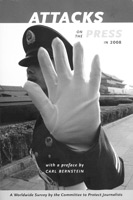
By Sarwat Ali Attacks on the Press in 2008 Editorial Director: Bill Sweeney Publisher: CPJ, New York Year of publication: 2009 Pages: 341 Price: $30 41 journalists died in 2008 notably fewer than the previous years but the 125 imprisoned journalists was only a modest decline which clearly demonstrated the threat to journalists in today's world. Nine journalists were killed covering the Afghanistan invasion. While they expected a hostile reception from the Taliban they also found unsympathetic attitude among United States and other Western forces. A new and terrifying landscape for the world's journalists has been laid out as the traditional role of a conduit to the public has changed. They had been tolerated, at times even welcomed by even the most radical groups but now militant groups have viewed journalists as emissaries of their enemies. These groups are not interested in telling reporters their stories because they have no interest in public opinion in the West. They have used the internet to communicate directly with their followers, the only audience they cared to reach. This conflict of interests played out dramatically in Iraq, where journalists found themselves caught between militants who wanted to kill them and military forces who wanted to control them. While the United States military implemented a programme to accommodate thousands of embedded journalists accompanying the invading forces, non embedded and independent journalists discovered that nothing could be taken for granted when it came to their safety. When CPJ (Committee to Protect Journalists) was founded in 1981 the prevailing threat to freedom of the press around the world were still from juntas, dictators, authoritarian regimes and social systems determined to dominate the media as a means of maintaining controls over citizens usually within the boundaries of the nation state. According to the Worldwide Survey 2008 by Committee to Protect Journalists these days the perpetrators of draconian measures are the following. -traditionally repressive regimes, repressive countries that pretend they are not repressive, and where the government may not be the primarily threat to journalists or the truth, where people are more afraid of murderous organised groups, criminal syndicates, terrorist organisations, militias and vigilantes. Today the greatest threat to freedom of the press are more insidious than a generation ago because they are intended to induce a climate of fear and self-censorship through systematic violence and emblematic arrests aimed at those who would practice real, independent journalism. Kidnappings, murders and torture are not just of reporters and editors but the members of their families, intended to suppress the truth. These are increasingly becoming basic strategies of the criminal regimes, drug gangs, local despots, authoritarian cultures and movements such as radical Islam that transcend national boundaries. Though in 2008, the number of journalists killed and jailed dropped for the first time since the 'war on terror' was launched. The 'war on terror' has had a devastating effect on journalists and the trend appears difficult to reverse. Over seven years journalists were targeted for murder in record numbers while the deterioration in the international legal environment led to a surge in journalistic imprisonments. The extra-ordinary courage and success of the journalists around the world as catalysts for human rights and resistance to oppression have produced a fierce and often counter reaction. The backlash is premised on the use of whatever means are necessary to face self-censorship upon journalists who would challenge the status quo or reveal discomforting truths. More internet journalists are jailed worldwide today than journalists working in other mediums. 40 percent of all media workers jailed worldwide are bloggers, web-based reporters, or online editors -- the largest professional category in CPJ prison census for the first time. Self-censorship is enforced through government rules and regulations that guide internet service providers about what news can be posted and who can post it. The Obama administration has promised to redefine the 'war on terrorism' by closing the United States detention facility at Guantanamo Bay and shifting the military focus from Iraq to Afghanistan. Unfortunately some of the same challenges that confronted the media in Iraq are now emerging in Afghanistan where there has been a spike in journalist kidnappings. The present era is characterised by the tension between technology and outright repression, the availability of satellite television, the use of the internet as the impetus for growth and economic modernisation which has rendered obsolete the old methods of press control and suppression of information such as media nationalisation and overt censorship. What should be done to make the environment safer for the journalists? When and wherever the United States fails to uphold press freedom at home or on the battlefield, its actions ripples across the world. By scrupulously upholding press freedom at home, by ending the practice of open-ended detention of journalists, and by investigating and learning from each instance in which the US military is responsible for the death of journalists, first and foremost according to the editorial board, the US can send an unequivocal message about the country's commitment to protecting journalists. It will make it harder for governments worldwide to justify repressive policies by citing the action of the United States.
Out of context The thorny issue of the limits of fiction By Khuban Omer Khan Nadeem Aslam's latest book The Wasted Vigil is set in
Afghanistan where people of different ideologies and religion cross paths,
while searching for something or someone When I read Aslam's book I was taken
aback by numerous misquotes attributed to the Quran. To find out more about
Aslam, his book and why he chose to misquote the Quran, especially in the
current climate, I attended a reading of his novel in Lahore. I asked him,
"Mr. Aslam, your fictional book is based in reality; it's not make
believe right? And in it you have described the mindset of a jihadi. Now, an
American journalist who has written a review of your book in the New York
Times has said that 'those unfamiliar with Islam may misconstrue your
characters' thoughts as being consistent with the faith'. How would you
respond to this statement? Also, do you have any obligation to your reader to
present an informed fictional account or can you write anything at all
without any obligation to the audience of the message's veracity?" Discomfort was writ large on the faces of much of the uber-liberal audience. It was as if I had attacked the man simply by asking him why he chose to misquote the Holy Book. While Aslam struggled to answer, he was politely interrupted by the moderator, who did not want a discussion on religion (even though she had earlier commented on how the book revolves around religion) and an audience member who said, "well this is how jihadis think, it's time we accepted that." After that I was silenced. Did I imply we deny what jihadis think? No. This is what I wanted to say: Aslam, in describing the mindset of his jihadi character, misquotes from the Quran by splitting the verses and taking them out of context. He italicizes the Quranic verses and does not reference them anywhere in the book. For example, on page 104 he writes, "Because no true Muslim should shrink from killing in cold blood, his jihad training had included slitting the throats of sheep and horses while reciting the verse from the holy Quran which gives permission to massacre prisoners of war: it is not for the Prophet to have captives until he has spread the fear of slaughter in the land." The verse is taken from Surah 8: Al-Anfal Ayah 67 which describes jihad as a defensive war and when read alongside Ayahs 70-71 brings Allah's message into perspective. Aslam does this again when he writes on page 105, "He chanted the sacred words of the Quran. I will instill terror in the hearts of the infidels, strike off their heads, and strike off from them every fingertip." This is half of Ayat 12 from Surah Al-Anfal The misquote is actually the end of the sentence where Allah is commanding angels, not humans, to attack the enemy in Jang-e-Badr. This is just one more example of how the author misconstrues the Quran's message for the sake of fiction. In Aslam's defense, on answering my question at the reading he did manage to get across that his character Duniya (who makes her appearance in the latter part of the book) represents moderate Islam and therefore counters Casa's view. My answer to him (had I not been silenced) would be that he does not go through the effort of describing a moderate Muslims viewpoint through Quranic quotes. He only describes the Jihadi's perspective in light of the Quran. And since my purpose is not to salvage the image of Muslims around the world, for I know people like Casa exist, all I'm saying is that Aslam should be careful when quoting from the Quran. It is a very small point, if you think about it, yet it is an important issue because the thought of being mindful when it comes to the Quran is so unbearable for some people. Given the way Muslims are perceived all over the world and how some Muslims perceive themselves, it is not fair of someone to perpetuate the stereotype in such an irresponsible manner, while people like me have to pick up the pieces and defend the Quran. Unfortunately, after distributing some handouts (at the reading) with the same information as in this article, I was ambushed by hate mails by those who thought I was attacking all fictional writing. That seems highly un-intellectual for a group of people who should be critically pondering and questioning literature with some degree of education and thought. For those who bombarded me with condescending words, told me not to be an apologist for Islam and even tried to stop me from distributing my handouts I have to say: If Aslam has the right to write whatever he wants and label it as fiction, then we should have the right to disagree with his method. Nadeem Aslam "though culturally a Muslim but otherwise a non believer" (reference: interview with The Independent) says "I have no message in my book". He needs to realize that all expression, art, writing, fiction or non-fiction, has a message. His book has a message, and a purpose. Aslam also believes that "the novelist's job is not to pose solutions, but to find out how best to live." "From [his] viewpoint, all writing is political". Aslam has written this book, knowing it has a message and knowing it's a political message.. Why would Mr. Aslam choose to attribute words of ill-will and unprovoked aggression to the Quran? For the sake of fiction?
Two new poets are preoccupied with inequality and self-annihilation
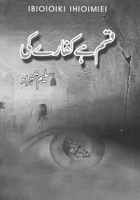
By Abrar Ahmad Qasam Hay Kaffaray Ki By Salim Shahzad Publisher: Book Home Lahore, Year: 2009 Pages: 136 Price: Rs200
Salim Shahzad is a notable poet with a unique diction. Qasam Hay Kaffary ki is his recent collection of poems -- the second in Urdu. The poems included were selected by the distinguished scholar and celebrated senior poet Mohammad Salim-ur-rahman The central theme that emerges in Shahzad's poetry is the lacklustre life, hardships and the cohesive texture of semi-urban town. Shahzad's poems, though poorly constructed, are filled with feelings of despair and frustration that he finds in the inhuman situation around him. His style of using precise, brief and incisive lines pierces the intelligent reader and categorically raises the burning question of inequality and injustice in the society. The preface the book is a display of text bookish command of the critic on post-modernism, a critical theory in vogue these days. Literary movements in the past, like the progressive writers' movement, existentionalism and modernism provided a philosophical basis. Consequently writers got immense inspiration to go with or against these theories while the prime focus of all these movements remained the human existence. It may also be observed here that we had our own socio-political environment and none of these theories were applicable without modifications or revisions. "Modernism" in Urdu is not the one practiced in the West. Posts- modernisms is just a collection of ideas critical of modernism. We as a society are yet to live even a "modern" era hence the application of the tools of post-modern criticism on our literature is simply adventurous and baseless. It exiles an author from his own writings. The preface writer in this book has displayed an intense interest in the deconstruction of the text, ignoring the spiritual and intellectual struggle which the poet experiences in the creative process. He advises the author to address the issues of "Hyper world" which is nowhere to be seen in the humble sluggish locale around him. Salim Shahzad does utilize vocabulary in unique manner. His words are a bit odd but totally in conformity with what they are intended to express. His association with the human condition triggers an intense nausea in him but he settles with an expression sympathetic, considerate and revealing. Somewhat coarse and rough in style, he has found an expression compatible and in line with his creative experience. All in all, Qasam Hay Kaffary Ki is an absorbing collection of poems.
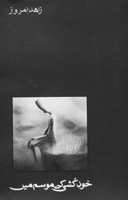
Khud Kushi kay Mosam mein is a collection by Zahid Imroz, a young poet from Faisalabad. It is a slim volume of emotionally charged poems with a balanced artistic treatment and craft which unfolds an extremely restless individual at the mercy of the basic questions of life. The premise of his spiritual and intellectual struggle reminds us the question raised by Albert Camus in the opening pages of The myth of Sisyphus where he writes, "There is but one truly serious philosophical problem and that is suicide." The poet faces this question patiently since he is powerless as well as rebellious. Nothingness that surrounds him gives him a space to breathe. But he's not absolutely helpless. Like existentialists, he scorns the world and digs some meanings out of his otherwise useless life. Sensuality, albeit a bit divergent one, is his other refuge – the glimpses of which are scattered throughout his poems. He has succeeded in creating interesting poems and at places he is quite impressive as a poet. Aftab Iqbal Shamim, the celebrated poet, is anxious in the preface about the physical survived of the young man due to his obsession with the question of suicide. He rightly discovers an intense melancholy which infuses freshness in his offerings too. He finds these poems compact and artfully intense. While reading this poetry some significant senior poets and trends keep coming to the reader's mind, it also shows frequent bright glimpses of the poet's individuality too. Zahid Imroz is a pleasant poet displaying reasonable command on the genre with an enviable intrinsic turbulence so vital to proceed with style. His painful awareness of absurdity of life has found refuge and meanings in poetry. He has addressed this question successfully and is poised to live abundantly. In him we may find yet another important poet emerging on the scene in the years to come. Khud Kushi kay Mosam mein By Zahid Imroz Publisher: Aaj ki kitabain, Karachi Year: 2009 Pages: 112 Price: 120 Rupees
By Kazy Javed Marquez stops writing In a letter published in a recent issue of the literary
journal Takhleeq, Dr. Anwar Sadeed who celebrated his 80th birthday a few
weeks ago, wrote that he had been seriously thinking giving up writing. But
his friends and admirers, including this humble scribe, opposed his
intention. Fortunately, he is still writing and in fact, he is writing more
than many of his colleagues. The Nobel Prize winning novelist Gabriel Garcia Marquez, who had been giving hints of being "worn out by writing" in recent years, has finally laid down his pen. Memoirs of My Melancholy Whores is the last novel that reached his fans five years ago. They have been waiting impatiently for his new writings since then. None has appeared. This long gap as well as the aging of Marquez has disappointed many of his readers and they have begun to believe that they will not get any new book from their beloved writer who had been writing in Franz Kafka's style for the past four decades. Hopes, however, were raised last year when his friend, the novelist Plinio Apuleyo Mendoza averred that Garcia Marquez was working on a new novel. Now a recent newspaper report based on the comments of Garcia Marquez's agent Carment Balcells and his biographer Gerland Martin has made it clear that nothing new should be expected from the Colombian writer's pen. Gerald Martin has been quoted in the report as saying that Marquez "won't write any more books. But I don't think this is too regrettable, because as a writer it was his destiny to have the immense satisfaction of having a totally coherent literary career many years before the end of his natural life." Marquez has been very popular in our country and his books have been in great demand. Local publishers have brought out pirate editions of two of his best-known novels One Hundred Years of Solitude and Love in the Time of Cholera. Urdu translations of some of his writings have also been made available. The Fiction House of Lahore published the Urdu version of One Hundred Years of Solitude, under the title Tanhaee Kay Sau Sal with a terse introduction by Faqir Ishu Lal in 2000. It was translated by Dr. Naeem Kalasara.
The City of Love Dr. Fatima Hussain who teaches history at Delhi University is now a well-known scholar in our intellectual circles. She has delivered lectures in Lahore, Islamabad and Karachi during her many visits to Pakistan. The Classic Publishing House of Lahore published a book compiled by her few months ago. Titled Sufism and Bakhti Movement: Contemporary Relevance, it carries nineteen articles written by renowned Indian and Pakistani scholars including Dr. Madhu Trivedi, Professor Harkans Mubhia, Professor Khawaja Masud and Dr. Chandere Shekhar. In the preface to the book Hussain has written that Sufis and Bhaktis with their accommodation for the "other" can go a long way in healing social divisions and conflicts in our present unhappy world. The Palestine Question: A Historical Perspective was Hussain's first book which was published for Delhi. I cannot make any comments on its contents as I have not read it. However, I do know that Hussain is nowadays working on her book Lahore: The City of Love. The book is expected to hit the bookstands before the end of the year. Lahore is a city of love for her also in a very personal sense: her beloved husband -- the noted writer, intellectual and political leader Fakhar Zaman -- lives in Lahore. Hussain was in Islamabad recently where the Pakistan Academy of Letters arranged a lecture on Sufism. In her lecture, she observed that unnerving implications of new-imperialism and the consumer culture produced by unbridled capitalism are forcing people everywhere to adopt violent means to seek reprisal from injustice. Sufism, she said, "provides a way out, at least in our South Asian context where Sufis and mystic divines, irrespective of their faith, have devoted themselves to helping humanity."
Naipaul unforgiven Nasir Bughdadi, the editor of Badbaan is not willing to forgive Nobel Prize winner V.S. Naipaul for his two books Among the Believers and Beyond Belief. Published many years ago, they carry a cultural study of the Muslims of Pakistan, Iran, Indonesia and Malaysia. Naipal was never sympathetic to these Muslims and his thesis, in a nutshell, is that the non-Arabic Muslims of these countries are "new converts" to Islam and are not capable of assimilating it in spirit. In his editorial note to the current issue of the quarterly Badbaan, Nasir Bughdadi has criticised Naipal on his views and has also advised him to carefully read Edward Said's Orientalism. He believes that Said's book will provide Naipal with the insight required for the correct understanding of contemporary Muslims. I do not fully agree with Bughdadi but I admire his editorial skills. Badbaan's current 620-page issue carries over two hundred literary pieces -- articles, short stories, poems, ghazals, book reviews, letters, opinions, notes etc -- penned by local and Indian writers. The long list of contributors includes many famous names such as Dr. Jamil Jalbi, Dr. Salim Akhtar, Zia Jallundhri, Nida Fazli, Latifuz Zaman Khan, Sataya Pal Anand, Abul Kalam Qasmi, Mansha Yad, Rashid Amjad, Mirza Hamid Beg and Khalid Saeed.
|
|