


|
|
|
|
|
 |
 |
   |
policy mood
street TOWN TALK phasing
out Stroking
smoke
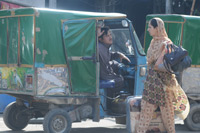
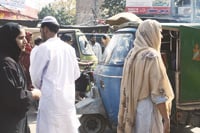
policy Once bitten, twice shy! The reluctance on the part of rickshaw owners to adopt environment-friendly technologies is not without reason By Mustafa Nazir Ahmad Commuting within Lahore is not something people in the
right frame of mind would relish. You have to contend with dilapidated
roads, logic-defying speed breakers, endless traffic jams, ever-increasing
VIP movement and what not. However, if you do not live in some posh
locality or do not have an air-conditioned vehicle, what makes commuting
within the city an even more daunting task is the cloud of dense smoke
that engulfs you whenever you happen to be led by a two-stroke auto
rickshaw. As if this is not enough, the smoke pollution is coupled with
noise pollution, something for which these rickshaws have always been
infamous. Concerning smoke pollution, the situation was not that bad until the introduction of liquefied petroleum gas (LPG) a few years ago. In fact, vehicles running on diesel were considered as the main threat to environment at that time. Though rickshaws plying on petrol (now a rarity) also emit smoke, especially if not maintained properly, their smoke is less hazardous to health than that of those running on LPG. In addition, the latter also emit more smoke than the former, mainly because their engines consume a large quantity of oil to run smoothly. "Because there are no LPG filling stations and only a few selected agencies in the city, mainly on the Lytton Road, it is difficult for a rickshaw driver to first go to an agency for LPG and then to a petrol pump for good quality oil," Ustad Asif, a rickshaw driver for more than 20 years, tells The News on Sunday. Thus, rickshaw drivers prefer to buy both of these from LPG agencies that normally sell sub-standard oil. "The added advantage is that this also saves some of their money, because the adulterated oil sold at agencies is cheaper than the one sold at petrol pumps," he adds. Despite these problems, once introduced in the market,
LPG cylinder-fitted rickshaws became a common sight in no time and for
good reason: LPG was much cheaper than petrol at that time and its
shortage, resulting in its exorbitant prices, is a much later phenomenon.
The commuters also heaved a sigh of relief, because LPG rickshaw drivers
asked for a much lower fare in comparison with the ones who plied petrol
rickshaws. Hence, petrol rickshaws, which did not remain competitive any
more, were phased out in a short span of time. However, travelling in a LPG rickshaw is a horrendous experience as a commuter. The adulterated oil used to boost its engine has a pungent smell that makes you feel like throwing up, especially if much attention has not been paid to the rickshaw's maintenance. At times, the smoke emitted also comes inside the vehicle, causing inconvenience to the passenger(s). Still, cheaper fares held sway and the vast majority of people opted for LPG rickshaws rather than pay more. Some other factors were also involved. Most importantly, of the more than 50,000 registered two-stroke rickshaws (official figure) in Lahore, hardly a few thousand are being driven by their actual owners. "At least 80 percent of rickshaws in Lahore are running on rent. The majority of drivers are amateurs who do not care about the quality of oil used or for the maintenance of the vehicle," says Tahir, who has been plying his own rickshaw for the last 12 years. However, the excessive smoke emitted by LPG rickshaws is resulting in the imposition of more and more restrictions on them, irrespective of the fact whether they emit excessive smoke or create noise pollution. The Punjab Transport Department took the decision to replace two-stroke rickshaws with four-stoke ones in 2006, in view of the court orders against a writ petition filed by an NGO regarding Lahore's environment. The City District Government Lahore (CDGL) first banned two-stroke rickshaws on the Mall and then extended the ban to Jail Road, Gulberg, Main Boulevard and Defence Housing Authority. Initially, most rickshaw drivers thought that this was just another half-hearted measure by the government and the ban would be lifted ultimately. However, time has proved them wrong. Protests by rickshaw owners / drivers – who claim
that the number of two-stroke rickshaws in Lahore exceeds 100,000 and the
ban would affect the livelihood of at least one million people – have
not been heeded by the government (neither this one nor the previous one).
Despite this, the CDGL failed to meet the deadline of Dec 31, 2008, set to
phase out the vehicle completely. Lest one forget, this deadline had
already been extended by a year. As a result of the ban, two-stroke rickshaw owners / drivers have witnessed a sharp decrease in their income. "My earnings have halved since two-stroke rickshaws have been banned in some areas of the city," Tahir says. Considering this scenario, one wonders why two-stroke rickshaw owners are reluctant to switch to four-stroke compressed natural gas (CNG) rickshaws, which the government claims it offers at easy installments. They can easily sell their two-stroke rickshaws and purchase new or used four-stroke rickshaws. Similarly, two-stroke rickshaw drivers, who get the vehicle on rent for Rs 150-200 per day, can also pay even less amount to the bank as installment and have a brand new CNG rickshaw of their own. The situation becomes ideal, especially when one compares the price of CNG with that of LPG. When this question was put to rickshaw owners / drivers, most of them said keeping a four-stroke rickshaw was like maintaining a luxury car. They also point to their design flaws. "Of the more than 20 models of CNG rickshaws available in the market, not a single one is reliable. In addition, their spare parts are so expensive that you lose your whole day's earnings even if a nut has to be replaced," says Mumtaz, who recently bought a used CNG rickshaw for Rs 120,000 and regrets the decision. However, after the complete phasing out of two-stroke rickshaws, the design of CNG rickshaws is expected to improve and the cost of their spare parts is expected to decrease. Some rickshaw drivers also blame the banks responsible for financing of four-stroke rickshaws. "Many people have deposited the first installment with banks, but are still waiting for the release of their CNG rickshaws despite the passage of five to six months," says Naseem Khan. It is mainly for this reason that even the potential buyers are approaching the open market, instead of banks, for the purchase of both new and used CNG rickshaws, which are also available on installments. A few rickshaw drivers also castigated the government for initiating a scheme without first conducting a proper feasibility, as well as for failing to manufacture the desired number of CNG rickshaws. Another, and perhaps the most important, reason why people are reluctant to switch to CNG rickshaws is that they fear the government might come up with something new after a few years and ban the now acclaimed CNG rickshaws. The same fervour was witnessed when LGP rickshaws were first introduced, but now the government is all out to ban them completely. Perhaps rickshaw drivers do not want to take another risk, or they do not afford one, but do they have a choice?
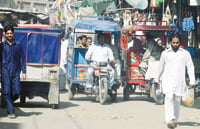
Roaring rickshaws By Aziz Omar "Chacha jee/yaar Barkat Market/Shimla Pahari jaana hai, kinnay luwo gay…….." and so ensues the negotiations with a typical ruckshay wala on the rate for a particular route. The driver would say 250, I would say 150. At most times a driver would shake their head and utter nah jee or give a scornful smirk thus bringing the dealing to a grinding halt. I myself would think of befitting profanity for him and move to the next rickshaw. But in some instances, the dismayed driver would carefully explain the dynamics of the rate that he has quoted, referring to the price of petrol/LPG/CNG. The cost of maintenance and repair would also be thrown in to further corroborate the figure. Whether it is a short hop down the road or a long haul across the city, the three-wheel bug looking vehicle has been the sine qua non of local transport since I became conscious. Every nook and cranny of the city that one wants to travel to is accessible via the auto rickshaw. I have had a sort of a love/hate relationship with this ungainly vehicle. On the one hand there is the ease of availability at every corner when you want to get to work, make a grocery shopping trip or reach a meeting place. Once I was even able to stuff a 21-inch computer monitor in one and bring it from Hafeez Center to my house. Only a person who often commutes in a rickshaw can imagine how cumbersome such kind of a fit would have been. Just climbing inside one is a proper task for some, especially if that person is carrying around some excess weight themselves. However, on the other hand there is the fantastic din that is unloaded upon the poor ears of the travelers as well as the pedestrians. The wonderful smoky effect that the put-putting buggy leaves in its wake deserves a special mention. Having my own wheels under me is a very recent phenomenon. I have always had to rely on a rickshaw to ferry me to and fro from a bus stop. Be it (pouring) rain or (piercing) shine, the trusty rickshaw is found to be parked everywhere, waiting for its next customer. And very rarely have I experienced a rickshaw break down with me as a passenger. Their engines somehow always manage to come to life with constant cranking and puttering around by the driver. Actually it's not the machine that is the bone of contention. The traditional blue-bodied rickshaw with the locally customized peacock coloured hood is manufactured by the renowned Italian company Vespa. The two stroke 150 cc odd engine is able to deliver a powerful thrust to the vehicle. But the modification that has been done to the inner workings in almost all cases is the removal of the silencer. This is done apparently to decrease the oil and fuel consumption but they appear like sub-machine guns when two or more are moving together. During my travels on a rickshaw, at times I have had the opportunity to engage the driver in a candid conversation. One such exchange that struck me the most was with a chap who used to drive his auto for a few hours in the morning, then worked as a lab attendant at the Punjab University and then plied his machine till night. He stated that he toiled this much just to ensure that his kids keep going to school and don't have to be in a state of wanting in future. There are several such stories of resilience and determination out there. Simply banishing the rickshaws out there from the roads will only leave the income earners high and dry. Their role in urban transport has to be appreciated and technological innovations such as electrical motors incorporated to ensure that the familiar rickshaw doesn't become a museum relic. - Festival: 'Weekend cycling ride' on Sunday, April 19 at Zakir Tikka intersection at 5pm.
- Photography Exhibition titled 'First Flight' at Ejaz
Art Gallery. Photographer: Azhar Sheikh. The exhibition will continue till
Monday.
- Fashion Show at Alhamra Arts Council, The Mall on April 25, Saturday from 10am to 4pm.
- Current Artists: An exhibition of the works of young artists held once in a year at Alhamra Arts Council, The Mall till April 30, Thursday. The gallery remains open from 9am to 5pm daily.
- Fifth Annual Conference on Management of the Pakistan Economy on Apr 20-21 at Lahore School of Economics. The underlying objective of the conference is to promote dialogue/discussion on key economic issues facing the country today.
- Readings from Urdu novel, Saghir at Lahore Chitrkar on April 25, at 7:30pm. Saghir is an adaptation from Julien Columeau's original French novel and is based on the life of well-known Urdu poet Saghir Siddiqui. Tanvir Shah will read few excerpts followed by comments & discussion.
Need to plan beyond ban Crackdown on motorcycle rickshaws is on the cards while those in the business as well as commuters are baffled at the government's move By Saleha Rana Mian Nawaz Sharif introduced two-stroke motorcycle
rickshaws, known to us as Chingchis, after his visit to China during his
last tenure. They were distributed for free and exempted from challan for
two years to bring them on roads. Now they have been asked to move off the
roads. In the last ten years, these crawlies have grown in number, replacing traditional tongas which the government desperately wanted to remove from roads at that time. And that they did. Now the mesmerizing tic toc of tonga can be found in literature only. The Punjab Government gave licences to these rickshaws but somehow they never got route permits in five major cities of the Punjab which are Lahore, Multan, Faisalabad, Rawalpindi and Gujranwala. All two-stroke rickshaws are banned on 43 roads of Lahore. Then how and why do they ply the streets of Lahore? Chief Traffic Officer (CTO) Mirza Shakeel says, "RTA gives route permit and traffic police checks them. I have just taken charge and do not understand how they have been on roads for so many years. We have plan to remove them." According to Traffic Authority Punjab, more than 15,000 rickshaws are on the roads of Lahore. The people running them say their number has crossed 50,000 count but in the absence of an association of motorcycle rickshaws, the exact number cannot be ascertained. Munir Ahmed Joya, Secretary Regional Traffic Authority (RTA) says, "The Supreme Court ordered not to give route permits to two-stroke rickshaws a few years ago. Motorcycle rickshaws were considered a personal transport, the reason why they were not given route permits." "For around 70,000 people motorcycle rickshaws are a source of income directly or indirectly," says Rana Jawed, an auto rickshaw showroom owner. Government has no alternative plan to provide livelihood to these people. Motorcycle rickshaw drivers are worried at the impending action. This class has no savings. They consume what they earn on daily basis. The commuters also dread the day it will be banned. There are areas in the city where there are no buses and wagons - where the main transport is Chingchi. These rickshaws are quicker than buses and wagons so people prefer travelling on them. At places they are cheap as well. Sub Inspector Mohammad Babar who controls traffic on station says, "these rickshaws create traffic problems. They stop wherever they want. If they get stands like buses, they can be organised." A Wapda employee Haji Farooq says, "I live in Shahdara where I get no conveyance other than motorcycle rickshaws. In their absence, commuting will become very expensive." A woman who commutes by public transport, says, "In the absence of any competition on the different bus routes, the commuters' waiting time has increased. If the situation is such on the main roads, we can't hope for a better facility on the branch roads." Mrs. Munawar who travels from Data Darbar to Ferozewala, says this mode of transport is affordable. "The poor cannot afford another conveyance. Government should not take steps which are against the interest of the people." Hundreds of students cross Ravi Bridge through these rickshaws everyday. "Students cannot afford the fare of auto rickshaws. If they do not find any public conveyance, they won't be able to come to their institutions. If the government is going to ban these rickshaws, it should provide buses and wagons," says Mariam, a Government College University student. Ramazan, a rickshaw driver told TNS, "I've been living off the income earned from driving a rickshaw for the last ten years. I'm married and have two children. This is my only source of income which varies from 200 to 500 rupees daily. I don't understand why government is banning the vehicle." Muhammad Boota has seven children and is the only earning hand in his family. "I'm riding motorcycle rickshaw for 11 years. I earn 400 to 500 rupees. I give Rs. 250 to the rickshaw owner that can barely afford food for my children. I don't know what I'll do after the ban. Theft and robbery, I guess." Mohammad Iqbal who runs the vehicle from Data Darbar to Shahdara, says, "If government wants to remove motorcycle rickshaws, it should give alternate livelihood. I am married and my family survives on what I earn. This is the only thing I can do. What will I do?" he asks.
Environment Protection Agency and Pakistan Standard and Quality Control Authority have confirmed the operation will be carried out against motorcycle rickshaws. The chief minister has ordered to remove all illegal vehicles from roads. Transport Authority has made teams to remove motorcycle rickshaws from Lahore and the operation will be carried out with the help of 22 traffic wardens. Each team consists of one official of Transport Authority and 3 to 4 wardens. 210 traffic police wardens will eliminate motorcycle rickshaws from five major cities of Punjab. Licences are given to vehicles of registered manufacturing companies like Sohrab, Suzuki, Ching Chi, Yamaha etc. Improving balance system, break system and controlling speed to the proposed standard of 20 km/hr can make them perfectly fit for the road. Secretary Provincial Transport Authority, Chaudhry Iqbal told TNS that Transport Authority has a plan to provide buses and wagons as a substitute. Unemployment is a more chronic problem than environment. It's the government that introduced these rickshaws and engaged a huge number of people in it. The numbers given above are only from Lahore while these rickshaws are everywhere in Pakistan. Next time government initiates something which provides employment to people, we hope it will be with foresight. Poor people don't know what to do if policies fail. Countries like Pakistan should use labour intensive methods of production. Motorcycle rickshaws are more labour intensive than buses and wagons if Motor Vehicle Examination System assures their fitness.
Two-stroke rickshaw is a major cause of pollution, but with empty bellies, environment is not much of a concern By Waqar Gillani "The earth has a fever. And the fever is
rising."Al Gore's words from Nobel lecture have never been more relevant
to our times. The question, however, is environment protection and capitalist
ambitions. If pollution is the rich man's problem, its major cause is the
poor man, in other words, the poor countries. Be it the first world or a country like ours, vehicular pollution is a major source of urban pollution. Lahore -- the second largest city of Pakistan with a population of more than nine million population -- is no exception. City District Government Lahore's definition of pollution says "it is the presence of chemicals in the atmosphere in quantities and duration that are harmful to human health and the environment." In vehicular pollution, air and noise pollution are on the top. In Lahore, according to the figures available from the CDGL, the gradual increase in vehicles is more than 14 percent a year now. Out of these numbers of vehicles, which are more than one million, the number of rickshaws is almost 80,000. According to the reports prepared by CDGL, with the decreased number of buses and increase in private vehicles there is also the increasing pollution caused by two-stroke rickshaws. The pollution caused by the rising number of vehicles is causing lungs and respiratory diseases besides heart issues. District Environment Officer Tariq Zaman Khan told TNS that according to their studies the 60 to 70 percent of the total pollution in the city is air pollution. And 80 percent of this air and noise pollution is because of vehicles and 60 percent of it is because of rickshaws, especially two-stroke rickshaws and motorcycle rickshaws. "So, overall, we can say that 50 to 60 percent pollution in the city is because of these rickshaws," he said. "The CDGL now has also installed three monitoring stations to check this pollution ratio." These monitoring stations have been installed at Jail Road, Township and Town Hall, Lower Mall). Zaman informed that efforts are underway for some regular policy to check the emission of two stroke vehicles and the availability of proper equipment for the annual passing of two stroke rickshaws. "The government needs to invest substantially in order to get rid of these rickshaws and replace this obsolete technology with good urban transport system." District Coordination Officer (DCO) Lahore, Sajjad Bhutta, while talking to TNS, also admitted that rickshaws were major source of air and noise pollution. "It is up to the Punjab government how speedily it chalks out the plan to combat this environmental issue," he said, adding, "The CDGL is trying to ban these rickshaws in different phases already." Things might not be as easy as the officers would like us to believe. In a poor country like ours environmental concerns are overshadowed by economic issues. The affordable and profitable vehicles like 2 stroke rickshaws could be the first choice for anyone trying to make ends meet. Take it from Razzaq, a forty-year-old owner of a 2 stroke rickshaw. "These rickshaws are being banned to make our roads look good. I am not willing to believe that it has anything to do with environment concerns. If that is so, they should ban other vehicles like buses and even motorcycles." Razzaq is one of the rickshaw owners who are least concerned about global warming. For them, it doesn't even exist. And he is not alone. For most of us environment is least of our concerns because life is spent in making ends meet. It is rather ridiculous to expect from someone with an empty belly to care about what he inhales. However, this is not an excuse to ignore the problem. What needs to be done is the introduction of environment-friendly projects.
|
|