


|
|
|
|
|
 |
 |
   |
entrepreneur MOOD
STREET Town
Talk service
"We
are here to purchase furniture for our daughter's dowry as she is getting
married next month," whispered Shaista while choosing a four seat wooden
sofa for her daughter. "Of course it is sad that we cannot buy new
furniture for our daughter but what can be done, one has to spend according
to one's own earnings," she further says. Many young people would come forward to do their own thing but they find it very difficult to generate adequate capital in Pakistan to finance an independent venture By Jazib Zahir Avid Lahoris attempt to
run their own businesses in an environment not always conducive to
entrepreneurship Shortly after his
graduation from Government College, Raza adopted a career path that is as
familiar to our society as medicine and engineering. He took up the reins of
the family business. Following in He might have leveraged
his business degree to grasp the middle rung of a corporate ladder in a local
bank but he was averse to the concept of answering to someone else. "All
my life I've seen people in typical jobs sweat and toil and not get what they
deserve," he muses. "I have the chance to be at the helm of my own
trade and really control my destiny." It is an opportunity
cherished by several in our society, including many who possess that rare
spark to construct an enterprise from scratch. In the case of Fahad, the
entrepreneurial instinct was stoked while he was still a college student in
Lahore. "I realised that there was a lot of misinformation in circulation
regarding the best academic and vocational opportunities for our youth,"
he says. This epiphany translated into an online forum serving to connect the
well-informed with those who sought wisdom. During his higher studies in
Sweden, he rubbed shoulders with some of the finest minds in the still nascent
academic field of entrepreneurship. These exposures have served him well as he
is presently the proud owner of two start-ups. Entrepreneurs allude to
a variety of justifications for shunning a traditional career. Yasser Bashir
has channeled his strong academic and professional background into the
creation of two companies focusing on software applications. "I choose
entrepreneurship because it allows me to extend my circle of influence,"
he explains. "I have the opportunity to lead my company in a direction
that can really benefit my society in many ways." In addition to this
noble sentiment, he also recognizes the shortcomings in our standard work
environment that he is attempting to address. "Too many of our companies
are hampered by a low sense of ownership among employees. One of my objectives
in setting up independent ventures was to create an environment where
employees are truly owners of the business itself and not just of piles of
stock options." But such success does
not come without growing pains. Consistent power supply and internet
connectivity are the mainstays of many businesses yet are acquired at
exorbitant rates and often at unsatisfactory standards of quality. Being able
to identify nimble team members who may thrive in the precarious environment
of a start-up is another hurdle. In the case of Ahmed who recently returned to
Pakistan and is looking to string together a team to pursue an entrepreneurial
vision, many resumes were acquired through online job search sites. "But
I found the right people mostly by looking around myself and through friends
who understood what I needed," he explains. "There aren't a lot of
people around with the creative skills a startup treasures and that's one of
the challenges in trying to set up your own thing here." Umer was keen to be his
own boss shortly after graduating from FAST and successfully set up his own
software house. But the dream only lasted for 20 months before he decided to
return to a more conventional career path managing products in a large
company. "Given the choice, I'd prefer to be doing my own thing," he
admits, "but the limited success of my first venture can be attributed
largely to an environment that is just not entrepreneur-friendly. It is very
difficult to generate adequate capital in Pakistan to finance an independent
venture and the excessive red tape and onerous taxation just stifled my
attempt to run my own company." While he enjoyed his time in the driving
seat and sees it as a character building experience, he is also quick to point
out that entrepreneurship is risky business and involves a constant appraisal
of the opportunity cost of the effort. Local business schools
offer a range of courses and workshops aimed at churning out entrepreneurs of
high caliber in recognition of their critical contribution to our economic
growth but the International Finance Corporation has highlighted that
entrepreneurial activity in Pakistan is deficient, particularly among females
and the economically depressed classes who may benefit from it most. Fahd captures the
sentiment of budding entrepreneurs best when he says, "You don't want to
live someone else's life, and living your own life requires you to have your
own professional setup". Many agree but need a more conducive environment
to give tangible shape to their aspirations. MOOD STREET 'Thank you, madam!' By Salma Omar I
received a pleasant surprise recently, when I parked outside the paan wala's
shop round the corner to buy a Jazz card. After delivering the card with the
remaining change, the paan wala's teenage assistant said 'thank you, madam'
in a reedy voice. "What?
thank You?" This was unusual, even if you were out to buy the most
expensive item. Coming from a busy paan wala's harassed assistant is
absolutely miraculous. No surprise, therefore, he made me feel so, well,
refreshed. It was
not me alone, my niece who was accompanying me found it equally strange and
giggled as she repeated 'thank you, madam' at least twenty times in mock
gratitude during the five minute drive home. I wondered if she was giggling
at 'thank you' because it came from a poor little boy or because it came at
all? Probably both. What we
need to do, really, is giggle at the lack of 'thank you's' in this city of
BMWs and Mercedes, mobile phones and ever-new expensive coffee bars. As
Lahore's barometer of wealth has gone up, its temperature measuring civic
courtesy has stayed stuck at zero. Frozen... Solid! Wealth has not made us
better citizens towards the people around us. We bang doors in people's faces
as we enter or exit the most expensive shops. In fact, we take pride in
scoring a point by entering a shop where somebody else has held the door open
for their own entry. We make extra effort to run pedestrians down on the few
zebra crossings that exist in this city. We race to force pedestrians to
scuttle aside to get into a parking place (the lack of another car waiting to
snatch that parking space is not enough deterrent to persuade drivers to
abandon plans of crushing a pedestrian). We cut into queues where other
people have been waiting and pretend that nobody will notice. We throw trash
thoughtlessly on the streets. We splash through puddles of water spraying
dirt on motorcycle riders and pedestrians. And
we've forgotten to utter 'Meherbani' or 'Shukriya' -- two of the most sweet
sounding words in Urdu. Some
people think that we learn civic courtesies in schools but fail to practice
them because our families are models of the most uncivic behaviour. And so it
remains the way it is -- a skill acquired in schools and left in schools.
Period. It is
also thought that if we act arrogant, we will get our way easily (and get
more respect as well) aka 'rude is cool'. Sure! Would you say the same, if
you had a door shoved in your face? What exactly do we achieve by overtaking
another car just to stop at a red traffic light? Is it really so urgent to
buy a dozen eggs in a bakery that we hop over the other customers awaiting
their turn to pay first? Little
actions, that spread a little happiness or unhappiness, as the case might be!
Time is a commodity in short supply and hopping the queue can be justified
under such circumstances but is it a crime to simply request the other
customers if one can pay first due to urgency? We simply don't do so as it
would be a sign of weakness. Yet, if the same politeness was shown to us, it
would make us feel a sense of respect for the other person. There's
another logic: "Everybody does so, why shouldn't we?" Well, OK,
fine! We can hide behind conformity and use the oft-quoted excuse that it is
the failure of our political and bureaucratic institutions that inculcate
this apathy. Yes, I know that if the larger institutions followed the rule of
law, we would have a justification for driving correctly, for not breaking
queues, for not being litter-bugs par excellence! I know. But before we hide
behind the argument of weak institutions, let's ask ourselves one question.
Who makes institutions? We aka THE PEOPLE. There
cannot be a newly uniformed Punjab Police at super market check-outs and shop
entrances to enforce queues and prevent people from banging doors in other
people's faces. Above all, the economists inform me that the transaction
costs would be too high. But leave the economists alone for a while too, for
these are matters of an inner conscience for a society and a city as a whole.
In particular, the conscience of the privileged cannot plead conformity as an
excuse because no curse of lack of education or privilege can justify it. In a
paradox typical of Pakistan, it seems that the less-privileged have better
manners to teach us. Maimed, badgered or coerced into submission, ordinary
people have the most justification for exhibiting rudeness. In contrast, they
sometimes show the most unusual fineness of manners. Yet, the privileged bear
a greater responsibility. Manners, no doubt, are not the domain of the
privileged but just as the privileged shape the development of this city, can
they be so blind as to ignore that BMWs, sky scrapers and mobile phones do
not provide adequate readings on the cultural barometer? The temperature of a
city's culture is, above all, provided by the civic sense of its citizens.
•
Exhibition: Paintings
by Saeed Ahmad at Nairang Gallery till Saturday, August 25. The gallery
remains open from 11am to 11pm. •
Jazz Night at Peeru's Cafe --
a fusion of Jazz and tabla on Sundays at 9pm for free. •
A concert of unheard melodies at
Government College University Lahore every Saturday at 01:30 PM •
Puppet Show for Children at Alhamra, The
Mall at 11a.m. •
Horse Race Shah Jamal - Shalimar Bagh at Shah Jamal every
Thursday 09:00 PM •
Puppet Shows for everyone at Peerus Cafe Every
Sunday03:00 PM •
Qawwali Music Session at Data Darbarevery Thursday
at 03:00 PM service Fighting fire The fire-fighting department faces several problems and calls for attention to become equipped to meet emergencies By Khan Shehram Eousophzye Inadequate
funds, non-availability of proper infrastructure, shortage of manpower,
pathetic hydraulics, non existence of a proper fire act and no technical
knowhow of fire-fighting, are some of the main problems being faced by the
central fire brigade of Lahore. The civic and rescue departments of Lahore
are in jeopardy as neither the local government nor the citizens are taking
this situation seriously. While Lahore's population has increased almost
threefold since 1980 the fire department of Lahore still functions according
to the policy and standards set up in the 1980s. There
are 13 fire stations in Lahore that cater to a population of 63,73,000.
According to the Keeping
in view the depleting condition of the fire department an ordinance was
drafted in March 2002 with the help of Fire Protection Association, which was
to provide a Rescue and Fire Service (RFS) to the provincial government. The
RFS, according to the ordinance, was to formulate and implement Pakistan's
emergency and fire code, through which the RFS was given the authority to
keep a proper check and balance over the safety measures to be taken by
citizens to prevent any untoward incident. According
to the fire officer of central fire station Lahore, the emergency service of
1122 is the first step taken after the drafting of the ordinance in 2002.
"Without implementing the proper act related to the emergency and fire
services in the Constitution of Pakistan, services like Rescue 1122 won't
help the fire department out of this quagmire. Rescue 1122 is working
parallel to central fire station of Lahore which is not a good sign. This
will create utter confusion among the citizens of Lahore as to who to contact
in case of emergency, until and unless the workload is properly divided among
the central fire station and Rescue 1122 service," he says. The fire
brigade services in European countries and America are so well equipped and
technically updated that citizens can take up fire fighting as a profession.
In UK, USA, Germany and many other countries there are volunteer fire
fighters who are categorically divided into paid volunteers and unpaid
volunteers. In contrast here in Pakistan no one dares to take up this as a
profession and volunteering as an unpaid fire fighter is like a joke.
Furthermore, governments of these countries have entrusted the fire brigade
services of their respective countries to keep a regular check on buildings
to ensure that international fire codes are being observed. Here in Pakistan
neither the fire brigade departments feel any heed to go through regular
inspections of buildings nor do the citizens of Pakistan feel the
responsibility of installing devices such as fire sprinkler system or fire
suppression systems in their houses or buildings. What the
government should think is: how to develop the current fire brigade
department and raise it to international standards. The first thing should be
to impart technical knowhow among existing fire-fighters. According to Raja
Altaf, fire officer central fire station Lahore, the current fire-fighters
have 15-20 years experience as compared to those with new Rescue 1122 service
but when the question of comparing this experience with the technical
knowledge of fire fighting was placed in front of him blame game started. He
said, "the CDGL and the Punjab government never took interest in
allocating a big budget for this department. We are doing our best in the
current budget allocated to us." Secondly,
there is a need to instal water hydrants at locations from where the fire
brigades can refill as soon as possible and return to the site of fire. The
fire brigade truck has the capacity to carry 1000 gallons of water and needs
to be refilled in the shortest possible time, but the dilemma is that this
water for refilling is only available at 13 primitive overhead taps which are
under the control of Water and Sanitation Authority (Wasa). Thirdly,
the government should introduce fire safety regulations in all high rise
buildings, educational institutions and public buildings which means
installing fire safety devices like water sprinklers and fire extinguishers.
Along with these devices all buildings should have a proper ventilation
system, fire exit and smoke detectors. Fourthly,
incentives like basic risk allowance should be given to the fire fighters.
Fire fighters succumb to diseases in the line of duty, mainly cardiovascular
so medical incentives should be provided to these people. There is need to
improve their fire fighting kits to reduce risk of injury. With the
rising phenomenon of terrorism around the globe, its high time that the
government upgraded its fire and rescue departments to meet emergencies.
"We
are here to purchase furniture for our daughter's dowry as she is getting
married next month," whispered Shaista while choosing a four seat wooden
sofa for her daughter. "Of course it is sad that we cannot buy new
furniture for our daughter but what can be done, one has to spend according
to one's own earnings," she further says. Another
buyer at the Main Market of Lahore says, "We buy second hand furniture
because we cannot Second-hand
furniture shops have their own niche in the furniture market business. There
is fifty percent profit for the old furniture shops. Where it has helped many
families in acquiring essential items at lesser costs, it has also become an
important industry in our economy. There are many markets of second hand
furniture in Lahore. The one in Main Market Gulberg is more popular as good
stuff can be found there. There are others on Ferozepur Road, in Sabzazar and
between Scheme Mor and Coca Cola AND many more. The
second hand furniture market at Main Market Gulberg boasts of more than fifty
shops and is the biggest such market in the city. It is interesting to see
that these shops put on sale any household item that reaches them. The wares
on sale are mainly furniture but range from electrical goods such as fridge,
airconditioner, washing machine, microwave oven, table lamps to plates,
dishes, glasses, prams, baby's dining chair and toys to sewing machine. How do
these items reach these markets and how ordinary buyers turn into sellers?
Inaamullah, owner of the Pak Household Furniture, tells The News on Sunday
that usually the sellers are families who are migrating within or outside the
country such as government servants, army officers or even commoners who want
to sell off their furniture. They do not have any alternative other than
putting their furniture on sale at the auction houses. Tahir Mahmood, owner
of the Allah Malik Household Goods firmly says that no compromise is made on
the quality of furniture. "Second-hand is not inferior. We uphold a
certain standard, knowing that finally the furniture will be sold off from
our shop," he said. The
dealing is not that smooth. Mohammad Ejaz, Vice President of the
Anjuman-e-Tajiran, Main Market, blames the shopkeepers of the second hand
furniture for exploiting the needs of the seller by charging Rs.16,000 for an
item worth Rs. 2,500 knowing
that the seller is vulnerable. Ejaz, who also owns a shop named VIP Furniture
Shop (which deals in new furniture goods), says that second-hand furniture
shops have monopolised the market, knowing that they have fifty per cent
profit on every item. Ishrat,
a housewife who was disposing off her furniture, agreed, saying that the
shopkeepers make full use of the problems of the common people. "I
bought this bed for Rs. 7,500 two years back but now I am selling it at the
same price. What profit have I made from it," she said. Mostly
the shopkeepers change the sofa cloth, polish wood and sell furnitures at
higher price with at least fifty per cent profit. Inaamullah refuses all
these claims, saying that used house furniture is no more a profitable
business. "All we earn in a day is Rs. 200 to Rs. 250 which are given to
the workers as their wage," he says. Tariq
Sheikh of Asia Furniture unveils a fascinating side of the story. He says
second hand furniture market has become an investment centre for some.
"I have a customer in DHA, Y Block. She sells her furniture every three
to four months so that it is auctioned on higher prices," he says.
Another customer of his, a young girl, once asked him to copy a bed design
from an Indian Soap 'Kumkum' and for that he had to watch a few episodes of
the play. In
today's world it has become difficult to take out time and get furniture made
on order, hence the furniture auction houses make things easier and consume
less time and energy. QUESTION TOP 10 Begging
points 1.
Main Market 2.
Main Market 3.
Main Market 4.
Liberty 5.
Shadman Chowk 6.
Chauburji 7.
Data Sahib 8.
Saggian bridge 9.
Mozang Chungi 10.
All of the city on a Thursday To
enlist by popular vote the 'top ten' for next week, send in your emails on 'Top ten
Lahori phrases'.
|
|
 the footsteps of his father who founded the
company decades ago, he manages local distribution for several high-tech
multinationals such as Hitachi, matching their products with existing
requirements in our universities, industries and medical centres.
the footsteps of his father who founded the
company decades ago, he manages local distribution for several high-tech
multinationals such as Hitachi, matching their products with existing
requirements in our universities, industries and medical centres. 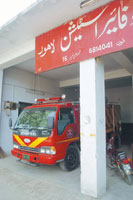 statistics provided by the fire officer of central fire
station situated in city's Town Hall, one fire station serves a population of
two to five lakhs and a fire fighter engine caters to a population of one to
two lakhs. This inadequate number of fire stations and fire fighting engines
go together with the outdated technical training, low morale and discipline
of the officials of this department.
statistics provided by the fire officer of central fire
station situated in city's Town Hall, one fire station serves a population of
two to five lakhs and a fire fighter engine caters to a population of one to
two lakhs. This inadequate number of fire stations and fire fighting engines
go together with the outdated technical training, low morale and discipline
of the officials of this department. 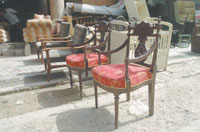 afford new one. The prices at new furniture shops go up
every day which make new furniture further out of reach of many people,"
he says. On the contrary Chaudhary Jamal insists that he buys old furnishings
not because they are cheap but because he believes old wood is seasoned. He
then supports his point of view by saying that for instance take Shisham and
Tali.
afford new one. The prices at new furniture shops go up
every day which make new furniture further out of reach of many people,"
he says. On the contrary Chaudhary Jamal insists that he buys old furnishings
not because they are cheap but because he believes old wood is seasoned. He
then supports his point of view by saying that for instance take Shisham and
Tali.