



|
|
|
|
 |
 |
   |
cricket Money
and fame is what they only want! cricket India
break jinx with Test rubber win in England Doping,
cycling go side by side
cricket Yousuf's natural skills simply take one's breath away. He picks up the length so quickly, building his game around great reflexes allied to perfect eyesight By Dr Nauman Niaz Cricket holds an endless
fascination for me, which defies all the changes in format and I count myself so very fortunate because every night (it can't be in the mornings since clinics and patients take one's greater toll) of my working life I have looked forward to immersing myself in this wonderful sport. Apart from clinical medicine that has now become an instinct and cricket, there was nothing else I wanted to do, and I have never lost my appetite for the game. Invariably the joy and thrill of seeing cricket being played lifted my spirits, even during spells of disillusionment and near despair when strange decisions of the cricket board and its numerous committees proved disheartening. I dream about Pakistan cricket progressing, institutionalised and trouble-free not in conflict the moment it is in now. One imagines being able to pick ones side and put the theories to the ultimate test at the highest level. Reality is different. Pakistan cricket is still stuck miles outside the promised-land. Throughout these disappointments, though, I never lost a genuine, deep-seated love of cricket. One is losing now. Only recently, Mohammad Yousuf, Pakistan's most successful batsman was left out of the team picked for the first Twenty20 World Cup. We had as usual clumsy reasons to adhere to. Chairman of the National Selection Committee Salahuddin Mulla reasoned saying that Yousuf was a world class performer and he had been rested. Interestingly, with a national team desperate to see its players gelling, they'll be without their premier run getter. There was another one -- according to some Yousuf was not physically fit to sustain pressures of Twenty20 cricket. His fielding is gaunt and weak, so they said. Someone else opined 'Yousuf should now be looking forward to representing Pakistan only in Tests; he is too consumed to last spiritedly in One-day Internationals or Twenty20s'. Nevertheless, getting into the playing attitude, Twenty20 may well provide evidence to be not a young man's game but a clever cricketer's sport. One must have the enthusiasm to throw oneself around. But it's more than that. It's about players with piercing, multi-dimensional expertise. It's cricket's clearest example of the chemistry between a cricketer's accepted wisdom and implementation. Yousuf needed to be there; he is a gritty reliable batsman, shrewd and a slick run-accumulator. His dropping should go down tough with the selectors. Batting, particularly at the highest level, is not merely a matter of technique. The correct mental approach is also vital, with concentration and self-discipline key factors in the make up of any truly great player. Attention to detail is important too, and no natural talent continues to flourish without constant fine-tuning. Ability has to be stretched over a lengthy period of reliable consistency rather than displayed with a brief, flashy brilliance. That's why the technocrats believe that Mohammad Yousuf is currently one of world's best batsmen. Yousuf's natural skills simply take one's breath away. He picks up the length so quickly, building his game around great reflexes allied to perfect eyesight. Yousuf also drives great benefit from nimble foot work, gliding into position with graceful ease to unfold his wide range of strokes. He doesn't hook or seldom does, but the he doesn't need to, sensibly content to let the really short ball go by. His trademark is the cover drive, helping the ball on its way from his front foot with the left foot pivoted perfectly. His selectivity of stroke is flawless, providing the basis of his scoring ability. When any batsman gets the length wrong he is in trouble, but Yousuf rarely errs in that direction. His timing is impeccable and he operates with an easy fluency which enables him to rocket along without taking the slightest risk. He is, in fact, poetry in motion, using his bat with a rapier like precision to direct the ball effortlessly into gaps in the field. In that sense he is very different to Inzamam-ul-Haq, who more often resorted to quick eye to satisfy his desire to dictate to the bowler. Inzamam's confident swagger on his way didn't give due warning of his intentions, not sought always to impose himself on the bowlers, yet he mostly was. Yousuf, without a matching physical presence, is neatly clean and clinical, impressively orthodox, yet with an elegance of stroke play which carries the textbook approach into another dimension. His greatest asset is that by seeing the ball early he could get into position quickly, gaining that crucial extra split-second when dealing with a delivery. A batsman seeking merely to defend does not need quite so much time, but in no more than the blink of an eye Yousuf gives himself the opportunity to do more than preserve his wicket. He creates the means to pick up runs leaving the fielders and bowlers helpless in the knowledge that their best is not good enough. In every way Yousuf, taking the cricket world by storm in 2006 scoring nine hundreds in a calendar year, has now earned a privileged position in Pakistan's cricket history. Without disrespect to the selectors, one must contend saying the man of Yousuf's caliber has been disrespected. A first-class match, a Test, a One-day International or a Twenty20 prototype, batsmen like Yousuf will always excel and one is sure his absence will strongly be felt. It was like cutting one's own fingers. Twenty20 is not about flair and youthful exuberance, the unorthodox hitting and bowler's demise. It's about sensate planning, and a real mind game. Who could have been more intelligent, if fully fit then Abdul Razzaq. There are people, as per reports even few within the team who are utterly surprised to see Yasir Arafat replacing Razzaq. According to one of the players, a half-fit Razzaq could have been more resourceful than Arafat battling in full flow. Pakistan needed a thinking bowler, a pressure-free performer, contemplating to bowl a little seamer, or one really outside the off stump with the batsman anticipating to nudge or pull round his legs, or a low full toss; should we expect Arafat doing all this in nascent stages of his international career? We would not be having Razzaq bowling block-hole deliveries. We must believe it's a great talent but not many people have it. Imagine Mahendra Singh Dhoni, India's Twenty20 captain pulling his front leg out of the way and hitting through mid-wicket. With naivety on his side, Arafat may well forget bowling surprise balls mixed with the traditional length ones. And without Yousuf, Pakistan's batting would surely be without delicacy, but the one filled with desperation. Mohammad Sami isn't there but Shoaib Akhtar is, though barely hanging on a thread. Few modern Pakistan sportsmen have fascinated the public more than Shoaib Akhtar. A record-breaking (at least in terms of speed) international cricketer and an acerbic personality, Shoaib has never been far from controversy during his career in the game. From highlights like his two back-to-back wickets at Kolkata in 1999, a fiver against South Africa in 1997 etcetera to low points such as the squalid doping case in 2006, his has been a dramatic roller-coaster of a life lived in the public eye. Now PCB's disciplinary committee members have tried to cut through the Shoaib mythology to expose the truth about his charismatic, single-minded and often exasperating personality. On Friday last, Shoaib was seen maddened, thoroughly infuriated in the office corridors of the PCB whilst most of the staff had gone to the mosque to offer prayers. Shoaib didn't show anger for having been fined Rs 300,000 leaving the camp in Karachi without informing team manager Talat Ali Malik; he had a different story to tell. Unique testimony from people at the PCB doesn't provide answers to a wide range of intriguing questions: Why was Shoaib selected on the team if his tantrums were not acceptable to the authorities or why was he not dropped or was it better to drop him from the squad to maintain discipline within the ranks? One remembers clearly that Dr Nasim Ashraf, Chairman of the Pakistan Cricket Board, had promised to end power-play and indiscipline from within the national team. Whether a fine is going to halt Shoaib from rankling still 'mid-way' approach and policy has lifted the lid on the new-faced PCB and is in line with the policies of Chairman PCB. Dr Nasim may well need to pull people up to deliver as he has envisioned cricket growing progressively. If one intends to read through Shoaib's attitude and persona, at times he'll appear as utterly self-centered, the rudest most arrogant man on earth and on others if you take people in the team, he is a mile ahead of any of them, he really is. He can be hated and equally rated highly. His cricketing content seems flawless. There are people, who think, Shoaib controls his supporters. It seems no one can put anything against him. He would sit back of the room, feet up, reading a book, then put up his arm and sixteen other hands would follow. To some he has ruined Pakistan cricket. Shoaib is a sort of a guy we are lucky that he isn't a politician he could have easily blown up the world. He needs special handling and tender care only if the authorities, selectors and management are sure that he still has a lot to give to Pakistan cricket.Underneath that brusque facade there is a sensitive soul, a soul that wants to be loved and admired but does not really know how to get it. And there are† people at the PCB not knowing †how to give it to him. One regrets that despite Dr Nasim Ashraf's attempts to restructure Pakistan cricket, clipping the rough edges, smoothening out the relationship between the PCB and the players, investing enthusiastically and hugely in development programmes, somehow the other with paid selectors operating quite independently, the old paranoid state of countryís team is being revitalised; player-power or power share is again creeping in. The big burly Inzamam was left out to dampen player power but still it seems, in circles we are desperately getting back to it. Shoaib Akhtar has been sternly treated contrary to what he likes, Abdul Razzaq is furious as evidenced from his television out burst on a local channel and Mohammad Yousuf despite his repeated confirmations that he has taken the ouster positively must be embittered. Do we really need to pop up surprises picking a 33-year-old Misbah-ul-Haq with an uneventful international record and leaving out Mohammad Yousuf at 32? Furthermore the selection committee has selected two left-arm spinners, Abdul Rehman and Fawad Alam? Two left-arm slow bowlers operating in Twenty20 matches? Time has come to stop whimsical decisions taking place -- all the powerful on the so called reform group have had their time. Now they must be stopped in their tracks. They have won the day on their demand to oust outstanding players to avoid allowing them selfishly tearing apart over the years. Regrettably, haphazard selection policies have been the ruination of Pakistan team on the field.
An Indian channel-sponsored Twenty20 league has been arranged which will include teams having retired superstars, present players and upcoming youngsters from across India By Muhammad Shahbaz Zahid No matter what sport we are
talking about, money is the main point of focus of players What we lack here in Pakistan, sometimes, is the commitment towards what we do. And same has been the attitude of people here towards sports as well. From the playing fields of hockey to cricketing grounds, and from squash courts to boxing arenas, the hunger for more money has been continuously marring the true spirit of sports. The general point of view is players want more (money and fame) from the game they play and in reply don't want to contribute to their fullest of potentials. And when a player makes a name for himself in a particular sport he is related to, he has his nose up in their air, shows attitude everywhere and thinks he has the authority and infinite power to do anything wanted. The dilemma in the Pakistan cricket team is still on the run. People have been waiting to see when the things will unfold in a positive manner but nothing seems to be working properly. And there are certain reasons which have erupted to again nullify the progress of our national cricket team. New talk in the cricketing market these days is of Indian Cricket League (ICL). An Indian channel-sponsored Twenty20 league has been arranged which will include teams having retired superstars, present players and upcoming youngsters from across India. But before this ICL 'thing' starts, there are certain things that have been questioned, raised. The Board of Control for Cricket in India (BCCI) has clearly shown its resentment towards the ICL saying it is 'a rebel league' and BCCI won't accept its presence in any way. Though BCCI's stance has changed a bit since the announcement of ICL being formed, it has clearly mentioned that "(Indian) players (present/former/upcoming) who will participate in the ICL won't have any sort of relation with the BCCI afterwards. They won't play in national (India) colours again and won't receive any sort of pensions or financial assistance from them". Sri Lanka Cricket (SLC) has gone on with the same theme as BCCI and has warned its players of participating in the ICL. SLC has also said it would ban its players from future national participation as well. Though former skipper Marvan Atapattu, who asked for his contract to be terminated after he wasn't selected regularly for the national team, has been linked with ICL. May be a decision to join ICL made him request for his contract termination. The ICL, which hasn't been accepted nor rejected by International Cricket Council (ICC) because ICC says it's the internal matter of India board and they won't interrupt in its progress, has been facing huge criticism from other circles as well. Australian captain Ricky Ponting said that it won't help youngsters in any way and "(huge) money offers from ICL will lure the youngsters away from their national duties and only thing that will be on their mind would be money and more". ICL, which has officially roped in former West Indian skipper and legendary batsman Brian Lara and have been linked to sign in other superstars as well including Shane Warne, Glenn McGrath, Marvan Atapattu and Inzamam-ul-Haq, has also been harshly criticised and opposed by the Pakistan Cricket Board (PCB). Under pressure, perhaps, from their neighbouring cricketing boards and ICC, may be, PCB has also made their stance clear against involvement of its players in ICL. PCB, who at first said that none of their players has been invited to play in ICL and neither of them, if invited, would play in the ICL saying all of its players have their full focus on the upcoming inaugural edition of the Twenty20 World Cup, are now in a state of jeopardy for some reasons. By the time this article was being written, a report in 'The News' by our cricket correspondent brought up the news that several leading players of the team have threatened to pull out of the Twenty20 World Cup, which will start next month in South Africa, to protest against 'rude behaviour' of a PCB official. The correspondent was being told by sources that even captain, Shoaib Malik, has also threatened to opt out of the tournament. Reports suggested that Malik had a heated argument with PCB Director of Operations, Zakir Khan, over an appeal filed by pacer Shoaib Akhtar against a fine imposed on him by the PCB. The correspondent added that Malik left the argument fumed up and later discussed the issue with Akhtar and all-rounder Shahid Afridi among others. The main angle that has been brought in by cricketing circles and of course by our correspondent as well is that this threat has come at a team when few of the players are seriously thinking to sign up for ICL. And when the things aren't going one's way and he sees a better (money-making) option, he goes for it. And that is what happened in some cases. Before the players threatened to sign up for ICL after Malik-Zakir saga, which may see as many as seven to eight contracted players sign up for ICL simultaneously, another player, Imran Farhat who has been out of Pakistan ranks for sometime after several incidents, requested the PCB to release him from the contract. Why, because he was lured by the ICL. It has been confirmed by Farhat that he has been given a lucrative offer by the India league and as his Pakistan future is already in jeopardy, he immediately asked the PCB to terminate his contract so that an easy way to participate in ICL shapes up for him. The PCB had said that any contracted player who opts to play in the ICL won't be allowed to play for the national team. And as Farhat realised his comeback options are limited now, at least till the present body of the PCB is present, he opted to walk out of his contract so that he doesn't get a life ban from the country's board and can play cricket, rather make money out of ICL according to me. Farhat's reaction and Malik's spat with Zakir can trigger a huge collapse in the national team that would see many players going against the board and opting to play in the highly-lucrative ICL. Inzamam, the team's former captain, has been quoted by some that he has received an ICL contract and after he resigned from the ODI captaincy and hasn't been included in the Test squad yet, his involvement in ICL's set-up sure seems to be getting confirmed. Some say Inzamam has passed his glory days but hunger for more money might tempt him to take up this opportunity in order to expand his career. Mohammad Yousuf and Abdul Razzaq -- both of them were left out of the T20 squad -- have been linked with ICL up to a strong extent. Yousuf, who has been termed as the 'hungry-for-money' player by some critics as he never ever misses a tournament even if a busy schedule is ahead. This example was seen when he participated in the Afro-Asia Cup as well event though that tournament wasn't that important. And as he has been left out for the T20 World Cup, he has to keep up the 'money-making' momentum and nothing else than playing in ICL would fulfil his ambitions. Though a world-class player, no doubt, his off-field antics also have been the source of criticism as he has been quoted asking huge sums for working in commercials and advertisements. Razzaq, who harshly criticised the PCB selection committee for dropping him of the squad, is also in the frame to join ICL. Both Yousuf and Razzaq haven't signed the PCB contracts yet which further justify the fact that they might join the rebel league. Whatever the reasons are, one feels that personal interests and hunger for more money might lure national players away from their jobs towards foreign cricket league. One should realise that if they are dropped from the squad for one reason or the other, they shouldn't turn their back completely towards the selection policy and should admit the given reasons or criticise in a polite manner. Or if they have something against the board, or a single person, they should try to figure out the solution and solve the matter in mutual consensus. It shouldn't turn into a hapless incident in which players act like babies and threaten to give up their contracts and national duty. Everyone should act like responsible citizens, considering the fact that they represent Pakistan. May be then we can see things turning towards betterment. The writer is a staff member at 'The News' Karachi shehnu@gmail.com cricketExperience sacrificed at altar of 'personal whims' The irony is that Pakistan has selected a bit of a 'boring' squad for the thrilling encounters of the T20 World Cup By Gul Nasreen Personal whims and follies
seem to be reigning supreme in Pakistan cricket. The latest In Pakistan too people were eagerly waiting for the inaugural event and were anticipating a 'balanced outfit' for the T20 World Cup. However, the irony is that Pakistan has selected a bit of a 'boring' squad for the thrilling encounters of the T20 World Cup that be will be cherished more by genuine specialist batsmen and all-rounders than the 'so so hard-hitters of the ball'. Yes the exclusion of legendary Mohammad Yousuf and star all-rounder Abdul Razzaq from the inaugural edition of the tournament has rendered Pakistan's final squad unexciting. Contrary to other participating teams who are marked by the presence of legendry players, Pakistan have upheld a 'mediocre approach' by preferring average cricketers over the skilled and capable players. The reality is that without the duo of Abdul Razzaq and Mohammad Yousuf it will be miracle for Pakistan to reach the semifinals of the prestigious tournament. The way Pakistan's only current world class batsman Yousuf and ace all-rounder Razzaq were ignored completely speaks volume of the situation prevailing over our national cricket. They were not only dropped from the side, but were frustrated to the core by the earlier signals sent by the national selection committee days before the schedule of the announcement of the squad, hinting that the duo will be not make the final 15. Both the heroes of Pakistan cricket came to know that their names were not under consideration. They were severely dealt with, and this is the way how we as a nation provide such unhappy treatment to those people who serve the nation extraordinarily. The decision to drop Yousuf and Razzaq has come at a time when both have yet to sign new central contracts offered to them by the PCB. Both are said to have been made lucrative offers by the organisers of a new Indian league. If this is the way the senior cricketers are going to be treated after serving the country honestly and diligently, the players too will think twice whether or not to avail 'lucrative' offers like the one offered by the India League to our players. It may be mentioned here that Yousuf has always maintained that he was keen to play in the Twenty20 form of cricket. Yousuf created many a unique world record in Test cricket last year, and he was an integral part of the team and played a pivotal role in either saving Pakistan from embarrassing situations or steering the team to a sure win-like situation in crucial encounters. He along with Inzamam-ul-Haq, on many occasions, has come to the rescue of Pakistan batting, when the top order used to collapse in all important encounters. Both the batsmen have always endured and survived fearsome bowling attacks of the world. Abdul Razzaq is the most reliable all-rounder Pakistan has ever produced. Razzaq, who has taken 246 wickets and scored 4465 runs in ODIs, has rattled the stumps of many batsmen at crucial stages when they looked dangerous against Pakistan, and brought back Pakistan into the game on numerous occasions. In one day matches, when Pakistan on many occasions lost all their specialist batsmen, and the asking rate had mounted too high, Razzaq's clean and brutal hitting took Pakistan out of trouble and put the team on the road to victory. If we look at the selection of other teams, experience has been given preference over new talent. Sri Lanka have picked Sanath Jaysuriya, Mahela Jayawardene, Chaminda Vaas and Muralitharan. These players are all over 30. It has been signalled that Yousuf was dropped on the basis of his not up to the mark performance in fielding and also his slow batting style which is not suited in this quick shorter version of cricket. It is also said that Pakistan omitted Yousuf due to the 'age factor', but what about Misbah-ul-Haq, who has been picked at the age of 33. Another reason for dropping Yousuf is his weak fielding. This again is not a valid reason, as the overall Pakistan fielding standard is not up to the mark. The fact is that Pakistan has never been a first class fielding outfit. Pakistan's fielding lapses have been the talk of the cricketing town for long. Even at the national camp at Karachi the fielding standard of Pakistan players was not up to mark. The young players spilled many simple catches at their will. The ground fielding was also substandard. Blend of youth and experience has always produced endurance and ensured success. However, the unwise selection committee in Pakistan does not pay heed to this 'mantra' and has most of the time kept Pakistan cricket at bay from this touchstone of selection. It may be mentioned here that Yousuf has been a member of the Pakistan national cricket team since 1998. He is best known for his achievement in 2006 when he broke the great West Indian batsman, Sir Vivian Richards's world record for the most Test runs in a single calendar year In November last year, Yousuf achieved the 10th highest ever figure in ICC's Test batting rating. His rating of 933 gave him a personal best of second place in the rankings behind Ricky Ponting and was the third highest ranking of any current player as well as the highest for any batsmen from the sub-continent. He is the third Pakistani batsmen to cross 6000 runs in Test cricket. Yousuf has the second highest Test match centuries number amongst Pakistani batsmen, currently tied with Javed Miandad on 23 and only two behind Inzamam-ul-Haq. By scoring two hundreds in the Karachi Test against West Indies last year, Yousuf became the sixth Pakistani player and 30th cricketer in Test cricket to hit a century in each innings of a test match. As far as his ODI records is concerned, Yousuf is the third highest run scorer amongst Pakistani batsmen. Having scored at an average of over 41 runs, he has been placed third after Javed Miandad (41.70) and Zaheer Abbas (47.62). He is a batsman in the classical mould, with all the exquisite shots in his repertoire. And the most striking feature of his batting is that it has always been a blend of defense and aggression. That Yousuf is in good form can be gauged from the fact that the star batsman is placed no.2 in individual batting averages under the latest rankings list issued by International Cricket Council. Yousuf is just behind the Aussie captain Ricky Ponting, who is on top of individual batting aggregates with 936 points. Yousuf is placed at the runners-up position with 915 points with Kumara Sangakarra of Sri Lanka taking third position with 900 points. To conclude one would agree with a veteran sports analyst who while commenting on the Yousuf's expulsion from the side said, "Yousuf's natural style of flair and attack definitely suits a 20 over game where you need to make quick runs with sensible hitting rather than mindless hoicks and senseless cross-batted swats. We all know when a class batsman tries to hit out, then what are the possibilities than relying on pinch-hitters." India break jinx with Test rubber win in England England's defeat ended the six-year unbeaten streak of Michael Vaughan's team at home. It was England's first home series defeat since the Ashes were lost in 2001 By Khurram Mahmood At last India have broken
the jinx and clinched yet another Test series win in England The series win against England was a perfect gift from Rahul Dravid and company to their nation on its 60th Independence Day. Overall it was India's third victory in England after the 1-0 win by Ajit Wadekar's team in 1971 and the 2-0 victory by Kapil Dev's men in 1986. It was Rahul Dravid's second major Test series win after their first series victory in the Caribbean for 35 years. England's defeat ended the six-year unbeaten streak of Michael Vaughan's team at home. It was England's first home series defeat since the Ashes were lost in 2001. It was the first time when India retained the lead after they also reversed their trend of squandering away the advantage in a series, as they did in Zimbabwe in 2001, in the West Indies in 2002, in Australia in 2003, in Pakistan in 2004 and in South Africa in 2006. Rahul Dravid's side drew the third and final Test at the Oval to win the series 1-0 after recording a comprehensive seven-wicket win in the second Test. Rain had saved India from definite defeat in the opening Test at Lord's. This was only the second time India have escaped with a draw after being nine down, and the first time since 1946 also against England. The victory margin could have been 2-0 in favour of India, but Dravid did not enforce the follow-on despite a first innings lead of 319 and his safety-first approach in the third Test at The Oval. But only Dravid can't be blame for the decision, obviously it was the entire management and senior players decision. Indian chief selector Dilip Vengsarkar defended the decision not to enforce the follow-on and said that "We were 1-0 up. We had the series in the pocket. There was no reason to take the risk and why would we take the risk to bat on the fifth day?" Indian spin magician Anil Kumble also showed his batting skills with his maiden century in the third Test at the Oval. His previous best was 88 against South Africa at Kolkata in 1996-97. Surprisingly it was the only century for India in the entire series. Kumble scored his first century in his 118th match, and his 151st innings, he consumed the most number of Tests for any batsman to score his first hundred. Before Kumble Chaminda Vaas held the earlier record -- his unbeaten 100 against Bangladesh in Colombo earlier this year came in his 97th Test while Jason Gillespie was playing in his 71st Test when he struck that memorable 201 not out also against Bangladesh at Chittagong in 2005-06. The 1-0 victory over England gave India its best third position in the ICC Test Championship ranking with 107 points and left behind Sri Lanka (107 points) and South Africa (102 points). Now India are just four points behind England (111) who are second-placed. England dropped four points following the home series defeat but maintain their second spot in the Test ranking. Australia are still enjoying their first position with 141 points. The seven-match one-day series starts at the Rose Bowl on August 21. INDIA
IN ENGLAND PATAUDI TROPHY, 2007 AVERAGES India Batting & Fielding Player Mat Inns NO Runs HS Ave SR 100 50 0 Ct St A Kumble 3 5 2 162 110* 54.00 53.11 1 0 0 1 0 MS Dhoni 3 5 1 209 92 52.25 66.34 0 2 1 6 0 VVS Laxman 3 5 1 205 54 51.25 45.75 0 2 0 4 0 SC Ganguly 3 6 1 249 79 49.80 55.08 0 2 0 0 0 KD Karthik 3 6 0 263 91 43.83 50.77 0 3 0 3 0 SR Tendulkar 3 6 0 228 91 38.00 43.18 0 2 0 4 0 W Jaffer 3 6 0 185 62 30.83 45.23 0 2 1 0 0 R Dravid 3 6 1 126 55 25.20 36.73 0 1 0 4 0 S Sreesanth 3 4 2 41 35 20.50 82.00 0 0 0 1 0 Z Khan 3 4 1 28 11 9.33 32.55 0 0 1 1 0 RP Singh 3 4 0 30 17 7.50 41.09 0 0 1 2 0 Bowling Player Mat Overs Mdns Runs Wkts BBI BBM Ave Econ SR 5w 10w Z Khan 3 136.2 41 366 18 5-75 9-134 20.33 2.68 45.4 1 0 RP Singh 3 92.3 20 347 12 5-59 7-117 28.91 3.75 46.2 1 0 SC Ganguly 3 28.0 8 65 2 1-11 1-24 32.50 2.32 84.0 0 0 A Kumble 3 143.4 25 483 14 3-32 6-136 34.50 3.36 61.5 0 0 S Sreesanth 3 113.0 29 338 9 3-53 5-133 37.55 2.99 75.3 0 0 SR Tendulkar 3 38.0 0 152 1 1-26 1-104 152.00 4.00 228.0 0 0 VVS Laxman 3 1.0 0 5 0 - - - 5.00 - 0 0 england Batting & Fielding Player Mat Inns NO Runs HS Ave SR 100 50 0 Ct St KP Pietersen 3 6 0 345 134 57.50 58.08 2 0 0 3 0 MP Vaughan 3 6 0 295 124 49.16 47.27 1 1 0 1 0 AN Cook 3 6 0 223 61 37.16 53.86 0 1 0 3 0 AJ Strauss 3 6 0 211 96 35.16 42.62 0 2 0 4 0 PD Collingwood 3 6 0 197 63 32.83 51.30 0 2 1 2 0 IR Bell 3 6 0 190 67 31.66 75.09 0 2 1 2 0 RJ Sidebottom 3 6 3 58 25* 19.33 48.73 0 0 0 0 0 MJ Prior 3 6 1 73 42 14.60 36.13 0 0 1 12 0 CT Tremlett 3 5 1 50 25* 12.50 43.85 0 0 2 1 0 JM Anderson 3 5 2 22 16 7.33 33.33 0 0 0 3 0 MS Panesar 3 5 0 17 9 3.40 20.00 0 0 1 0 0 Bowling Player Mat Overs Mdns Runs Wkts BBI BBM Ave Econ SR 5w 10w PD Collingwood 3 37.0 6 109 4 2/24 3/35 27.25 2.94 55.5 0 0 CT Tremlett 3 143.1 36 386 13 3/12 6/92 29.69 2.69 66.0 0 0 JM Anderson 3 146.2 31 498 14 5/42 7/125 35.57 3.40 62.7 1 0 RJ Sidebottom 3 117.0 28 303 8 4/65 6/107 37.87 2.58 87.7 0 0 KP Pietersen 3 6.0 0 41 1 1/41 1/41 41.00 6.83 36.0 0 0 MS Panesar 3 130.5 24 403 8 4/101 4/101 50.37 3.08 98.1 0 0 MP Vaughan 3 4.0 0 18 0 - - - 4.50 - 0 0 Doping, cycling go side by side Is it not inhuman to expect athletes to pedal bikes at 2,200 miles for three weeks without drugs use? By Waris Ali The Tour de France and doping have been going side by side since the inception of the biggest international cycling competition. The faster the cycles ran, the faster the doping allegations pierced into the unique world sport; but they coexisted so harmoniously, so surprisingly, despite being foe to each other. Just in the same spirit, this year's edition of the Tour saw many cases of doping. Rasmussen had been mired in controversy, having been dropped from Denmark's cycling team on July 19 after failing to inform anti-doping officials of his whereabouts twice this year. He blamed an administrative error on his part and was cleared to continue at the Tour. Patrik Sinkewitz, a 26-year-old German cyclist for the T-Mobile team, tested positive for an abnormal level of testosterone a month before the Tour began. The two main directors of the Tour de France acknowledged this year that, because of ongoing doping scandals and suspicions, a vast majority of the French public does not believe bicycle racing is a clean sport. After confessing to using the banned blood booster EPO (erythropoietin) for a brief spell in his career in 1996, Tour de France sprint great Erik Zabel of Germany offered to hand back the first of the six consecutive jerseys he won in 1996. Denmark's Bjarne Riis, Zabel's former Telekom teammate, recently admitted he used EPO throughout his career. Giro D'Italia winner Danilo Di Luca is accused of having worked with Italian doctor Carlo Santuccione, who is under investigation for allegedly supplying banned substances to Italian sportsmen. Early Tour riders were said to have consumed alcohol and used either for dulling the pain of competing, followed by use of substances meant to increase performance rather than dulling the senses. During the 1967 tour, British cyclist Tom Simpson died climbing Mont Ventoux following usage of amphetamines. The 1998 Tour was marred by a major doping scandal when Willy Voet, one of the soigneurs for the Festina cycling team, was arrested for possession of erythropoietin, growth hormones, testosterone and amphetamines. The arrest was followed by further police raids that recovered doping products in possession of players. The situation irritated the riders who staged a 'sit-down strike' and refused to continue. A 2000 criminal trial proved involvement of Festina team in doping. While the 93rd issue of the French pride last year had been individualised by such developments as the absence of seven times winner American Lance Armstrong, the chief occurrence was the doping scandal that resulted in ouster of 13 prominent players, many among them the tournament favourites, making an American successor of the American cycling legend as the champion of La Grande Boucle, as the Tour de France is known in France. While doping has since long been an issue associated with this above 4000 kilometers long race, the events in 2006 bore the stamp of the 1998 tournament that was better known as the Tour of Shame because of the revelations about doping practice by the cyclists. As the most controversial scandal since the 1998 tour, this event saw the ouster of thirteen riders from the tour, on the eve of Strasbourg prologue, stemming from a Spanish doping scandal. Two race favourites Jan Ullrich and Ivan Basso were among those excluded from the Tour, along with podium candidate Francisco Mancebo. The world's most prestigious road bicycle race is being contested annually since 1903 by professional cycling teams during the first three weeks of July, and constitutes the Triple Crown of Cycling, with Giro d'Italia and World Cycling Championship being the other two. While cyclists pass through Italy, Spain, Switzerland, Belgium, Luxembourg, and Germany to cover the track distances, most stages take place in France. Given all the concerns over doping scandals, Tour de France ratings are surprisingly stable; total live program viewer impressions are up 5 percent to an average 219,779 homes on the network throughout the race's first 20 days. Its television audiences has increased in Europe as one of the most open contests in years overshadows drug scandals that have tarnished three former cycling champions, a fact that helped persuade companies to remain in the sport as cycling seeks to regain credibility. They believe that doping is undermining the sport, but not the Tour. They also denied that the race had been diminished by the drug controversy around its leader, Michael Rasmussen. The public's perception of the Tour de France is different than its perception of cycling in general. In the years following the Festina scandal, anti-doping measures were put into effect by race organisers and the UCI, including more frequent testing of riders and new tests for blood doping (transfusions and EPO use). A new, independent organisation, the World Anti-Doping Agency (Wada), was also created. Created on the initiative of the International Olympic Committee in 1999, the World Anti-Doping Agency produces a list of prohibited substances that athletes are not allowed to take. In 2004, the World Anti-Doping Code was implemented by sports organisations prior to the Athens Olympics standardising the rules and regulations governing anti-doping across all sports and all countries for the first time. Evidence of doping has, however, persisted. EPO and steroids were found in the car of the wife of third-place finisher in the 2002 stage race. In 2004, a rider admitted doping was endemic to the players, while another rider detailed how he had allegedly been forced by his team to use banned substances. The 2005 Sportsman of the Year, Armstrong has also been several times accused of doping, but always turned out to be blotless. That is why, Armstrong described himself as "the most tested athlete in the world". A series of discoveries of doping scandals seem to cause another puncture to cycling's credibility. But one must never conclude that this confluence of scandals means that sport has reached its nadir, at which celebrity, multimillion-dollar salaries and doping have turned out victorious over authenticity and integrity. The legitimacy of competition, after all, has repeatedly been cast into doubt for more than a century. Yet, fans keep making accommodations. They rationalise, even persist in willful denial about the transgressions of their heroes, staying devoted to sport. Fans may be concerned about drugs in baseball, but not enough to stop buying tickets. In the steroid era, the major leagues remain on pace to set an attendance record for a fourth consecutive year. Fans don't always care that the fix is in; one of the most popular programs on cable television features the theatrical fakery of professional wrestling. While the world's most famous bicycle race is now under threat, only the most naÔve have considered cycling to be clean. It seems inhuman to ask athletes to pedal their bikes at great speed some 2,200 miles in three weeks, often up tortuous mountain passes, without chemical assistance. Fausto Coppi of Italy, who won the Tour in 1949 and 1952, was once asked if he ever fueled himself with amphetamines. "Only when necessary," he said. How often was that? "Most of the time," Coppi replied. Jacques Anquetil of France, a five-time winner, once said with sarcasm, "Do they expect us to ride the Tour on Perrier water?" Meanwhile, there is a small but seemingly growing movement to legalise banned performance-enhancing drugs. Given the widespread drug use in society, some say it is unfair to single out athletes for punishment. Why allow Viagra as a performance enhancer, but not steroids, the thinking goes. In an interview before his death in 2005, Steve Courson, one of the first athletes to admit to steroid use, said it was time to acknowledge that the values taught in youth sport bore no resemblance to the values of elite sport. The noble cause is all gone. These guys are entertainers, period, in the money sports. They're not role models.
|
|
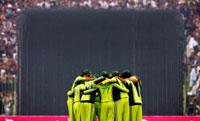 fashion introduced over the years in the search for a more modern image. The
legislators are constantly striving to attract a new audience, which is
understandable in these days of high pressure marketing, but the simple,
uncomplicated battle of wits between bowler and batsman is enough to stir my
senses and emotions.
fashion introduced over the years in the search for a more modern image. The
legislators are constantly striving to attract a new audience, which is
understandable in these days of high pressure marketing, but the simple,
uncomplicated battle of wits between bowler and batsman is enough to stir my
senses and emotions.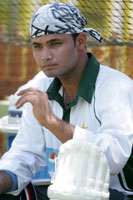 or for players in some cases.
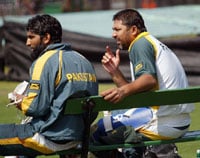 manifestation of it is the so-called 'liberal and moderate' approach to the
selection of Pakistan squad for the inaugural Twenty20 World Cup in South
Africa next month. Currently this genre of cricket is considered to be the
most exciting and awe-inspiring form of the game. It pulls capacity crowds in
the modern day world when the game lovers, owing to busy life, love to watch
fast and result-oriented cricket.
manifestation of it is the so-called 'liberal and moderate' approach to the
selection of Pakistan squad for the inaugural Twenty20 World Cup in South
Africa next month. Currently this genre of cricket is considered to be the
most exciting and awe-inspiring form of the game. It pulls capacity crowds in
the modern day world when the game lovers, owing to busy life, love to watch
fast and result-oriented cricket.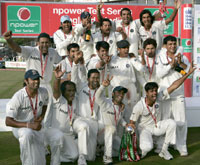 after beating home side in the second Test at Trent Bridge by seven wickets
while the other two Tests ended without producing any result.
after beating home side in the second Test at Trent Bridge by seven wickets
while the other two Tests ended without producing any result.