



|
|
|
|
 |
 |
  
|
politics profile
Icons of our times Playing in
different times
As the six-month-old coalition falls apart, many analysts foresee a return of the vengeful politics of the 1980s and 90s By Aoun Sahi After Musharraf's
resignation on Aug 18, politics in Pakistan has taken a U-turn. Many expected
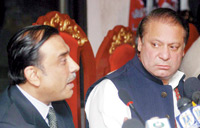
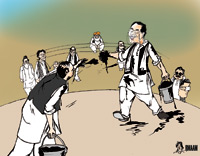
a Pakistan People's Party (PPP) officially nominated Asif Ali Zardari as its presidential candidate on Aug 23. The six-month-old coalition, often considered the last hope for democracy fell apart on Aug 25. With the announcement of PML-N's own presidential candidate, the 'bargaining power' of PML-Q and the smaller political parties such as ANP, MQM and JUI-F has increased manifold. Both PPP and PML-N are forced to contact PML-Q, known more as the dictator's party, for its support especially in the Punjab where none of them can form or sustain a government without its help. Many observers foresee a return of the vengeful politics of 1980s and 1990s as both PML-N and PPP have started blaming each other for the breakup of the coalition. There are others who are still optimistic. "We are generally very pessimistic. We should understand that after a decade, real political process has kicked off in Pakistan," political analyst, Sohail Warraich, tells TNS. "The breakup of the coalition is a setback and it should have stayed intact for at least one year; but a positive outcome of this divide is that political forces are making their own independent decisions," says Warraich, ruling out the role of the establishment and adding that the next election could not have been fought as a coalition anyway. "According to my
information, before signing the Murree Declaration, PML-N delegation had Well-informed people within PPP say the day Zardari started revealing the details of Nawaz Sharif's promises and commitments to the nation, Sharif may have to go on the back foot. Some analysts think Zardari has been playing mature politics. He seems in no hurry, has been providing space to all his political allies and is slowly getting his share in power corridors. For others, he is losing credibility as well as public support. During a press conference on Aug 25, Nawaz Sharif accused Zardari of repeatedly reneging on his promises to reinstate the judges which, according to him, was the prime reason to quit the coalition. But, to many, nomination of Asif Zardari as a presidential candidate hurt the PML-N more than PPP's position on restoration of judiciary. PML-N knows that with the all-powerful co-chairman of PPP as the president, the probability of reducing the presidential powers under the 17th amendment would be minimal. Asif Zardari has already announced that the new president will renounce his powers under 58(2)b. But the other presidential powers under the 17th amendment such as the appointment of the governors, the three Services Chiefs and the Chief Justices may not be removed even though they were agreed at the signing of the Charter of Democracy (CoD) on May 14, 2006. PPP leadership is not too happy about the rigid stance of PML-N regarding Asif Zardari as a person who does not honour his words. Acting President PPP Punjab Ghulam Abbas criticises Nawaz Sharif for reviving the ethnic politics of the late 1980s by refusing to acknowledge the three provinces' support for Zardari's presidential bid. "Independence of judiciary is not an issue of PML-N; if they were interested in it, they would not have nominated a candidate who was the mastermind for overthrowing Sajjad Ali Shah, ex-CJP to get himself in that office." He also points out that Zahid Hamid, the ex-law minister who drafted the chargesheet against the deposed CJP and placed him under house arrest, is now a PML-N MNA. He says PPP wants to keep the coalition intact and PPP's role in Punjab will be defined by the party's central executive committee. Ahsan Iqbal, secretary information PML-N, denies the allegations. "We never gave any such assurances to PPP before the Murree Declaration and want the restoration of judiciary to its pre-November 3 position." He disagrees that politics of the 1980s and 90s can ever return to Pakistan. "There is a huge difference between Nawaz Sharif of 1988 and 2008; now he is a mature and experienced politician who understands the tactics of anti-democracy forces very well. On August 25, before announcing the breakup of the coalition, he delivered a long speech before all leadership of PML-N, asking them that breakup does not mean we should start a character assassination of our political opponents," he says. According to him, both PPP and PML-N are ideologically different political parties and CoD was signed on the supposition that one party would be in power while the other in opposition. "Coalition of two parties after elections was something really extraordinary which we had never thought about earlier," he tells TNS. Iqbal holds that picking and choosing judges of their own choice means PPP does not want an independent judiciary. He thinks that both ANP and MQM are not supporting PPP on ideological basis. "In fact they are forced to do so because they need PPP's support in respective provincial assemblies to remain in government." Ahsan Iqbal disagrees that PML-N is trying to get the support of PML-Q. Senator Haji Adeel, Senior Vice President ANP, thinks that Pakistanis traditionally want quick fixes like dictators give. "For example we want every problem to be solved in one day while democracy encourages processes that are time-taking. Only a dictator can depose or reinstate 60 judges in a day, so we need to change our thinking," he says. According to him PPP and ANP are ideologically very close. "PPP has already announced changing the name of NWFP to Pakhtunkhwa and giving more autonomy to provinces while Kalabagh Dam has also been scrapped." He thinks natural alliances are made during the time of elections while in government formation "one can also sit with one's opponents." "While signing accords with Asif Zardari, Nawaz Sharif never thought of engaging with the other coalition partners and now when PPP is not respecting these accords he wants to engage with us, which is not justified." He does not think that democracy is under threat. "Zardari is a wise man and I hope that with the help of his partners he will bring Pakistan back on the right track."
Meeting R.M. Naeem after ten years finds him transformed into a significant painter, a worthy teacher, a patron of artists and a philosopher of sorts By Farah Zia It was around 9 in the
evening when I climbed the dimly-lit stairs behind Grounded, the cigar lounge The windows on either side of the room were open, the ceiling fans on and yet the room was hot and humid. I saw no commotion, though, on account of heat. Some of the students looked as if they came from backgrounds where un-airconditioned third floors were simply unthinkable. But all of them were concentrating on their work as if that alone was the purpose of life. This is the studio where Naeem takes his art classes. It is different from the apartment that he has acquired as a residency to house artists, he tells me. And then he has a house which is home. We sit in a makeshift office which is actually part of the same big hall. And the interview begins. It is over ten years that I last interviewed R.M. Naeem. A boy from Mirpurkhas in interior Sindh, known in the art circles as the distinction-holding painter since his thesis work of 1993 was fresh in people's minds, Naeem had just held a show in Lahore. It was one of his first few exhibitions and a noticeable one. He had, by then, also begun taking art classes for amateurs as well as those aspiring to get admission in one of the two foremost art institutions of the city. If memory serves me right, those classes were held in open, on the rooftop, actually the verandah of his rented house, also in Gulberg. The class was packed even then. R.M. Naeem has come far, almost light years from the signboard painting days in his hometown. A significant painter, almost a trailblazer, he has made his name as a worthy teacher, has taken on the responsibility of patronising young artists from all over the country in a residency programme which is sponsored by him alone, and, as I gather from his conversation later, has become a philosopher of sorts. He also married in the meantime. His wife Sadaf, an artist in her own right, has all the support of her husband. And guess what, he named their son Wajood Ibne Sadaf. A refreshing thought, from a person whose experience in interior Sindh was "hundred per cent opposite." We talk about the internationally-known practice called residency. Ten years have transformed Naeem, I notice. His hair looks greyer, the glasses are an addition. The bohemian now looks like a prosperous bohemian; I smile at the contradiction. At the stage of career where Naeem is, he felt it was about time he returned some of what he had earned - knowledge and skill - to the young artists, something he never got a chance for when he started off. "We have created hype about art and made it inaccessible for the masses. We only talk about a superficial change but do not want to go to the grassroots level to bring about that change." Unlike other places where a group of people initiate a residency, it was Naeem's own idea and he then formed a board of four people, "who understood the philosophy". Among other things, this is how he wanted to improve what he called "the distorted image" of Pakistan. "The picture of the country that an artist can show is different from the one shown by the politician which only makes us worthy of charity. I was in Hawaii recently where the local newspaper wrote that my show had changed the picture of Pakistan as shown to them by CNN. So this people to people contact is very important." Art in Pakistan has seen a remarkable change in the last ten years. Naeem has his share in making it look so significant; he has worked really hard and yet he is not entirely happy with the attitude of artists. "They [the artists] get everything from the people but are not ready to give anything back. They want to display in London but not in Alhamra, because they say they do not like the crowd. If we select our audience, how are we going to reach out to the masses and bring about a change?" By opting for private galleries etc, are the artists not trying to get to the buyer and does it not make economic sense? Naeem disagrees. "No, the buyer is there. See if I have a show in London, there is no harm in doing a travelling show. I can still show my work here. And why is it important to sell abroad? It is like picking a thing from the museum and selling it. Tomorrow, if one of these artists is acknowledged as great, all of his work will be abroad and the country will have to spend money to get it back." The real art collector, he says, has vanished from the scene. "What we have instead is the businessman, the investor. They buy a work of art, put it in the store, from where it keeps shifting places in different stores as its value increases." A teacher for long, he disagrees with the method of hiring. He thinks that institutions exploit people, by picking up on young graduating students and hiring them as under-paid teachers in what are sold to them as "great institutions". This way, they only attract mediocres because the good professionals do not have the time to teach. "A serious work like teaching is given to people whose only experience is of being students. It is important that you inspire as teachers and not just pass on information. It is equally important to ask if they have resolved that information themselves, and has it been stored as some form of knowledge within them." It is better to come in the field, gain experience, and then teach if you have some time, he says. Does he think that teaching helps the creative process in a positive way? The class outside is over. Naeem must take a break to look at the work and assess it. He replies when he comes back. "A good teacher is one who has patience. It is not important that you get good results in four years; to produce something great at the time of thesis. Somehow the teacher starts prompting. We cannot make artists; they are only being introduced to become artists. They know how to become one when they go and work in the field. Here the teacher imposes his own ideas and when you look at a student's work, you can tell who is behind the work." Teachers tend to replicate whatever is being done abroad. How does Naeem view this relationship of Pakistani art with the West? "I think these are dangerous times. The business has expanded immensely, we are getting such huge prices for our work, that somehow, knowingly or unknowingly, we are working for 'them', not ourselves. The subjects are nothing except violence and burqa-clad women. What are we trying to tell the world? How did Iranian cinema and literature develop despite all restrictions? Genius comes out in a restrictive environment. We have blamed only Ziaul Haq, then Musharraf. I think we should thank our terrorists who have provided us with the subject matter." Art activity, in Naeem's view, has to be long term. An artist should not get his subject from the khabarnama; that is the job of a cartoonist. "We are only making whatever is easy to understand. It is like the difference between journalism and literature." Does he mean that the subject matter is too political? "It is politically prompted. Subjects like women's issues, more fit to be dealt with in television play, are only helping the artists get rich but they are not bringing about an intellectual change." What qualities are important for an artist? Skill, as one would have expected from him, is "like oxygen". Otherwise, he says, there has to be a confluence of ideas and skill. "You have to keep all your senses open, read, move around and listen. Here as I said that the middleman has spoiled things; the real business is about mediocrity. The worst and the best do not sell. The best is just not available. What the West has done is that it has established mediocrity by saying "Wow this is new, interesting," so our genius artist is happy being mediocre now." Naeem agrees that art for the masses is the responsibility of the state. Though he is skeptical whether the time for art has come in this country where people have some real bread and butter issues. He is all praise for the private sector, without which "this country will go back by a hundred years" "You can't wait for the national shows which take place every ten years. When I got the national award, the show happened after seven years." The stylised figure, an all pervasive presence in Naeem's paintings, represents monks, Krishna, or a character related to Christ's stories. "I was thinking about the iconography of all religions practiced in South Asia, their visuals, rituals, the common elements between them. I found that all religions have focussed on peace and harmony. My characters are sexless; gender is not dominant in them. You need difference to fight, if you do away with difference, you won't fight. There is a common code in every religion; in Haj, Majlis, or even in schools, people are dressed alike. This kind of similarity is important and it makes you comfortable. Of course difference is necessary for identity but only on the level of the individual. When you talk in terms of totality, there should be common elements." The thoughts seem paradoxical when you think that art activity is generally considered anti-Islamic by the clergy. Not for Naeem who understands religion in a different way. R.M. Naeem belongs to a generation of artists who really expedited the pace of art. When he started, there weren't many people around who survived on painting. He did. Then more people came and followed his example and survived. The lifestyle he enjoys has inspired many more and will continue to do so. Naeem thinks the worst side of life is poverty and the pain and anger associated with poverty come in handy when you are involved in a creative process. "I have yet to see a great person whose only experience in life was that of pleasure." But this world needs all sorts of people, he concludes. In her latest exhibition at NCA Gallery, Rawalpindi, Hamra Abbas has addressed the concept of reality and imagination in a multifaceted way By Quddus Mirza Celebrated artist Pablo
Ruiz Picasso's father Jose Ruiz Blasco was also a painter, maybe not as Same could be said about Hamra Abbas, who has created so many sculptures of eyes in her degree show that she hardly needs to repeat it in her new work. Her recent sculptures, displayed for a day at the NCA Gallery Rawalpindi Campus (before these works are transported to Canada), have eyes, yet without any dark patch for the pupil. In the exhibition three sculptures (installations) executed in fibreglass, along with two pieces made in paper, were shown. Actually the matter of
representing eyes has been a crucial concern for sculptors from the Archaic In the new sculptures of Hamra Abbas, eyes are drawn in almost the same colour as of the body -- hence without emphasising on the differentiation of that organ from the rest of the body. This approach is significant, towards art-making in particular, and the cultural context in general. The fact that eyes are not rendered in a detailed manner indicates that her work lies somewhere between reality and fiction. Actually it is not Hamra's work, but all art survives in that gap or gulf, between actuality (physical world) and possibility (imagination). One puts certain pigments on fabric or wood and assumes that it portrays people, places and object from our surroundings. One composes some hard or soft substance in such a scheme that these start to substitute reality. Every method and material of art-making is a departure from reality to the realm of ideas and vice versa. Hamra Abbas has addressed the concept of reality and imagination in a multifaceted way. Not only the works displayed at the new gallery space were imposing in their dimension, the issue itself had a wider relevance. Her figures: two baby Hercules (from the labels of Gripe Water bottles) three Buraqs, and the single black woman with a stick, referred to collective image-making in our society. A group of people situated between the East and the West breathes simultaneously in the past and present, and continuously alters its aesthetic preferences. In that respect, the recent pieces of Abbas represent a culture that is a combination of several contradictions. The artist appears to be defying as well as challenging the monolithic interpretation of tradition and heritage. For instance the figure of a small child, holding a serpent in his hand had its origin in the Greek mythology, but due to Woodward's, the English pharmaceutical company, it became a known visual in many households in Pakistan who raised their children on the Gripe Water. Similarly the figure of a dark woman, standing with a stick and wearing an outfit from the Superman comics, can be from multiple sources -- the miniature painting, Indian classical sculpture, Hindu temple statues, Superman/Superwoman series and last but not the least, Jamia Hafsa ladies. In the same way, buraq is an image that can be connected with Sphinx, the Indian goddess with a female face and cow's body, and other such blend of bird, beast and beautiful maiden. These figures convey a different and ancient form of globalisation. Throughout history, images, techniques and ideas have travelled from one place to another and were adapted -- like fruits, vegetables and trees -- to such a degree that they became local and indigenous entities. Most of these survive in the sphere of popular culture, in the form of toys, folk paintings and transport art of our country. Thus the cherub-like child, buraqs and a superwoman (with traces of Hafsa girls and Indian statute) are part of our local visual dialect, that is widely used and understood by a majority, which is not concerned with the genealogy of an image, nor bothered about its alien links, while domesticating it. However the problem of identity, ethnicity and origin matter to those who maintain a 'safe' and respectable distance from the popular -- plebeian -- culture; and whenever they show their interest, it only is an academic concern or an artistic pursuit. In both cases the popular imagery and ideas are 'used' in order to fabricate high Art and problems of theory. Clearly and cleverly, Abbas criticises the aspect of alienating certain forms and images. She has deliberately infused elements which are supposed to be from the outside, yet we have become accustomed to their presence in our lives (sometimes without being conscious of it). Her imagery of boy with snakes, three buraqs (which were designed as part of a merry-go-round) and 'local' superwoman were created like large-scale toys. The surface of these sculptures was smooth, shiny and painted in bright hues -- resembling the plastic products (although the sculptures were executed in fibreglass!). These enlarged toys, in a sense, depicted big aims: The woman's attempt to overpower -- either through supernatural forces or spiritual fervour; Hercules capturing snake, a symbol of control, especially in the sexual/gender arena (since serpent has been associated with the male organ) and Buraqs in the shape of merry-go-round, offer the possibility of riding on these female/mares and achieving a sense of worldly pleasure. It takes the genius of an artist like Hamra Abbas to pick and present signs imported (or imposed) from outside, and transform and translate these into our genuine visual expressions -- through immense skill which makes art into a reality. The same reality that has turned her objects into icons of our times. A recent piano concert at the Annemarie Schimmel Haus was very different from today's concerts which are played to bigger audiences with amplified sound By Sarwat Ali This was not Beatrice
Kline's first visit to Pakistan. She was here last year as well and She played the music of Mozart, Beethoven, Chopin, Liszt and Poulenc -- all very recognisable figures on the musical landscape of the world. There was a time during the colonial period and a little later when western music meant the classical music of Western Europe. No music other than the grand classical tradition was readily available to be heard here, as some sections of the population were familiar with the tunes and compositions of the grand masters. In the houses of well-to-do, and those more prone to a western lifestyle, a piano or two adorned the drawing rooms where children, especially girls, were encouraged to acquire some skill on the piano as a social grace. This music was also played in clubs and by some bands like that of the military and police. With the coming of more popular forms of music following the Second World War the grand classical tradition was pushed in background. The guitars and the drums took over from the piano and the violin. Basically this chamber music was meant to be played without amplification for a very select audience. As indeed it was during the 18th and 19th century in Europe when princes of small states or far from the line of monarchy provided real patronage. It was very different from today's piano concerts which are played to relatively bigger audiences and the sound is amplified but in the concert at the Annemarie Schimmel Haus it was like old times, played to a small audience without the sound being amplified. It was intimate and relaxing, not loud and overpowering. Mozart wrote concertos for a large number of instruments but his three piano concertos are what we most closely associate him with. Throughout his life, he was a composer as well as a piano player .He scored the orchestral parts such that they could be played by any combination available, from a string quartet to a chamber orchestra with or without wind players. Beethoven was a key figure within the Romantic Movement and he broke free from the servitude that patronage imposed on an artist. During his lifetime he was regarded more for his piano playing than his compositions. In addition to a great number of bagatelles and sets of variations, he wrote thirty two piano sonatas, several of which have been given descriptive titles. Liszt was an incomparable master of keyboard technique The musical language of the compositions transformed one basic motif throughout an entire work anticipated Wagner leitmotif and Schoenberg's ideas. Poulenc, the French pianist and composer, developed a tone of voice and throughout his working life displayed a suave, semi classical elegance from his witty transmutations of Paris streets and Music hall songs into settings of devout limpidity and religious works. The Polish composer and pianist Choplin apart from a handful of songs and a few cello pieces devoted his entire career at performing or composing on the piano. His poetic style embraced harmonic and dynamic inventiveness to produce flowing singing lines and unexpected sonorities. Piano is not a very old instrument for, in the 18th century, music was created by action of hammers on strings. The most important features of the instrument were the way in which gradations of force in the fingering could produce contrast between soft and loud production of notes. In Germany the idea was taken up by the organ-builder Gottfried and Silbermann and demonstrated to Bach who was not impressed, nor was Voltaire who declared the pianoforte an ironmonger's invention compared with the harpsichord. The earliest instruments were for sometime referred to as fortepiano and the name is frequently used today to distinguish the type known to Mozart and Beethoven before the development of the more powerful models whose metal frames could stand up to the repeated hammerings against the strings. Most keyboard instruments had traditionally been made with horizontal strings as with square piano or the grand piano. Upright piano fortes were introduced by John Hawkins of Philadelphia around 1800. Cristofori's major pioneering devise had been an escapement action for releasing the hammers swiftly after they had struck the strings. This was later improved to prevent the hammer bouncing back and hitting the string again. Early in the 19th century, the French manufacturer Erard invented a double escapement which, by checking the hammer before it fell all the way back, made faster playing possible. To produce an agreeable tone, hammers were provided with padding; over the years there was first leather covering, then cloth over leather, leather over felt and then the all-felt hammers. In Pakistan very few pianos
are left and that too not in good working conditions. There is hardly anyone
left to tune it properly but one of the few places where it can be heard is
the Annemarie Schimmel Haus. |
|
 change of this kind; perhaps not as swiftly as it happened.
 accepted the minus one formula for the restoration of judiciary. They assured
PPP of their support in this regard but did not want to make this point a
part of declaration. After signing the pact, Mian Nawaz Sharif refused to
accept that he had been informed earlier about this position of PPP. The same
thing happened with the re-appointment of eight judges of Sindh High Court
before the impeachment of Musharraf," says Warraich.
accepted the minus one formula for the restoration of judiciary. They assured
PPP of their support in this regard but did not want to make this point a
part of declaration. After signing the pact, Mian Nawaz Sharif refused to
accept that he had been informed earlier about this position of PPP. The same
thing happened with the re-appointment of eight judges of Sindh High Court
before the impeachment of Musharraf," says Warraich.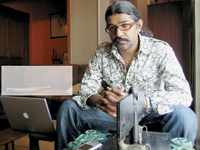 in Lahore's Gulberg, to reach R.M. Naeem's studio. On the third floor, the
darkness gave way to a bright spacious hall-like room with twenty or so
students, more girls than boys, busy sketching two male models seated in two
different corners of the room.
in Lahore's Gulberg, to reach R.M. Naeem's studio. On the third floor, the
darkness gave way to a bright spacious hall-like room with twenty or so
students, more girls than boys, busy sketching two male models seated in two
different corners of the room.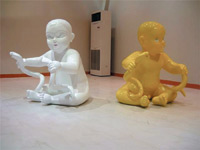 famous and fortunate as his son, but pretty accomplished and successful. He
specialised in making doves, and towards the end of his life, due to his
fading eyesight, he asked Pablo to do the detail of dove's feet for him.
Young Picasso, with his astounding skill, used to paint this part on his
father's canvases. Years later, when Pablo Picasso evolved his own style, he
drew doves in a simplified manner, often omitting the feet. Asked about this,
Picasso replied that he had already made so many dove's feet that he didn't
feel like making any more.
famous and fortunate as his son, but pretty accomplished and successful. He
specialised in making doves, and towards the end of his life, due to his
fading eyesight, he asked Pablo to do the detail of dove's feet for him.
Young Picasso, with his astounding skill, used to paint this part on his
father's canvases. Years later, when Pablo Picasso evolved his own style, he
drew doves in a simplified manner, often omitting the feet. Asked about this,
Picasso replied that he had already made so many dove's feet that he didn't
feel like making any more.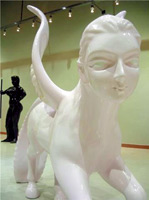 Period. Historically, the classical Greek artists used to fill the eyes with
precious or coloured stones to include an aspect of reality. Later,
especially in the age of Renaissance, sculptors, working with white marble,
carved out the pupils in order to suggest the dark patch in the middle of the
cornea. Emphasis on the eye was important because in a majority of cultures
it is the human eye that represents and identifies an individual (maybe due
to this, whenever one has to hide the identity of a person/criminal/suspect
on the media, the eyes are covered with a small black band).
Period. Historically, the classical Greek artists used to fill the eyes with
precious or coloured stones to include an aspect of reality. Later,
especially in the age of Renaissance, sculptors, working with white marble,
carved out the pupils in order to suggest the dark patch in the middle of the
cornea. Emphasis on the eye was important because in a majority of cultures
it is the human eye that represents and identifies an individual (maybe due
to this, whenever one has to hide the identity of a person/criminal/suspect
on the media, the eyes are covered with a small black band).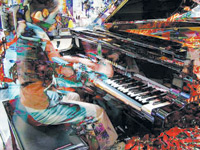 demonstrated her skill on the piano by holding a number of concerts and
participating in workshops. This time around she played the piano at the
Annemarie Schimmel Haus last week, mostly pieces of the great masters of
classical music of Europe. It was clear that she has been through the
customary music education , best represented by the German tradition of
catching them young and then grilling them through an almost two decade
regimen of strict discipline and rigorous training. Born in Germany she went
to Cologne Music Conservatory and later to the National Academy of Santa
Ceclia at Rome. And later worked with David Garret and Erik Sch Elschenroich.
demonstrated her skill on the piano by holding a number of concerts and
participating in workshops. This time around she played the piano at the
Annemarie Schimmel Haus last week, mostly pieces of the great masters of
classical music of Europe. It was clear that she has been through the
customary music education , best represented by the German tradition of
catching them young and then grilling them through an almost two decade
regimen of strict discipline and rigorous training. Born in Germany she went
to Cologne Music Conservatory and later to the National Academy of Santa
Ceclia at Rome. And later worked with David Garret and Erik Sch Elschenroich.