


|
|
|
|
 |
 |
   |
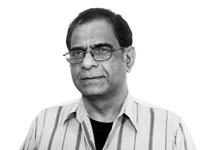
Progressive
romantic Zia Mohyeddin
column
Ahmed Faraz became a very
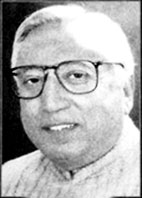
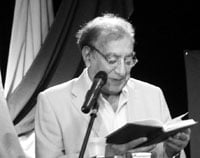
popular poet in the very early days and was able to retain that When his first book of poems was published it was clear that a significant voice had appeared on the stage of poesy. Initially it was the impassioned lyrics based on the impetuosity of passion that attracted people's attention, especially young people's attention but gradually, as the truth of his emergence sunk in, it became clear that the impassioned intensity had a deeper strain that defined an entire approach to his relationship with the times. He treaded the path paved by poets and elders before him. He maintained the duality that had cropped up in our sensibility of pitching 'ghame janaan' against 'ghame a doraan,' calling it a dangerous and damaging divide, retarding the full flowering of human potential, and sought the urgency of demolishing it. It is a little difficult to
say how this duality became the most important conflict in the history of our But then the rumblings of a new divide began to be heard in the beginning of the nineteenth century and by the time Ghalib matured into a poet he too dwelled on this duality. The duality was recognizable then though he did not try to strike a balance between the two or place one above the other: "ghame ishq agar no hota ghame roozgaar hota" With the dawn of the Progressive Movement, this duality became the central conflict that needed to be resolved. The two were pitched against each other and a resolution was demanded not from some metaphysical agency but from society. The social order that was extant had the capacity to refashion and mould itself according to hearts desire. Though Faraz carried the
seeds of this duality in his poetry but it was actually the seeds of 'ghame It may have been a coincidence that during the same time period Peshawar saw the emergence of many poets, the three most important and prominent being Khatir Ghaznavi, Hamadani and Ahmed Faraz. Peshawar is not a place one associates with Urdu poetry, though the tradition of Persian poetry must have been very strong in the city. One always thought that it would be Persian, Pushto or Hindko that the poets would be expressing themselves in and not Urdu but poets like Faraz made Peshawar yet another centre of Urdu, thus registering a seismic change. There was a time when even Altaf Hussain Hali, who was born only ten miles to the West of river Jamuna, was not considered bona fide enough to be a poet of Urdu and with Iqbal and the creation of Pakistan the frontier was stretched to cover the Punjab. It goes to the credit of Faraz and his contemporaries that the frontier shifted further to the west and even incorporated areas west of the Indus. One basic reason of his
acceptance and popularity was that his poems found a ready home in the Faraz, like so many of our
poets, also found the parameters of national existence set on very narrow
lines and often raised his voice to do away with institutions and attitudes
that stifle the full flowering of human potential. He had to pay a price for
that and was often on the wrong side of the powers that be. He also went into
exile, roamed the streets of distant lands and found himself alone among
adoring fans in foreign climes but returned to Pakistan where his fans
expected him to keep raising the banner of various freedoms even higher. His
poetry is good enough to survive him and will be the anthem of all those in
future who want the intensity of passion to permeate all spheres of life. All
our actions and deeds steeped in the anguish and impetuosity of love to be
raised a bar higher than the Mazhar ul Islam "Well, I don't know what to say. In our culture, people have obituaries ready when they know someone is critically ill. You must have seen the result of this kind of over-efficient literary performance in the media when the rumours of Faraz's death were circulating in July. On Faraz, I only have to
say that he was a multi-dimensional poet who could manage a government job,
revolutionary politics and poetry all at the same time. I don't have that
kind of self-contradictory skills. Moreover, I think he chose a popular path.
Otherwise, he was a human being with the usual flaws that come with being
human." Arif Waqar "He was a master of the technical aspects of his craft and also a socially responsible and committed poet. He believed that a writer cannot function only in a cocoon of aesthetic considerations without commenting on the social realities around him. He tried to emulate the model of Zulfikar Ali Bhutto and introduced romantic passion into revolutionary politics. Near the end of his life, he was disillusioned with the state of affairs in the country and still tried to change it. That is the essence of his work and life." Shehzad Ahmed "It is no small achievement to dominate the world of Urdu poetry for more than fifty years in South Asia. His first book came out around 1957 and with the second book he had established himself as a major voice. It also goes to his credit that he spoke his mind and wrote poetry of resistance and romance. He spoke truth to power and remained a free individual while working for different governmental institutions. He had to face court trials for his writings and, also, go through the experience of exile but he maintained his integrity till the last day. I salute his talent and couage." Zia Mohyeddin column Who wants to be a writer? "Get your thoughts down on paper" was the first bit of advice I got from our schoolmaster who wanted the entire class to write a 'composition' on 'My Favourite Pastime.' Some of the students, who confessed later that they did not have a hobby, had to invent one; some had a subconscious phobia about revealing what their most cherished pastime was; a few simply copied what the brighter students had written. We all filled our 'copy-books' with our mental effluvia. We were judged for grammatical mistakes, spelling mistakes and punctuation. Marks were also deducted for poor handwriting and not leaving enough space in the margins. There was not a single mark given to anyone for 'thoughts' or 'ideas.' If you don't have an intelligent idea in your head writing a stupid one down in a notebook is not going to help. One hears all the time of writers honoured for the crystalline elegance of their prose who kept notebooks and diaries. They got up, we are told, in the middle of the night and wrote for an hour or two in their diaries. These random, midnight jottings then became great and worthy literature. I used to scribble some of my musings on the backs of discarded envelopes: (I must have had some kind of a complex about soiling a nice, clean page). Here is something I wrote on the back of a handbill about a Thai restaurant: 'We must not make the mistake of thinking that poetry is only found in the works of poets. You can find it everywhere where words are used.' Another jotting on the back of an airline boarding card: 'He greets the rest of us by raising one hand, one finger aloft, like an umpire giving a man out. (I don't mind telling you that I was sometimes complimented for my apercus). For a long time I harboured the illusion that anything I scribbled down would be a prerequisite of literary productivity. It was only when I sat down to benefit from these scribbling that I came a cropper. The belief that if you write it, must mean something is responsible for half the world's bad writing. Writing is all about expressing an idea, not smart observations about the idea. Once you have an idea – and have learnt to express it with words, naturally, but with brevity – you join the ranks of creative writers. Let me illustrate: 'The mother, a plump, flashy woman, whose height nearly matched the father's, looked as though fighting back cries, tears, a tempest of anger, barters with God.' We get a complete picture of a woman, frustrated, embittered and conscious of a wasted life. No more words are needed. In America the business of teaching students who wish to become writers is in the hands of writing teachers, especially those who are credentialed in the field called Rhetoric and Composition, commonly referred to as Rhet Comp. Rhet Comp specialists have their own nomenclature: they talk about things like "Sentence Boundaries" and they design instructional units around concepts like "Division and Classification" and "Definition and Process." The arch guru, Dr. David R Williams, who has been teaching people to write in some of the top universities of America, is a writing clinician. Dr. William thinks it is a must for would-be writers to be exposed to sample exegesis of, among others, "Moby Dick," "One Flew over the Cuckoo's Nest," and "The Awakening." He is firmly of the view that students should write like Camille Paglia. I have never read the lady so I am not able to comment. People discover what they have to say in the process of writing it. Once on paper, words assume a horrifying concreteness. The fluidity of thought is gone, replaced by rows of squalid squiggles. These squiggles, horrifying or not, have become your idea. They won't go away and they won't change by themselves. I have frequently stared at these squiggles until it dawns upon me that my idea is utterly vapid. There are people who do not put anything down on paper till an entire sentence has formulated itself in their heads. Bertrand Russell was one such writer. The critic, Robert Warshow waited until he was completely satisfied with the sentence he had in his mind before he wrote it down. He then proceeded to write the next sentence without ever looking back. Warshow is not considered to be a model of good prose, but Bertrand Russell is. Does it prove anything? Dr. Williams is a big proponent of writers' "voice". Would-be writers who follow this rapidly are apt to have trouble with grammar and punctuation because they assume that the goal of writing is the reproduction of speech effects. American writers of pulp fiction often write just as people speak, but even they have to use a bit of narrative to elucidate certain hand gestures, twitches and grunts. Speech, as we all know, is characterized by all things that good writing ought not to have. Our speech is marked with repetition, contradiction, exaggeration, too many 'I mean to says' and 'you knows' fragments and clichés, not to mention drawls and gestures irreproducible in written form. People talk for hours without uttering a single relevant sentence. And yet we understand them perfectly partly because we understand their body language, their winks and grunts and partly because they repeat their sentences at least three times. The great advantage of speech, of course, is that you cannot make a comma or semi-colon mistake when you are talking. Still, the illusion persists that the spoken word can somehow be carried over into print with all its personality and expressiveness intact. Friends of the critic Desmond McCarthy a leading light of the Bloomsbury circle, thought that he was a fantastic conversationalist, and that his genius was never reflected adequately in his writing. One day, some of them invited McCarthy over, and hired a stenographer to hide outside the room and record his conversation. McCarthy showed up and obliged by talking brilliantly. After he left, the friends waited impatiently for the transcription to arrive. They read it. The writing was completely banal. I am now going to make a confession. After all these years of writing inconsequential columns I am beginning to realize that I shall never be a writer. I say this because I haven't got the patience to go through the sample exegesis of Moby Dick. And another thing: the arch guru Dr. Williams insists that writers must write many drafts at least four. Well, I get bored with what I have written after I have revised it once.
|
 popularity till the very end.
 poetry. In the classical Persian period when poetry was written there was
lack of fulfilment and a yearning that needed no gratification, for it was
usually played against the backdrop of an objective reality that was not
really amenable to human desires and fulfilment. It somehow had eternal
contours; the change in the temporal world did not qualitatively change the
human condition.
poetry. In the classical Persian period when poetry was written there was
lack of fulfilment and a yearning that needed no gratification, for it was
usually played against the backdrop of an objective reality that was not
really amenable to human desires and fulfilment. It somehow had eternal
contours; the change in the temporal world did not qualitatively change the
human condition.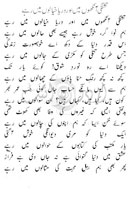 janaan'' that always sprouted with vigour in his creative output. Very few
poets in the Urdu tradition have properly gauged the depth of love and the
anguish of a flesh-and-blood relationship. For most, it was an imaginary
world which just crumbled against the mirror of reality but, for Faraz, it
retained the intensity of the anguish, plummeting deeper in what can best be
described in the words of another great poet Shah Hussain "sajna di
majmani khatir dil da lahoo chani da".
janaan'' that always sprouted with vigour in his creative output. Very few
poets in the Urdu tradition have properly gauged the depth of love and the
anguish of a flesh-and-blood relationship. For most, it was an imaginary
world which just crumbled against the mirror of reality but, for Faraz, it
retained the intensity of the anguish, plummeting deeper in what can best be
described in the words of another great poet Shah Hussain "sajna di
majmani khatir dil da lahoo chani da".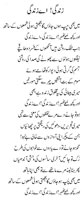 sensibility of the people. The language that he used, the metaphors that he
created were not very farfetched, not innovative beyond recognition but
within the realm of the ordinary middle class Urdu readers. They could easily
identify with the environment and the world that his poetry created, and
there was absolutely no hurdles, either intentional or by the necessity of
the newness of experience. The hurdles were expressed in a language that was
not difficult to receive. Most of the lines of Faraz hit the bull's eye. He
qualified with flying colours which, for some, is the most essential
condition of poetry that it should be instantly received and appreciated by
the listener and the reader. Though he was not exclusively a mushaira poet
but this quality of his poetry was not far from the tradition of the mushaira
and an instant oral impact was its hallmark. When his poetry in printed form
was read it carried the feel of the instant oral assimilation of the mushaira
tradition.
sensibility of the people. The language that he used, the metaphors that he
created were not very farfetched, not innovative beyond recognition but
within the realm of the ordinary middle class Urdu readers. They could easily
identify with the environment and the world that his poetry created, and
there was absolutely no hurdles, either intentional or by the necessity of
the newness of experience. The hurdles were expressed in a language that was
not difficult to receive. Most of the lines of Faraz hit the bull's eye. He
qualified with flying colours which, for some, is the most essential
condition of poetry that it should be instantly received and appreciated by
the listener and the reader. Though he was not exclusively a mushaira poet
but this quality of his poetry was not far from the tradition of the mushaira
and an instant oral impact was its hallmark. When his poetry in printed form
was read it carried the feel of the instant oral assimilation of the mushaira
tradition.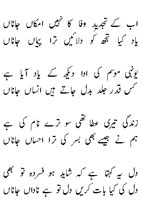 grind of ordinary existence.