


|
|
|
|
 |
 |
  
|
politics interview In
quest of spiritual fulfillment Seize
the size
Party time for Bilawal If Bilawal Bhutto wants to be a leader of Pakistan, he will have to be a person of tomorrow not a person of yesterday By Adnan Rehmat In his estimate -- and for all practical purposes --
former military ruler Pervez Musharraf had, at least in the medium to long
term, ended the politics of dynasty in Pakistan. For the better part of the
first decade of the new millennium, there was not a single member of the
Bhutto family in parliament either at the federal or the provincial level; or
from the other dynasty -- the Sharifs. In both the general elections held in
the 2000s -- in 2002 and 2008 -- the laws were manipulated and the playing
field crooked up to ensure that there will be neither a Bhutto nor a Sharif
to queer up the very-long-term plans Musharraf had of continuing to rule the
roost for another decade. Even the best plans can be laid waste, as Musharraf found out to his chagrin. Events leading up to the 2008 elections and after have ended up restoring not just the two main political dynasties but also some other key realities that had been engineered for elimination but to no avail: the mainly two-party system, the triumph of the common voter (over the ghosts stamping ballot papers in the dark), and a radically transformed judiciary (from a compliant handmaiden to the strongest of the three pillars of state, at least for now). Restoring image Benazir Bhutto, who valiantly led her party to a fifth election triumph at the national level in 35 years, however perished on the campaign trail in the streets but not before restoring the most powerful political currency in the country: Bhutto. With "Jeay Bhutto" slogans restored to the National Assembly, President House and Prime Minister House after 15 years and "Mian Hamara Leader" jingle making a comeback in the Punjab Assembly and the Chief Minister Secretariat in Lahore, it was but a matter of time before political tribalism took over and the two dynasties slowly but surely slipped out of the veneer of nicety and political politeness. We have seen how, first through a shrewd deal with Musharraf and then with the ultimate sacrifice, Benazir succeeded in restoring the Bhutto factor and re-installing her dynasty into the corridors of power and how the plucky and pugnacious Sharifs did the same, at least in their powerful home base in Punjab. However, such was the long shadow that Benazir cast that after her physical elimination, her party has piled on blunder after blunder, squandering the political capital that accrued with her Pakistan People's Party winning the most votes at the hustings. The threat to the Bhutto dynasty is clear: domination by the Sharifs.
nothing doing While even Benazir's own two stints in power are known as mired in mismanagement and even corruption, the current PPP government -- led by her widower and accidental beneficiary Asif Zardari -- really takes the cake at being paralysed, out of tune with realities and failing to take the lead on making right a lot of the wrongs Musharraf's messy rule left behind. The result has been poll after poll showing the obvious: the self-imposed incapacity of PPP to offer good governance, putting one wrong man of the party after another in key positions that instead need leaders, implementers and energetic doers. In the meanwhile, the Sharifs with some deft politics of principles and priorities that resonate with Pakistan's teeming millions have stolen the thunder of dynastic politics and seem way ahead in the opinion polls for being more charismatic than the Bhutto dynasty, or whatever remains of it with the inimitable Benazir leaving a gaping hole in Pakistan's body politic with her sad assassination. Things are so bad that these days the harshest critics of Bhutto's party are not in the opposition -- instead they are either within the party or those who voted for it and now disillusioned with it want nothing to do with it now. Enter Bilawal, one of several from Zulfikar Ali Bhutto's lineage but the only one who comes even close today to the once formidable mantle that his grandfather built. For someone wishing to fashion a career in Pakistan's treacherous political realm, being the grandson of Zulfikar and the son of Benazir are credentials that even a billion dollars can't buy. And with the People's Party's political fortunes dwindling and the current PPP men and women in power in key positions failing to set imaginations on fire, the danger of the Bhutto charisma -- the lifeblood of the PPP -- is fading rapidly (in no small measure because of the dour set of the party's leaders), it is time to, once again, substitute substance with style. A select few at the party helm (that's how things are done now at the 'people's' party) have decided to revive the Bhutto charisma by formally launching Bilawal into politics. The roadmap to leadership According to well-placed sources in the party, an initial 10-month roadmap, starting in July and culminating in April with the commemoration of the anniversary of Zulfikar Ali Bhutto's hanging, has been drafted that will see Bilawal increasing his public and political profile. He is currently studying a three-year law degree at Oxford that will see him completing it by the end of 2010. While the launch of his full-time career is planned at the start of 2011, he will be undertaking high profile assignments regularly, starting with and limited to in-house/party engagements in the first phase -- the 10-month roadmap. His current summer vacations were used as a launching pad in this direction when he addressed the first of such meetings of party workers (as opposed to party legislators). He will be spending the next few months addressing more such meetings in Islamabad, Karachi and Larkana. He will also be meeting party legislators, assembly wise, after a couple of months. Other assignments include attending National Assembly and Sindh Assembly sessions at least once per session for which he will be making more trips, even if they have to be short, to Pakistan from UK over the next several months. Bilawal, say the sources, is key to arresting the despondency within the party that is worrying even Zardari. The disillusionment in-house comes with the old guard relegated to the sidelines and technocrats and Zardari loyalists, many of whom could not even come close to Benazir's lieutenants leave alone herself, to the forefront -- into the federal and Sindh cabinets in particular. The sources say that the plan, reportedly approved by no less than Zardari himself, aims to be two-fold: energize the party by restoring the Bhutto charisma through a higher party profile for Bilawal and retaining his grip on the party, which is in danger in the weeks and months ahead as moves to abolish the 17th Amendment gain momentum and the parliamentary system is restored by taking away powers from the president and giving them to the prime minister. Priming for parliamentary politics Under the reported medium-term plan (after the first 10-month phase is over) for Bilawal, the son of Benazir Bhutto and Asif Zardari will be, after his 'leadership' is oiled through meetings with party legislators, primed for a stint in the National Assembly by running for a by-election on his own mother's seat in Larkana. This plan, depending on how it goes, is expected to culminate in leading the party into the next general elections, which might be much earlier than as currently scheduled around the end of 2012 or start of 2013. The helpful father arranged a clinically safe crowd of about 250 carefully selected party workers in the safety and comfort of the President House late last month to formally launch Bilawal's practical career. Watched on by a smiling Zardari and Prime Minister Yousaf Raza Gilani, Bilawal tested his diction on a loyal crowd. He spoke in anglicised Urdu, albeit reading from a script, employing the unmistakable fidgety demeanour and restlessness of Zulfikar Ali Bhutto (now waving his hands, now his hand on the hip) and the rhetoric of Benazir Bhutto (nauseating references to martyrdom, laying down lives for people's dignity et al). Clearly someone close to Benazir is tutoring him. It was nothing to write home about though, according to one of the participants, but served the purpose of rushing Bilawal's studious boyhood into political manhood. His misplaced emphases were in keeping with a novice -- at times he was shouting, a requirement more in keeping with addressing a crowd in a stadium rather than a booming hall of the presidency that can't even keep whispers in. The party workers have also been accorded the "privilege" of staying in touch with him (while he is away studying abroad) through email: chairman@ppp.org.pk! Tomorrow, not yesterday, please Nevertheless, the work is cut out for both Bilawal and his party: for the former it is to earn his stripes (like his mother did by getting her hands dirty after Bhutto's hanging) by learning the language, hopes and despair of his own party's workers and legislators, and for the latter to appeal to the voters if the party wants to come again to power. With the party's best such as universally admired Aitzaz Ahsan and Raza Rabbani sidelined and that anti-dote to charisma -- Zardari -- at the helm, the party's not going to win another election. Bringing magic back to politics before a thoroughly dis-amused electorate made wiser by the harshness of political realities is a tall order. Rhetoric will not work. Nor will relying on the legacy of the well-loved but securely in the past Bhutto and Benazir. This is a different milieu he is growing up in and first he has to prove himself a Bilawal, an ordinary Pakistani, before he can prove himself a Bhutto. He looks far from ordinary. Being a Bhutto will not automatically make him the next big thing in Pakistan -- look at what happened to Benazir's own siblings. If he wants to be a leader of Pakistan, he will have to be a person of tomorrow, not a person of yesterday, as he's begun. He'll have to live, study and work in Pakistan. Which is probably unlikely for a long while to come. In the meanwhile other political realities will unfold. As they always do.
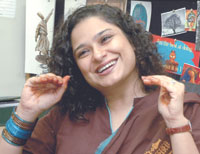
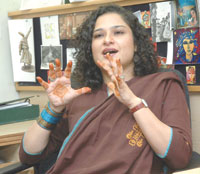
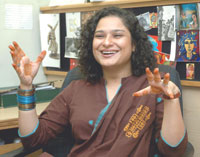
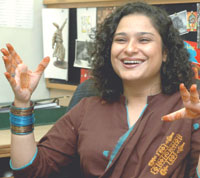
"I hate people who glorify war" TV is her first love. Theatre and radio no less. Sania Saeed chit chats about everything that left an impression on her mind as a young child, and made her what she is today By Shahid Husain Great French existentialist thinker and author of 'The
Second Sex', Simone de Beauvoir, once remarked that "one is not born a
woman, one becomes one". It holds true for a large number of women who
have excelled in art, literature and culture and left a deep imprint on
society through their commitment and hard work -- despite odds. Sania Saeed
is one such TV and theatre artiste. Sania was born in Karachi in an enlightened middle-class family on August 28, 1972. Her mother Abida Saeed is a prominent educationist while her father Mansoor Saeed made a niche as a political worker and a translator. Her grandfather late Anis Hashmi was a known revolutionary. Sania studied at Montessori Children's House, St. Joseph's Convent School, PECHS Girls College and the University of Karachi from where she earned her B.A (Honours) in Psychology in 1998. But her real schooling was done at home -- "I lived
in Gulberg, a middle-class locality of Karachi and I had to change two buses
to get to school. Today when someone asks me why I walk so fast I tell them I
had to be dragged all the way from Empress Market to St. Joseph's School by
my mamoon (uncle) when I was four. That was the daily drill," she
reminisces. Sania and her family shifted from Karachi's Gulberg to Tariq Road
in the 1980s. Sania's home was a favourite hideout of political workers, intellectuals and writers. No wonder that she started taking part in plays at a young age. In the 1980s, when General Ziaul Haq suppressed the press, political parties, student and trade union organisations, Aslam Azhar, the doyen of PTV, her father Mansoor Saeed and some other like-minded friends established the theatre group Dastak, and staged famous plays such as, Galileo at Rio Auditorium in Karachi. The response was unbelievable. "It was one of the biggest advantages in my life and also a paradox because I was studying at the St. Joseph's Convent with upper middle class and doing theatre with working class children," she said. She developed a sense of belonging to her school and its old heritage building. For her, its culture had no artificiality since both rich and poor studied there: "I had Hindu, Christian and Muslim friends -- and I had exposure to the working class. So, fortunately, I never developed a prejudice against any religion or sect," she said with a sense of pride. During her school days, Sania joined an organisation
called Sathi Barla Sangat, a children's organisation in Sindh. "We were
a group of children. We volunteered time, established a small library, and
taught fellow-students," she recalls. "This way, I got my first
encyclopaedia at age 11. In those days it was impossible for a middle class
child to possess such a collection. "My training and learning was very different in many ways. I learnt a lot from my work and by being with my parents rather than from books. I learnt even to see religion, politics, and culture objectively and in historical perspective," she states. Sania was still at school when Pushtoon and Urdu-speaking population clashed in the Orangi town in Karachi. That, she remembers, was her first brush with violence… "It's difficult to explain to many people who have not gone through such trauma. I hate people who glorify war," she remarked. She passed her matriculation in 1988: "Abbu used to take me to examination centres for my matric exams in 1988, where constant firing would be going on. He would hide me between the seats of the car." When she lived in Karachi's Gulberg, she didn't have TV at home -- but "I would listen to Sung Sung Chalein and Kalian on FM radio because you could tune TV on FM frequency then. It was during those days that she also participated in
street theatre. Her first appearance was in Aadhi Duniya, a TV play in 1992.
Among her more recent performances are 'Mein Adakara Banoongi' for Katha
group that drew good audience. Perhaps, Sania's most popular performance was
in the PTV play 'Sitara aur Mehrunnisa'. PTV honoured her with the Best
Actress award in 1998 for the serial. "In theatre you can be area specific. You are addressing specific people. People choose to come and watch a play or a film. And that is important. On the contrary, TV is involuntary. It's freely accessible. It is consumer driven and has largely become urban. It has to address a wider range of audience and tries to find a middle ground. It is always easy to reinforce the rhetoric; it's safe and always works. So that's what most people decide to do -- Acchi aurat ko khoob rulao, hur achai, burai ka baar us pe daal do… and it's a sure shot hit," she said. Sania was the first announcer for NTM in 1991, the first announcer for FM Gold, and the first female actress to play a role in family planning play, Aahat. "I was invited by Population Communications International (PCI), a sub-organisation of the United Nations to attend an interactive activity with the press and celebrity community for my work in the play. It was called 'soaps salute soaps'. I appeared on the Emmy awards as a guest along with actors from India, Argentina, and I think Bangladesh. That is also a first and apparently the last for Pakistan so far. Sadly, only one newspaper in Pakistan picked up the story, whereas the Indian press really celebrated its artistes in their media," she regrets. Sania's first love is TV. It has an important place in her life, where she was guided by the likes of Sohail Rana, Farooq Qaiser, Aslam Azhar, Safdar Hashmi, Shahid Shafaat and Behroz Sabzwari. Radio is dear to her as well. As a school girl, she recalls, she attended functions at Karachi's Theosophical Hall, which was opposite the Radio Pakistan, and "I would dream of going to the Radio station because the building was so enchanting. After Sitara and Mehrunnisa, I just walked into Radio Pakistan and volunteered for radio audition," she added. "I was sent to Iqbal Jafri who asked me why I wanted to have a radio audition. My reply was simple: I want radio training. I was handed over a script and asked to report the other day." Sania plays other roles in life too: she dances (she was trained by Ghanshyams for a year or two) and loves animals. "I got my first pet when I was at the university. Julie passed away some six years ago, Buzz four year ago. Presently, I have seven cats."
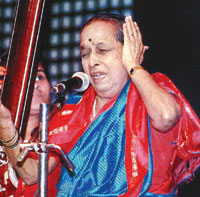
In quest of spiritual fulfillment Gangubai Hangal neither played to the gallery nor was she too enamoured of the gimmicks that musicians take fancy to By Sarwat Ali Gangubai Hangal who died recently was the last of the
divas that set a high standard of vocalisation in the kheyal and thumri
genres of classical music. The others that could have been placed alongside
her -- Hirabai Barodkar, Roshan Ara, Rasoolanbai and Kesarbai -- have all
gone long ago, while she lived a long and illustrious life, earning all the
major awards that the Indian Government and other institutions have earmarked
for classical music. Born in the second decade of the 20th century at Dharwad, the northern part of Karnataka in a family of musicians, Gangubai Hangal's mother Ambabai and grandmother Kamalabai were both Carnatic vocalists. She rebelled by opting for North Indian classical music rather than Carnatic as both her mother and grandparents were well-versed in the Carnatic tradition. It is said that Ustad Abdul Karim Khan dropped in to listen to her mother Ambabai's musical rendition. There was little opposition when she opted for a different style of singing. After several gurus she finally found her mentor in Sawai Gandharva who tutored her assiduously to become a leading figure among the great vocalists of the first half of the 20th century. In 1928, initially she started training under Dattopant Desai and Krishnacharya in Hubli. And, only later approached Pandit Rambhau Kundagolkar, known as 'Sawai Gandharva', who also had Bhimsen Joshi and Firoze Dastur as his disciples. Her training under Sawai Gandharva went on for 15 years until she mastered the Kirana Gharana style of music Her brothers and sisters in arms, Bhim Shen Joshi and Hirabai Barodkar, both associated with the Kirana Gharana and both following the tradition of the Gharana through the shagirds of the Gharana have been experimenting and adding various hues to the primary colours of the founding fathers. Sawai Gandharv had been associated with the Marathin Theatre of Govindrao Tembe, Shivraj Tatak Mandali and that may have been an explanation for his greater diversity of expression. It was difficult for her to establish herself as a vocalist in an age that was dominated by the likes of Ustads -- Bare Ghulam Ali Khan, Ameer Khan, Ashiq Ali Khan, Faiyyaz Khan and certain female vocalists, the leading among them being Kesarbai Kerkar. Gangubai had already gained prominence when she had performed as a child before the top Congress leadership including Gandhi. She was good enough to be broadcasting in those early years of the radio for All India Radio in 1936 and when HMV decided to record her they changed her name many times to make it marketable. She was Gandhari Hangal, Gangubai Hublikar or simply Gandhari till she became so well-known that the company realised she did not need a ploy. She neither played to the gallery nor was she too enamoured of the gimmicks that musicians take fancy to. In an age that was showing signs of disconnect between classical music and popular taste, most musicians including the masters resorted to some gimmickry, demonstrating to the audience the great command of the craft. The semi-literate audiences applauded these and set the way for more gimmickry. But she held steadfast to the very basics of music -- the purity of the sur and the correct exposition of the raags. Till the end as a performing artiste she did not deviate from it and in the process won appreciation from the connoisseurs of the classical music. She was also in her person very close to the artistes who pursued the form in quest for spiritual fulfillment. Almost a jogan, she was initially averse to preparing herself for a concert or a performance. She was simple and dignified, and carried with her the austerity of her person. This was reflected in her music as well. She won admiration from those familiar with the link of music with enlightenment and meditation. Certain lucky maestros in music have had many known shagirds and one such dominating influence was of Ustad Abdul Karim Khan. He travelled, imbibed from various sources and sang in tune, perhaps deviating at times from the strictly laid rules. This departure, though rare, was always necessitated by musicality. He was perhaps aware of the changing taste in music and the slipping away of the patronage from the feudal aristocratic elite to the fast rising middle classes in places like Maharashtra. From among his many shagirds multiple strands flowed. At times, the diversity of creative sources developed in many different directions. His stay in Maharashtra especially in an area that was the confluence of Karnataka and Andhara helped him in weaving the various musical strands. The popularity of the Parsi Theatre with its special kind of music much-liked by the man in the street too was another dimension to be considered. Abdul Waheed Khan, the other doyen of the Kirana Gharana was purist to the very end and did not entertain the creative flights of Abdul Karim Khan readily. Gangubai's voice underwent a change during the course of her career. It became resonant and heavy after an operation and this changed her style of singing as well. She was then favourably disposed to exploring the middle and lower octaves, which gave a greater depth to her vocalisation. She was conferred with numerous national awards for her contributions to music. Some of the notable awards she received were the State Sangeet Natak Academy (1962), Padmabhushan (1971), Padma Vibhushan (2002), Central Sangeet Natak Academy (1973), Dinanath Pratishthan (1997) and Manik Ratan (1998). She had five honorary doctorates to her credit. She also helped with state funding in establishing the Gangubai Hangal Gurukul Trust Music Academy in Hubli. She was given a state funeral that was attended by the chief Minister of Karnataka. She tutored her daughter Krishna who had a few recordings accompanying her but she died a few years ago leaving Gangubai bereft. She then concentrated on her granddaughters and grandnieces, who hopefully will carry the tradition forward.
At the ongoing group show at Karachi's VM art gallery, scale is a rather personal concern
By Quddus Mirza Back in the VCR-days a young artist visited Britain.
There, he went to watch a James Bond movie in one of the London cinemas.
Before the film began, a promo for another film, The Last Emperor, was played
on the screen. Now, to impress his companions, the artist excitedly told them
that he had already seen the film on video. Soon, an animation appeared in
which a small man fixed a ladder against the screen; held a bucket of paint
and started to cover the picture with white colour, till a tiny rectangle
remained on the screen -- with a message: "This is how you see a film on
video!" The incident played a crucial role in making the young artist understand the importance of scale in both conceiving and criticising an art piece. He learnt: an image must be in harmony with the scale selected for it -- or vice versa. Artists and art students are often not concerned about this aspect of art. Other factors such as storage facilities, costs of transportation, gallery demands or latest trends are considered but not the link between pictorial matter and its suitable scale. The idea of size has ceased to be relevant for most art practitioners and viewers unless the emphasis is on the value of scale or its creative and courageous manipulation. This was particularly obvious in Ayaz Jokhio's work exhibited at Lahore's Rohtas 2 between October 23 and 31, last year, where the scale was as small as the postage stamp. In complete contrast is the ongoing show at Karachi's VM art gallery (from August 11 to 29, 2009). Titled 'Size Does Matter', it includes works by four artists, each showing one large scale work, executed in a variety of mediums and surfaces, it reflects the artists' desire to be 'big' in their creative pursuits. So, the wide space of VM is well-covered with huge surfaces. Here, size is a personal concern. And two approaches are rather obvious: a typical one represented by Naseer Ahmed Bhurgri and Munawar Ali Syed, and the other by Asad Hussain and Adeel uz Zafar. In the works of Naseer (graphite on board) and Munawar (pastel and chalk on a convex section of cube) imagery is not essentially developed for their particular dimension. Naseer has drawn a web of parallel lines which occupy upper half of his composition with a flower and a silhouette of a man's face in a strange light. All three elements -- unrelated to each other -- except in the scheme of mark-making signify the sensitive application of medium. So the scale overpowers but it does not overwhelm a spectator. However, one assumes that the choice of imagery and the method of fabricating it on a large surface may have a personal value (a catharsis) for the artist for it hardly succeeds in being anything beyond. Similarly, Munawar's piece, which invokes a range of
references, religious and spiritual, psychological and physical, operates on
a limited level. Outlines of objects of material need, such as cell phone,
car, electronic gadgets etc, are superimposed in a complex narrative on a
dark surface. The spread of products portrays our desires and possessions and
the usage of chalk on a black board-like panel points to our conditioning.
But the introduction of a specific sacred symbol betrays a general habit of
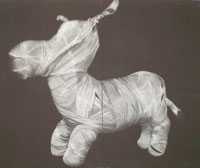
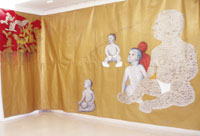
our artists -- of posing a question and then providing the answer. Surprisingly, the work of other two artists seem more interesting and resolved. Adeel has enlarged a tiny toy, donkey wrapped in bandage, on a huge dark vinyl surface. By carefully scratching white lines on the black coated layer, contours of toy are drawn in a realistic manner. Absurdly, its monumental scale and placement on a floating tone of grey alludes to our socio-political situation, where a useless motif or position is often blown to such great heights that it becomes a familiar object. Asad has expressed ideas within ideas through a diversity of surfaces and dimensions. Employing his experience of a set designer at a local TV channel, he has created a curtain-like form on one side of the gallery. Golden paper, installed as a screen with images that are composed of many children, birds made of drone planes and drawings of children hint to our altered reality and the role of media. It's a message convincingly conveyed by blending materials and imagery. Despite the diversity in approaches and pictorial preferences, the work of four artists affirm that large scale not only enlarges the imagery of an artist, it also expands ideas. After all, 'Size Does Matter'! |
|

 Doing
nothing,
Doing
nothing,