


|
|
|
|
 |
 |
   |
Editorial Our
own handiwork One for the
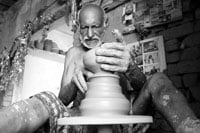
road Export goods By Usman Ghafoor Naveed Niazi claims to have given a new dimension to ceramics. "Whereas most people think ceramics is just about pottery, I gave it an architectural twist which is most contemporary," says the 29-year-old, National College of Arts graduate, currently involved in what he calls a "profitable business enterprise". 'Cheques'
and balances Added value
All year round, we are cribbing about one petty issue after another, about our petty differences. We often have complaints and, also, fights with people of other religions, other sects, race and value systems. Close on the heels of our Independence Day, we at Special Report thought why not look at something that we -- as a nation -- were proud of; something to do not with our nuclear assets -- for a change -- nor with the jingoistic concepts of 'One religion, one country' et al. We thought let it be something to do with our arts and heritage -- a treasure we have inherited through our previous generations in a history spanning well over 5000 years. We thought why not look at the marvellous variety of handicrafts our local craftsmen and artisans have been creating -- most of them having acquired the skill from their ancestors and perfected it with practice. There we have our NWFP women excelling in Justi (Phulkari) work while the men make brass utensils and silverware, the Baloch and Sindhi natives have their Rillies and Ajraks and marble/onyx carvings, the Kashmiris specialise in shawls; Punjab boasts of blue pottery, items made from ivory and buffalo horn carvings, Khaddi, hand-knotted carpets and so on. The list is endless. In the world of fashion, every handmade piece is called a masterpiece because it cannot be replicated. All our regional arts and crafts have a great cultural appeal, especially for foreign tourists. No wonder a lot of these handicrafts get famously smuggled and land at some of the world's most renowned museums. The Sikh yatrees are known to especially visit Taxila where they can pick items like shawls as gifts for their soon-to-wed daughters. The export potential of these commodities is also great; all that is required is the government patronage and support. In this respect, TDAP (Trade Development Authority of Pakistan) has proved to be an ineffective replacement of EPB (Export Promotion Bureau). No wonder, around the 'August' occasion of our country's 62nd birth anniversary, we thought let's forget our problems and differences and celebrate -- for now at least -- our diversity.
The government remains largely indifferent to the promotion and upgradation of handicrafts and the craftsmen and the artisan community By Aoun Sahi The history of handicrafts in our region is as old as age.
The first signs of handicrafts in this part of the world can be traced back to
the Indus Valley Civilisation of almost 5000 years ago. The Civilisation had
rich cultural traditions as well as a high degree of technical excellence in
pottery making, sculptures, jewellery and weaving -- to name a few. The
craftsmen not only catered to the local needs but they sent surplus items to
ancient Arabian cultures via sea routes. Today, if you look at the performance
of Pakistan in promoting and reviving handicrafts, it's quite poor. We have the potential and the local expertise in the field, as people of our area have been involved in handicraft-making from times immemorial, but what we lack in is an enthusiastic interest on the part of the government to develop this sector. Compared to us, neighbouring India scores wonderfully well. The central as well as provincial governments of India have started many initiatives for the upgradation and promotion of arts and crafts. For instance, they support their artisan community through various programmes, with the result that India is now considered a brand, internationally as well. The government of West Bengal provides their artisans with soft loans, organises programmes for training and revival of languishing crafts and for diversification, in every district year after year. It has also set up design and service centres for them (artisans). The artisans above 60 years of age are also paid pension. Pakistan, on the other hand, remains largely negligent of its craftsmen and artisan community, 62 long years (of independence) later. "We have been making pottery for ages, but never has a government agency or official contacted us," says Muhammad Akram, a 60 years old pot-maker from Ahmedpur Sharqia, Bahawalpur, while talking to TNS. According to Akram, there is no facility of loan available to people like him. The situation in other parts of the country is no better. TNS spoke to craftsmen and artisans based in Skardu and what they said was nothing different. "Many of the local traditional handicrafts have vanished because the government has never given any assistance to us," says Wazir Hamayat Hussain, an expert on Balti culture and music. "Before 1970, there were princely states in Skardu and the rulers of these states would sponsor artisans to promote and safeguard their craftsmanship. For example, the traditional woodwork has almost vanished from Skardu, but in princely states, the rulers had a lot of official carpenters who made mosques and 'khankas'. After the abolishment of Raja system, there was nobody to assist them. So this art is on the verge of extinction in Skardu and its adjoining areas." Wazir says other forms of handicrafts have also met with a similar fate in the area. There are NGOs that have been working on the dying handicrafts of Baltistan, but they do not have sufficient resources." Incidentally, handicrafts are the only source of livelihood
for the majority in the area. It is true that the government of Pakistan has made a few efforts in the recent past to help the craftsmen. On the provincial level, small industry boards are considered responsible for the promotion and upgradation of handicrafts, whereas the federal government in 2007 also initiated a project, namely AHAN (Aik Huner Aik Nagar), to support and train artisans in different parts of the country. This project is the first proper effort on the part of the government for which a grant of Rs 200 million has already been announced. "The purpose of the project is to train and educate artisans at their doorstep. As you know, handicrafts are a totally rural business, so we go to them. The main purpose of this intervention is technology upgradation, capacity building and marketing of finished products," says Naveed Sheikh, Regional Manager (Punjab), AHAN. "We began with four pilot projects in different areas of the country in 2007. By 2008 we had completed 46 projects. Presently, we are working on 36 projects all over Pakistan." According to Naveed, the provincial small industries departments had done fairly well in the field of the promotion of handicrafts until the mid-1990s. "Later, their focus shifted. "They have established outfits for artisans but they have not worked for the upgradation of our product. The main issue at present is quality and we have been trying to address this. We have engaged Pakistan's top designers to train the artisans but I admit that so far we have not been able to do so at the mass level." Naveed says that in Punjab alone, "we have worked with around 3000 artisans which is not a great number but given our limited resources, it is an achievement. We have done cluster mapping of artisans and craftsmen throughout Pakistan and identified potential 600 areas out of which 119 are situated in Punjab. But at present we are working only on 10 projects in the province. "It may be mentioned here that so far AHAN or, for that matter, any government department, has not devised an export policy regarding handicrafts, whereas last year our trade motto was, 'Foreign experts will be invited to Pakistan to train our artisans'. It shows the seriousness of the government about the promotion of handicrafts." Hassan Mahmood Yusufzai, Managing Director (NWFP), Small Industries Board, says the Board has not been providing any kind of technical assistance to artisans in the province. "We have set up showrooms for handicrafts in NWFP. We are basically a loan providing agency but in NWFP right now even this facility is not available because our default rate is very high." He admits that handicraft is a very important sector. "But one needs to invest a lot of time and resources to improve the quality. You know, the concept of One Village One Product (OVOP) was first introduced in Osaka, Japan. The governor of Osaka himself monitored all the developments and it took them 24 years to demonstrate their products. Whereas, we have not been providing basic things to our artisan. In Islampura, Swat district, more than 5000 artisans are associated with the traditional shawl weaving and they have to go to Lahore to buy the raw material which increases their cost a lot." He further says, "The raw material is imported by Lahore-based importers and they sell it to them at very high prices. If a government department imports the material, their cost can be decreased considerably. We've been asking the government to intervene but nothing has come out of it so far. This is so unfortunate that a lot of them have left the profession only because of this issue." Experts believe that in Pakistan, arts and crafts are a neglected department. "There is a deliberate effort on the part of the government to neglect these fields," contends Sajida Vandal, former principal National College of Arts, talking exclusively to TNS. "Our previous governments have always tried to drum up the idea that we are a part of a Muslim culture; this was basically meant to delink us from our centuries-old indigenous culture of the region. Handicrafts are also a part of our culture. So, once the government decided to impose a new culture on the region, all components of the culture including our handicrafts fell prey." She makes a comparison with India, saying "their top leadership has always played a very important role in promoting handicrafts. Gandhi himself used to weave clothes for himself. The Indian government made a special team right after the partition with a mandate to locate the craftsmen all over the country. These teams went to rural areas and mapped the handicraft potential and expertise of different areas. In the second phase, these artisans were provided with financial and technical assistance on their doorstep and it helped a lot for the revival of handicrafts. "India has also adopted craftsmanship without associating it with a certain religion because they know how to use culture to promote their business," she adds. "I am visiting Multan and Bahawalpur these days in connection with UNESCO's project of mapping of cultural assets in these districts, and I have yet to see any kind of efforts from the government's side for the revival of crafts in these areas."
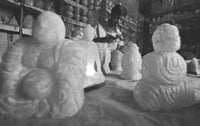
The sale of local handicrafts has always thrived with the influx of national and international tourists. How has the trend changed now? By Waqar Gillani In the international market, the best known handicrafts of Pakistan come from Northern Areas like Hunza, Gilgit, parts of NWFP including Swat, and also from Multan, Bahawalpur, Lahore and Thattha. When the Pakistani government decided to set up Pakistan Tourism Development Corporation (PTDC) in early 1970s, the foreign consultants, in their feasibility report, emphasised on the creation of four departments within the Corporation, including one for the promotion of handcrafts. The report, however, couldn't be implemented. Tayyab Nisar Mir, Deputy General Manager (Publications and Promotions), PTDC, tells TNS that currently the Corporation has 38 motels and 18 centres across the country. "All of them house handicraft shops." The promotion of handicrafts is important for the tourism industry and, that is why, PTDC also holds international exhibitions to attract tourists. This practice is a part of representing the culture of the country. Tayyab reveals that PTDC also collaborates with the National Council of Arts and Lok Virsa for the purpose. In Pakistan, according to the reports complied by local tour operators, 60 percent of foreign tourists visit Northern Areas. They know more about Hunza and Gilgit and other northern parts of the country than most of us do. In the case of Hunza, handicrafts and tourism complement each other. Recognising the importance of traditional handicrafts in local development in general and tourism development in particular, a group of people formed a handicraft development society in 1994. The society turned into Karakoram Handicraft Development Programme (KHDP) in 1996 and, in 2006, was divided into five companies after the Swiss Agency for Development and Cooperation pulled the plugs and stopped donating. The main focus of the project remained women, people with disabilities and other neglected segments of the society. Ghulam Ali, CEO of KHDP, tells TNS that the Northern Areas are most popular for their locally produced handicrafts. "We started this project to commercialise indigenous skills and stop exploitation." He says tourists were always target customers for these handcrafts. For an interaction between KHDP Handicraft project and local tourism sector, the project has developed the capacities of hundreds of women and linked more than 3,000 women with the market. Thread Net Hunza is another well-known brand distinguished for its quality, uniqueness and aesthetic appeal. The project intervention has increased the marketable local handicraft products from three to more than fifty innovative items. The crafts promoted by the project gained a good name in local, national and international markets, and three of the products received the UNESCO Seal of Excellence for their quality and cultural appeal. According to the data complied by UNESCO, the total sale of local handicrafts increased from Rs 25,000 in 1996 to Rs 3.4 million in 2005. As a result, income levels increased, which helped the workers to improve their means of livelihood. Increased incomes have resulted in increased savings, which provide a cushion against any unfortunate situations. Due to the flow of national and international tourists the sale of local handicrafts thrived. The 9/11 incident and subsequent war on terror has badly affected the tourism industry and consequently the handicraft sector as well. "In Hunza, the tourism sector has proved to be an agent for the protection, preservation and promotion of traditional handicrafts," Ali concludes. The provincial and federal ministries of tourism also focus on the promotion of handicrafts. "Hunza and Gilgit still have bright prospects of promotion of handicrafts," Saeed Alam, field officer of Pearl Tours, a private tour operator company working nationwide, tells TNS. The Ministry of Tourism seems uninterested as compared to tour operators and NGOs in promoting handicrafts. An effort to contact the ministry of tourism revealed that it had no particular policy in promoting handicrafts of the country for the tourists. Muhammad Sharif, Public Relations Officer, Ministry of Tourism, tells TNS how handcrafts are a good tourism product after archaeological sites of Pakistan and mountains. The ministry, which also collaborates with tour operators across the country, has also urged the operators to have detailed information on the handicrafts and their main centres in order to help and guide the tourists. However, the ministry itself has no particular policy or study in this regard, he says. Export goodsPakistani handicrafts need a market abroad to thrive By Saadia Salahuddin No surprises, marble and onyx together are Pakistan's
number one handicraft export. Flower vases from 5 to 48 inches in size, pin
boxes, powder boxes, wine cup sets, watches, plates with shell inlay, paper
weights, office sets, lamps and bowls which the Chinese, Koreans and
Malaysians love… The list is long. Pakistan has the best green onyx in Chaghi, Balochistan, and black and gold marble equals that mined in Italy. "If Pakistan keeps exporting even raw marble and onyx for a hundred years its reserve will not end," says Chaudhry Naseer, an exporter of onyx and marble wares. Besides marble and onyx products, other handicrafts that have found market abroad are brass-work items, salt lamps and woodwork. Unfortunately, Pakistan is one of those countries in the world which is rich in natural resources but does not capitalise on them. We are exporting raw materials mostly. For instance, our country exports marble in blocks, and China is the biggest buyer of the product. As Naseer puts it, Pakistan sells marble at Rs 25,000 to 30,000 per tonne (1000 kg) and China makes a very good use of this rate. Also, marble vases are exported in bulk to China where they are re-packaged and exported to other countries. Salt lamps are peculiar to Pakistan, too. They clean the air and are considered particularly good for those with breathing problems. They come in a variety of shapes. "Do not switch off the bulb if you want to keep the salt lamp in shape. They get de-shaped with moisture. Zero-power bulbs are fitted in salt lamps, the same that are used in refrigerators. That uses only 3 units in a month," says the manager at a government handicrafts shop in Lahore. Chiniot's wooden craft has great potential as well. Bowls, tables with brass and plastic inlay, trays, wall hangings etc are in great demand in Europe. Malik Asif runs a woodwork unit in Sillanwali. He believes that with little support from the government 500 craftsmen can be trained in 6 months and any order can be met. "But we need help from the government," he asserts. "I sold a piece that cost me Rs 1800 for Rs 14000 in the US." Muhammad Iqbal Mirza, General Secretary of Punjab Handicrafts Manufacturers Trade Group, sees the Lahore Chamber of Commerce as a big hurdle in the way of the craftsmen. "Foreign delegations that come here are hijacked by the LCCI members who do not show them the crafts." He also laments the end of the EPB (Export Promotion Bureau). "Bangladesh has made a village for the artisans where 4000 of them are living, working and exporting handicrafts, and prospering. Artisans are surely a country's valuable asset. They work with devotion, and they must not be forced to walk away in search of greener pastures. The government must provide their craft a flourishing market, national as well as international.
Private individuals who are launching themselves in the business of handicrafts have their own set of issues By Usman Ghafoor Naveed Niazi claims to have given a new dimension to
ceramics. "Whereas most people think ceramics is just about pottery, I
gave it an architectural twist which is most contemporary," says the
29-year-old, National College of Arts graduate, currently involved in what he
calls a "profitable business enterprise". "I make (handmade) ceramic tiles, murals, fireplaces and other items that are traditionally associated with architecture, for my private clients," he tells TNS. Because these handicrafts are an innovation in ceramics, Naveed says, he is able to "attract architects that are looking for creativity and novelty. I am so blessed that my work is very popular; every time I am left with no items that I can put up on my rack". Naveed's workshop -- a one-room set-up in the backyard of his house in Lahore -- is generally without any assistants. A kiln, lots of clay and "my hands" are his only equipment. "Since it involves a skill which is my own, I like to go it alone. If I need help, I bring my students over. "But, it is definitely a growing business," adds Naveed who is also teaching at his alma mater. "I get to earn a lot more than what my salary package at NCA has to offer." Naveed is not the only 'taught' and trained artiste who has
managed to start his own private work, albeit on a small scale. Most graduates
from NCA, Indus Valley and other arts institutions of the country like to be
self-employed. Some of them even have the chance to cut their teeth by
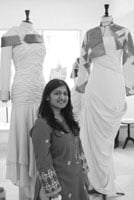
associating themselves with an established NGO. Aneela Arooj from Islamabad is
one such case in point. A fresh graduate from Pakistan Institute of Fashion Design, Aneela got picked up by AHAN (Aik Hunar Aik Nagar), an auxiliary organisation of SMEDA (Small and Medium Enterprise Development Authority), that allowed her to intern in Haripur, Hazara, with a group of women who were skilled in Phulkari ('Justi', in local lingo). Currently, she is finishing a project for well-known fashion designer Saadia Mirza; this includes a range of bustier, bridal cholis, shawls and pants. "Phulkari is a dying craft," she tells TNS. "But it is going through a revival. Historically, it was a folk thing; it wasn't meant for sale. But, today, it is considered invaluable and is a favourite with designers. Come to think of it, no single, handmade piece is a replica of the other." Aneela is also planning to launch her own label this year. It will have ready-to-wear as well as unstitched, hand-embroidered clothes and accessories. Before that she will have to register herself as a private company, under the Societies Registration Act. Aneela highlights the importance of help from NGOs without which a non-local cannot build a workforce. "The NGOs help you identify home-based workers. Besides, the locals trust these organisations more than they trust outsiders." Having identified the workers -- in Aneela's case, it was all women -- the intern is supposed to assess the levels of skill of the workers who are, then, divided into groups, as per their performance, and asked to make samples. This will test the neatness of the hands as well as quality control. Talking about the problems she had to face, Aneela says, "First of all, it required me to relocate to a place that was alien to me. It was very tough for a single female like me to work and live away from home, all by myself. I had to also face a lot of discouragement from family and people around me. "Secondly, the living conditions at the centre are very bad. There's no electricity and no bathrooms as such. My eating and sleeping habits were initially very disturbed. Then, I was required to keep myself covered from head to toe, no matter what. Only my eyes would be visible." Her troubles didn't end here. Aneela says every time she had to travel down to nearby villages by the only Suzuki pickups available, it meant "you'd have five male passengers sitting on the one side and five women on the other. You'd be jostling for space." The women workers aren't allowed to leave their houses after maghrib prayers. This put restrictions on a (self-admittedly) workaholic like Aneela who had to also manage a variety of other things, from acquiring raw material and getting them through the product finishing, to looking after the workers." Though you get creative satisfaction at the end of the day, the internship or even a project for a well established fashion designer does not mean huge bucks. "After a lot of hard work and determination, you are not paid well," laments Aneela who is currently working with 40-odd women. She also has an assistant, a Hindko-speaking local, who helps coordinate meetings for her. "When it comes to payment, the NGOs are the worst," says Aneela. "Those lucky few who are paid are not paid well. To regain their trust is very tough for a person like me who was a complete outsider." Laeeq Ahmed, 48, is a resident of Pak Colony, Bismillah Hotel, Karachi, which also houses his small finishing and assembling unit. Laeeq's specialty is decoration pieces and household items made of onyx. Besides, he has a manufacturing unit in Orangi, with a modest workforce of two. But he has seen tough days all right. "It's been 30 years now," he recalls. "I began in handicrafts almost by default. I had just finished my BSc from Karachi University and was looking for a job that I wouldn't find. In my desperation I came across a few people in our mohalla who were into handmade stuff. I took some loan and started buying items and then selling them at profitable rates." Soon Laeeq was designing and creating items for the market. Luckily for him, "my items found great appreciation, and my business began to grow." Laeeq tells TNS how EPB (Export Promotion Bureau) was very supportive towards private individuals like him with meagre resources at their disposal. "We'd be regularly invited to showcase our work internationally. Till date, I've had the chance to put up stalls in Turkey, Jordan, Saudi Arabia, Muscat, Nepal and India." Later, EPB was disbanded and replaced by TDAP (Trade Development Authority of Pakistan) -- an arrangement Laeeq is not happy with. "They aren't doing anything for us," he says, lamentingly. To quote Aneela, "Governments come and go, politicians make lofty statements but do virtually nothing for new, private entrepreneurs. I for one hope to be able to keep the promise I've made to these women who do wonders with their crafts despite such tough conditions."
Workers are exploited and under-paid By Naila Inayat In the art and craft class in school I used to be a
backbencher and never did I understand why my crafts teacher would always
quote a saying of Oscar Wilde that goes --"Children have a natural
antipathy to books -- handicrafts should be the basis of education. Boys and
girls should be taught to use their hands to make something, and they would be
less apt to destroy and be mischievous." I wonder if Mr Wilde was talking
about all the handicraft workers who are suffering even despite this natural
skill of theirs. "We the women have been facing several problems over the years; we don't get our due share and it is often either factory owners or the NGOs that take away all the profits, leaving us workers with nothing as such," says Shabnam Rahi, a home-based worker from Lahore. Thanks to the global recession most workers have lost their jobs as factories were closed down. "The factory owners say they are not getting ample orders from their clients and so they cannot pay us," says Jamal Hanif, a wood worker from Bhawalpur. Jamal is now working with a local NGO. Being a home-based worker brings a different set of problems for him. "I am using my own resources like electricity and water and, at the end of the day, all I get is hefty electricity bills because I'm working endlessly for the NGO without being paid appropriately." Jamal is not the only one who is facing these problems. Many such workers share this grievance. Rukhsana Naz of the Women Workers Help Line tells TNS, "Women are the main stakeholders in the handicrafts industry but unfortunately they don't get their due share in the pie. From gotta kari, jogger-stitching, phulkari, crochet, knitting, sewing, etc., they are the main workers. However when it comes to defrayal, the middlemen do not give a just amount to them. They exploit the women workers. If the total bill is Rs 1500, they'd pay Rs 1000 or sometimes even less. And if a worker resisted exploitation, they'd say, 'Madam, aapko kya pata hunar ka kya muavza hai… aapkay itnay hi paisay bantay hain'." "The solution to this core issue is to eliminate the middlemen and ensure the capacity building of the workers so that they know exactly what is the value of their handicrafts," says Sami Yazdani, product developer and designer at AHAN (Aik Hunar Aik Nagar). Yazdani believes that if the workers are trained (AHAN gives them training programmes) then they would go to the market and see for themselves the value of their handicrafts. "We need to curtail this middlemen-dependency which is only possible if we educate our workers. "However, up till now the workers haven't had access to raw material which, again, makes the middleman's involvement imperative. Usually, in the backward areas, it is the shopkeeper who takes double profit as a retailer and a middleman." "This has somehow become a non-issue for me; all that I know is that I work for around eight hours a day and get paid Rs 5 a piece," says Shabnam who is working to support her two little children. "My husband is unemployed for the last few months and there is not much resistance that I can offer to the owners. I have to be satisfied with whatever they give me." Similarly, Lubna Ejaz, a crochet maker from Haripur, says that coming from a conservative family it was a blessing in disguise for her to be working from home and getting money on time. "Even though sometimes I have to make my daughters help in my work, too. This inevitably affects their studies but I have no choice. I have to pay their school fees. Also I want them to learn the craft early, so that they can become independent." There is a lot of physical work involved in preparing a handicraft item-- for instance, in making 24 to 30 pairs of shoes, a worker needs to put in about 8 to 10 hours that require intensive use of his muscles, hands and eyes. Above all, there is no medical assistance, no precautionary instruments and not even security cards. But Mian Khan Abbasi, Executive Director, Badban, thinks otherwise. "Whosoever is a little troubled would complain as if he is not getting anything, and will saying that the NGO is reaping all the profits. I have been an activist myself so I know how much truth is there in such complaints." "There should be a law for home-based workers. This so-called people's government should do some legislation for us; after all, for how long will we remain oppressed in the name of cheap labour. This thekaydari mindset has to go if you want these workers to prosper," says Rukhsana. "We are a part of the Fair Trade Federation and we follow the principles. It is essential to maintain a check and balance on everyone involved in the business," says Samina Omar, Executive Director, Sungi Development Foundation.
The local workman's vocabulary of aesthetics is limited. Therefore, patronage is indispensable for bringing novelty to his craft By Sarah Sikandar One of the many regrets of Willy Loman from Death of a Salesman was that life never gave him a chance to work with his hands -- one unfulfilled desire that surpassed all other wishes. He was, one could say, a born craftsman who was never to use his hands. A loss only a craftsman can identify with. But in a machine-oriented culture such as ours, a handmade object fails to receive the admiration it deserves. Handicraft -- a post industrial revolution terminology --
has the essence and temperament of the very culture that breeds it. The
diversity and variety of Pakistan's handicrafts range from the intricate
pattern of the Chinioti woodwork to the vibrant hues of Multani embroidery.
Unfortunately, the network of Pakistan's handiwork has not been acknowledged
at home and abroad. Many reasons are cited but mainly the deteriorating
standard and lack of innovation are said to be the two culprits. Innovation comes only with exposure and knowledge. An average worker in Pakistan has little exposure to incorporate new themes in his work and experiment. Ayesha, a local entrepreneur who works both with handicrafts and other pieces, says it is the gulf between the designer and the worker that had stopped innovation. Unless and until the two come together, she believes, there is little possibility that newness can be brought in. This is true since each has what the other doesn't -- the designer has the education and the training and the craftsman has, of course, the craft. Zareena, a resident of Rajanpur, a village near Multan, makes bed spreads, cushions, clothes and accessories with help from her three daughters. She has never gone beyond Multan where she has a loyal clientele of begums who buy her products. That is the extent of her business. She gets nominal price for her work, ten percent of which goes to commuting from her village to Multan. For years, she has been making the same designs with little alteration in colour and fabric. She is using the same designs she used when she first learnt the craft. Shakir Ansari from Lahore does brass work and makes vases and does calligraphy on bronze plates. For years they have also been doing the same pattern, using the same pattern and same material. People like Zareena and Shakir are losing their market -- he to western-inspired decorative items and she to the fast growing prêt market and designer culture. Hence, the already subdued desire to create something new is hardly given a second thought. Naeem Safi, who has worked extensively with craftsmen from various cities of the country, says the aesthetic value of a handicraft should be judged on the basis of its cultural value and not its aesthetic value. An Indian shawl, he says, might not be valuable for the design which might not be that good but for being a souvenir from India. The complaint that aesthetically the quality of our handicrafts has deteriorated holds true for many objects mainly because their demand has almost diminished with time. And when the demand and supply chain is broken it naturally becomes impossible to sustain that specific genre. The reasons -- there is no patronage from private or public organisation, the worker doesn't get acknowledged and respected for his craft, cheap and durable replicas of these objects (Multani tiles, for instance) demean the value of the original piece, the crafts are dying because the next generation is going for more practical options. Rizwan Beyg, one of the country's leading fashion designers, has been working for the past couple of years with workmen from Haripur, Hazara, North Bahawalpur, Multan and Kot Adu reviving the dying craft of Phulkari, blue pottery and ceramics. The designer says that through his project he has been able to eliminate the role of the middleman and "virtually doubled the cash flows that the embroidery workers were receiving." His patronage has automatically brought innovation to the age-old craft of these workers. This kind of patronage is indispensable for bringing freshness in our handicraft. The local workman's vocabulary of aesthetics is limited. The doors and windows made by the Swati craftsmen have a long Pagan tradition behind it and there is little chance it will change. There is also a criticism that we need not apply Western standards to judge the aesthetic quality of our pieces. But the West, it is forgotten, is a major market for us. The least that can be done is improvement in the quality and presentation of the pieces and innovation without losing touch with the local motif. Tahir Yazdani, the head of Lahore Heritage Club, believes money is the basic problem. He says that for creating awareness and implementing the design thought it is important for someone to be willing to invest money. For nothing is better for a craftsman to get the satisfaction from working with his hands and be rewarded for it. "Willy Loman," says his wife, "was a happy man with a bunch of cement."
-- Input on Rizwan Beyg by Aziz Omar
|
|