


|
|
|
|
 |
 |
   |
wall-chalking Indus
Watch Music
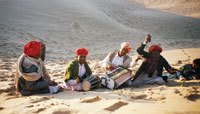
in the dunes of Thar Fighters,
not victims
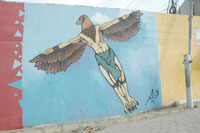
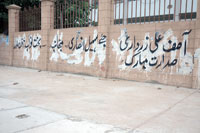
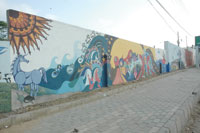
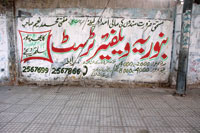
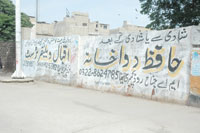
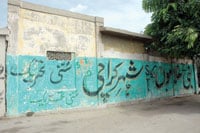
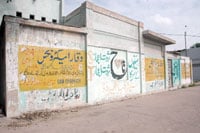
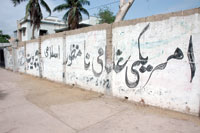
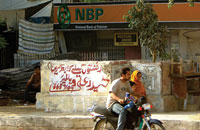
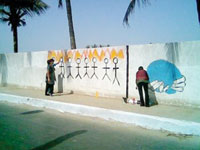
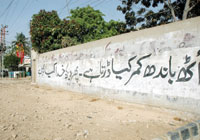
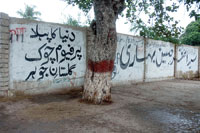
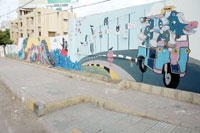
Writing on the wall Graffiti remains a popular method of advertisement and political expression in the city but at what cost? Jan Khaskheli takes a look Political activists affiliated with leftist parties that have seen various wall-chalking trends -- from crude oil to the recently introduced packed colour sprays -- believe that the kind of material used for this purpose is completely up to the resources available to the party. "If the party has more resources, its cadre can use colour spray while others still use crude oil and cheap powder mixed with glue to highlight its slogans. It is not washed away even by the rain," said Santosh Kumar, a die-hard worker of a leftist group.
Spray bottles do not have enough variety -- this is why activists make their own colours, he said, adding that though the method is old, it is still remains a favourite among activists to express the way they feel. Public places, the boundaries of recreational parks, bus stops, walls on main roads and educational institutes are appealing places for the political cadre to express their demands through wall-chalking. In this regard, it is between 2.00 a.m. to 4.00 a.m. that most activists prefer to write on walls because law enforcement agencies are not patrolling at that time. In fact, careful activists keep an eye out for police mobiles while others indulge in wall chalking. Now, however, the trend has changed. Activists, said Kumar, do not fear the police but anti-social political activists, who pretend to be government agencies and get violent with rival parties.
A retired professor tracing the history of wall-chalkings just after Partition said the trend started when small-scale corporations used wall chalking as a way to advertise their products such as biscuits and toffees. As compared to this, multi-national companies always used billboards for advertisements. According to him, political wall-chalking in Pakistan started during the Ayub Khan era during which student organisations took an active part in this kind of sloganism. He said that earlier, they were in the interest of the common man but this is not always the case now. In fact, the language used sometimes is not even grammatically correct.
Furthermore, he said now wall chalking confuse the people even more. All religious, sectarian and nationalist groups are violating municipal laws, dirtying the walls, which is confusing for people because the very groups who are supposed to be asking for what is right are violating the law. He said that the municipal law exist but like other laws, it is ineffective allowing certain elements to continue with this dirty game. Aly Ercelawn, a social development expert said that the Pakistani society is quite different from other countries in South Asia where the enforcement of municipal law is visible. "We can see posters there but not wall-chalking," he explained. According to Ercelawn, wall chalking is an instrument for mass mobilisation. Earlier it was not seen in many parts of Karachi because the middle class residing there was not interested in such activities. In those days, Karachi was limited to Laloo Khait (Liaquatabad) and Lyari.
A former official of the defunct Karachi Development Authority (KDA) from Lyari referred to the current trend of wall-chalking as "anarchy". He saw the movement against the Ayub government and said that it was a mass struggle. But now "we build homes, which these people dirty for their personal gains. It is embarrassing," he told Kolachi. He said it is not just wall-chalking -- even the banners that people hang are never taken down. It shows the failure of the municipal administration that is unable to remove them. The official further said that political parties should educate their cadre to protect property and avoid violation and the municipal administration should take action against the offenders.
An old political activist, who is now a banker, felt that now "vulgarity is being promoted in the name of highlighting issues. There is hooliganism as the activists now even abuse people and their families as per the instructions of their political leaders." Sometimes, activists even pass verdicts on certain people and communities. There is no law to monitor such things, he said, adding that this only leads to further vulgarity. He pointed out that the anti-Muslim League parties in East Pakistan were active in the political struggle before Partition and continued after Independence. So the political struggle may have started in Karachi during the Ayub Khan era but there is a huge history behind it as far as the rest of the country is concerned.
Perhaps the worst situation in this regard is both outside and inside higher educational institutes and its hostels, where even classrooms are replete with objectionable language. A former activist of the Communist Party of Pakistan, recalling previous agitation trends, said that it was the duty of activists to litter walls with slogans mostly demanding release of their less known comrades languishing in jails. The leftists broke all records of initiating wall-chalking all over the province simultaneously for the same cause. He said that the famous politicians of today have been made popular through wall chalking and can be called 'wall chalking leaders'.
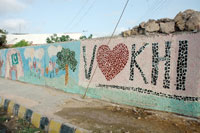
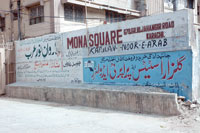
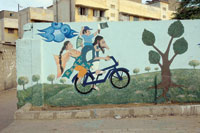
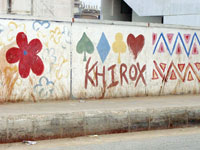
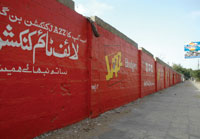
Artists or tricksters: Who is destroying our city's walls? While wall-chalking has taken over most of the city's facade presenting an unattractive picture, advertisers have found it to be an effective tool
By Rabia Ali "By writing on the walls, I create curiosity among the people about the place," says Mursaleen Khan Sherwani, the owner of Perfume Chowk, while talking to Kolachi. "It is a way of silently and peacefully protesting against the system of paying bhatta and bringing it to the attention of officials."
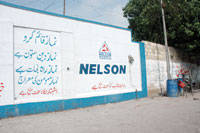
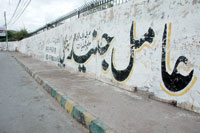
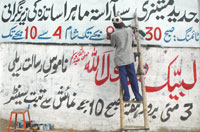
Sherwani does "publicity" of his small-scale business by spray-painting public places such as flyovers, bridges and the shutters on the shops. The paint he uses costs Rs32, and he is careful not to paint on residences. He has been doing this for the past 10 years and vows to continue until the day he dies. Last year he was ordered to pay Rs2.6 million by the Cantonment Board Faisal for 'destroying the city's façade', although the notice was cancelled after Sherwani strongly protested against it. His most recent work has been on a newly constructed bridge, which resulted in the government confiscating his stall for nine months. "Because the government comes down hard on me, I will do it more and more," says Sherwani. "Why am I the only one hand-picked by officials? It is totally unjust. Multinational companies have been chalking the city for years, but no one questions them." Apart from Perfume Chowk, the city is a host to a spate of wall-chalking announcing the wonders of 'Aamil Babas'. However, the famous Junaid Baba, whose publicity advertisements have marked most of walls in the metropolis, denies that he is personally involved. "My customers and well-wishers do this out of reverence," he says. "I have no idea how much any of it cost, or whether or not they (the people who advertise in his name) acquire permission." As one Aamil, on the basis of anonymity, explains, "Advertising on the walls of the city is the cheapest way to promote one self. The effect is long-lasting. On a six-by-four wall, painters charge Rs50 to Rs75. We select the area, and every advertisement on the walls has a serial number allotted to it." The Aamil admits that while the walls are painted over by professionals, they do not seek permission from anyone to hire them. "We paint over any wall we want, but often we are traced down by the police." In such a case, the advertisements have to be erased if they do not want to pay the police. "They lock us up and make a case against us, but we don't care about the beauty of the city. We are just interested in doing business." Meanwhile, Kamran Idrees, who belongs to the marketing department of Nelson Paints, a local paint company stresses that his company does ask for permission before painting over any walls of the city. "Wall chalking is a marketing technique," he says. "Even though it is not smart marketing, it is a trend people having been following for several years. It is the cheapest way to promote oneself and create awareness among the people." Idrees goes on to add that it is the painters who decide how much should be charged for painting over a wall. "When we want to paint, we ask permission from the City District Government Karachi. If it is at a residential place, we ask the residents. It works two ways. Some people demand money, others don't ask for anything." Idrees argues that despite such paintings being considered an eyesore, there is no harm in any of it. "At least it's better than the 'Bengal ka kaala jadoo' advertisements," he says. "We put up advertisements on the wall. Along with promoting ourselves, we convey a public service message to the citizens, which is a beauty in its own."
Rebel with many causes
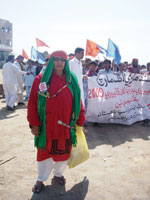
By Urooj Zia To put it plainly, 46-year-old Ameerzadi from Safzali Brohi Goth, Jhang Shahi, district Thatta, loves participating in protests and rallies. "It is my hobby," she told Indus Watch with a matter-of-fact shrug. "I know that change can only be brought politically, and to do that, we should not shy away from lodging our protests and putting our demands forward at every platform possible." Early life Ameerzadi has been protesting "since a very early age". When she was young, she used to go to rallies with her father, or with other men from her village. As she grew older, her father decided to give her away in marriage to a much older man. "I think I was barely 10 or 12 years old at the time. My husband was in his 60s," she said. She had protested against her early marriage too, but to no avail. "The man was offering my father a lot of money in exchange for my hand in marriage. My father was poor, and I knew that the offer was too good for him to turn down. I lodged my protest, but no one listened to me," she said. "Eventually I gave up. My husband-to-be was a very, very old man. I knew he would die soon." The personal and the political During the short period between her wedding and widowhood, Ameerzadi gave birth to six children -- four daughters and two sons. "What could I do! I had no say in the matter. In any case, I had more important things on my mind. I had made it clear to my husband that he could not stop me from participating in protests and rallies. I had told him that he could not stop my political activities. In return, if I ended up producing babies almost every year, it was a trade off that I had to make," she told Indus Watch. "I knew that after my husband died, I would be left alone to take care of all my children. That was something that I was very concerned about, so I went about making myself self-sufficient even while my husband was alive. Since he was so old, he wasn't much use, financially, anyway," she said. Apart from organising people politically, Ameerzadi also took up various odd-jobs. Among other things, she sewed clothes for people, guarded the village wells, and took care of nearby shrines. "Initially, the people in my village would taunt my husband by saying that he had been cheated by my father into marrying a man, instead of the girl that he had paid for," she said with a laugh. "My husband would get irritated, and then life at home would be difficult for me. He tried to beat me up a couple of times. At the end of the day, however, he was an old man, and I was young and strong, brought up on hard work. He just did not have the upper hand in physical strength. Eventually he gave up and learned to ignore the villagers' taunts. The people in my village gave up too and got used to my 'manliness'." Rallying for a cause Ameerzadi has been associated with the Pakistan People's Party's (PPP) women's wing ever since its inception. "[PPP founder Zulfikar Ali] Bhutto did a lot for us. He gave us a voice. Of course, we had to fight a lot of battles on our own, but at least he gave us a rallying point," she told Indus Watch. She grows tearful as she remembers Bhutto's daughter, former prime minister Benazir Bhutto. "She was an amazing girl -- very brave. She had more guts than all of these men around," she said, gesturing at the men milling about at the village Dhaaba (tea stall). Shah Sherazi and the PML-Q Ejaz Ali Shah Sherazi from the Pakistan Muslim League-Quaid (PML-Q) is the "big man" in Ameerzadi's area -- the man who everyone goes to in hopes of getting their problems solved. For Ameerzadi claims, however, that Sherazi -- who was affiliated with the PPP before turning to the PML-Q during former president Gen. (retd) Pervez Musharraf's reigh -- has brought her nothing but "tragedy and tears." "Sherazi got Basheer Jokhio appointed as the Nazim for Jhang Shahi," she said. "He killed my son, Wazeer." Relations between Ameerzadi and Sherazi, however, weren't always so acerbic, according to what she said. "We supported Ejaz Sherazi a long time ago because of the PPP, but during Musharraf's time, he joined the newly-formed PML-Q. We are not turncoats, and therefore could no longer support him," she said. "Sherazi's men started torturing PPP supporters in the villages," Ameerzadi alleged. "They stole everything that we had." 'They killed my son, daughter-in-law, grandchildren' Ameerzadi used to guard the pipeline that supplied water from the well in her village, "because druggies have a habit of stealing these pipes and selling them". She was paid Rs7,000 per month for her services. "I built a thatch hut and lived beside the well to be able to protect the pipes better. My children also lived with me. Four months before October 18 (2007), 'they' killed my son, Wazeer, who was barely 21 years old, because I had stood up at a recent Jalsa (public meeting) called by Sherazi, and criticised and his goons for the treatment that they were meting out to PPP supporters in our village and in nearby areas too. I did it right in front of Sherazi. I'm not afraid of him. Why should I be? So they killed my son, and then forced the people in my village -- people who I had known all my life to turn against me." Ameerzadi went with some friends to bury her son, while Wazeer's widow and children stayed home. "'They' came while we were at the graveyard and set fire to our house. My daughter-in-law and my grandchildren were burnt alive," she alleged. "As if this was not enough, they bulldozed what remained of our house the next day." Ameerzadi, however, holds no grudge against Sherazi. "He is a good man. He is being misled by this Nazim that he appointed," she maintained. Pleading to 'the king' for help Ameerzadi says that is happy that a PPP government is now in power, but she is "not satisfied" with the government's performance. She claims that none of the problems of the village have been solved. "Please give (President Asif Ali) Zardari a message from me. Please tell me that I want to know what he plans to do for us," she told Indus Watch, and then continued in halting Urdu. "Tum Badshah Ho Ker Kia Kar Dya? Tumhari Biwi k Saath Saath Chala Hum. Tum Humarey Liyay Kia Kar Raha Hai? (What have you done, now that you are the king? We walked side by side with your wife. What are you doing for us?)"
By Jan Khaskheli 'Sindhi folktales of Thar', a book written by Dr Kishni Phulwani of Rajasthan, India, and translated from Hindi to Sindhi by Noor Ahmed Jinjhi, is a combination of the colours of the Thar desert, which stretches across the border in both, Pakistan and India. The book has been published by Thardeep Rural Development Programme (TRDP), a non-governmental organisation working for the wellbeing of the desert community, and promoting and preserving the old culture of the politically-neglected region. The book revolves around Manganhars -- the real
folktale narrators of the region. The theme was chosen by the author for
her PhD from Jodhpur University, India. The Manganhars are common to
Sindh and Indian Rajasthan. They narrate folktales to the tune of
traditional drums and attract wide Dr Phulwani has also touched upon history, geography, languages being spoken in the region, culture, socio-economical conditions and the role of artisan communities. Portraying the scenario, the author almost quoted poetic folktales of several Sindhi poets, especially Sur Marvi by Shah Abdul Latif Bhittai. Marvi, a symbol of the traditions of the region, was kidnapped by King Omar when she had gone to a well to fetch water. She was brought to a palace, and offered every luxury possible to make her agree to stay there. Marvi, however, spurned all offers by the king and demanded that she be allowed to go back to her parents' makeshift homes. Dr Phulwani recalls the memorable days of her childhood, when her family migrated to India in 1966 from Sindh. Being closely attached with Sufism, her father used to listen to Sufi songs and Bhujans (Hindu religious songs) till late in the night, and would tell stories to his children before sleeping under the starry skies -- on the rooftop of their house. Dr Phulwani obtained her PhD in Sindhi Classical Literature and was very inspired by folk stories. She discusses the similarities among them in her book. Komal Kothari, who has done a lot of work studying the role of the Manganhar community in preserving folktales, has written foreword of the book. Even after migration to India, Sindhi Hindus continue
to organise annual Melas of Sufi saints, whose shrines originally exist
in Sindh, Dr Phulwani sayd. She visits these Melas regularly to pay
homage to the shrines and to Sufi thought, which inspired her to write
her valuable book. The author obtained her Masters degree from Jodhpur University, India, and chose folklore literature as a minor subject. During her study, she went through the contemporary literature of the world. When she showed her desire to continue to work on Rajasthani literature in India and Pakistan, she was advised to meet Komal Kothari, who has done a lot of work to promote Rajasthani music, art and folklore literature and frequently visits both sides (India and Pakistan) to collect information. The author focused on the Dhat region and reviewed literature produced in Dhatki, Marwari, Gujrati, Sindhi and Rajasthani languages. According to her, the area now in India was part of Sindh before the Partition of the subcontinent on August 14, 1947, and the people of these areas from both sides of the border have a very close relationship. The author has raised a question for future researchers regarding the originality of indigenous Sindhi folktales. For instance, the stories of Umar-Marvi, Moomal-Ranoo, Noori-Jam Tamachi, Sassui-Punhoon, Laila-Majnoo, Leela-Chanesar, Sorath-Rai Khanghar, Heer-Ranjho, Sohni-Mehar and Jisman-Oden were sung by poets of the past in similar tones. This question raised by the author may inspire other researchers to clarify the originality of these folktales for future generations.
Ameerzadi is not an exception, as Indus Watch has come across several cases of everyday people from rural Sindh, who have decided to take the political or socio-political route to address their grievances. These are the stories of some of them who Mahnaz Rahman spoke to Naran Maan Singh lives in Haji Raana Baloch Goth. He
studied up to the 6th grade and then a welfare organization invited him
to teach in its school which operates in a shack. Sindh got married in
1998; he has three kids. He could not complete his studies because his
father had grown old and weak and was not able to earn for the family.
He is the only brother of six sisters. There are 25 to 30 children in the school where Sindh teaches; half of them girls. Though they are students of different classes they sit in one classroom. The people of the village drink muddy water from the canal. Men and women both work in the fields. His village is deprived of electricity, natural gas and proper roads. Sindh says that his village should have a good school building, villagers should get education and safe drinking water. There is lack of transport facilities. Singh hopes that his students will one day be able to address all these issues. Pasaram from Hirdaas Patel School Pasaram is matriculate and since his childhood, he wanted to become a teacher. He acquired his education while living in his village and wanted to do something for his village. His school was six to seven kilometers away, and he used to commute via bicycle. He has two elder brothers -- one works in a mill and the other is a mechanic. His two younger sisters have studied till the fifth grade. Pasaram feels himself lucky as now his village has a middle school, a government dispensary which provides free medicine, doctor comes daily, there is electricity, and there is a proper road near the village. According to him "it is a modern village". One wonders how, and Pasaram is quick to explain. "Hirdaas Patel is the head of our village. He is the chief of our ethnic group and he has good contacts," he said. That may be true, but the village still has no sewerage system and inner lanes are still unpaved. More teachers Master Manji-Syed Ali from Anwer Shah Goth has been teaching since 2005. He could not clear his Intermediate exams in the first attempt and did not have money for fees to reappear in the exams. His Goth is deprived of all basic amenities. There are no roads or brick houses, nor is there electricity, potable water, or a government school. People drink muddy water from the canal, and live in huts made of reed and wood. UNICEF has given them training to make latrines. Pregnant women have to be taken 25 miles away to Mirpurkhas for delivery. Last year one woman died on her way to a hospital. Manji teaches forty children and laments that villagers do not recognize the importance of education and prefer their children to herd cattle. Water issues Lalji of Pathan Village works in Bhuro Patel School as helper. He is matriculate. There is no electricity in his village. An NGO has laid water pipes and there are now four water taps. There are 60 Hindu households in this village. They have made their huts on government's land so they can't make brick houses as they fear that the government will ask them to evacuate its land. There are no latrines and no electricity. However, they have one "pakka" temple. These are some brave souls who, despite being deprived of the most basic facilities of modern, civilized life, continue to fight hardships.
|
|

 audiences.