


|
|
|
|
 |
 |
 
|
comment
Q&A
Losing
connection with script
comment Azfar Nafisi in
her exquisite book, Reading Lolita in Tehran, describes living as a woman in
a theocratic republic as making love to someone you loath. It puts one in
the mind of the non-Muslims living in Pakistan (although it is equally true
for the women). While the solemn quest of our media to ensure that every
child in the country knows that the gravest problems that we face are of
“sovereignty” and “independence” etc continues, it might be of some
value to go back to the beginning or almost the beginning. One cannot engage in a
half-decent conversation on the Constitution of Pakistan without someone
bringing in the Objectives Resolution (Article 2-A, after Zia-ul-Haq) as a
trump card. The resolution passed in 1949 begins with, “Whereas
sovereignty over the entire universe belongs to Allah Almighty alone and the
authority which He has delegated to the State of Pakistan, through its
people for being exercised within the limits prescribed by Him is a sacred
trust.” On the face of it, it does
make a lot of debate on parliamentary or judicial supremacy redundant or at
the very least defines new parameters. I am not sure that all our elected
representatives realise that they are intended to be the vicars of the
Almighty Himself. Although the resolution goes on to talk about the token,
boilerplate adequate provision for the minorities, it is clear that the
non-Muslims have lost the argument at the outset or perhaps were never
really invited to the argument. If the jingoist, hyper
nationalist polemists and school Pakistan Studies curriculum are to be
believed, it seems that the country was intended to be a homeland for the
pure, the fortress of the faithful, a Utopia, one may go so far as saying an
Eden. Well, if this is an Eden then the Objectives Resolution is the serpent
and the original sin followed. Almost all of our
television anchors and analysts display ritual solidity in the opinion that
Objectives Resolution forms some sort of a benchmark and outlines the Basic
Structure of the Constitution from which the non-sovereign Parliament cannot
deviate. One can agree with them in so far as the structure is fairly
“Basic” in the other connotation of the word as being rudimentary,
unsophisticated. In 1998 (PLD 1998 SC 1263), the then Chief Justice Ajmal
Mian in an obiter dictum posed the rhetorical question of if the Parliament
was to amend the Constitution to make it a secular state, can it be argued
that the Court has no powers to examine the vires of the Constitutional
amendment. The same question was again put and pondered by the present Court
in the 18th
amendment proceedings. One can imagine the non-Muslims being unnerved
by the philosophic enterprise of My Lords. I have always been
uncomfortable with the usage of the term, “minorities” in the context of
a democratic country. Since we do not vote as a group and ours remains even
if nominally a, “one man/woman, one vote” republic the term comes across
as being too vague or perhaps too specific. However it does seem to have its
utility these days, since while most of our zealots will not go as far as
calling the “Shia” as non-Muslims, at least not in the media, efforts
are underway, if they have not already succeeded in turning them into a
“minority.” The Objectives Resolution
further articulates, “Wherein the principles of democracy, freedom,
equality, tolerance and social justice as enunciated by Islam shall be fully
observed.” The statement got off to a decent start and could have been
from any post-enlightenment document save for the conditionality in the last
part. In essence, non-Muslim taxpayers will be subsidising the enforcement
of a system that they do not intellectually agree with. And then there is
the minor problem of whose Islam shall be “fully observed”, Sunni, Shia,
Wahabi, Deobandi or Brailevi.
I have so far restricted myself
to the Objectives Resolution and it is not to give the impression that it is
the only fundamentally oppressive part in our jurisprudence but for the
reason that the list of legal provisions institutionalising discrimination
is too elaborate to be dwelt upon in an opinion piece. The Objective
Resolution in many ways lays down the framework and sets the tone for future
tyranny to be undertaken without undue difficulty. Justice Rana Bhagwandas
publicly mentioned some recently; firstly a non-Muslim is ineligible to be
the president or the prime minister of this country. The number of
non-Muslim members of the parliament (10 out of 342) is considerably less
than their numeric strength. Provisions mandating equality before law are
rendered partially inoperative because of ineligibility to public offices. The list continues beyond
what My Lord enumerated, freedom of an expression guaranteed by Article 19
is a representative example. Every citizen has freedom of expression and
there shall be freedom of press, save when restrictions are imposed in the
interest of “glory of Islam” (there are other equally precise conditions
such as “integrity of Pakistan”, “decency and morality” etc). It
seems too strenuous to stress this but this freedom of expression can mean
very little to non-Muslims especially when they are compelled to be the
custodians of the “glory of Islam.” Article 20 of the Constitution
articulates the freedom to profess religion and manage religious
institutions with not only the defensible claw back of law and public order
but also of “morality.” Again the State has taken upon itself the godly
role of ascertaining the morality of the beliefs of the people, rendering it
as good as useless to non-Muslims. I will assume that you know about the
declaration of Ahmadis as non-Muslims and would also have some idea of the
role of Zia-ul-Haq in mutilating our legal system and society. Even a causal reading of
these laws reveals unblinkingly the intention that “we” are to be
Muslims first and Pakistanis second. As far as one of “them” saying that
she is a Hindu first and a Pakistani second, I think it would be the time
that we would make Article 6 and the mandated death penalty useful. What
strikes the eye is the absence of this question of the prioritising of
loyalties, Muslim and Pakistani from the national, inescapable debate on
dual nationality of members of Parliament. Our Constitution, laws and
mindless repetition of Iqbal and ideology of Pakistan requires a dual
nationality from the get go. As people gear up for their fourteenth Umra and
stressing that the proper pronunciation of the Holy month is “Ramadhan”
(as it is the correct Arabic pronunciation in case you are wondering) and
not “Ramazan,” one would have imagined the thought that most of us
already have a dual nationality and even a dual loyalty might have crossed
the mind. The irony here is that it
remains close to impossible to be a naturalised citizen of the Kingdom of
Saudi Arabia in the world of temporal laws. I will not be ambitious enough
to propose a specific solution to undo this architecture of totalitarianism
since it requires a complete overhaul, perhaps a new Constitution. Nor will
I be hopelessly optimist enough to see that happening anytime soon. For the
time being, it might be worth remembering that it is mostly the members of
“minorities” who remain the only true, single nationality citizens of
Al-Bakistan.
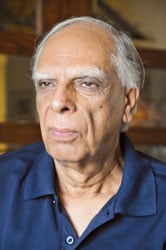
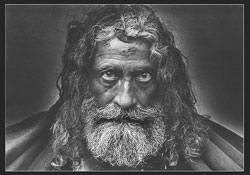
Q&A Working with his portable large-format Bronica,
Syed Javaid Kazi has roamed the streets and backroads of the world seeking
that moment of calm repose when meaning and composition unite to make an
image at once significant and beautiful. Born in Jullundhar, East Punjab, in
1945, Kazi grew up in Rawalpindi and earned a Masters Degree in Physics from
Government College, Lahore. In a career spanning more than five decades, the
international award-winning photographer has spoken of his camera as an
extension of his eye, which suggests his unparalleled ability to recognise
some spontaneous composition that speaks of the mystery, the humour, the
universality in the people and events that pass before him — and in the
same instant seize the fluid convergence in his frame. In an interview with TNS below, he muses on the nature
of this creative process while taking us down the memory lanes in Rawalpindi
where early photography dwelled. The News on Sunday: What is your earliest experience of
a camera? Syed Javaid Kazi: My family migrated from Jalandhar in
East Punjab to Lahore before finally settling down in Rawalpindi, in 1947.
There was chaos all around and one had to think in terms of starting one’s
own business. My grandfather was initially allotted a house in Lahore but
when the extended family joined us, we handed over the house to them and
shifted on Lawrence Road in Pindi. The new city had a rather artistic
environment: Fareeda Khanum used to live in our neighbourhood and Madame
Azuri in an annexe next doors! The Rawalpindi of my childhood was a
wonderful city that had no parallels. There was an Anglo Indian community in
the cantonment that had created its own ambience. An elderly photographer, L C Ram used to run a corner
shop on Edwardes Road (now Bank Road) in Saddar, I used to frequent with my
grandfather as a child. My father was more interested in collecting pictures
than making any. It was L C Ram who gave me my first Baby Brownie camera —
a small box for 127mm film, and the incentive to take my earliest pictures
with free film and free developing. TNS: What inspired you to take up photography seriously? SJK: The photographer who influenced me the most or
initiated me into photography was Asghar Quettawala who had a photo studio
on Edwardes Road in Pindi — a teakwood-lined shop with inspiring pictures
all around. I was only twelve years old when he introduced me to
Pictorialism. We used to spend the summertime in Murree. Coincidentally,
Asghar Quettawala who had a studio in Murree right next to the GPO, would
also stay there during the summer. I asked him to teach me printing, being
more interested in developing and printing than taking pictures. I used to
take tuition in Ghariyal in the mornings, and the best option was to
practice commercial printing in his studio in the afternoons, and it was
here that I had my first go at developing and printing in Asghar’s
guidance from the late 1950s until the early 1960s. Customers would
generally ask for postcard-sized b x w images. It was in Murree that I first met Nisar Mirza who became
a dear friend later on. Dr Aftab, a passionate photographer, used to have a
clinic below Sam’s on the Mall. He would often share his pictures with my
father. TNS: Tell us about the pet equipment behind such great
pictures. SJK: The amateurs today won’t start photography until
they have professional equipment. Those were different times. We used to
start at a very basic level and upgrade gradually. I used Baby Brownie for
good 2-3 years before switching to Brownie 120mm. I made early b x w images
with Ikonta Zeiss. And even though I did work with fisheye lens, the
wide-angle perspective never appealed to me. In any case, I realised one
could work a lot better with a single standard lens than fiddle with
multiple lenses lest you lose the moment. Even today, I carry only the
mid-range zoom with me. There was no dearth of photographic supplies in those
days. From Johnson’s pre-mixed chemicals down to a large variety of Kodak
and Agfa paper, everything was readily available. Both Kodak and Agfa (later
Agfa Gevaert) had distributors and dealership here. Kodak used to be the
first preference in film, but in paper Agfa would offer a much bigger
choice. TNS: What was the exhibition milieu like in those days? SJK: When we shifted to College Road, Rawalpindi,
Peerzada Waheed — an old-time photographer who had also migrated from
Jalandhar — became our neighbour. Together with Col. Omar and H K Burki,
he revived the Jalandhar Camera Club, renaming it as Capital Club of
Photography. Photography exhibitions used to be a regular feature of
Jashn-e-Murree, held either at the Ambassador’s Hall or at the Municipal
Corporation’s Hall. I got the first award of my career at the National
Exhibition held there. Later on, my first international award came in 1967
from Willingdon, New Zealand. Initially, photography exhibitions would be held either
at Zubeida Agha’s Contemporary Art Gallery on Canning Road, Saddar, or at
the Pindi Club in Rawalpindi. Then came up Rawalpindi Arts Council next to
the Cathedral before shifting into the former Freemasons Hall handed over by
the Army. Another venue that supported us tremendously was The
Council for National Integration chaired by Safi Safdar, a painter of repute
himself. The Jang Group of Newspapers would sponsor our catalogues and
brochures. In other words, there was no dearth of exhibition venues in those
days, per se. TNS: What kind of a role did Lahore play in developing a
dialogue with photography? SJK: After my graduation in 1964, I shifted to Lahore
where I had the good fortune of staying at the YMCA Hostel on the Mall for a
few months. The YMCA used to be a hub of activities: besides badminton and
table tennis, photography exhibitions and theatrical plays were a regular
feature there. The days I spent in Lahore were most formative and
helped formidably in grooming my interest in photography. Firstly, it was
Asad Ali’s inspiring work, and secondly the culture spawned by Pak Tea
House and The Coffee House on the Mall. Nasir Kazmi used to frequent Pak Tea
House while Faiz Sahab patronised the Coffee House. Students would flock
there in the evenings, and I would also join them, eavesdropping on
conversations between Faiz Sahab and Safdar Mir. Faiz was the editor of Pakistan Times in those days.
When I met him the first time, he asked me about my interests, and then
advised me to show him my photographic work. Upon seeing my work, he invited
me to his office the very next day. He kept my pictures, and the Pakistan
Times Sunday supplement carried one image of mine at a time for years
without fail. When Faiz assumed office as the Director of Lahore Arts
Council, he formed a photographic society at the Alhamra. Mian Wahid used to
be in charge there. There was a studio and a darkroom there that you could
use for free. When Nisar Mirza shifted to Lahore, we would go to the Walled
City on Sundays to make pictures. TNS: How would you explain Pictorialism, and who were
the early influences? SJK: Appreciation of light is the first principle of
Pictorialism. If you look at the early pictures, none of them is flat-lit;
instead there is an emphasis on highlight, cross light, etc. Then
Rembrandt-lighting would be used a lot in portraiture. Yousaf Karsh is the
one who started the trend. Pictorialism implies artistic pictures with
respect for and appreciation of light. It isn’t like you can venture out
at 12 noon to take pictures! If you went to the Badshahi Mosque, for
instance, you would wait from morning till evening for the most appropriate
light. The period between the 1960s and the 1970s was the
golden period for all arts, especially photography. Attitudes were
progressive; there was no restriction on the content of the images and no
objection. Aftab Ahmed pioneered darkroom techniques, such as solarisation
and posterisation in Pakistan. Darkroom techniques were a novelty in those
days! The basics of photography lie in the aesthetics. You
can’t develop the inborn eye; you can only, perhaps, polish the
aesthetics. If you try too hard, the images may cease to be spontaneous. The
majority is hooked on sophisticated cameras. Most people want to know which
camera has been used to take a particular picture. I am reminded of the
conversation between Ansel Adams and Ernest Hemingway, when upon the
occasion of Adams’s show in the United States, Hemingway approached him
and said: “I saw your last exhibition that was wonderful. Which camera did
you take those pictures with?” Adams turned around with a smile on his
face and retorted: “I read your last novel which was wonderful. Which pen
did you write it with?”
Flower of
many secrets ‘Flower of My
Secret’ is the title of Spanish Director Pedro Almodovar’s film but,
every morning, my encounter with flowers is of a slightly different type. On
my walk routine, I come across signs saying “Plucking of flowers is
strictly prohibited.” I wonder about the use of word strictly which means
the act is absolutely not allowed. Yet, no one takes the sign seriously.
People do not stop picking flowers; their behaviour an indication of how we
react when stopped from doing something. Similarly, people
disregard traffic rules even if it puts their own lives in danger. The urge
to violate traffic rules stems not out of haste but to provide personal
satisfaction — of moving on roads as one fancies without paying any
attention to security and driving signs. There are other areas in our lives
where we disobey social codes and customs for the sheer excitement of being
different and even ‘destructive’. What takes place on the
roads or in parks for minor pleasure is repeated in creative endeavours too.
In the words of Salman Rushdie: “It is the job of an artist to be
iconoclastic, to give dissenting view.” This means the artist must defy
the prescribed path and conventional course in order to create something
new. Usually, through these
conventions, the society not only explains how an artist should work but
also decides on his subjects; defines the duty and function of art; and
suggests how art can be more accessible to its audience. These norms are not
taught in an art school nor are they demanded by ordinary persons. But if
you pick any piece of criticism and comment on art, you discern it in the
subtext. The public, in the form of
its intellectual representatives, puts some ethical responsibility on the
artist too. That he should not cheat in his work, must not make forgeries,
avoid any controversial topics and stay away from themes which are immoral
or contradict the faith. Also, it expects the artist’s creations are not
offensive in terms of race, gender and class. In addition to that, the
artist must adhere to his national identity, and present himself as the
representative of his country not only in his art, but in his life too. He
is not supposed to misbehave, for instance, by excessive drinking, chasing
women, disagreeing with his hosts or dressing immodestly, especially when he
is travelling abroad, since he is not an individual but a segment of his
society. The issue is not whether
the artists follow these codes or not but the real question is: if they
should? To break law in normal life is a crime but to do so in the realm of
art may not be so and is likely to be appreciated. If one studies the
history of art (and of literature too), one finds examples of individuals
who negated the norms of their age and produced works which were judged
disrespectful, disturbing and immoral. Often, the artistes were banned to
show or publish their works, or were jailed for their outrageous creations,
as was the case with D.H. Lawrence, Saadat Hassan Manto and several others. Decrees on these
individuals and their works do not depend on a particular political position
or frame of mind but, usually, it is the vocal sections of population who
join to protest and prohibit an insulting work of art or piece of literature
(One could recall the reactions against Satanic Verses in Pakistan, Iran and
other Muslim societies and outrage of Hindu fundamentalists towards
paintings of Hindu goddesses by M. F. Husain). In such a scenario, it
becomes difficult for a creative person “to swim against the stream” as
Camus insisted. Yet, they have been doing so either by showing in public or
privately, and inviting the wrath of reactionary forces (as happened to
Sadequain during his solo exhibition at the Punjab Arts Council in the
mid-1970s and with Colin David during the display at his house in the early
1990s). Perhaps, this urge to resist and revolt against the authority is an
inner calling for an artist because, when you examine the life history of
these creative individuals, several of them were repressed by their families
or an authoritarian parent (like Franz Kafka). An early experience in
rejecting and detesting power may be translated and extended into renouncing
the norms of society through art. Whatever the reason, an artist survives on
challenging the established notions of ethics, morality, best behaviour and
good art. He also questions and criticises the sanctity of common beliefs
and moral constructs. Thus, one finds the names of artists who were
persecuted, prosecuted, hunted and ridiculed on the basis of what they
produced. Several of them were degenerate by our normal, mediocre standards,
indulging in vices of all sorts, but they created incredible works of art
and literature that opened new possibilities in their respective genres. With such a long history
of resistance, the question is how to survive today in an atmosphere of
censorship and moral/exemplary behaviour. To renounce these in one’s work
is as difficult as to do so in one’s personal/private life. However, the
premise of resistance has changed now because, besides moral, ethical and
political pressure, it is also unsettling to face another kind of compulsion
— one’s own style of work Due to an intense and omni-present market, it
is almost impossible to change or abandon one’s recognised style in art.
Looking at the majority of art here, one notices that to forsake one’s
acquired methods of art-making is as tough as opposing the society, state or
cultural conditions, but is probably as easy as plucking flowers from a
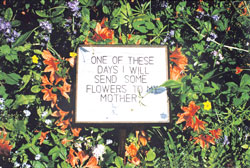
park? caption 'Mapping the Terrain'
sight specific work (London) 1996; Nausheen Saeed.
Losing
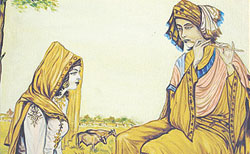
connection with script The urs of Waris
Shah to be held at Jandiala Sher Khan has been postponed because it fell in
the middle of Ramzan. It has been announced that the urs will now be held
sometime in September. But, in the last few years, this vibrant festival has
been shorn of its cultural aspects and has steadily become a lacklustre
affair. For three days and nights,
the endless recitation of Heer by bards hailing from all over the
subcontinent was its main feature but it has been toned down, to an extent
that it has almost lost its cultural significance. It is important to recall
and remember the Punjabi poets, their lives and works because, as it is,
Punjabi has been pushed to a corner. It became a casualty of the
language-divide associated with religion in the run up to independence.
Punjabi is an older language going back 700 years and the mother tongue of
the people living in this region, but it got tagged with the Sikhs since
their liturgical literature is in Punjabi and they developed a script called
Gurmukhi. A much younger language,
Urdu, after its germination in Hyderabad Deccan, adulthood in the
Delhi/Uttar Pradesh regions secured a comfortable position in Punjab during
the colonial period as it became the medium of education. Now, for most Punjabi
Muslims who constitute a majority in this country, it is left as an oral
language, the connection with the script largely being lost. In this day and
age where the written word is given scholarly precedence over the spoken
word poetry, sayings, bolian, anecdotes, qissas and hikayats etc. are
summarily dismissed as not worthy of consideration. If one looks at history,
oral tradition was given precedence over the written word and for centuries
the oral tradition expressed the intellectual and cultural developments of
the people here. Even religion was revealed in the manner of an oral
tradition and it was much later that it was written down by the followers.
No need was felt at that time to write these revelations. The dead written
word could never have replaced the vibrancy and immediacy of the sayings
communicated orally. But with technical
advancements in recordings and cheaper/ready accessibility to the computer
softwares this debate about the distinction of the oral and the spoken can
be put to rest. Whatever is available in the now dying oral tradition should
be immediately recorded and preserved. It is unfortunate that the diversity
of accents, pronunciations, the style of narration, recitation, the
enactments of the qissas and kahanis is now almost lost. Probably, the written word
as popularised by the invention of the printing press may be on its way out
and is in the process of being replaced by e-books and other softwares/programmes.
Softwares that can easily be accompanied with sound and with so much else
like the entire history of the text if it happens to be a classic, its
various versions and the critical assessment over a period of time. Instead
of only publishing the text of the various Punjabi classics, even
contemporary writing has always been accompanied by the recordings of the
oral renderings of the text, either by the poet himself, if he is alive or
by scholars or traditional bards who are familiar with the text and are
connected to that dying tradition. There may be very few left now, and an
honest search will have to be made to identify them. If done soon probably
there is still a decent chance of reconnecting the written and the spoken
word. Sound is shared by
language and music and this relationship of sound between the two has
allowed words to creep stealthily into music rather than the meaning
designated to these words. No wonder this need to record is felt even more
urgently in music because the relationship of notation and the note is even
more inexact and fluid than that of the spoken and the written word. Most of the classics in
our tradition have also been musically rendered. In Punjab and Sindh the
classics have been sung or composed in various musical modes. The Heer has
been sung in bhairveen, Mirza Sahibaan in talang while the kaafi was sung in
the kaafi raag. This too is a dying tradition because the emphasis has
shifted to either remaking/reworking the older melodies though modern
instrumentation, which basically means synthesised software generated
sounds. And because not enough is being done to preserve our heritage, much
is being thrown in the dustbin in the name of contemporaneity. The decision to
sing/recite Heer in bhairveen must have caught on to become a standard
practice. Over decades it must have been formalised and singing Heer in any
other raag must have been considered improper. Bhairveen was and is a very
popular melodic mode in Punjab, and has the possibility of engaging all the
surs. It is not confined, though, to a certain area or a region and there
are many variations of bhairveen which are sung in various parts of South
Asia. From the tunes in Afghanistan to Sindh to Bengal, bhairveen is a
universal melodic mode that fits into the style and taste of the various
regions. What should be tackled
immediately in music needs to be done in the case of an oral language that
has lost its living connection with the script. The development of the
script is also important but scripts are always inexact and function in a
living relationship with the spoken language. If not done, the language of
the majority may only be left as an oral language and this is the first step
in the language becoming extinct.
|
|