



|
|
|
|
|
 |
 |
  |
cityscape MOOD
STREET Town Talk skill Towards
a new Lahore
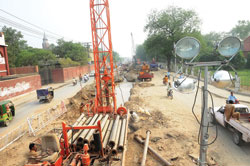
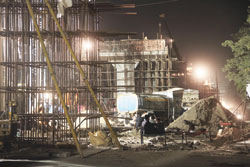
cityscape Development and displacement While work on the Bus Rapid Transit System goes all over the city, those affected by it voice their grievances By Alhan Fakhr and Jehanzeb Shoaib “Aaj ki zehmat……..
kal ki sahoolat” read posters hitched by the provincial government on
electricity poles and bridge girders throughout Lahore. If you’ve seen
the fault line that runs through the centre of the city, you know what
we’re talking about. Ever since the launch of the Bus Rapid Transport
Project in June 2011 Lahore is covered with construction camps and
machinery. Amidst rapid construction taking place in the city, are we sure
that this project is bound to be successful and worth the inconvenience it
causes Lahoris to face these days? Even though government
agencies are trying to convince the public that the project is continuing
smoothly and that it will end at the earliest, the project and
particularly the opposition it faces suggest the contrary. A major chunk
of the opposition the project faces currently centres around how the
Punjab Government should not have dug up the entire city during the
monsoon season. The Chief Engineer TEPA, Saeed Akhtar while addressing
this opposition explains: “We decided to construct the entire track at
once since we had budget and time constraints. If we constructed the track
in phases, the total time taken to complete the project would have been
four years and the cost would have escalated to 4 billion. Constructing
the entire track simultaneously will allow us to complete it by November,
this year. As for the monsoon and dengue concerns, we ensure that water
present on our campsite is drained each day, which ensures it doesn’t
become a breeding ground for the dengue vector. We’ve been lucky that it
hasn’t rained a lot this year, but we’re also prepared for that as we
have motor pumps available at each campsite which allows us to ensure that
water drains and does not remain standing.” It comes as no surprise
that the introduction of this project has invited widespread criticism
from the public. The traffic blocks around Ichhra, Kalma Chowk, Lytton
Road and Qartaba Chowk to name a few, are exasperating. To top that off
the bus terminals will be situated in the middle of two-way roads; to
access the terminal civilians would have to climb overhead bridges since
tall fences protect the bus lanes. The shocking aspect is that many
pedestrians, especially the elderly, weak women and disabled would be
excluded from this service, as they would not be able to trudge the
staircase. The proposal of installing elevators was deemed unfeasible by
experts and was shelved. The environmentalists
have also raised concerns on the BRT as they did over the construction of
the Kalma Chowk flyover that the environmental impact of these diesel-run
buses would be escalated due to the absence of green belts, which have
been eradicated for the construction of the track to take place. The
authorities claim that the trees which have been uprooted will be
replanted. Let’s see how that goes. “Hum
tang aa chukay hai is sey, hum poora din bhethay dhool miti khatay rehtain
hai,” (We are sick of all this. We keep waiting all day in this terrible
dust), says Riaz, a local shopkeeper on Lytton Road whose workshop awaits
customers. “Humaray gahak nahi
atey kyun keh rasta saaf nahi hai, is se humara karobar bohat mutasir ho
raha hai. Kab khatam hoga yeh?” (We don’t receive customers because
the road is blocked. This has affected our business immeasurably. When
will this work end?), he continues to protest. In the aftermath of the
launch of the Bus Rapid Transport, the project faces constant opposition
from the public who view the government’s promises skeptically. Among
this faction come various shopkeepers who share the same complaint, that
this project is hampering their business thereby affecting the sales. A strong opposition, a
religious body; the Ittehad Bainul Muslimeen has appeared on the scene as
they protest against the construction of an overhead bridge as part of the
Bus Rapid Transit System which stretches from Katchery Chowk to Ravi Road
by linking it with the shrine of Hazrat Ganj Bakhsh because for that they
need to demolish the façade of Karbla Gamay Shah. These clerics feel that
it would greatly hurt the sentiments of Muslims. The government in its
response has started working on developing an alternative route but such
hurdles are hampering the speed of the project. The proposal to use the
Government College University property for this project also triggered
protest by its faculty and students who flatly refused such a proposition. Similarly, many
rickshaw, bus and wagon drivers in Lahore see the BRT as major
competition, and have been protesting because they fear it will affect
their business severely. To some extent, this opposition is reasonable:
the BRT system will eliminate the means to make a living for thousands of
these drivers in Lahore since these private bus and wagon services will be
eliminated once the BRT is launched. In a country where unemployment is
rampant, creating efficiency through better transit ultimately means
cutting a number of people out of the job market, at least in the short
term. On the other hand some
rickshaw drivers are welcoming this new development as they predict it
would facilitate their business because rickshaws would be providing a
door-to-door service, which this system cannot provide. Where the BRT aims to
solve the growing conundrum of expensive public transport and traffic
congestions, the undergoing process of construction is exacerbating these
above-mentioned issues, highlighting them by the day. Only after the
completion of this project can we pass a judgement as to whether this
project was worth all the disruption. (Another story inside.)
Over the years,
Lahore as a city has undergone quite a metamorphosis. The city has a whole
new vibe now. It seems bigger, wider and cleaner than I have ever seen in
my lifetime. The city is buzzing with new road projects, overhead
passenger bridges, street names and signs on the roads and the ever
expanding list of restaurants and cafés. I moved abroad with my
family when I was in seventh grade. So the periodic visits to Lahore over
the years have made these changes in the city much more prominent to me,
than they would be to the average Lahori. What was viewed as
socially acceptable and what was not has also started to change. Girls
walking around in jeans without being looked at like aliens is more common
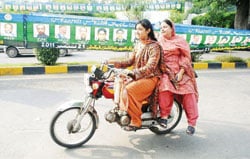
and acceptable now. Very few in number but
now you can actually see girls riding motorbikes on the roads of Lahore,
which is a very prominent change even from last year because last year
when I visited Pakistan, while talking to my cousin, I expressed the
desire to learn to ride a motorbike, which surprised him no end the
possibility of a girl wanting to learn to ride a bike, let alone ride
around on it on the streets of Lahore. This is quite a welcome
change in my view. As always beggars are
ever present on the streets of Lahore but compared to previous years, very
few children can be seen begging on the streets. In comparison to last
year, when they were seen on every street, the number of women carrying
around small children either sleeping or drugged have been cut down in
numbers a lot maybe due to all the media focus on the issue. On another
positive note there has been no dengue this year so far, thank goodness.
If some aspects of the city have gotten better, some have gotten worse.
Compared to last summer the power cut situation has gotten worse. Electricity loadshedding
every hour is quite hard to get used to. The popular saying that
the only thing that remains constant in life is change holds very well be
true as far as the city is concerned but the attitudes of the people
remain just the same. The city has taken a new step towards cleanliness;
majority of the roads have been re-constructed and get cleared of trash
daily. Yet people still carry the attitude that as long as it’s not in
our own home, throw the trash wherever you want. The same people are the
first to complain how dirty Pakistan is in comparison to other western
countries while they are not willing to do their part to keep it clean. It’s a similar case
with traffic in Lahore. Now there are more traffic lights in Lahore, some
with wardens standing in the middle of the road but how many people
actually follow those rules is the real question. Not a single car can
actually be seen driving in the traffic lanes. All of them tend to drive
right on the line, which defeats the whole purpose of having them on the
road in the first place. Leave the streets,
people cannot even restrain themselves from littering historical
monuments. From Lahore Fort, Minar-e-Pakistan, Badshahi Masjid, people
feel this innate need to make their own mark on it with graffiti markings.
Wherever there is a sign indicating do not throw trash here, you can be
sure enough to find trash right by that sign. Recently, I took a trip
to Khewra salt mines and there is some really cool stuff for the public to
see like a Minar-e-Pakistan made out of salt. What ruins it is graffiti at
the back of it. Mostly, people have signed their names. While every single
salt water pond had signs by it stating, “Do not throw trash or bottles
in the water” and you probably guessed it by now every single pond had
bottles and trash thrown in it. The city can keep
changing but the attitudes of people also need to change if we are really
to move towards a more progressive Lahore and a progressive Pakistan.
* Exhibition of
Calligraphy at Ejaz Galleries
opening on Thursday, Aug 9 at 6:15
pm. Ten artists from Lahore and Karachi are exhibiting their works. The artists are: Shahid
Rana, Bin Quallander, M.A. Bukhari, Noureen Akhtar, Jamshed Qaiser, Aamir
Kamal, Arif Khan, Asad Faruki, Mashkoor Raza, Tariq Javid. * Exhibition: Hidden
Agenda by Ayesha Siddiqui at Koel Gallery opening on Aug 11 from 5-8pm. The exhibition will
remain open till Aug 31. * Lecture on Ethics of
Disagreement on Wednesdays till August
15 at Hast-o-Neest Centre for Traditional Art and Culture. Timings:
3:00-4:00pm. * Farsi, Arabic and
Calligraphy lessons at the Hast-o-Neest
Centre for Traditional Art and Culture for the month of Ramazan till
August 18. Short courses are also available.
skill ‘Raffu’
(darning) isn’t just a skill; it’s an art. To mend a cloth by using
the threads present in that same cloth and arranging them to align and fit
the pattern; making something broken fixed again, by hand, is certainly an
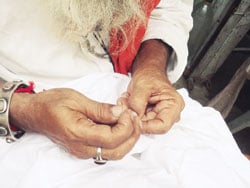
art. The wrinkles on their
arms and the wear and tear of their fingers; the preciseness of their eye
and the sweat on their forehead; the dirt on their ankles and the cracks
on their feet tell an extraordinary tale of hardship and endurance. They
sit by roadside and near drainage sewers; few in number in the whole city.
Without a proper shop or
even a workplace for that matter, they darn and mend whatever they get,
whatever condition they get it in, often settling for a wage much lower
than the skill would require. To make ends meet they expand their
horizons, taking whatever cloth they possibly can, be it jeans or even
carpets. Whether it is a hot day
with the sun burning their feet or a dry cold day that their aged bodies
can’t possibly be equipped to handle, you will find them in that same
corner, on that same street, be it in Gulberg, Chuburji or Anarkali. Most have been in this
profession for a good fifty years, some even more. This ‘Kashmiri
derived’ art is something that takes time and dedication to learn, and
only those that have learnt or have ever been in the process of doing so
realise its worth. Most of the raffu walas today learned this art from
their forefathers at a young age. “We can’t afford to
send him to school, and if he doesn’t do something he’ll get involved
in all sorts of wrong things which will disgrace the family name,” are
the words of Salahuddin’s father, a local darner. Raffu has not only
been a career option for many in the past couple of years, sometimes it is
the only option for people. One particular raffu
wala took me to Girja Chowk in Cantt and brought me face to face with a
darner who wasn’t comfortable revealing his name. This fellow adopted
raffu as a means of livelihood because he could not do anything else.
Having been gripped with paralysis, leaving only his arms and hands
functioning, he found that he could do this work and make a living. “Raffu is delicate
handiwork and time consuming. Just learning the skill takes up to two
years, that’s close to how long it would take you to get a college
degree. Mastering this skill, however, takes even longer,” are the words
of 65 year old Muhammad Butt, who has been in this business his entire
life. Their customers and
wages have remained more or less the same in the last 10-15 years. “We
have been sitting here in the same place for years now. Old and loyal
customers come to us with expensive shawls or clothes that have been torn
and are far too valuable to be discarded,” are the words of the same
man. Their daily wage comes out to be Rs600-700, which may be above the
minimum wage but not enough to make ends meet. To say that ‘raffu’
is extinct would be wrong, however, to say that it is endangered could not
be truer. It just so turns out
that the characteristics of raffu that make it an art is the same reason
for its demise in Pakistan today. The world that we live in today is
engulfed by the concept of ‘Time is money’. Every country is in a race
to be the first and to be the best and in that race we lose out on a lot
of valuable possessions. The older generation
felt a need for darning to live on because the demand for it also existed.
The younger generation however, has not expressed a demand for it, hence
the supply doesn’t exist. They say that even if the demand continues to
exist there will be no supply available. Many raffu walas believe
that darning by machine is something that has taken over the authentic
form of darning. They believe it to be a disgrace to the painstaking work
and immeasurable effort that goes into hand darning. “Nothing can ever
take the place of raffu by hand, regardless of how many machines they
make,” are the comments of Salahuddin, a local darner. About his children, he
says, “I have tried several times to teach my children this work so this
skill can live on but they just aren’t interested,” whilst others
remark, “There is no room for darning, along with many other such arts,
in tomorrow’s Pakistan. I have seen this country change course countless
times and we hardly get back what we lose.” Technical training
centres operating in rural and urban areas, used to teach darning, amongst
other arts, in the hope of preserving this precious skill. However, this
wasn’t something they were able to force onto the students nor was it
something that grew in the hearts of many. Students were so
disinterested in darning that they would bring their work to the raffu
gars already there. “We were incredibly disheartened to find that even
with the opportunity available, there were few takers. The professionals
would refuse to do the students’ work because they thought it to be a
disgrace to the culture of handiwork and if this art really is meant to
die, then it too, deserves an honorable death,” says Salahuddin. “Children today have
different clockwork. Why would they want to spend immense amount of time
learning an under-appreciated art when they can spend lesser time
mastering skills that have a place in today’s world,” are the words of
Salahuddin. “I tried to take the
initiative myself and told young boys to come work with me. I was willing
to teach them how to darn and agreed to pay them 100 PKR per week.
However, none of them was truly willing to learn and left after a week or
two,” is what Abdul Rauf, a darner from Anarkali, had to say. Raffu gars who are
artists and labourers alike, shed a tear every time the painful reality
hits their heart that their legacy will no longer live. They are doomed to
sit at the stuffy and shabby corners of dry cleaners’ shops where the
faded colour of the floral mat they sit on reminds them of the reality
that their bodies can no longer keep up with changing times, even though
the vigour in their heart can light a fire. In the narrow and aged streets
of Anarkali, where every building tells a story, these raffu wallas tell
theirs, that they are alive, but dying.
Towards
a new Lahore
Once constructed, the
first line of the Bus Rapid Transport Project is meant to cover 27
kilometers spanning from Kahna all the way up to Shahdra. “This line is
meant to be formally inaugurated by December 19, 2012 by Dr. Qadir Buksh
and the Punjab Chief Minister, Shahbaz Sharif. Hundred buses are ready to
be gifted to Pakistan as soon as the track is ready. Furthermore, Turkish
authorities are also assisting the Punjab Government to develop a parking
plan alongside the bus track as well as training the local traffic police
and workers who will be deployed on the track once its running. If this
umbrella project succeeds, the Punjab Government intends to extend the BRT
system to other cities of Punjab which include Faisalabad, Gujranwala,
Sialkot, Rawalpindi and Gujrat,” explained the same official from the
Pak Turk Association.
While various
contractors have been assigned the task of constructing the BRT track,
other government and semi-government institutions serve as the masterminds
behind executing the entire project. NESPAK, a semi- government
institution is responsible for providing blueprints for the BRT track as
well as the diversions that have been created throughout the city to
ensure the smooth movement of traffic throughout Lahore. “The Traffic
Engineering and Transport Planning Agency (TEPA), is present on each and
every campsite. Not only do we overlook the construction work alongside
the contractors i.e. the construction companies but TEPA is also
responsible for the engineering of the whole project,” says Rana Mohsin,
the site in-charge for TEPA’s campsite on Lake Road as he explains the
role of TEPA in the entire project. The Lahore Transport
Company (LTC) is also a major stakeholder in the entire project as it is
responsible for the maintenance and running of the Rapid buses once they
arrive while the Lahore Development Authority (LDA) is solely responsible
for the maintenance of the track, the bus stations and the overhead
pedestrian bridges once the entire plan is executed. The Punjab Information
and Technology Board (PITB) also has a key role to play in development of
the entire project. “By December 30, 2012 the PITB will develop an
entirely computerised system for ticketing along with a tracking system
which will monitor the movement of the Rapid Diesel Buses throughout
Lahore. The Punjab Information Technology Board is also developing an
e-ticketing system which will be the first for Pakistan’s Public
transport sector,” confirms a source in the PITB. The
features of this BRT system like reserved lanes, level boarding, signal
prioritisation, and off board payment all contribute towards making the
system a parallel to those present around the globe. Let’s see how
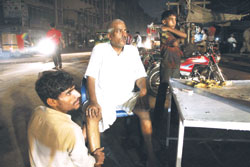
‘world-class’ it turns out to be. Power-less caption Passing time in the open in the absence of electricity.
|
|
 Town
Talk
Town
Talk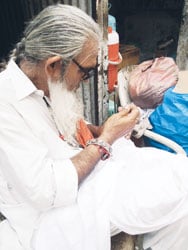
 The
Bus Rapid Transport Project is a joint venture between the government of
Punjab and the Istanbul Municipality Corporation. The project apart from
the Government of Punjab is also overseen by the Pak-Turk Association,
which serves as a liaison between Pakistani and Turkish corporations
involved in the construction of this project. When asked sources in the
Pak-Turk Association about Turkey’s imperative role in the project, an
official informed TNS: “Our organisation plays a coordinating role in
the entire project. The Government of Turkey under Dr. Qadir Buksh has
invested in seven different sectors in Pakistan. Three of these projects
are the Ring Road Project, the Bus Rapid Transport and Hydro-electricity
generation.” Our sources in the Pak-Turk Association also informed us
that two Turkish firms namely OzPak and Al-Yarak have undertaken the task
of assisting in the construction of this massive project.
The
Bus Rapid Transport Project is a joint venture between the government of
Punjab and the Istanbul Municipality Corporation. The project apart from
the Government of Punjab is also overseen by the Pak-Turk Association,
which serves as a liaison between Pakistani and Turkish corporations
involved in the construction of this project. When asked sources in the
Pak-Turk Association about Turkey’s imperative role in the project, an
official informed TNS: “Our organisation plays a coordinating role in
the entire project. The Government of Turkey under Dr. Qadir Buksh has
invested in seven different sectors in Pakistan. Three of these projects
are the Ring Road Project, the Bus Rapid Transport and Hydro-electricity
generation.” Our sources in the Pak-Turk Association also informed us
that two Turkish firms namely OzPak and Al-Yarak have undertaken the task
of assisting in the construction of this massive project.  With
Turkey’s role being clearly defined in this project, the Government of
Punjab has also allocated the responsibility of constructing and managing
the entire project to several government, semi- government and private
corporations. Maaksons, a private construction firm is responsible for
constructing the track from Kalma Chowk all the way up to Ichhra. The
National Logistics Cell (NLC), a government run cell is constructing the
track all the way from Mozang to Lytton Road, while two private
construction firms ZKB and JV are collaborating to build the remainder of
the track. “ZKB and JV are responsible for constructing 2.5 kilometers
of the BRT track from Qartaba Chowk all the way up to Mayo College,”
elaborated M. Habib Khan, the Project Manager for ZKB and JV.
With
Turkey’s role being clearly defined in this project, the Government of
Punjab has also allocated the responsibility of constructing and managing
the entire project to several government, semi- government and private
corporations. Maaksons, a private construction firm is responsible for
constructing the track from Kalma Chowk all the way up to Ichhra. The
National Logistics Cell (NLC), a government run cell is constructing the
track all the way from Mozang to Lytton Road, while two private
construction firms ZKB and JV are collaborating to build the remainder of
the track. “ZKB and JV are responsible for constructing 2.5 kilometers
of the BRT track from Qartaba Chowk all the way up to Mayo College,”
elaborated M. Habib Khan, the Project Manager for ZKB and JV. 
