



|
|
|
|
|
 |
 |
  |
development Not-so-national anthem By Zoha Majeed Throughout school years many things underwent change; some drastic, some rather mild but there was some sort of change, be it our friends, teachers, grades or courses. However, every school day began with the morning bell that called students to gather to begin the day by honouring what we all truly were Pakistani. It didn’t matter whether it was a humid summer morning or a chilly winter one, even the flooded ground from the weekend’s rain couldn’t stop that national anthem from being sung. While private schools would have a band and karaoke music to assist their students, public schools in rural and urban areas would make do by just the vigour in their voice and the determination in their chords. People living around any school can recall children singing national anthem first thing in the morning at school. It could be heard loud. Town Talk
development Land of opportunity Land acquisitions by government for roads expansion have led to protests against ‘unjustifiable compensations’ By Shahzada Irfan Ahmed Sikandar Khan, a
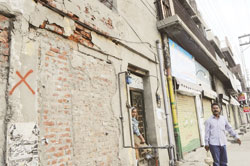
bearded trader in his late 50s, oversees the demolition of a portion of
his shop located close to the Lahore Camp Jail at Ferozepur Road. Issued a
notice to clear 12 feet-depth of the shop for inclusion in the road
expansion project, he tried all available channels to get it cancelled but
to no avail. Finally, he has employed
private labour to remove the structure before the enforcement team of
Lahore Development Authority (LDA) arrives with its favourite herd of
contractors. In that case, the contractors will do the cleansing work
themselves. If they can do the work for free, why is he footing the bill
himself? The answer is simple; the LDA contractors, according to Khan’s
allegation, become owners of the rubble which includes costly construction
material such as bricks, wood and iron rods and girders. The owner of the
vacated building will be entitled to the price of land decided by the
government. This happens when they do the demolition work themselves, so
he is trying to avoid this forced seizure. Khan is just one of the
many victims of those official land acquisition drives where rules have
been violated and the state machinery has relied more on use of force than
dialogue. He has been promised compensation but he does not know when that
amount will be paid to him. All he knows is that he has to vacate the
place as early as possible and transfer its ownership to the project. If Khan is to be
believed, it is sheer violation of the Land Acquisition Act, 1864 which
bars state authorities from acquiring land till the time the agreed market
rate has been paid to the owners. The said law is the basis for legal and
administrative land management in Pakistan and provides framework for
acquisition of properties in projects of public purpose. Many land acquisitions
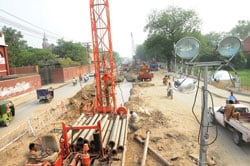
related to projects such as construction of Ring Road, expansion of Multan
Road and Bus Rapid Transit (BRT) have evoked criticism from the affectees
and led to protests against ‘unjustifiable compensations’ awarded to
them. For example, the government is offering Rs.800,000 per marla at
Lytton Road but traders claim the rate there is Rs.2 million per marla. “The affectees have
relevant forums to approach for arbitration but the options are limited
for certain reasons,” says Muhammad Akram, a real estate advisor. Having
witnessed a few land acquisitions and participated in price determination
surveys, he says it is practically impossible to avert acquisition once
the project is announced to be launched for public purpose. The state, in
this case, has the authority to occupy land even forcefully so people
avoid confrontation and try to agree on leaving against monetary
compensation for their property. The process of land
acquisition starts with issuance of notices under section 4 of the Act to
the owners of the property required for the project. “These properties
are marked, an area-wise compensation package or award announced on the
basis of property market surveys, claims and public hearings called and
objections regarding compensations are heard in subsequent stages by the
land acquisition collectors, Akram adds. Normally compensations
are calculated on the basis of average property transaction costs recorded
over the last five years or so in the areas in question. Akram says as
most people mention prices much lower than actual in sale deeds in order
to avoid taxes, the average amount works out to be quite low. “This is
one reason why affectees agree on compensations lower than the market
value. The courts of law need supporting documentary evidence which the
affectees lack.” He tells TNS individuals who mention original price and
pay heavy taxes suffer the most as their deals have little weightage while
average prices are worked out. The affectees are not
always the losers. They are sometimes so influential that their resistance
leads to a change in the original project plan. This has happened in
Multan Road expansion project near Kharak where service lane was done away
with to save commercial properties of some ruling party politicians.
Similarly, the Punjab government dropped its plan to acquire land on
Ferozepur Road from Muslim Town Mor to Qartuba Chowk and construct an
elevated corridor instead. When asked about this
preferential treatment, Punjab government spokesman Pervez Rasheed told
media the plan was changed out of fears that people will move courts and
delay construction of the BRTS. TNS contacted Lahore
Transport Company (LTC) General Manager Uzair Shah, who is also looking
after BRT, for comments on the land acquisition process for the project.
He says that Lahore Development Authority (LDA) has been assigned this
task and it is doing so according to the relevant laws. Shah adds any
person not satisfied with the process has relevant fora available to
approach for redressal of complaints. Ahmed Rafay Alam, an
environmental lawyer with special interest in town planning, agrees BRT is
a project launched in public interest but believes the ill-planning
involved in its execution has caused too much inconvenience to the people.
He tells TNS “public purpose” is a bit vague term and sometimes
governments do strange things under its pretext. For example, he says, the
Punjab government has acquired hundreds of kanals of land to build a golf
course. “How can a golf course serve public purpose?” Rafay tells TNS some
people from Ferozepur Road have approached him, and they claim they were
not issued proper notices by the concerned authorities before the
acquisition of their properties. An LDA official tells
TNS on conditions of not being named that it’s true they have acquired
land without paying compensation in selective cases but this has been done
under an agreement with the land owners. He says there are people who are
not satisfied with the compensation offered to them. “I suggest they
should approach the relevant authorities (land acquisition collector) with
relevant record to register their complaints.” The official says the
land acquisition laws even have the provision of offering interest on
outstanding amount to claimants who succeed in getting the compensation
amount revised in the court. “The law is not oppressive at all, the
official adds, saying a court order had barred Punjab government from
acquiring land in Narowal on grounds that the Act applies only in cases of
emergency.” He claims land
acquisition for BRT, on the whole, has been smooth and, barring the tussle
with Dar-us-Salam publishers at Lower Mall, all issues were settled
amicably. The law, he says, takes pure property value into account and
cannot compensate for the goodwill money (pagri etc) related to successful
businesses, or on the basis of likely escalation in property prices in
future due to its proposed usage under the said project. “Most of the
reservations are based on these elements,” he concludes.
Throughout
school years many things underwent change; some drastic, some rather mild
but there was some sort of change, be it our friends, teachers, grades or
courses. However, every school day began with the morning bell that called
students to gather to begin the day by honouring what we all truly were
Pakistani. It didn’t matter whether it was a humid summer morning or a
chilly winter one, even the flooded ground from the weekend’s rain
couldn’t stop that national anthem from being sung. While private schools
would have a band and karaoke music to assist their students, public
schools in rural and urban areas would make do by just the vigour in their
voice and the determination in their chords. People living around any
school can recall children singing national anthem first thing in the
morning at school. It could be heard loud. When I began school I
remember being a part of this enthusiastic celebration of our nation.
However, in my 11 years at school even I am no stranger to the fact that
things have changed. I no longer sense the same drive and dynamism that
once came with this very anthem. If you were to be a
third person spectator to an average morning assembly this is what you’d
see; students scurrying across the school and in crowded hallways,
gathering for the assembly. They’d line up and you’ hear low key
chatter coming from the back of the line which would stop every now and
then, when a teacher came for rounds. As soon as the drumming for the
national anthem would begin they would put their feet together, hands by
their side and chin up and…mumble? Lip sync? Not sing at all? In reality
it’s all of the above. So why is it that this
melodious, 3-stanza composition, built on eastern beats with a series of
exalting highs and lows, has found its way into that portion of many of
our lives which makes it mandatory yet insignificant. Even after being a
part of the same generation, the same clique, it is hard to understand why
this happened to begin with, and what led to this great deterioration of
our conviction and devotion. Many consider it to be the new wave of
‘cool’ that has been adopted by the 21st generation. This contemporary
idea is highlighted in documentaries such as ‘Merchants of Cool’,
whose basic jist is that today’s generation has adopted a popular
culture of ‘cool’ which may be generalised as anything that is
unknown, uncommon or different. There is a modern need to disassociate
yourself from a clan mentality and be recognised as an individual.
Consequently, everything that is new and uncommon is considered ‘cool’
and as soon as it is adopted by others and becomes universal it is no
longer ‘cool’. While some argue that
this very idea is what is prevalent in today’s youth and the reason they
don’t sing the national anthem as it should be sung, another idea is
that most of the youth genuinely doesn’t believe in this nation, hence,
they simple don’t associate with the national anthem as a symbol of
pride and honour. Strangely enough, many
adults from the past generation agree saying, “Times were infact better
when we were growing up.” Things such as the War on Terror, drone
attacks, suicide attacks, governmental policy, inflation, increasing
unemployment amongst many others have affected rich and poor youth alike,
causing disassociation with the nation. This is seen when a lot of youth
go to study and even move abroad. While there are many
takes on why this is happening, there is one thing almost everyone is sure
of, and that is the domino effect in this sort of a situation. While one
or two or even a small section of the younger population, lets say, a
school is influenced in this way, there will be many others that will not.
However, the increase is because of the domino effect students mimick
other students and the process goes on; that is, the fall of one domino
eventually makes all of them fall. While some of you
reading this may be thinking that this is a small issue, to me if
nationalism is not in our veins, then how can we as a nation focus on
other issues? The love for your nation isn’t exactly something that you
are taught, its something that you acquire by associating yourself with
your nation in the smallest ways possible, such as; wearing green every
14th August, making time for that annual family picnic to Minar-e-Pakistan,
reading Kamila Shamsi because she’s someone you can relate to more, and
amongst other things, singing that national anthem every day at school. So when we start to lose
small nationalistic actions present in our daily life, we feel the need to
restore them.
*College Day 2012 at LGS
Paragon on August 25 from 4-7pm for anyone who needs
help with colleges, essays, interviews and
applications. *Talk on ‘The Arab
Spring – A People’s Perspective’ by Raza Naeem at Thaap on Saturday, Aug 25. *Exhibition: Hidden
Agenda by Ayesha Siddiqui at Koel Gallery opening on Aug 11 from 5-8pm. The exhibition will remain open till
Aug 31. *Open Mic at The
Knowledge Factory on Friday, Aug 24 at
8:00 pm. *3rd International Gems
and Jewellery Exhibition at Pearl Continental Hotel
|
|
 Town
Talk
Town
Talk
