|
|
| |
Lion
for Lambs**
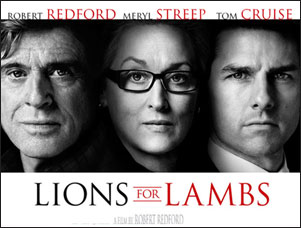
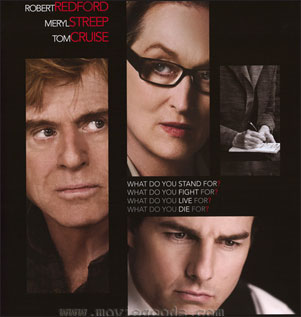
*ing: Robert Redford, Meryl Streep, Tom Cruise, Michael Penna
and Derek Luke
Directed by Robert Redford
|
| |
 |
| |
|
Take
a hot button subject, an Oscar-winning director, and place some
heavy star power in front of the camera and you have all the ingredients
for a mega hit that will pack theaters and leave people buzzing,
right? Unfortunately, the answer is no in the case of Lions for
Lambs.
Lions for Lambs has all those elements but the filmmaker somehow
forgot to add the most important part of the recipe to the mix –
a real story to tell. Robert Redford's first film as a director
in seven years is his most overtly political drama, an intelligent,
occasionally provocative feature that wears its political agenda
on its sleeves but doesn't convince dramatically or artistically.
|
| |
| The
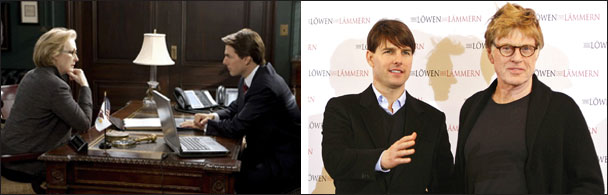
film follows three storylines playing out simultaneously. One segment
focuses on Republican Senator Jasper Irving (Tom Cruise), a politician
with a risky idea on how to stop the war. Senator Irving invites a
journalist (Meryl Streep) who's been in the business for 40 plus years
– long enough to have covered the debacle that was the Vietnam
War – into his office for an hour long one-on-one in order to
give her an exclusive on his ambitious new plan of attack. Irving's
plan: to surprise the enemy by using smaller, quick-moving military
units. Of course that means there's less support and back-up |
 |
| should
things turn nasty, but Senator Irving's ready to take that risk because,
as he tells the reporter, he'll do whatever it takes to turn the war
around. |
| |
|
While
Senator Irving's busy explaining his approach to winning in Iraq
and Afghanistan, lifelong friends Ernest Rodriguez (Michael Pena)
and Arian Finch (Derek Luke) are sitting with their fellow soldiers
as their commanding officer explains their next mission –
a mission based on Senator Irving's proposal. Their leader admits
the plan's being rushed into fruition, but they are under orders
to carry out the attack. Exactly how rushed the mission is quickly
becomes evident when the unit's helicopter comes under heavy fire
and Rodriguez and Finch are left alone in enemy territory after
falling (or in Finch's case, jumping) from the helicopte
|
| |
| California,
Professor Stephen Malley (Robert Redford) calls student Todd Hayes
(Andrew Garfield) into his office to discuss his future. Malley sees
something special in the kid, despite the fact he's no longer showing
up for class on a regular basis. Once passionate about political science,
Todd has become disconnected and cynical. Malley thinks there's a
way to reach him, if only he can get Todd to become engaged in current
affairs. Believing there's an activist waiting to be awakened, Malley
tells Hayes all about two of his favorite students – Ernest
and Arian – who left college because they wanted to make a difference
and couldn't do so by just talking about ways to fix things. They
gave up college life to enlist in the military to see for themselves
what's going on beyond the safe walls of their California College. |
 |
| |
|
Senator
Irving's priming himself for an eventual run at the presidency and
Cruise's performance captures that sickeningly smooth political
vibe. Redford's fine as a college professor who's been around the
block quite a few times but hasn't given up hope that he can positively
influence his students into becoming better human beings.
The usually stellar Streep is, for lack of a better description,
wasted as a reporter who knows she's being used and manipulated
yet can't seem to stop playing along anyway. Streep's playing a
woman who has supposedly interviewed thousands during her four decades
in the business, yet she fidgets and huffs her way through this
one interview with this particular senator. She knows him, he likes
her, so why the nervousness? The decision by either Redford, Streep
or a combination of the two award-winners to play her as almost
overwhelmed by her interviewee's presence was a weird choice.
None of the leads sell their stories with the exception of Michael
Pena and Derek Luke. These two made the most of their parts in Lions
for Lambs, and gave the film a much needed jolt of both emotion
and adrenaline whenever they appeared onscreen.
Those who've seen the trailer or read anything about the film will
know going in that the movie blasts President Bush and all those
who backed the war in Iraq. But the film does absolutely nothing
to win over the hearts or change the minds of fence-sitters, and
that seems to have been its entire goal.
Get engaged, speak out - the call to action is the point of the
film. Lions for Lambs is not here to entertain us, it's here to
inform anyone willing to listen about what's going on right now
in the world. However, and this is where the movie fails so miserably,
there's a whole lot of pontificating that leads to absolutely nowhere.
That's right, nowhere. After sitting through this dialogue-heavy
drama and you're expecting all the insistent yapping to have been
leading up to a finale that'll knock your socks off or at least
leave you anxious to make your voice heard, there's a meek little
ending that's more of a feeble whimper than a roar. Lions for Lambs
is an extremely disappointing film that wastes a solid premise.
There's neither depth nor vigor (spoken or visually) to any of the
contentious back and forth, and though its trio of stars excellently
portray their various characters (dangerously self-interested young
Republican, conflicted and appalled journalist, noble professor),
they remain, throughout, mere stereotypes.
--Saba Sartaj K
*YUCK
**WHATEVER
***GOOD
****SUPER
*****AWESOME |
| |
|