


|
|
|
|
|
 |
 |
   |
elections MOOD
STREET Town
Talk education
Sheer violation The Code of Conduct regarding election spending is all set to be flouted this time like ever before
By Hamid Waleed It is short memory of the voters that keep our politicians
in office, they say but voters cannot be blamed alone for that. The Election
Commission of Pakistan is also equally responsible for the return of already
tried politicians because of its casual attitude towards implementation of
the Code of Conduct for the election candidates. As the election activity starts in the month ahead, the political parties and their nominated candidates are all set to urge the voters to vote for them on January 8, 2008. One way to attract voters is to make the election campaign colourful by all possible means. Politics in Pakistan has been concerned with right or left instead of right or wrong, therefore, the politicians apply every possible idea to grab the attention of voters without realising that they are violating the related laws. Huge election expenses are never restricted to public gatherings or election offices; money is spent on printing of stickers, pamphlets, banners, flyers, billboards, wall chalking and election symbols. They put their election symbols like bicycle and cart etc. on the roofs of their election offices. Ahead of the 2002 elections, the Election Commission of Pakistan revised the Code of Conduct for candidates under the Representation of the People Act, 1976. The revised Code of Conduct limited expenses both for the candidates of National Assembly and Provincial Assemblies to Rs. 1.5 million and one million rupees respectively. Besides, sizes of the posters, hoardings, banners and leaflets/handbills were also restricted to 2ft x 3ft, 3ft x 5ft, 3ft x 9ft and 9" x 6" respectively. Similar Code of Conduct was also applied to the election
candidates of local bodies held in 2005. Sources in the Election Commission
of Pakistan point out that number of complaints against the violation of the
Code was more in local bodies' elections compared to the general elections of
2002. In order to see that the Code of Conduct is followed in spirit, the Election Commission of Pakistan has a complaint cell. The commission does not act on its own. It is supposed to act only after someone from the general public registers a written complaint with it for violation of Code. It is very rare that someone, either from the general public or the contesting candidates, reach the complaint cell of the Commission against violation of the Code. Resultantly, the whole exercise proves futile and violation continues unchecked. Election Commissioner Punjab Ayaz Baig says the number of complaints received for local bodies elections was impressive. However, other sources in the Commission point out that it was still not a worth mentioning number. It is not easy to access the record on elections lying in files because it was no good asking the EC for the exact complaints received in 2002 general elections or the following local bodies' elections in 2005. The revised Code of Conduct for upcoming general elections that was announced in the month of October faced controversy immediately after its announcement. While the limits on expenditures were clearly mentioned in the draft rules they were missing altogether in the final version of the Code of Conduct. The political parties assumed that the Election Commission has withdrawn the limits on expenses on campaign but the Election Commission, after realising the mistake, made clear through press that the limitation existed as mentioned in the draft rules and no one is allowed to cross the prescribed limits. The confusion, however, still exists and good number of candidates are likely to be unaware of the clarification. According to the procedure, notification of a candidate is not issued by the Election Commission of Pakistan unless the said candidate files return on its election expenses to the Commission after winning the elections. The Commission's staff issues a standard return to the winning candidate, requiring from him to describe whether he spent within the prescribed limit during the election campaign. The winning candidates describe their expenses within the prescribed limit and the commission staff verifies their claim without any inquiry on ground and the central office notifies them as winners of the election. This sheer violation of the Code of Conduct that goes unnoticed generates unimaginable business activity in printing presses. A rough estimate, according to the community sources, suggests a business activity of over Rs 2 billion only in Punjab during the election season. According to the market sources, the Royal Park market turns into hub of business activity and election candidates from across the province rush to that area to get their stickers, banners, posters, flyers and pamphlets printed. Printing rates shoot immediately and the business activity creates many temporary jobs in the market. Right from the designers to machine men, everyone makes money out of the lust for power on the part of election candidates. So much so, that many investors import hi-tech printing machines to make hefty profits in a short span of time. "Now that December is here we will start receiving heavy orders," says Omar Khan, a local printing press owner, adding, "Some candidates have placed their orders and have asked the printers to keep the place allocated for election symbol empty until it is allotted and printed accordingly." Talking to The News on Sunday, one party candidate for National Assembly asserts that each candidate spends around Rs. 2.5 million to Rs. 4 million on his campaign in general. It seldom happens that someone approaches the Election Commission of Pakistan against the MPs. The Election Commission, on the other hand, has a severe shortage of staff to deal with violation of the Code of Conduct. Benefits of break
By Saadia Salahuddin Breaks are good - break at school, from school, from work, in short from any routine - all kinds of breaks are welcome. That is why people in Europe save all year for a holiday. Most of the people switch off the phones and e-mails as well. The idea of a break is to relax. While the Europeans go to sunny places because sunlight is
precious in that region we go to hilly areas, to cool places because we have
long summers in the plains. A break can be taken with change of scene, leaving the office worries behind. A very small number of people go on holidays, still fewer disconnect themselves from work, hence we hardly relax. A number of us holiday with family, that is siblings and parents. Most of the time the family that travels to a destination is on holiday and the family at whose place they are staying are going to work. This creates kind of imbalance and spoils the holiday for the adults while for children meeting cousins is the the best time of the year. The wise ones choose rest houses, hotels and rented rooms where families and friends go together. One does not feel guilty of burdening the other. This makes holidaying better. For some, workshops and conferences at far off places or simply away from home, come as a break. They offer a chance to learn something new, meet new people from different regions who do not judge you. We make new friends in good faith. Remember your classfellows from childhood. How much fun it was with them. When we grow old, from which I mean when we are no more naive, making friends in a class that is there to learn new things, is still great. It's important to keep making new friends because they bring new ideas with them, hence widen our horizon. If you want to understand the true meaning of break, watch school children in recess. The moment the bell rings all the children run out of the classes, the boys diving in the corridors with lunch boxes in their hands, to nowhere -- most of them just run and run throughout the break time, one after the other. I wonder if little boys eat their lunch. Many prefer to play during the recess and eat the lunch after school. They don't want to lose any time that is a break from class -- that is definitely meant to play. The scene is nearly the same after school but schools have become so crowded that children's playplace is constantly shrinking. When I was in school I viewed the days preceding the sports day and that day itself as a break from routine. Going for practices and selection, daily for different events are memorable and the annual sports day brought with it colours and fun. In modern schools, which were not there when I was a child, there are no playgrounds. Still they hold the special day, guess where? I was immensely surprised when my children one day came and told me that "today was sports day and it was held on the rooftop of the school and we had a lot of fun." So they could have fun even on the rooftop. Children do not waste a moment of break. If we want to understand the meaning of 'break' we should observe children. It's about enjoying every moment they are on their own. Once, sometime back, while waiting for the bus to arrive at a bus stop, I saw a bunch of school children. Like me they were there to board the bus that would take them home. They were jumping from the footpath to the green belt again and again and enjoying every moment of the time and space that they had on their hands. I loved them at that moment and only if we learn to live like children again it would be great.
World Performing Art Festival 2007 at Alhamra, Gaddafi Stadium
• Film Night featuring Beggars of Lahore, Yeh Hum Naheen & Hazaar Chaurasi ki Maa from 4pm to 9pm on Dec 02, 2007 at Hall#2.
• Assorted Puppet Skits/Patay Khan from 04:00 to 05:00pm on Dec 02, 2007 at Camp#6.
• Folk Puppet Bahadur Ali from 4pm to 5:30pm on Dec 02, 2007.
• Florian Feisal -- Herzkasper from 4pm to 5pm on Dec 02, 2007 at Camp#4.
• Paintings by Assaad Sallahuddin from December 2 -4 at Nairang Galleries.
• Exhibition - Shahid Sajjad on 02 Dec 2007 at National College of Arts.
• Exhibition of Blue Pottery Products organised by TEVTA's Institute of Blue Pottery Multan & Institute of Pottery Shahdara Lahore on Dec 02 from 11am to 11pm at Avari Hotel.
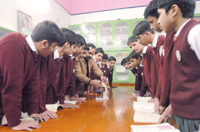
Limiting education Students and educationists dispute a new system for secondary schools examination that disallows private students to appear in matric examinations in science group
By Zaheer Ahmed "I want to become a doctor," says a 14-year-old
Yasin S/O Muhammad Ali, resident of Salamatpura locality of Kot Lakhpat
industrial area who wants to appear in matriculation examination as a private
candidate but is upset over the restriction imposed by the government on
appearing in board exams with science subjects. "We are four siblings, our father has abandoned the house and our mother works in various houses in Model Town area and hardly earns Rs 2,000 per month. I also sell newspapers daily till 9am and later work at a grocery shop where I am employed for Rs 1500 per month," Yasin tells TNS. From here he gets a breaks at 4pm. This is the part of the day which he looks forward to because this is the time when he goes to study. An aged retired government employee has been kind to teach the boy. He lives in the same locality. "Financial constraints do not allow me to take admission in public or private school and restrictions on private students for appearing in science subjects has discouraged me. It seems that I am being deprived of my fundamental right to get modern education due to wrong policies of education department," he adds. The Education Department Punjab through a notification NO.S.O(A-II)8-5/2002, dated 27-1-2004 had introduced a new system for secondary schools examination under Board of Intermediate and Secondary Education (BISE) in which private students cannot appear in matric examinations in science group and other subjects where practical exam is a must. The science group consists of Physics, Chemistry, Biology, Math and Computer Sciences for class 9th and 10th. Ever since the restriction was imposed, there has been a clamour to withdraw this rule. The government on one hand is spending billions of rupees on education sector and on the other depriving the poor children of their fundamental right to get modern education by imposing restrictions on private students under the new examination system. President of Pakistan Pervez Musharraf had already directed the seminaries to make special arrangements to impart science education to its students in order to bring them in mainstream of national development. Imposing restriction on private students means contradiction of the order of the president. There are no proper facilities for regular students to get education in science subjects as a number of schools in rural areas of Punjab have no lab and science teachers and the children of backward areas have no choice but to study humanities. In this way, talent is going waste. According to statistics presented by the Ministry of Education in a senate meeting in 2006, there are 56,233 schools in Punjab, of them 26,902 schools are without boundary walls, 12,536 are without water facilities, 38,414 without electricity, 31,502 without latrine while 4,301 schools have no buildings. The restriction on private students to appear in science group tantamounts to strangulating the talent and depriving them of their fundamental rights to get modern education. "New examination system for private students at matric level will prove to be an obstacle in the way of new generation to become doctors, engineers and scientists. It is heartbreaking to restrict the working children from appearing in science group in matric exams," says Abdul Quddus Kasuri, secretary Model Falahi Society Kot Lakhpat. The restriction is encouraging private educational institutions which are affiliated with the BISE, he says. These educational institutions are making money by attracting private students through advertisement and are getting Rs 3000 plus other dues for sending their admission. He appeals to the authorities in the Education department to review the restriction and allow children to appear in science group in matric examinations. "The government should facilitate them instead of introducing new matric exam system," says Chairman All Pakistan Teachers Federation Muhammad Azam Butt. He says, "The Education department is restricting private students in order to encourage private educational institutions, just to make money." He says being a member of the board himself he asked the board chairman and fellow members to eliminate this restriction on private students but they say this is an order from the high-ups. He says some school owners are running many schools on one registration. Abdul Rehman, District Officer School says that the private students got relaxation in the last couple of years which cannot go on for ever. He denies that there are missing facilities in government schools. Special Secretary Schools, Capt (retd) Zahid Saeed says the decision to restrict private students from appearing in Board exams with science subjects has been taken by the Inter Board Services Committee (IBSC). The stance of the Board in this regard is that a private student does not attend the science lab, so how can he qualify practical examination. Billions of rupees are being spent on the promotion of modern scientific education and for this purpose science and computer lab facilities are being provided to schools in the Punjab. He admits that special focus is on the recruitment of science teachers rather than arts teachers which are already available in abundance. There are 4545 high schools for male and female students in the province besides 409 higher secondary schools where 7000 SST (science teachers) are available, while the number of arts teachers in the government schools is 25580. "Our focus is to recruit maximum SSTs in future," he adds. A hefty amount of six billion rupees is being spent to establish 1700 computer labs during the fiscal year of 2007-08 while an amount of five billion rupees has already been spent on providing missing facilities to schools in Punjab in the last few years. A sum of Rs one billion has been spent for the provision of computer labs to 515 schools, he adds.
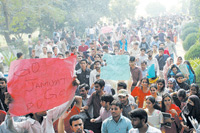
Student politics at Punjab University has seen some unprecedented developments in the last few weeks By Khan Shehram Eousophzye The moderate students in Punjab University were perhaps
looking for an opportunity which they got in the form of Tehreek-i-Insaaf
chief Imran Khan's arrest some time ago at the hands of Islami
Jamiat-e-Talaba (IJT). For the first time in decades they managed to take out
anti-Jamiat rallies within the premises of the university and plan to take
out more. "I personally wanted to put an end to the IJT rule," says
Ali, a student of law at the Punjab University. "The grim incident that
took place in the university premises clearly showed the intention of the IJT
of not allowing someone who could act as a potential threat to their
cartel." The maltreatment of Imran Khan at the hands of IJT acted as a catalyst. Moderate students felt the need to build up on the situation and thus put an end or at least dilute the influence of IJT. Imran's manhandling and arrest were followed by peaceful and civilised protest rallies that condemned the untoward incident. At this critical time, small groups of students grabbed the opportunity and joined forces with the moderate students. Sensing this strong opposition, IJT was forced to immediately retract from its stated position and blamed the incident on 'unknown' elements. The IJT has always had the support of the highups of the institution. It was thought to have been protected, supported and even patronised by professors and people within the administrative body of the university. The anti-IJT student uprising was countered by the pro-IJT professors in such a way that is alien to any educational institution around the globe. A threat was publicly announced that students caught protesting would have to face the wrath of the teachers supporting IJT. With such intimidation from the teachers the students who were not well-off financially, drew back from the movement to safeguard their education. Amjad who is staying illegally at the university hostels says, "Why should I raise my voice against the IJT. The IJT has solved my accommodation problem so why should I raise my voice against them. If they were so unpopular among students, they would be in power since the 1980s." Many like Amjad who reside within the walls of the hostel consider the IJT leaders as their mentors. Students who come from conservative and rural backgrounds make up the majority who praise the efforts of IJT in combating vulgarity and enlightened thinking. "I see my future bleak," says a student of Mass Communication department. "A Punjab University student is always looked upon as a failure due to the label of IJT we carry with us. Our university does have students who can do wonders in their respective fields but the oppressing environment in the university restrict such students to think out of the box." Many term the silent role played by the government an indication of official thinking. The students of the university came up with demonstrations condemning the emergency and blackout of information. It's an open secret that the now civilian President Pervez Musharraf was certainly experiencing a low popularity graph within the university. Some also say that the university is a fertile ground for supporters of Jamaat-i-Islami and the Jamaat considers the university more important than Mansoora. The Jamaat left no stone unturned to pacify the aggravating situation. In a nutshell the protests which left a strong impact on IJT were a natural reaction of the students. The IJT had maintained an aura of unease in the university all these years and dictated its own rules to others. The students reaction to IJT has served as a warning against the IJT. There may be more to come in the future.
QUESTION TOP 10 Cafes 1. Cuckoo's
2. Zouk
3. Freddy's
4. Masoom's
5. Coffee Tea & Company (CTC)
6. Hobnob
7. Pancake Lounge
8. CremeOgCafe
9. Hot Spots
10. Hot Fuzon |
|