



|
|
|
|
 |
 |
  
|
discovery
By
Salman Rashid Two
years ago my friend Shahid Nadeem took me walking in the Margalla Hills above
Golra village. There he had discovered a stepped well (baoli) which the
locals said had been built by Sher Shah Suri. The baoli was there all right,
but the item about the Suri king was balderdash for we are so Two
years ago, Shahid left his car under the shade of huge mango and banyan trees
outside the village of Shah Allah Ditta and we walked up the footpath leading
to village Kainthla in the hills. About forty-five minutes later we were at
the baoli. Small in size with a narrow flight of stairs leading into the
murky water, the baoli was crafted with finely dressed stones. It was clear
that the construction had not been paid for by donations but from the
imperial purse and I estimated it was about three hundred years old. As we
were walking to the baoli, we fell in with two elderly men. I asked one where
the path led and he, simple man, said it ended at village Kainthla. I had to
tell him that there wasn't a path in this great wide world that ended
anywhere but at the edge of the ocean. When our ancestors walked, and they
have walked since the beginning of time, they did not stop. Only the ocean
thwarted them. This path, I knew then, led on to Taxila and beyond. The
oldies did not believe me. My friend Shahid did and he went nosing around in
the hill of the baoli again. On one of his visits, he ran into an old man who
led him to the all but buried ruins. Some months ago Shahid called me again
to say he had a discovery not far from our baoli.
Shahid
was returning to Puprala after several months. His last visit being in
mid-winter, the area had been comparatively freer of undergrowth and the
ruins easily visible. But now, at the end of a good monsoon, the hills were
rank and we went stumbling about the various hillocks. With the sun low in
the west, just when we were about to give up, we happened upon the ruined
walls. Here was
a stone-lined water tank surrounded by several walls of good ashlar masonry
that came into fashion in the 3rd century BCE. None of the walls rose above
ground level and where in some places it seemed as if the buildings when they
were constructed would have been sunken. But that could not be the case.
After the buildings were abandoned, the long centuries of seasonal rains
washed down soil from the higher slopes and deposited it around the
construction. Over time the roofs collapsed and the interiors filled up with
clay to give the impression of sunken rooms. But both of us being novices, we
could not make out anything more of the ruins. The old
man who had first led Shahid to these ruins told him of how he in his youth
saw his father plundering this site for building material. And this was no
solitary case. The man said people came from all around and carted off camel
and donkey loads of dressed stones to build their own homes. Even he as a
young man helped himself to this readily available material. The operation
ended only when the upper, more easily detachable, stones were cannibalised
and gone. What little remains of Puprala was saved because erosion had sealed
the walls with tons of clay. To my
untrained mind, the Puprala ruins appear to be a Buddhist hermitage by the
side of the ancient road that connected Taxila with whatever town stood on
the site of modern Rawalpindi. Here, far from the monasteries of Taxila --
about three hours away by foot, the more devout would have resorted to spend
the days of their austere lives in secluded worship and contemplation.
Occasionally the monks would trek to Taxila to beg for alms and food. At
other times, travellers coming from or heading to Taxila by the monks' road
would leave an offering or two at the hermitage. Life
would thus have gone on. Then one day early in the 6th century, alarming news
would have reached the Puprala hermitage, brought in by refugees fleeing only
with their lives: strange people on horseback, fair of skin and hair, their
pates shorn and the hair of the temples and occiput falling in ringlets from
under their helmets, their tunics sewn on with metal pieces as armour carried
sword and fire into the peaceful land of the Sindhu River. They knew no
mercy, neither for the young nor the elderly; man or woman they killed with
wanton savagery. But who would wish to kill them, the monks would have
argued. They were passive worshippers who wished no one any harm. And with
this thought in their minds, even as the warners fled, the monks continued to
chant their mantras in their tree-shaded hermitage. Not long
afterwards, perhaps on a day when the monks were setting out for Taxila,
begging bowl in hand, they would have seen the dark cloud of crows and
vultures that Pundit Kalhana tells us of in his 'Rajatrangini'. 'The White
Huns,' writes the Pundit, 'left so many dead behind, that vast hordes of
these birds feeding in the wake of the advancing army followed them as a
cloud. Then the hermits of Puprala would have heard the din of the butchery.
A few might have fled; the rest remained ready to die for their faith.' When the
Huns moved on from Puprala, they left behind a charred ruin, blood-drenched
slopes that were once green and rang with birdsong and the stench of burning
human flesh. When the smoke cleared, no one returned. None were left to
re-people this cloister. The elements took over and smothered the walls that
once knew the echo of whispered mantras. All this
is pure conjecture. But I believe it would have happened for the ruins of so
many of Taxila's monasteries tell a similar tale. In the case of Puprala, the
Huns may or may not have destroyed it; it may simply have passed out of use
for some other, perhaps less violent, reason. But this we can only know when
the archaeologist turns his attention here. Meanwhile,
Puprala is today what the ruins of Taxila were at the beginning of the 20th
century: virgin, unexplored remains that hold secrets untold. When the
archaeologist's spade is finally applied here, there will be stories to
discover. Interested?
Puprala lies at North 53º-22.044º, East 72º-54.605º.
By
Ali Sultan This
rarely ever happens -- in the middle of thousands of conversations going on
at the same time, the visual overflow of seeing so many faces, of crossing so
many eyes, the sheer complexity of five stories crammed with mechanical
equipment -- but if you stand in the middle of Hafeez Centre, To walk
into Hafeez Centre is a strange, awkward experience, like a page out of one
of writer William Gibson's postmodern cyberpunk science fictions -- an odd
mixture of the latest technology and an almost low-life dingy appearance. The
seemingly endless rows of mobile phones held by female hands made out of
transparent plastic, the latest wafer thin monitor screens, the smallest USB
drives with the largest space, odd looking computer casings with blue lights
coming out of them -- mechanical moths for our human hands -- every one
waiting for us to touch their soft keypads, to only once put our lips to
their microphones, to plug them into sockets and breathe life into them, to
be bedazzled and comforted by the thought that they will make our lives
easier, yet all seem to understand that someday we will abandon them when we
fall in love with the next best thing. The
repair shops, tiny offices with dusty hard disks piled one on the other, seem
like operation theatres of our generation. Men and women sit nervously here,
anxiously waiting for a man to tell them that their memories -- the last
e-mail of a dead father, the first photograph of a five year old son, the
third letter where someone told someone else that they don't love them
anymore -- basically their past lives wrapped in a small hard disk have not
completely crashed on them. Hafeez
Centre also reminds you of playwrights Arthur Miller and David Mamet. The
place contains a wonderful mixture of washed up old salesmen, chain smoking,
beady eyed individuals who don't give a hoot about what you want to buy
unless you actually show them money and slick haired, a grin a mile salesmen
who will sell you a shoddy second-hand monitor, a MP3 player and a DVD ROM
where you only wanted to replace a wire. Hafeez
Centre has no singular emotional essence. Shirley Jackson once famously wrote
of a place as a living breathing complex entity. Hafeez Centre feels somehow
the same way, it's a complex freakish blend of machinery and man, its
complexity stems from the fact that technology and the human urge to change
the way we live and want to live is always evolving. The most
valid comparison in trying to describe Hafeez Centre is like asking an artist
to paint a face that is constantly changing. |
|
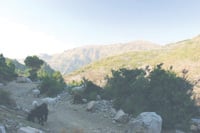 conditioned to
believing that the stepped well was invented by him and the minute we see one
even in remote Australia or Greenland, we know it was built by Sher Shah Suri.
conditioned to
believing that the stepped well was invented by him and the minute we see one
even in remote Australia or Greenland, we know it was built by Sher Shah Suri.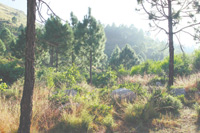 This
time around we did not have to park near the trees by the grotto and spring
of clear bubbling water. Road builders had bulldozed a fair-weather road all
the way to the baoli and we suspected that when we return again, we'll be
able to drive on a tarmac surface. Thence it was just forty odd minutes to
the ruins. We headed west to the ridge covered with pine trees and descended
on the other side into a virtual forest of broad-leaf trees that looked
rather like the familiar kuchnar. The leaves being exactly the same shape, it
sported clusters of small white flowers that told us that this was a
different species. The local name being puppar, the entire hill is called
Puprala. The Gazetteer of the Rawalpindi District 1893-94 contains a list of
trees found in the district. But there is no mention of a tree of this name.
This
time around we did not have to park near the trees by the grotto and spring
of clear bubbling water. Road builders had bulldozed a fair-weather road all
the way to the baoli and we suspected that when we return again, we'll be
able to drive on a tarmac surface. Thence it was just forty odd minutes to
the ruins. We headed west to the ridge covered with pine trees and descended
on the other side into a virtual forest of broad-leaf trees that looked
rather like the familiar kuchnar. The leaves being exactly the same shape, it
sported clusters of small white flowers that told us that this was a
different species. The local name being puppar, the entire hill is called
Puprala. The Gazetteer of the Rawalpindi District 1893-94 contains a list of
trees found in the district. But there is no mention of a tree of this name. close your eyes
and take a deep breath, then just sometimes you can hear the soft humming
sound of computers singing to you.
close your eyes
and take a deep breath, then just sometimes you can hear the soft humming
sound of computers singing to you.