


|
|
|
|
|
 |
 |
   |
emergency MOOD
STREET Town
Talk violence
RESPONSES TO
LAST WEEK'S
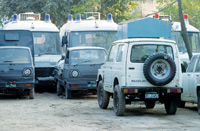
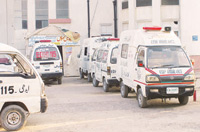
emergency In the absence of first aid Acute ambulance shortage in the city hospitals is one thing, what is more alarming is that the ones that are there, do not have the basic first aid kit in them
By Shehryar Warraich An ambulance on road striking sirens, trying hard to take a
serious patient to hospital, is something we have all seen. It may face
several hurdles in its way, say, in the form of defected traffic system,
ignorant attitudes and bad behaviours of people, traffic jams, blocked roads
due to some political figure passing or the other. But my concern here is not
related to any of these. There is something more important to which attention
must be paid. The issue is shortage of ambulances in the city of Lahore. The total population of Lahore is around 10 million today while the resources for this giant city are bare minimum. District Lahore has 20 government hospitals in total where not more than 90 ambulances are available to help the serious patients reach hospital in time. Fifteen per cent of these 90 available ambulances are out of order, and there is no hope in near future that this number will increase. Most of the ambulances do not possess even the basic equipment that can provide the patients with the first aid facilities to at least reach the nearest hospital. That further leads to causalities and deaths. A driver of Services Hospital, Lahore, who requests anonymity, states an incident at Mian Mir Colony near Upper Mall Scheme. "I was asked by the administration of the hospital to go to Mian Mir to take a patient, Faiz Rasul, from house no 225, street no 14. One of the staff members was with me. When we reached there, we found that the patient's condition was very serious. We, immediately, got him in the van and rushed to the hospital. Since the ambulance did not have any equipment to provide even first aid to the patient, he died on the way." When the affected family was approached, a very painful
detail was waiting to be delivered. Amir Rasul, 23, son of Faiz Rasul says,
"We immediately called two different help lines of the city when my
father had a heart attack but no ambulance was available at that time. At
last, we called Services Hospital to send an ambulance as soon as possible.
They took my address and told me that they were sending an ambulance. It
reached us after about 40 minutes. During this time the condition of my father
had become critical. We, then, immediately placed him into the ambulance and
rushed to the hospital. I can never forget that moment when my father's
condition was getting worse and the staff in the ambulance was helpless in the
absence of basic equipment in the vehicle, so they could not provide him with
any first aid. My father could not reach the hospital and lost his life on the
way, putting his head onto my lap, and I was but helpless." This is only one case that has been reported and only in one city. God knows how many have been dying helplessly like this in different parts of the country just because of the negligence of the establishment of many government and private hospitals and nobody knows how far such deaths and causalities will go. "Legally, it is compulsory to equip an ambulance with the first aid box which consists of glucose drips, oxygen cylinder, pulse oxy meter, spine board, splint, CPR, Dichloron, Buscopan and all with trained staff members," says Dr Khurram Basra of General Hospital, Lahore. According to the Medical Superintendent (MS) Services Hospital Dr. Ijaz Bhatti, this problem will soon be solved. "We are trying hard to achieve this target. We realise that the number of ambulances is far too small as compared to the population of the metropolitan. We are working on these measures and will soon arrange more ambulance services for the patients. Moreover, the problem of equipment has also been taken into consideration." The MS Mayo Hospital, Lahore, Khalid Ranjha says, "The establishment of the hospital is worried on this issue and serious measures are being taken to overcome the problem. Since the network of the hospital is very large and many patients come here on daily basis, it also needs more ambulances. We, along with the government, are trying to expand our ambulance services and hope to meet the target soon." A patient of General Hospital, Lahore states, "Private ambulances are also available outside many hospitals. When these ambulances are approached by the patients, they demand high price in spite of the fact that most of the drivers are unreliable, being drug addicts. These ambulance services do not have a staff; the driver himself acts as staff member. These drivers are mostly illiterate and very rude in their behaviours but we have to accept their services because there is no choice." Apart from the hospitals, many private and government Free Help Services have been established. The most famous and active in the country is Edhi. The second service is working in Punjab for the moment on government basis. This is known as 1122. "1122 is working with 14 ambulances which are highly equipped. There are three highly trained staff members present in every ambulance. The vehicles are equipped with complete first aid box accessories but their network is smaller than the population of the city. We receive five to six thousand calls from patients daily but cannot cater beyond a certain limit," says PRO 1122. Sibghatullah, zonal in charge of Edhi, says, "We have 70 ambulances for Lahore District and we daily receive 3 to 4 thousand calls from different people. We have 4 stations for Free Help Services. Every station possesses 10 ambulances. 30 ambulances are spared for out of city tasks but in case of emergency, these cars can also be used within the city." People often complain about the behaviour of the authorities. They say whenever they tried to approach Secretary Health, Punjab, Anwaar Ahmad Khan, to register their grievance and protest against lack of facilities in ambulances run by government hospitals or shortage of ambulance there, they failed to reach him in person. Moreover, common people have never been provided with satisfactory services. I also tried to get in touch with him several times for his point of view on the issue but could not because his staff came in between. I left several messages with his staff but to no avail. Increase in the number of ambulances is the dire need of the hour and the establishment must pay attention to this issue because the situation is getting worse everyday.
MOOD STREET Shhhhhhhhhh.......!
By Naila Inayat It's funny how one gets accustomed to the everyday humdrum
routine with very little hope of something new happening in life. So call it
one of 'those days' as I was on my way to work via local bus. Well, it's
exactly not local in terms of its appearance -- it's an airconditioned
spacious bus whose exterior carries adverts of the leading brands of the
country (who after the blackout on TV channels seem dependent only on such
ways to advertise their products), and has big windows through which you can
see outside but people from outside cannot see you. Howzat? With these alluring features, it is anything but local. I would rather call it an 'international' bus. On one of the FM radio channels a show HIV-Aids Say Tahaffuz marking the International day to fight AIDS was on air. I was surprised. Not because such a programme was on air, but at the fact that the bus driver didn't change the station. In a jam-packed bus and the radio playing on a high volume, he must be a brave man -- ready to face the consequences of running an 'out of the box' programme. The radio show was not just an ordinary awareness show; it provided a platform for victims who called up and shared their experiences. The ladies' section became slightly ruffled whereby the young girls kept giggling at the open talk by the radio jockey (RJ) but the aunties certainly didn't approve of it. Thankfully, they didn't make much fuss about it and most importantly, no one asked the driver to switch the radio off. Gone are the days when talking about such issues was considered taboo. Now people have somehow 'chilled out'. It's not that there is acceptance in the societal fabric regarding these issues, we still are confused as to how to respond to such notions which is quite okay when we have a look at our past. I remember back in school when one of my classfellows was caught reading Tehmina Durrani's 'My Feudal Lord' how she was reprimanded and suspended for a week. However, when we entered the green gates of college we had a teacher who was not only vocal about taboo issues but in reality the sex talk would always come into play for all the good and bad reasons; well, on second thoughts mostly good. Had it not been for her lectures, we would never have learnt if and when to speak. In our childhood we were almost conditioned about the channels we could watch with our families. Only one Indian channel 'Doordarshan' was available and the highlight of the week used to be Chitarhaar, a film song-based programme which was not to be seen with the family, especially Abbu. Now look at us; Ammi and Abbu are the first ones to tune into the Finals of Miss World 2007 and how disappointed were they when Chinese Zi Lin Zhang won the title. I didn't see this disappointment on their faces even when Pakistan lost to Ireland in the World Cup this year. My friend who is a school teacher tells me how her students drew nude images on the walls of the school toilets and their parents were called. The parents were intelligent enough to bring along a psychiatrist who tried to convince the administration that it is natural for kids to indulge in such activities; it's part of the growing process. However, it was of no avail and the kids had to face the music. As a society we are passing through a transitional phase where we are bombarded with all kinds of messages; at times it becomes confusing as to what to pick and choose. But who says we are heading towards Talibanisation? We are as good and as bad as anyone else. Our youngsters celebrate Halloween as enthusiastically as they would celebrate Eid. They party hard at private dance parties and we are proud that they do.
Town Talk • Furniture Exhibition by Ejaz Malik till Dec 10 at Nairang Gallery from 11am to 11pm daily. The gallery is open on Sundays. Address: 101-Habitat Flat, Jail Road, Lahore. Ph: 7587308, 7586686
• Exhibition: Contemporary Miniatures by Safdar Ali
Qureshi at Croweaters Gallery from 11am to 11pm till Dec 20. The artist
graduated from NCA in 2005 and this is his first solo exhibition.
• LEAF concert at Alhamra, Gaddafi Stadium on Tuesday, Dec 11 at 6pm. Sarah Zaman in concert. Sangat: Imdad Hussain, Sajjad Hussain, Zohaib Shehzad, Ghulam Sabir.
• Sitar students concert at Lahore Chitrkar on Dec 15 at 6:30pm.
• LEAF Discourses on Mughal Architecture at Model Town Library on Thursday, Dec 13 at 5:30pm. Speaker: Sajjad Kausar
• A concert of unheard melodies at Government College University Lahore every Saturday at 01:30pm
• Puppet Show for Children at Alhamra, The Mall at 11a.m Ticket for Rs. 5/10
• Puppet Shows for everyone at Peerus Cafe every Sunday at 3pm.
violence Silent sufferers Women bear with verbal abuse and beatings till one day they get a fatal blow, even then they try to protect the family's name
By Fareeha Sultan "No we can't tell you anything. Right now we don't
have any male with us, without their permission we can't tell you any thing.
We have already told our story to newsmen, also gave it to a TV channel.
Nothing happened. We are not interested. So, leave us alone." This is
what Samina, a burn victim in Mayo Hospital Burn Unit and her mother said
when they were requested to share their story. They totally refused to talk
on one pretext or the other. We get Samina's story through Dr. Saadia Effandi though, a young doctor working at Mayo Hospital Burn Unit. "Samina is 18 years old and belongs to Gujranwala. She has been married for two years and has a 10 month old daughter. She came to us with 85 per cent burns. Her face, chest, abdomen, lower body were badly burnt. At that time her husband was also accompanying her. He told us that she set herself on fire after a minor fight. I started admonishing her on how could she do that to herself. She has a daughter etc. When I came outside, her brother told me that not she, but her mother-in-law had set her ablaze." Samina's family is very poor. Her in-laws did not approve of the marriage after the engagement because by that time they had come to know that they won't be getting any dowry. Her brother promised that after the marriage he will arrange for the dowry; however he couldn't. Meanwhile, Samina kept suffering. So much so that sometimes her husband would throw her from the bed because she hadn't brought any dowry. Once, he decided to divorce her but on elders mediation she was sent to her in-laws' house till one day her mother-in-law set her on fire. She kept lying on floor for one and a half hour crying for help. Her parents' home is quite nearby. Some neighbour informed them and they took her to hospital. According to Dr Saadia, her chances of survival are there but nothing can be said regarding burn patients as they are very vulnerable. All the organs leave functioning properly. Such patients are always at risk of contracting septic or having high grade fever. Her family can't be blamed as they can't afford proper medical tests and protein rich diet. So her condition is deteriorating day by day. Dr. Effandi has endless stories to share. "If you would have come few days back then you could meet a patient who had 90 per cent burn. She was an electrical engineer, had love marriage, had children but even then she fell victim to her husband's ruthlessness. Initially, she kept mum, then gave false history but later the truth was revealed. Then there was a woman who started working because her husband was unable to earn and he burnt her because he kept suspecting her character. I still remember Iqra, a very pretty 17-year-old B.Sc student. Most probably her brothers burnt her on suspicion of having an affair, and the list continues." Dr Saadia says, "On average we receive 2-3 burn cases every day and 110 per cent women lie initially. They keep hiding the facts. It is unimaginable and unbelievable when a person is accused of self-immolation. I feel that women face violence irrespective of being educated. They are brought up to suffer bravely no matter whatever happens. Family protection becomes their priority. Sometimes, I feel sad that women hide reality because with 90-95 per cent burns there are no chances of survival. At least they should bring into limelight the culprits -- the ugly realities to the forefront. They conceal the identity of the actual person," the doctor says.
Here is the version of a victim of violence. "I, Rubina Kamal d/o Dilawar Khan, 42, am a resident of Green Town Lahore. I have four children. I was living with my husband Saif-ur-Rehman s/o Habib-ur-Rehman for 26 years. Vagabond is the word that describes my husband best. I, along with my two sons do labour. With me and my sons' earnings I built a house which is in my name. My husband would pressurise me to transfer the ownership of the house in his name. On August 15, 2007, I was working in my house when my husband tried to fire at me with a pistol but missed the target. My son snatched the pistol from him. Then he attacked me with a club lying nearby. I tried to save myself but it hit me, breaking my arm. Later, my husband abused and threatened to kill me." This is one FIR of the seven cases registered with the Women Police station Lahore this year. Out of these, five are in courts while two have been exempted. Total four rape cases were registered this year, two are in courts and two have been withdrawn while one case has been registered regarding abduction for rape. Going by the number of cases reaching the women police stations in the city we would infer that crime rate against women is low while it is not. Most of the cases are received in the different police stations in the city. A non-government organisation, Dastak, which has been a refuge for many helpless women over the years, received 375 women in 2007. According to Rubina Shaheen, in-charge crisis centre Dastak, "Sixty per cent of these women were married and victims of domestic violence while 40 per cent were unmarried who left home because of constant oppression, physical or mental torture, or those who wanted to marry of their own choice but were not allowed by the family. They came from all areas but majority of them belonged to rural areas and some of them were highly qualified." "In my fifteen years of experience, I never met a woman who left home by choice. Every woman decides to do that after she is left with no choice. Leaving one's home is neither easy nor appreciable, nonetheless, in our society the concept rather obsession to control and direct daughters, sisters and wives creates problem. People consider beating a form of violence but in my opinion not giving a girl the right to study or study the subjects of her choice is also a form of violence. We need to change the mindset of people because unless and until we don't change that, we cannot expect any betterment in the situation." Despite all the hype created by NGOs, oft-repeated media stories, increased representation in the legislature, the various movements for women's development, why are women in Pakistan still victims of all forms of violence, be it verbal, sexual or physical? According to Bilqees Akhtar, In charge Investigation, Women Police Centre, "Most of the time women are forced by their own kin and husbands to make amends and being in a weaker position they succumb to the pressures or compromise for the sake of children. Financial dependency is another reason. In my experience only economically stable women fight, others simply back out." Mehnaz Rehman, eminent human rights worker says, "Violence against women is a global problem. In Pakistan it is because of our over-all system, attitudes and because of the absence of any institutional help. We have a chain of power cycle where the strong rules over the weak. This problem cannot be addressed by conducting workshops alone but by practically bringing first equity then equality in our society. Media and NGOs have highlighted this issue and should continue with it. The more we highlight it the more there are chances of minimising it."
Glory and gloom
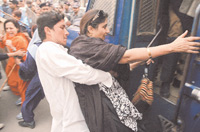
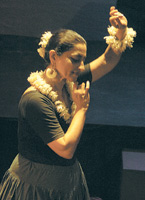
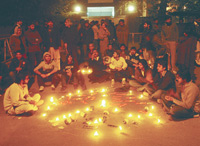
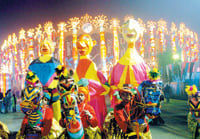
Rafi Peer theatre brought fun in the otherwise dreary atmosphere of the city; Recent protests against arrests. Photos: Rahat Dar
QUESTION TOP 10 Winter shopping places 1. Ichhra
2. Karim Block Market, Allama Iqbal Town
3. Mayo Hospital Landa Bazaar
4. Landa Bazaar Dilli Darwaza
5. Pace
6. Panorama for Jackets
7. Shawl shops in Auriga
8. Socks from Borh wala Chowk
9. Waistcoat from Anarkali
10. Peshawari caps and jackets from Bekhewala Mor
To enlist by popular vote for next week, send in your emails on top ten 'Bad habits of Lahoris' |
|