



|
|
|
|
 |
 |
   |
swimming
A
Test match to remember for Muralitharan at Kandy Sanath
Jayasuriya quits the longer version game cricket Kumble
should know courtesy costs nothing How
is the Misbah-ul-Haq factor helping Pakistan
She also
created two national records -- in the 400m individual medley and 200m
butterfly and earned the distinction of winning all the events that a swimmer
has participated in Pakistan
sports women have been making strides in recent times on the national as well
as international level. Though women don't get that much support, to promote
their Carla
Khan is one example that comes to our minds when we talk about Pakistani
women who have pulled off sporting glory for the country. Carla,
born in a family rich with sporting background, has been the sole fame-making
and title-winning female in international squash circuit for Pakistan. Though
she has been rattled up with injuries in the last year or so which has seen
her rankings fall massively, she still is one of the top sports women in our
country. Cricket,
the most popular game in our country, has seen female superstars as well.
From former captain Shaiza Khan to present skipper Urooj Mumtaz alongside
Sajida Shah and other players, many have made a name for themselves in this
highly-supported game. But
there is one other sport that has seen Pakistan women creating numerous
records, at least on the continental level, and bringing laurels for the
country. And that is none other than swimming. Swimming
has been one sport that has brought Pakistan with a lot of medals every time
its swimmers have participated in numerous Games at South Asian and Asian
level. And
surprisingly enough, Pakistani girls have always overshadowed their male
counterparts in winning medals for their team and one such swimmer who has
dominated the proceedings wholly is Kiran Khan. Kiran,
also from a sporting background, has been the newsmaker for a number of years
now when it comes to female athletes earning credits for their awesome
performances. And like many other sporting stars, she also started her
sporting career at a very young age. "It
started way back when I found my interest in swimming. As I have a family
background, that always was and is interested in sports, I didn't have any
problems to support my interest as many others do. It was a perfect start
that one needs," Kiran, currently staying is his hometown Lahore and
without any major assignments coming up, told 'The News on Sunday'. Kiran
has achieved many targets that she had set in her life and those haven't been
accomplished without hard work and dedication. And when
it comes to Kiran, there is only one mentor of hers who has truly guided her
all the way. "My father, Khalid Zaman, has been my only mentor in all
these years. It has been his support that has seen me reach these
targets," Kiran expressed. Mr Zaman is also Kiran's coach as well. Like any
other athlete here in Pakistan, swimmers too find it hard to train in local
available conditions and that does hamper their progress. And Kiran,
obviously, seconded our thought. "Yes, the facilities which are provided
here are not of standard. There is only one pool (of international standard)
present in our country (which is present in Islamabad). "When
we have to train for international assignments, we have to go there
(Islamabad) to practice along side our teammates. That hampers us in two
ways. One is that we have to go from our hometown to other place which first
of all is time consuming and is also expensive for the federation and us as
well. "The
second is that as I am a student, training in some other city also affects my
studies and I really have to work my socks off to cover up the loss
time," she explained. So what
can be done to eradicate this problem? "What
we need is proper training facilities and pools of international standard in
our areas as well. As I live in Lahore, there aren't many proper pools here.
The rest of the places where I train (pools in different clubs and hotels)
are very expensive and their membership costs us a lot. If the federation
provides us with these facilities at our doorsteps, that would be
fruitful," Kiran added. In 2001,
Kiran participated in the 3rd Women Islamic Games and that is where she rose
up to the occasion and made a name for herself. In that competition, she won
two golds, six silvers and two bronze medals. And in doing so she achieved
two other feats as well -- two Women Islamic Games records and six national
records. A truly amazing feat! Kiran, a
student of A levels (first year), has other laurels too to be proud of. But
that hasn't seen her hunger for more medals die down. "I
want to win more, obviously. I need to further improve myself on the
international stage as well and for that, I need more opportunities,"
she said. Kiran
would like the Pakistan Swimming Federation (PSF) to provide her with more
opportunities to represent the country at international events. "What we
need here is more participation in international events. That will encourage
us to perform better against the best in the business and the exposure that
will be provided to us will benefit us as well". Two
years after her feat in the Women Islamic Games, Kiran achieved yet another
milestone. In a Korea event, she reached the semifinals in the 100m freestyle
event, the first Pakistani to do so, and also reached the top 16 in the
world. "That
truly was wonderful. It was a very strong field and I performed very well. It
truly was an honour to represent Pakistan there," Kiran recalled. In 2004,
at the Athens Olympics, history was created when a Pakistani female swimmer
represented Pakistan. But it wasn't Kiran who carried the national flag
there. Instead, her teammate in relay events, Rubab Raza was the one who took
the honours. Though she didn't qualify past the heats, she achieved something
that none other female Pakistan swimmer had ever done. So why
wasn't Kiran, after all her achievements and progress, selected to represent
Pakistan at the Olympics. "We don't have proper qualifying system here.
If I am to take part in a tournament, I will go through proper qualifying
stages and then take a more forward. I will do everything on merit. "As
you know, there is a lot of hypocrisy amongst the people who are responsible
to promote the young talent and there is a lot of favourism. I don't want to
be a part of it. If there comes an opportunity which is totally based on
merit, I will go for it. Otherwise, I won't," Kiran continued. The way
Kiran spoke tells us the story that there were unfavourable conditions for
her at that time or otherwise she would've been there (at the Olympics) as
well. Any how, the feat achieved by Rubab was commendable as well. Kiran's
achievements didn't stop after the Korea event. She took part in the 4th
edition of Women Islamic Games as well (in 2005) and absolutely overpowered
her opponents in the pool. She won
golds in 200m medley, 100m backstroke, 4x100m freestyle relay; silvers in
4x100m freestyle, 50m backstroke and bronze medals in 100m freestyle, 200m
freestyle, 200m backstroke and 4x200m relay. When
Islamabad hosted the SAF Games, its ninth edition, Pakistan won a total of 14
medals -- seven silvers and seven bronze. And out of those 14, Kiran alone
won six silvers and two bronze for the country. And she
improved her performance at the South Asian level, winning the first-ever
gold medal for Pakistan in the South Asian Games (2006, Colombo) when she
finished first in the 50m butterfly event. In doing so, she also created a
national record as well. Kiran
says that she is 'the best female swimmer' in the country. Though her
performances speak for themselves, she herself is quite expressive of her
achievements and says no local girl can beat her on the day when she's in top
gear. Kiran
has represented different local teams as well during her career. At the 8th
National Women's Open Swimming Championship, Kiran, representing WAPDA at
that time, was declared the best swimmer. She
participated in sixteen events in that tourney and didn't win only three
golds out of those sixteen events. And if
that wasn't enough, Kiran now representing Pakistan Army in the 30th National
Games (this year) made a clean sweep of all the golds up for grabs. She also
created two national records -- in the 400m individual medley and 200m
butterfly and earned the distinction of winning all the events that a swimmer
has participated in. Now that was some achievement. "I
like to dominate the proceedings. Although one can't win everything at offer,
I strive to do so," Kiran said. "The standard of female swimming in
our country is not that high. There aren't any swimmers of high calibre
around," she added. Kiran
said that she is in perfect form at the moment and is raring to have a go at
more targets in sight. The swimmer, who likes the butterfly event the most,
has been eyeing international events to participate in. When Kiran has
participated in local events, it has been a one-woman show usually, and she
feels it will take others time to catch up. Kiran
currently holds ten national records now -- 50, 100 and 200m backstroke, 50,
100 and 200m butterfly, 200 and 400m individual medley, 200 and 400m
freestyle. Other
Pakistan swimmers, which include Mehrunnisa Khan, Eesha Khan, Sana Abdul
Wahid, Ayesha Tajwar, Rida Sabahat, Aqsa Tariq, Sakina Ghulam, Khadija Khalid
and Rubab, one feels will take some time to overhaul Kiran's achievements. If
they do so, hats off to them. But for now, we ought to salute our local
superstar Kiran. The
writer is a staff member at 'The News' Karachi A
Test match to remember for Muralitharan at Kandy By
Khurram Mahmood Sri
Lanka won the first Test against England at Kandy last week by 88 runs. This
Test will be remembered for a long time for its two memorable occasions.
First veteran opener Sanath Jayasuriya announced his retirement from Test
cricket after the first Test. But the
most important moment of the match came when spin magician Muttiah Before
starting the series against England, Muralitharan needed five wickets to
break Warne's record and he got the milestone on the third day of the
inaugural Test. Murali
was really happy after creating the world record on his home ground
especially when his parents, wife, relatives and school friends were also
present to congratulate him. "It's a bigger moment than if I had taken
it in Australia, it's the right time I think," said a delighted
Muralitharan. The
35-year-old master spinner wants to play till the next limited-overs World
Cup in 2011 and he wants to get the four figure mark in Test cricket by then.
In
1991-92 the two great spin magicians -- Shane Warne of Australia and Muttiah
Muralitharan of Sri Lanka -- both made their debut. Both spinners gave a new
life to slow bowling. Warne
and Muralitharan's wicket-taking race has left all the great bowlers behind.
First Muralitharan became the first spinner to reach the prestigious landmark
of 500 Test wickets, and then surpassed the world record of West Indian fast
bowler Courtney Walsh (519). Muralitharan's
fitness problems, which kept him away from the game for quiet sometime, gave
a fine chance to Shane Warne to supersede him and Warne became the first
bowler to take 600 plus Test wickets. Muttiah
Muralitharan made his debut against Australia at the Khettarama Stadium,
Colombo and his match figure was 3-141. Craig McDermott was his first Test
wicket. In 1993
Murali took his first five-wicket halul (5-104) in Tests in South Africa's
first innings. Kepler Wessels, Hansie Cronje and Jonty Rhodes were among the
victims. Australian
umpire Darrell Hair called Muralitharan no-ball seven times for a suspect
action on the second day of the Boxing Day Test against Australia in December
1995. Against
Zimbabwe in January 1998, Murali took his first ten-wicket haul in the first
Test at Kandy. Sri Lanka win by eight wickets and Murali's match figures of
12-117 were the best performance by a Sri Lankan bowler in Test matches. In March
2004, Murali's bowling action was reported as suspect by the ICC match
referee Chris Broad. Broad felt that the action with which Murali delivered
the 'doosra' during the Test series against Australia was not legitimate. In May
2004, Murali broke the highest Test wickets taken record (519) of Courtney
Walsh by taking the wicket of Zimbabwe's Mluleki Nkala as his 520th scalp in
Tests. In his
113th Test Muralitharan reached the 700-wicket milestone against Bangladesh
in July this year. Murali
has held the wicket-taking record three times, having originally passed
Courtney Walsh in 2004 before briefly sharing the mark with Shane Warne. He
then claimed it outright for the second time against South Africa until a
shoulder injury allowed Warne to move back to the top against India and
Muralitharan has been chasing him since. This time there is no one close to
knocking him off and with a tireless hunger for the game 1000 wickets is a
possibility. He has
now become one of the most lethal bowlers in the world, feared for his
abilities to puzzle even the best of batsmen. He has the ability to extract
turn even from the most docile of pitches and where nothing works, he brings
in to bear his devastating surprise weapon, the fearsome 'doosra' which is a
delivery that turns away from the right-handed batsmen. Muralitharan
has a best Test innings return of 9-51 and a match haul of 10 wickets or more
on a world record 20 occasions. He has grabbed five or more wickets in an
innings a record 61 times. He was declared one of the Wisden Cricketers of
the Year in 1999. He is
one of the essential elements of Sri Lankan cricket especially in Test
matches. Throughout his career, he has been Sri Lanka's main bowler both for
taking wickets and for keeping the runs in check. Just how much the team
depends on him is obvious from the numbers below: in the matches that he has
played, Murali's has taken 41% of the total wickets nailed by all bowlers. Murali's
bent-arm action has remained under scrutiny through his career. He has twice
been called for throwing, in a Test match in Melbourne in 1995 and during a
One-day International in Adelaide in 1998. But the ICC cleared his action
both times following extensive bio-mechanical research and deep discussion
with the experts, but he was again reported for a suspect action two months
later after the conclusion of Australia's tour to Sri Lanka. Muralitharan
has an excellent track record against each Test playing country. But in
Australia and India he was not successful as in other countries. In
Australia, his bowling aveage is 75.41 while in India it is 29.58 against his
overall career average of 21.77. He is
the only bowler to take more than 50 wickets against every opposition team he
has played. He has taken 20 ten-wicket hauls in Tests, while his close rival
Warne took 10 or more wickets -- only half that number. Murali has taken a
ten-for at least once against every opposition that he has played against. He is
the only bowler to take 75 or more wickets in a calendar year on three
occasions, achieving it in 2000, 2001 and 2006. The
writer works in the art department at 'The News on Sunday' in Karachi khurrams87@yahoo.com
Sanath
Jayasuriya quits the longer version game By
M Shoaib Ahmed Sanath
Jayasuriya has announced his retirement from Test cricket. The 38-year-old,
who was dismissed for 78 in his 110th and final Test, had scored 14 centuries
since Jayasuriya,
the 'Master Blaster' almost single-handedly changed the character of the
one-day format of cricket and he has been one of the most consistent
performers with bat and ball for Sri Lanka over the past 15 years. He is
the only player in the world to score over 12,000 runs and capture over 300
wickets in one-day cricket and said he has no plans to retire from the
shorter version of the game. One of
the world's most destructive strikers of the ball, Jayasuriya found belated
fame as a pinch-hitter at the 1996 World Cup, and then demonstrated that he
was also capable of massive scoring in Tests, eventually becoming Sri Lanka's
highest Test run-scorer. He is
known for both cuts and pulls along with his trademark shot, a shot over
point. Jayasuriya was promoted to the top of the batting order for ODIs
during the 1995-96 tour of Australia, and, with Romesh Kaluwitharana they
made use of the early over fielding restrictions to score freely. He was
instrumental in Sri Lanka's victory in the 1996 Cricket World Cup, where he
was adjudged Man of the Tournament in recognition of his all-round
contributions. He
remains dizzily dangerous, especially on the subcontinent's slower, less
bouncy surfaces. Wised-up opponents have learned to set traps in the gully
and at third man to stem the flow of runs, but on song he can be virtually
unstoppable, capable of scoring freely on both sides of the wicket. He served
commendably as Sri Lanka's captain for a successful tenure after the sacking
of Arjuna Ranatunga in 1999. He
bounced back in 2004 with his most prolific year in Test cricket since 1997.
The year included a blazing second-innings century against Australia at Kandy
that nearly levelled the series and a marathon double-hundred against
Pakistan at Faisalabad. Twin centuries followed during the Asia Cup 2004 and
his form was impressive enough for Somerset to sign him up for a season of
County Cricket in 2005. In 2005, Jayasuriya became only the fourth batsman to
get to 10,000 runs in one-day cricket. He was
born on 30 June 1969 in Matara. The all-rounder has been a member of the Sri
Lankan cricket team since 1989. He is the first cricketer to be appointed as
a UN Goodwill Ambassador (by UNAIDS, Geneva) for his commitment to prevention
of HIV/AIDS among young people in Sri Lanka. As a left-arm orthodox spin
bowler, he has a reasonable bowling average and economy rate. He regularly
helps to decrease the workloads of strike bowlers Muttiah Muralitharan and
Chaminda Vaas. Jayasuriya
held the record for the highest Test score made by a Sri Lankan, 340 against
India in 1997. This effort was part of a second-wicket partnership with
Roshan Mahanama that set the then all-time record for any partnership in Test
history, with 576 runs. Both records were surpassed in July 2006 when fellow
Sri Lankan Mahela Jayawardene scored 374 as part of a 624-run partnership
with Kumar Sangakkara against South Africa. He also holds the world's second
highest ODI score, jointly with Viv Richards, which is 189 runs against
India. He
currently holds the record fastest fifty in ODIs, scored off just 17 balls.
Jayasuriya was the previous record-holder for the fastest century (off 48
balls), before losing that claim to Shahid Afridi of Pakistan. He has hit 241
sixes in one-Day Internationals (ODIs) and currently holds the world record
for most ODI sixes. He has become the fourth batsman to score more than
10,000 runs in ODIs. On 20 September 2005, during the second Test of the home
series against Bangladesh, Jayasuriya became the first Sri Lankan to play 100
Tests, and the 33rd Test cricketer to achieve this feat. He scored two
centuries and two half-centuries in the 2007 Cricket World Cup held in the
West Indies. SANATH
JAYSURIYA'S FACT FILE Batting Type Mat
Inns
NO
Runs
HS
Ave
100s
50s
Ct Tests
110
188
14
6973
340
40.07
14
31
78 ODIs 403
392
18
12207
189
32.63
25
64
115 First-class
256
405
33
14480
340
38.92
29
68
158 Bowling Type Mat
Balls
Runs
Wkts
Best
Ave
Econ
SR
5w Tests
110
8188
3366
98
5-34
34.34
2.46
83.5
2 ODIs 403
14087
11168
307
6-29
36.37
4.75
45.8
4 First-class
256
14674
6462
196
5-34
32.96
2.64
74.8
2 cricket Out of the box thinking is the need of the hour Malik actually lacks experience as he has just captained his regional side for some Twenty20 games and was all of a sudden appointed as the captain of the national side By
Muhammad Asif Khan After
the depressing one-day series against India, the first two Test matches also
ended on a sad note. The Test series began with a hope however, the result of
the first Test match at the Feroz Shah Kotla ground was as demoralising as it
could be, and the Yes
a few good batting performances were there, but at the end of the day, we
could not achieve the desired result. The question is that when batsmen like
Kamran Akmal and even Muhammad Sami can show resilience then what was the
problem with people like Muhammad Yousuf and Younis Khan who just did nothing
in the first inning of the second Test match? Moreover,
the comments of the stand-in captain, Younis Khan, during the course of the
second Test raised a few eyebrows when he claimed that he was told to lead
the side at the eleventh hour, on the other hand, team manager Talat Ali said
that Younis was aware of the responsibility way before the commencement of
the Test match as Shoaib Malik was injured. What is the reality, I don't
know, something is fishy for sure. Coming
back to the performance of the team in Test matches, we simply did not
perform well and subsequently lost. The only positive of the two matches
played so far was the performance of Shoaib Akhtar, who was no doubt under a
lot of pressure because of the events he got involved in prior to the India
tour, therefore his performance even in the second Test was commendable for
sure. The
management opted to play him in the second Test although he was not fully
fit, but the poor management had no other choice as they were short of backup
in fact they had no one to replace the speedster. The other hope for the team
was the so called trump card, Danish Kaneria, who looked very ordinary, one
thing which was evident in the first Test match, that Kaneria shortened his
run-up and he was approaching the wicket very slowly like Shane Warne (In
terms of approaching the wicket only). This alteration I believe was doing
him no favour whatsoever, and I think he realised it too, and changed the
tactics in the next match, but the result I am afraid was not so cheerful for
him, means he has some other shortcomings which he needs to get rid of, what
I felt is that he actually lost the in-drift, which he used to have. I urge
him to work on that to be in the top league. The
other worry many believe is the captaincy of Shoaib Malik. Former greats like
Javed Miandad, Wasim Akram etc. are blaming the captaincy for the debacle.
Well I have a lot of regard for Miandad and Akram, but I feel they came down
a bit hard on the young Malik who is leading the side for the first time
abroad and more importantly under the added pressure of playing against
India. Yes, some flaws in him were exposed but I am sure this experience
would make him a better leader in the future. I
think it's too early to establish a viewpoint about his captaincy. The real
issue is that most of the players in the current team are playing for their
places and the management should give the players more confidence. Moreover,
if not Shoaib Malik then who else is capable of leading the side at the
moment as Younis Khan seemingly has already taken a back seat? Who knows,
perhaps if someone else was the captain then the scenario might still be the
same as our top order had not been performing consistently, middle order
batting was below par, settled batsmen played rash shorts at crucial moments
of the match, and most of all our wicket-keeper has just been ordinary. Malik
actually lacks experience as he has just captained his regional side for some
Twenty20 games and was all of a sudden appointed as the captain of the
national side, hence it is obvious that he would take sometime to get into
the groove. The Pakistan Cricket Board should be blamed because they did not
groom a captain when Inzamam was on the verge of his departure. What the
board did they just banked on one man, Younis Khan and did not think beyond
that, if two to three individuals are kept in view, then such a situation can
be shunned. What
I mean is that the board should appoint one vice-captain after the other to
groom him under a captain and also provide him with an opportunity to lead
the side once in a while, so that this "all of a sudden" thing
could be curbed, and a fellow chosen for the top job is somewhat ready for
it. Therefore this captaincy issue should be kept aside and individual
performances should be reviewed. Nobody
can teach people like Muhammad Yousuf and Younis Khan to be responsible and
avoid unnecessary strokes, as they have ample experience under their belts.
The question that why a new player is not inducted in the side? The captain
when asked for Asim Kamal before the Test match, the selectors refused and
the chairman in a TV programme gave a strange reason that Faisal Iqbal was
preferred over Asim because of his fine performance in Karachi Test against
South Africa. Just to remind the readers Faisal Iqbal scored 7 in the first
innings of the Karachi Test against South Africa and 44 in the second
innings. One more question: if the chief selector is pretty observant of the
recent performances then why is Kaman Akmal still playing? He was sidelined
in the last ODI aginst India only because he was unfit and selector were
forced to send Sarfraz Ahmed to India. Many people including myself had been
writing over the issue of Akmal's form and had he been replaced sometime back
then we by now would have a good pair of wicket-keepers like we use to have
in the past in Moin Khan and Rashid Latif, but unfortunately the selection
committee did not opt for it and now paying the price. But are they ready to
learn for this mistake? Here
I want to mention that Rashid Latif had presented a comprehensive long-term
grooming plan for wicket-keepers. According to the plan, Under-13, Under-15,
Under-17, Under-19 and Under-23 wicketkeepers will be groomed for the future
and for the purpose he intends to travel across Pakistan. I personally spoke
to Rashid, who is pretty keen and optimistic that his strategy would work and
he would be able to provide the board with at least five wicket-keepers from
each age group. He also suggested the PCB to hold trials for the Under-13
wicket-keepers all over Pakistan after every one or two years. I think it is
a brilliant idea, however needs proper implementation. In
the meantime, the board should not waste the opportunity they got in the form
of young Sarfraz Ahmed who was given a chance to represent Pakistan, but who
would guarantee his future? He performed all right in the first ODI he played
but the pressure of such a high-profile series must be on his mind which
could possibly have hurt his confidence a little, so I request the selectors
to give him a longer run which would surely do two good things. By playing
consistently, not only Sarfraz would get better but also Kamran Akmal would
get a chance to overcome his flaws and ultimately Pakistan would have a
quality pair to play with, like the Rashid-Moin duo in the 1990s. By
focusing too much on the wicket-keeper we should also not forget the other
weak areas in the team. Everyone knows that the opening slot has been a
headache for the management but I believe almost every position in the
Pakistan line-up needs a strong backup and this proposal regarding
wicket-keepers which I mentioned above, could be very very handy if expanded
to all departments of the game. After
going through this exercise a pool of young players would be available which
could be polished to replace an out-of-form player in the national side at
any given time. I am personally not in favour of a heavy duty coach for a
national side because at this stage amendment in one's false technique is
merely impossible. For example, Geoff Lawson with all his experience could
not convince Mohammad Yousuf to run carefully between the wickets because
Yousuf has developed a very strong habit of hit-and-run, which could have
been rectified during his early days but now it's not seemingly possible. Therefore,
instead of investing heavily in a coach for the national side, high quality
individuals should be hired to train the pool of youngsters coming through
the proposed setup, because if a strong backup is at your disposal then even
a sensible manager can cordially handle the cricket affairs. The writer is a freelance contributor
mak374@hotmail.com Kumble should know courtesy costs nothing Even Younis Khan's match-saving 107 not out in the second innings was a brilliant effort and certainly up there with the best and should have given some headache to the jury members By
Imran Farooqi If the
Kolkata Test will remain engraved in the memory of cricket fans for the
gallant fightback put up by Pakistan's fragile batting line-up, the same will
be remembered for some other reasons as well. One felt
extremely sorry for Misbah-ul-Haq who, despite producing a gem of a knock
under almost catastrophic conditions, though managed to save his side from a
certain defeat but failed to impress the match jury. Unfortunately, nobody
can guess what criterion had the jury followed for picking Wasim Jaffer as
man of the match. Jaffer
may have scored more runs in the match than the relatively-inexperienced
Pakistan middle-order batsman, but on sheer weight there is no way the two
innings could be compared. No doubt a double-century is itself a great
achievement and a landmark every batsman dreams about, Misbah's unbeaten
classic of 161 in the first innings could still be regarded as the most
valuable batting contribution in the match from both sides as it was
fashioned under tremendous amount of pressure and expectations. Even
Younis Khan's match-saving 107 not out in the second innings was a brilliant
effort and certainly up there with the best and should have given some
headache to the jury members. That these innings came against an attack that
included two of the best spinners in the world -- Anil Kumble and Harbhajan
Singh -- makes them even more impressive. Few
would argue that Jaffer's double-century was cast under ordinary
circumstances and against a bowling attack that did anything but attack as it
boosted two half-fit quicks in Shoaib Akhtar and Mohammad Sami, a rookie
medium-pacer in Sohail Tanvir, whose experience of Test cricket was till that
time limited to just one Test, and a leg-spinner, Danish Kaneria, who is
struggling to find his form on slow pitches that offered encouragement
neither to fast bowlers or spinners on any of the five days of the Test. All
the Indian batsmen, with the exception of Dinesh Karthik, savoured the
pop-gun attack and had had a terrific game with the bat as Pakistan's bowlers
continued to labour for wickets on an unresponsive track. Kumble
and Harbhajan managed to pick wickets mainly because they were far more
experienced and knew the conditions well. Besides, they were playing in front
of their home crowd, which does count a lot, and were also helped by some
poor umpiring, specially from Billy Doctrove who, like Darrell Hair, loves
nothing more than raising his finger that signals the dismissal of a Pakistan
batsman. Hair and
Doctrove were the main characters of last year's Oval fiasco. Hair got the
treatment he deserved since he was the one who had actually accused Pakistan
of ball-tampering. But Doctrove, who could not hide his hatred for Pakistan
in agreeing with the Australian, was allowed to make an honourable way out of
the scandal. Pakistan are unfortunate that wherever they play Doctrove gets a
posting, and whenever he gets it wrong it is Pakistan who find themselves at
the receiving end. It's time Pakistan approach the ICC and tell them to
either ignore Doctrove for their matches, or drop him from the elite panel
altogether. Back to
the Kolkata game. It must not be forgotten that Pakistan, with most of their
batsmen still playing to secure a permanent spot on the team, were facing a
huge first-innings total. Apart from Younis and Mohammad Yousuf Pakistan did
not have a batsman among the top six who had adequate experience of seeing
off such a monstrous challenge with ease. It needed a lot of guts and
application to make a match out of it. And it was heartening to see Misbah
and Kamran Akmal taking on the challenge with their chins up and helping
their team salvage a draw that had looked unlikely midway through the first
innings. The innings would have given them and the side the confidence that
is so vital for the development of their respective games. They showed that
the pitch had nothing to do with Pakistan's top-order collapse on day 3. India's
bitterness over the outcome of the match was quite obvious, but their skipper
expressed his dismay in a very crude fashion. He solely blamed 'poor
fielding' for his team's failure to finish off the game and take the rubber
2-0. Though Kumble was within his right to hold responsible for the draw
whoever he deemed fit, he plainly refused to acknowledge Pakistan's awesome
rearguard action, and instead criticized the pitch and fielding. A few words
of praise for Pakistan's middle-order would not have done any harm to the
Indian captain, who is certainly supposed to be aggressive and confident, but
not rude and must learn to give credit to his opponents when due no matter
how close his team got to winning a hard-fought game. It's no
secret that India have a formidable batting line, whereas Pakistan are still
searching for that luxury. Having proven performers like Rahul Dravid, Sourav
Ganguly, Sachin Tendulkar, VVS Laxman, and Mahendra Singh Dhoni in their
ranks does help a lot, and if India post a total in excess of 600 on a docile
track against a modest attack, it's no big deal. Not at all. But if the same
is achieved by a side like Pakistan -- who are as infamous for their
unpredictability as they are for their brittle and often unreliable batting
-- it will certainly draw a huge amount of praise. In Kolkata Pakistan could
not manage to equal India's mammoth score, but the former's tally of 456
still deserved some appreciation as at one stage the team were tottering at
150 for 5 with almost no hope of surviving full five days of the Test. The
result has proved that Pakistan are a force to reckon with if they show some
character. They can also draw inspiration from the fact that they will be
playing the final game in Bangalore, where they have won two of the previous
four encounters against India. If Shoaib is fit for the do-or-die clash and
Pakistan go into the match with the right mix they are bound to do well
against a side that will be wary of a repeat of the backlash they had
suffered in the 2004-05 series.
By
Gul Nasreen In the
post-World Cup cricket scenario when Pakistan was confronted with a galaxy of
problems leading to a crisis-like situation marked by the team's poor show in
almost all departments of the game, Pakistan recalled some discarded players
to its fold to rise from the 'ashes'. The then Test discard Misbah-ul-Haq was
the foremost of them. In fact his inclusion in the Twenty20 Cup attracted a
lot of criticism from various quarters as by then he was not a force to
reckon with. He had
then played five Tests for Pakistan from 2001 to 2003 and was unable to
impress much in the long version of the game.
Till 2003, he had 120 Test runs at a poor average of 13.33. That's why
he had failed to earn a place in the Pakistan team since playing an ODI
against Zimbabwe in Peshawar in 2004. Secondly,
analysts criticised his comeback for he was selected in Pakistan's Twenty20
squad ahead of prolific batsman Mohammad Yousuf. In this
backdrop, Misbah was under immense pressure to put up a good show to cement
his place in the team. However, returning after being eight years in the
cricketing wilderness, he is a transformed man. It's happy to note that
Misbah not only silenced his critics with an excellent run of form in the
inaugural World Twenty20 event, hitting a whirlwind 53 against India and a
match-winning 66 against Australia, but also forced his way into the Test
squad on the basis of a good show. Misbah-ul-Haq
has now become part and parcel of the team. In fact, his good run during the
ongoing Test series in India has brought forth his real essence to the fore,
i.e., his capability to deliver under pressure, which is a good omen for the
batting line-up that is known for 'collapses' under pressure. Pakistan
lost the first Test to India, but individually Misbah played satisfactorily.
Misbah top-scored with 82 in Pakistan's disappointing first innings total of
231. A superbly calm innings from Misbah-ul-Haq wrested control of the first
day's play away from India. Misbah, who had never before scored a Test fifty,
was cautious, and quick to move on to the front foot to counter the low
bounce as well. Though his fans were a little bit disappointed for his
failure of not scoring his first century in Delhi, they were happy that he
helped his team score a respectable total at least. In the
second Test at Kolkata, Misbah hit an unbeaten 161 to help Pakistan avoid
follow-on against the arch-rivals. He really frustrated India with his plucky
batting display as he batted cautiously in the first innings. Executing some
handsome shots against both pace and spin, Misbah also struck a six off
spinner Harbhajan Singh and 13 fours in his 303-ball knock. The way he
cracked an impressive century under pressure was a treat to watch. The
purpose to say this is that Misbah is no doubt one of our success stories in
the post World Cup 2007 scenario in all forms of cricket.
The
irony is that we label our players as one-day specialists or Test experts.
Misbah is a case in point. We had branded him as Twenty20 specialist during
that format's World Cup. Likewise, Muhammad Yousuf was dropped from
Pakistan's squad for the Twenty20 World Cup on the basis of being not fit for
that format of cricket. It was a bit misleading because we should not
particularly believe in being a specialist in one format or another. The
reality is that the best cricketers play according to the match situation and
the best batsmen weigh up what to do to score runs against whatever bowler
they're facing. We've seen enough to know that he's up to the job of
succeeding Inzamam-ul-Haq in all forms of cricket. The
striking feature of Misbah's attitude is that he lends an ear to what is
being told to him by a senior member of the side. Misbah not only acted upon
the advice of his senior teammate Muhammad Yousuf, but has also credited him
(Yousuf) for helping him play the career-resurrecting innings in Kolkata,
where he rescued Pakistan from total disaster in the first inning with a
knock he won't forget for the rest of his life. The main
thing for him was to stay at the wicket for maximum period so that Pakistan
could get a respectable total and he did that excellently. His
other team mates need to emulate Misbah's grit and determination and how he
made a niche for himself though his consistent performance in a team that has
been become a talk of the town for inconsistent and unpredictable show over
the years. THE
OTHER SIDE OF MISBAH'S PLAY In spite
of his scoring good innings under pressure, it has been witnessed that Misbah
has till now lacking that killer's punch which can win matches for the team.
In a way, Misbah's dismissals have been his bane in recent months. It may be
recalled here that he failed to get a single off the last two deliveries in
the league match against India in the Twenty20 World Cup in South Africa a
few months back. Then he
made a match of it in the final, unluckily falling to a cruel paddle shot
with just six needed for victory. The Mianwali-born batsman played a risky
shot which he should not have played at that stage of the game in the grand
final. His fans were disappointed at having brought his team close to beating
arch-rivals India on two occasions but failing to succeed on delivering the
killer blow on either occasion. Again,
during the first Test of the ongoing Indo-Pak Test series in Delhi his
dismissal was as bizarre as the one at Johannesburg. The way, Misbah took off
for a sharp single and had almost made his ground but in a bid to evade a
direct throw from extra-cover he jumped in the air and both his feet and bat
were in the air when the ball hit the stumps. His 'strange' run out reminded
one of the Big Inzi, who was 'bad' at running between the wickets and used to
get run out in the same bizarre fashion. His
being out in such a bizarre fashion does surely haunt his fans, but then it's
all part of the game called cricket. It's a bit disappointing on his part but
this is cricket after all. The whole nation is happy with his great 'come
back'. Hopefully, in the coming days he will put his shortcomings right to
emerge as one of the best batsmen of the team.
By
Nabeel Naqvi It's not
a hidden fact that domestic cricket in Pakistan has never flourished as it
does in countries like Australia and England. Some of our finest players from
the past have been very critical of our domestic system. Cricket brains like
Imran Khan and many others have even suggested some modifications that can
certainly prove more than helpful if implemented successfully. But, for
various reasons no reforms could be introduced in the current system and as a
result we fail to produce cricketers who have the mental strength to cope
with the pressure of international cricket. My point
here, is that if the Pakistan Cricket Board cannot adopt the system
implemented in other countries they can incorporate other ideas that can help
in producing quality cricketers. Innovation is the name of the game, this is
exactly what Europe has been doing in the past. Let's admit it Europe ended
Asia's dominance in hockey not by using their sticks initially but by using
their brains. Changes were brought into the game so rapidly that teams like
India and Pakistan could do nothing but become mere spectators. We can
introduce new techniques that can help us nurture talent better than others
so that we can produce champions instead of mediocre players. The plan
is simple. If the PCB cannot change its domestic skeleton it can introduce
the scouting system in the game. The PCB can hire former cricketers -- who
have the knack of identifying talent -- as professional scouts. Organised
scouting has never been done in Pakistan before. Actually it is a system used
in football. Football clubs all over the world have professional scouts that
help them unearth young talented players very frequently. Their job is to
continuously look for players who can fulfil the needs of their club. Once a
young player is identified, his potential is judged and his performance is
constantly monitored.If a player is really good the club might offer him a
contract and then he is groomed and trained in such a manner that it helps
the player show his true potential. Professional managers help him polish his
strengths and minimise his weaknesses. It is an idea loosely based on an old
strategy used by the Ottoman Empire, for hiring skilful soldiers at a very
young age. Actually, during the early days of the Ottoman empire, there was a
special fighting unit called the 'janissary'. Soldiers who were hired from a
very young age to serve as Royal guards, their skill was inimitable as a
result of years of training, in short 'they were born to fight'. Club
football has adopted this technique and they hire players at a very juvenile
age and then train them according to their talents. Definitely
there is no comparison between club football and international cricket. It is
not about comparing the technicalities of the two sports but the procedure of
finding talented young players that have the potential of becoming superstars
in the future. In fact
it has been done in Pakistan as well. Pakistan's legendary cricket captain
Imran Khan was a master of identifying talent, he was the one who singled out
Wasim, Waqar and Inzamam and brought them in the national side. None of the
three players had played much of first-class cricket when Khan picked them
for Pakistan. Rashid
Latif's ability of recognising talented young players isn't bad, so, past
players like him can be hired for such a job. Even foreign coaches have said
it on a number of occasions that Pakistan is a country with abundance of
cricketing talent. I say if there is such a profusion of talent in our
country then why can't we produce infallible players? The selection committee
is not the solution, I don't mean to criticise them, but I advocate the
formation of a separate working committee that is specifically given the task
of finding Wasims and Waqars for the future because with a domestic structure
like ours, there is no way we can compete with the likes of Australia. The work
needs to be done at the ground level. Talented kids from a very young age
should be contracted, those who have the potential -- on the recommendations
of the scout/s. These kids can then be physically and mentally trained for
the big stage, with the PCB bearing the study/accommodation expenses, just
like in club football. Training
athletes from a very young age has never been done in Pakistan, although
everyone is aware how fruitful it could turn out to be. This process would
not even require the Pakistan Cricket Board to bring any significant changes
in the current system. As far as the training of these players is concerned
the national academy can come in handy; players could even be sent to play
county cricket to polish their skills. It can
help us produce match winners, players who can turn the game on its head with
professional ease. This is something Australia is very good at doing, they
produce star players so frequently that the absence of a first team regular
after his retirement is never felt, as in the case of Michael Hussey
replacing Michael Bevan, or Stuart Clark replacing Glenn McGrath. But this of
course is a repercussion of a very strong domestic system, which
unfortunately we don't have. So, if
no drastic changes can be brought into the system, why not incorporate some
innovative strategies. There is no doubt about the success of such a
strategy, only if we take the matter seriously. The
writer is a staffer at 'The News' Karachi nnaqvi2000@yahoo.com
|
|
 future in sports, in our male-oriented society as the men do, there
still are some who have opted to fight against this discrimination and have
achieved what many thought they couldn't.
future in sports, in our male-oriented society as the men do, there
still are some who have opted to fight against this discrimination and have
achieved what many thought they couldn't. Muralitharan bowled Paul Collingwood during England's first innings and
become the highest wicket-taker in Test cricket with 709 victims in his 116th
Test. Shane Warne hung up his boots from Test cricket after setting a record
of 708 wickets in 145 Tests in January this year.
Muralitharan bowled Paul Collingwood during England's first innings and
become the highest wicket-taker in Test cricket with 709 victims in his 116th
Test. Shane Warne hung up his boots from Test cricket after setting a record
of 708 wickets in 145 Tests in January this year.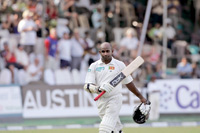 making his debut against New Zealand in Hamilton in 1991. He said he
would continue to play one-day cricket. He has made 403 appearances for Sri
Lanka in the limited-overs game.
making his debut against New Zealand in Hamilton in 1991. He said he
would continue to play one-day cricket. He has made 403 appearances for Sri
Lanka in the limited-overs game.  second Test match also did not provide an avid Pakistani
fan with a single moment of joy.
second Test match also did not provide an avid Pakistani
fan with a single moment of joy. 