



|
|
|
|
 |
 |
   |
election A
year after Taal Matol comment Another
disappearance RIPPLE EFFECT
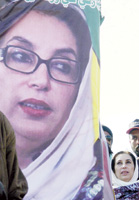
Benazir's presence may help revive her party's fortunes, but the days of one-sided election battles for the PPP seem to be over in Sindh By Adnan Adil A tough contest between the PPP and anti-PPP candidates seems on the cards in rural Sindh while urban areas of the province appear to be in the MQM's grip. Jamaat-i-Islami's decision to boycott the polls has further strengthened MQM's position on the 20 national seats in Karachi. Out of a total 272 general
seats of the National Assembly, there are 36 seats of rural Sindh -- In interior Sindh, the ongoing election campaign signifies the growing support for local landlords and other local political groups. The ride for Bhutto's PPP does not seem to be as smooth as it is thought it would be. One prominent example is that of Makhdoom Amin Fahim's family in Hala-Matiari area. Makhdoom's family is facing a stiff competition in their traditional stronghold. The Makhdooms, who have not lost a single election in last 60 years, are now canvassing door to door instead of relying on the support from influential clans or notables of the area. In 2002, Amin Faheem had won this seat hands down by securing more than one hundred thousand votes. In Larkana, the heart of Benazir Bhutto's vote-base, she has pulled out of the contest against her sister-in-law Ghinwa Bhutto on NA-204. Ghinwa Bhutto enjoys the support of Sardar Mumtaz Bhutto and other anti-Benazir forces in the area. Her daughter, Fatima Bhutto, is running her electoral campaign and is severely critical of Benazir who has smartly tackled the challenge from within the family by avoiding a direct confrontation with her sister-in-law and has so far ignored provocations from the other side. Benazir is now restricted to her traditional seat, NA-207 where the Jamiat Ulema-i-Islam (JUI), too, has a considerable presence. In 2002 JUI's candidate, Khalid Soomro bagged more than 26000 votes as compared to 54000 votes bagged by PPP's Shahid Bhutto. One reason of PPP's
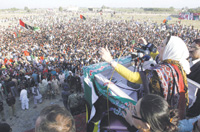
seemingly tight position could be the fact that the party has remained Another major factor seems to be the local government's system enforced in 2001. A number of new districts have been carved out bifurcating Larkana, Hyderabad and Dadu to the disadvantage of the PPP. The local mayors (district nazims and tehsil nazims) have vast powers and resources at their disposal to extend patronage and buy political loyalties. In most districts, Muslim Leaguers are incharge of the local governments. Badin is another PPP stronghold that is witnessing an interesting tough fight between two women candidates, PPP's Fehmida Mirza and PML-Q's Yasmin Shah. Fehmida Mirza is wife of former MNA, Zulfikar Mirza who has been declared ineligible to contest the election this time for being a loan defaulter. Yasmin Shah is wife of former provincial minister, Syed Ali Bakhsh aka Pappu Shah. Pappu Shah is out of contest facing disqualification on the charges of possessing a fake B.A degree. On Badin's other national seat, PPP's former MNA, Ghulam Ali Nizamani is pitted against PML-F's (Functional) Ali Akbar Nizamani in what is expected to be a close fight. The situation in Badin is so tense that more than one hundred polling stations out of 597 have been declared sensitive there. A similar situation exists in Nawabshah's NA-214 constituency consisting of Daulatpur sub-division. PPP's sitting MNA, Syed Ghulam Mustafa Shah is facing a stiff fight from PML's provincial minister Khan Muhammad Dahri.In the 2005, Khan Dehri had secured equal votes to Faryal Talpur (the sister of Asif Zardari) in the district nazim's contest but lost in the toss. Thatta district (NA-237 and 238) is another interest area due to shifting alliances on the eve of election. PML-Q's Sherazi group is well entrenched here with the support of district government at its disposal. But the Sherazi group is facing an uncertain situation because its traditional ally, the influential Malkani group, has joined the PPP. On the other hand, a large Jokhio clan is supporting the Sherazis. PPP's Arbab Wazir Memon and Abdul Wahid Soomro are contesting from these two seats on the PPP platform. Tempers are high in the districts of Sanghar, Khairpur and Mirpur Khas where the PPP and PML-F are locked in a cut-throat competition. In Khairpur, violent clashes have already started taking place between the two sides. Pir Pagaro's son, Syed Sadruudin Shah is a candidate in Khairpur. In Dadu, too, on the constituency of PML-Q's minister and feudal lord Liaqat Jatoi (Jamshoro-Sehwan) violence is feared on election day. In Tando Muhammad Khan (formerly part of Hyderabad district), the government has announced to deploy Rangers to maintain public safety on election day. More than 75 polling stations have been marked 'sensitive.' In Mirpur Khan, the number of polling stations marked for a possible violence is a whopping 411. In Sanghar, the home district of former Prime Minister Muhammad Khan Junejo and former chief minister Jam Sadiq, PPP and PML-F are arrayed against each other. Functional's candidate, Ghulam Dastgir Rajar has the support of his cousin and district mayor, Khuda Bakhsh Rajar. The district has a large following of Pir Pagaro. In some other parts of the district, Makhdoom Amin Faheem of Hala and Makhdoom Shah Mehmud Qureshi of Multan also wield considerable influence as spiritual-cum-political leaders. In Sanghar sub-division, Punjabi farmers settled there also make up a large voting block that traditionally supports PML-F. Seeing the tough fight, Benazir Bhutto has started holding rallies in the interior Sindh districts and her husband, Asif Zardari, who is living in self-imposed exile in Dubai, is also said to be coming home soon to organise the party's election campaign. After a long absence, Benazir's presence among the people may charge them and help revive her party's fortunes, but the days of one-sided election battles for the PPP seem to be over. The party that used to win polls merely on the tag of Bhutto's name now requires support from local clans and notables to sail through.
By Babar A Mufti In September 2002, George W Bush is reported to have told a Houston fundraiser about Saddam Hussein, "this is after all the man who tried to kill my dad." Can this be one of the reasons of Saddam's execution in haste? If there are personal
friends in international relations -- George Bush is never tired of calling
Tony It may also be enlightening to think what the Democrats might have done if they were in power in the US at that time. Would they also have bypassed the international norms and laws in their haste to punish the Iraqi president? Saddam Hussein was not only hanged but taunted and humiliated by the executioners. The execution was carried out in a uniquely strange and unprofessional manner. Startling as it may sound, the video of the noose around Saddam's neck was shown on almost all the news channels of the world, followed by abusive rhetoric, a scene which instantly took the viewer back to the times when personal grudges and hatred alone were the decisive factors in conflict resolution. The fate of 'Salahadin the second,' as Saddam called himself, was quite different from other dictators and the worst human rights violators, who were able to get away with their crimes against humanity even when those far exceeded Hussein's. As late as 1990s, Milosevic managed to incite and supervise the worst ethnic cleansing and massacre in the heart of Europe, killing thousands in Kosovo, Croatia and Bosnia-Herzegovina. Though tried on the charges of genocide and crimes against humanity since 2001, his case was a long one. There was no rush to pronounce him guilty overnight; the case moved at a snail's pace till the time Milosevic died of natural causes. Pol Pot also escaped Hussein's destiny. As a leader of Khmer Rouge in Cambodia between 1975 and 1979, he caused the death of more than one million people. And yet he was fortunate to be embraced by the US because of his opposition to the Communist regime in Vietnam. The same is true of Augusto Pinochet of Chile whose help Britain needed against Argentina during the Falklands conflict in 1982. Pinochet died a high profile friend of Margaret Thatcher -- killing as few as confirmed 3000 of his own people. Saddam Hussein, quite contrary to them all, was penalised for involvement in the killing of 148 Shia Muslims -- hence the taunts at the time of execution -- in the town of Dujail in 1982. His charge included the murder of a total 157 and illegal arrests of 399 people. (He was not tried for the War Crimes). Approximately the same time, 1983 to be exact, Donald Rumsfeld was visiting Saddam to assure him of help against ayatollahs of the Iran. The War Crimes tribunal would have taken longer to decide against Saddam. Furthermore, the US involvement in the Middle East would 'unduly' have been questioned. Saddam's execution was highly symbolic on other counts too. Iraq has been described as a test case for US where it seemed to be dismally failing. Not that there was a success in Afghanistan. The strategy adopted in Afghanistan was different. Without achieving the results there, a subsequent attack on Iraq worked as all the media attention got diverted, conveniently putting Afghanistan on the back burner. It was not possible to play the same game again where you create and leave the mess behind and move on to the next target. With the approval ratings of President Bush going down with every passing day and the next US presidential elections drawing near, there was no way George Bush could find a new target in Iran. Saddam's execution, in this way, was necessary and could prove to be some kind of success on part of George Bush. Also, even in Saddam's final moments, the victors made sure to show that the Shiites of his country hated him, and that his hanging came as a relief for many. The taunts did evoke Saddam's 'ugly past' and were geared to show the deep divide between the Shiites and the Sunnis of Iraq. If the plans to redraw the Middle East map are real then the drama at the scene of execution surely played in the hands of the sole superpower, reinforcing the need to divide Iraq along religious and ethnic lines. A message had to furthermore go across to Iran that the result of obstinacy could be very much similar to Saddam's. By any standards looking at an execution of a former president right next door at the hands of a common enemy was shocking and signified the real presence, unlimited power and unshakable resolve of the US in Iraq. It was also expected that the execution would break the will of the Saddam's loyalists and other insurgents, leading to a conclusion that a new Iraq had to emerge from the ruins of the old and that the old order was indeed no more. Finally, the execution strangely shifted the focus to the leadership of the enemy countries. We already know how people see an American hand in the deaths of the likes of Ziaul Haq (Saddam being the most recent and clear example), a person who supported the US cause but subsequently became irrelevant. So the message for the likes of Musharraf is to do their best to be relevant and needed and continue to achieve higher standards of performance. There are no personal friendships in this world. Saddam's execution and burial coinciding with Eid and the New Year celebrations last year is a grim reminder to the sad fact. (Saddam
Hussein was executed on December 30, 2006)
Taal Matol Season of happenings! By Shoaib Hashmi This being the Yule season, I am reminded that ours is a culture not only in transition but in turmoil. Like ducks to water, we have taken to Saint Valentine's day and now even Halloween which most Christians or Europeans don't really know about, and it makes one wonder why we haven't taken to Christmas -- I suppose because Christmas is an old tradition and we like to do new things! This is also the time of the year when we start cribbing about all the weddings we have to attend and how each wedding extends to ten functions and we are expected to be at all. Staying into the early morning hours and starting again the same evening. Mostly unperceived, a different obligation has crept up on us. Convocations! The word means a 'coming
together' and comes to us from the medieval tradition of European, and Originally I guess, it was the students who dressed it up by turning up in their fancy robes and hoods and academic gowns. Then the masons put in their two bits worth with their mortarboard hats -- which is what they are, boards on which they kept the mortar while laying bricks. Oddly the artists never came up with 'palette' hats. By the time the tradition came to America they made a big thing of it, and even taking it down to schools with their own convocations. Here too with all the new universities, they are divided between those which simply follow the Western tradition of gowns and mortarboards and those who try to go back in time to an older Muslim tradition with lovely woollen caps from Morocco or maybe Cordoba and flowing woollen gowns which go back to the 'Sufi' tradition of scholarship. One of these occasions -- which go on for three or four hours -- in which each attending family can have its moment of glory, cheering the son as he gets his degree, and then sit around for hours while thousands of others do. The fun is that schools with toddlers want to get in on the act too, and so they have their 'Annual days.' Now these are five and six year olds and they haven't written any theses, and there are few degrees you can hand out to them, so these annual days consist of little cups and trophies being dished out to kids who won the potato race and certificates of merit to whoever was fool enough to stand first in math or 'best behavior' certificates to the cutest kid in class who doesn't do much else than be cute! This is never enough, the rest of the school also wants to do its bit and somehow the tradition is becoming established for them to put on a 'fancy dress show' which means an unending procession of kids dressed up as 'things.' Here again there is a problem. Most kids or their parents and teachers can't think of anything else and the kids end up as 'bridegrooms' in their fancy gold lame 'Puggrees' and 'Achkans.'. There also used to be a mandatory 'Hijrah' and a 'Maulvi', blissfully these are no more. As usual for their replacements, people have looked far afield. Now little girls come as little 'Bo peeps,' 'Wendies' and fairies. Half naked little boys come as Olympuses full of Cupids and Eroses with their bodies painted gold or silver. It is all wonderfully cute and I don't mind it if only it didn't go on for hours!
comment The context for election 2008 is that all avenues of dissent, or at least those that matter most, are clogged One is not sure whether
Secretary of State Condoleezza Rice had missed the point or was it a Elections are important to democracy, though in our country people have been made to believe that elections mean democracy per se. Hence the oversimplification indulged in by Dr Rice. One only hopes that the political parties, who have decided to participate in election 2008, clearly understand this delicate difference. Elections, this time around, will not create a new context at the expense of one that is already there. There cannot be a wave of electioneering that would sweep away all the wrongs committed to save the government of the day on Nov 3 -- by mutilating the constitution of the country and repeatedly so. If there was no 'emergency'
proclamation on Nov 3, an election would have taken place at about But this is an election which is there by pure default. The rumours -- or hopes -- of emergency were raised from within the ruling party stalwarts to prolong the term of National Assembly by a year. Obviously then Nov 3 did not come with a poll announcement. It came at a time when the country's Supreme Court was hearing a case pertaining to Musharraf's eligibility to contest presidential election while holding the office of chief of army staff. This was a coup to purge the judiciary of its independent members, some of whom in the Supreme Court may have decided against the eligibility of Musharraf. The members of superior judiciary stood up in huge and unprecedented numbers against the Provisional Constitutional Order. As the system appeared to be almost crumbling, Musharraf tried to save himself and placate the Western demand by announcing the date of an election in early January. It was under the same pressure that he cleared the way for the vice chief of staff to become the army chief while he 'became' a civilian president. The context in which all
this happened is murky, to say the least. Un-constitutional, or illegal, has The context for election 2008, which is going to be fair and free also, we are told, is this: The judiciary is packed with pliant men, the major political parties are not boycotting the polls and a 'level playing field' has been provided with both the leading leaders back in the country. What is not being mentioned is that all avenues of dissent or at least those that matter most are clogged. The vocal and significant judges who did not take oath under the PCO are under house arrest. Electronic media has been muzzled to the extent that it looks little better than the official PTV. And not the least, the leading members of the lawyers movement too are under house arrest -- or in hospitals. What is not being recognised is that there is a resistance movement that keeps resurfacing here and there with a whole lot of new and persistent actors. Many of these make up the liberal elite who welcomed Musharraf in 1999 but despise him now. Students too are waking up slowly but not insignificantly, and from unexpected quarters, to the farcical politics. And lawyers have put forth a phenomenal struggle waiting for the right moment to strike -- a movement on the streets. So what does Musharraf do about this? Can he keep Chief Justice Iftikhar Chaudhry and Aitzaz Ahsan arrested endlessly? Is that not a constant source of embarrassment for the setup he's put in place? A few weeks down the road, the political parties too will have to face this essentially moral question. How will they cope with this politically-correct, cerebral and activist fringe that refuses to accept election 2008 as a normal political event? Once inside the parliament, the political parties may need two thirds majority to indemnify or reject the act/s of Nov 3. But isn't two thirds majority also what they might need to impeach the president? Is the president going to take that lying down? Musharraf may have had to act extra-constitutionally to pack the courts but he will be legally empowered to dissolve the parliament under the power available to him under article 58-2 B. This alone is the context in which the next elections are being contested.
Another
disappearance Rashid Rauf, a Pakistani-British national suspected of involvement in an al-Qaeda plot to blow up trans-Atlantic airliners, escaped last weekend from the police in Islamabad under mysterious circumstances. So far, police has arrested
four people, including two policemen guarding Rauf returning after an Days after Rauf's disappearance, officials in Interior Ministry and police are rather tight-lipped and there has been no official word on details of how did he manage to escape. A few police and intelligence officials spoke to the media, especially foreign, on the issue on condition of anonymity. The incident that happened around 2 pm last Saturday was reported to the media late at night. It is said that both high-ups in the Interior Ministry and the police came to know about it more or less at about the same time. The slip, apparently on the part of the two policemen, made Rauf's flight successful. The pair caught on Tuesday on suspicion of helping Rauf's escape told investigators that he eluded them after they took off his handcuffs to allow him to pray at a mosque, a police official said. "After the hearing, they had lunch at a restaurant and then they went to the mosque from where he ran away," said the official, who declined to be identified. "They said they didn't know what a dangerous person he was." Some reports even quoted officials as saying that the policemen escorting Rauf let his uncle to drive him to Adiala Jail in neighbouring Rawalpindi in his car. The escape is a huge embarrassment for the government of Pakistani President Pervez Musharraf. A senior security official described it a well-planned escape with the connivance of not just low-ranking police officials. "How could it happen such a smooth way? If it is thoroughly probed we might see more names." The government has formed a three-member team to investigate into the incident. Initially, interior ministry spokesman, retired brigadier Javed Iqbal Cheema said on the next day of the incident that the team would submit its report within 48 hours. This deadline was later extended to three to four days. Arrested in Pakistan in August last year, Rauf was identified by Pakistani officials as a key figure in a plot to carry out suicide bombings on US-bound airliners over the Atlantic. Rauf was related by marriage to the family of Maulana Masood Azhar, head of the banned militant group Jaish-e-Mohammad. Azhar's father, Hafiz Allah Bukhsh, had said in an interview with Reuters that Rauf had been a member of Jaish, a group focused on fighting Indian-rule in Kashmir, before joining a rival movement that was anti-American and more focused on Afghanistan. But later Jaish denied he had any link with the group. Some reports have also suggested he used a splinter group, Jamiat-ul-Furqan, as a conduit to communicate with al Qaeda. According to reports, Rauf had left Britain for Pakistan in 2002 after the murder of an uncle. Britain had sought his extradition in connection with the killing. There are also unconfirmed reports that British government has sought his extradition in a swap with Baloch nationalist rebels hiding in Britain. Pakistan had said it was considering the extradition request. A spokesman for British Prime Minister Gordon Brown in London has said Pakistani authorities assured them that Rauf's recapture was a priority. An anti-terrorism court dropped terrorism charges against Rauf in December 2006, citing lack of evidence, and referred lesser charges, including the possession of explosives, to a civil court. But a high court in Lahore, acting on a plea from the government, later suspended the trial in a move aimed at getting the case referred back to the anti-terrorism court. Rauf's lawyer, Hashmat Habib, said his client's flight was a mystery. "What made him do that when there was no major case against him and he was willing to go back to London? It is a mystery." Police have also detained two of his uncle and raided his residence in Bahawalpur. Habib said "His family is very worried about the whereabouts of their son." -- TNS Report
By Omar R. Quraishi The dark days that descended upon this land on November 3 are not over by any stretch of the imagination. Also going by the tone of the president's speech to the nation on the evening of December 15, and by an interview that he gave to the Washington Post and Newsweek, it seems unlikely that things are going to get better any soon for those millions of Pakistanis who want true democracy to reign in their country. Also, in all the lifting of the emergency, an interesting story surrounding an apparently concocted poll, according to which a healthy majority of Pakistanis were happy with the current regime, went by unnoticed. The story was carried -- as expected -- by APP and it basically showed that the current government was very popular with the people of the country. The story was odd in that only APP and not a single independent wire service carried it and that it was very sketchy on the details of the polls (usually a size of the sample survey and the time period during which it is held are at the very least part of such information which accompanies such a story) leading some sceptics to doubt its veracity. In due course of time it emerged that the so-called institution which allegedly carried out this 'survey' only existed in cyberspace. Clearly, this was a failed attempt by some quarters to rebut and counter the many surveys that have cropped up of late gauging public sentiment in this country on a number of, mostly political and governance-related issues. Talking of polls, the one carried out by the International Republican Institute (IRI), said that an overwhelming majority -- 67 per cent -- of Pakistanis wanted the president to resign from his office and that an overwhelming majority were also opposed to the imposition of the emergency, the provisional constitutional order and the curbs placed on the media. Around 70 per cent, the poll noted, felt that the PML-Q did not deserve to regain power in the next election. The IRI is funded by the US government and most of its staff are affiliated with the Republican Party. Currently, the chairman of its board of directors is Republican Senator John McCain. Among the directors are several former US cabinet embers and members of Congress including Republican Senator Chuck Hagel However, the reaction to this poll, which must have come as an embarrassment to the government, was immediate and quite severe. Without arguing the numbers -- which would be a difficult exercise in any case -- a government spokesman tried to raise questions about the timing of the survey and suggested quite bluntly that it was serving an ulterior motive. Even if, for the sake of argument, it is accepted that there is an 'ulterior motive' to the survey one would have to wonder what it would be given that the institution which carried it out is so closely affiliated with the Republican Party. The fact of the matter is that it has no ulterior motive per se and is part of its brief to carry out polls in various countries around the world. And clearly, doing so before or around the time of election in a particular country makes sense. In any case, the government also responded with unusual severity with regard to a New York Times story some time back which had, after travelling to a village in Punjab, concluded that the president and his regime have less support in the rural areas than in the urban areas. Again, the rebuttal centred on a potential ulterior motive of the story and positing several questions that seemed to suggest that the writer had written the story with a mala fide motive. Moving from surveys to the lifting of the emergency, as I said earlier, those who think that things are back to normal need to think again. All actions taken by the president on and after November 3 have been exempted from any lawsuit in any court. In fact, even more ominously, all the (tremendous) increase in the president's powers following November 3 cannot be questioned in any court of law. Of course, the initial murmurs of muted protests which 'greeted' these constitutional amendments may well swell in the days to come given that a reasonable explanation on how one person holding the office of president -- and that too while the Senate is very much in existence -- can amend the Constitution by decree. While legally the emergency has been lifted and the Constitution restored, it now exists in mutilated form. Practically speaking, especially for the print and electronic media, nothing has really changed. The TV channels have lost their bite and they are as bland and boring as PTV (which for its part seems to be actually doing a reasonably bad job of playing Goebbels). So many people one has come across in recent days who say they have stopped watching local TV channels. After all, there's only so many cooking shows and/or pretentious anchors that you can watch. In such a situation, to expect the election to be free and fair would be a wish that is never going to be realised -- not at least in the foreseeable future and with the 'amendments' to the Constitution as decreed on December 15 still in place. In the end one would just like to quote a few excerpts of an interview that the president gave to the Washington Post and Newsweek (the publisher of the former owns the latter). The person who interviewed him is Lally Weymouth, the only daughter of Katherine Graham, the publisher of the Washington Post and whose brother Donald Graham is currently the CEO of the Washington Post Company. Currently she is Senior Editor at Newsweek. Excerpts: Q: You imposed a state of emergency. You announced it will be lifted on December 15. Does that mean that the regulations recently imposed on the press will be lifted? A. There are no restrictions on the press. Q. Wasn't there a code of conduct (mandating 'responsible journalism')? A. We issued a code of conduct and asked them to sign it. It's as good as you have in your own country. All the channels except one accepted it, and all except one are open. The print media were not closed at all. Q. In the US, there is no code of conduct for journalists -- they are free to write what they want. A. If you see our press and electronic media, there is no problem criticising the government.The problem was that they were distorting realities and creating despondences in the people of Pakistan by showing pictures of dead bodies and interviewing terrorists -- not showing the law enforcement authorities in a good light but showing the terrorists in a better light. Thus they encouraged terrorism and discouraged the law enforcers. They were undermining the good work of the government, were entirely one-sided, and some responsibility had to be brought in. Q. In the US, it would be unacceptable to have a code of conduct. Don't you think you should lift that when you end the state of emergency? A. No, the code of conduct is there in most countries of the world. Why should we compare the United States to Pakistan? (Several questions later) Q. Mr President, terrorism is not rising because of the media. Terrorism is rising because the U.S. went into Afghanistan, bombed the Taliban, and they ran into your country. A. No, let me give you the answer. You take this Red Mosque incident (in which pro-Taliban clerics at an Islamabad mosque instigated an armed standoff with the government last July.) We took action. What did the media do about it? They showed those who took action as villains and brought those mad women who were there on television and made heroes of them. It should have been converted into a great positive. Instead, it was as if we had done something terrible. The writer is Op-ed Pages Editor of The News. Email: omarq@cyber.net.pk
|
|
 NA-200 to NA-238 minus two urban seats of Hyderabad city.
 out
of power for almost a decade since 1997. Since then, local leaders outside
the PPP and the Muslim League led by Pir Pagaro have strengthened their
position by virtue of being in power and through use of state funds and
machinery.
out
of power for almost a decade since 1997. Since then, local leaders outside
the PPP and the Muslim League led by Pir Pagaro have strengthened their
position by virtue of being in power and through use of state funds and
machinery.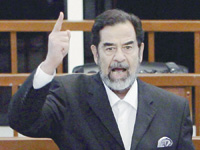 Blair or General Musharraf his personal friend -- there are personal enemies
as well.
Blair or General Musharraf his personal friend -- there are personal enemies
as well.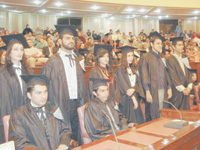 especially English university towns who gathered together once a year to
honour their own and make a bit of a fuss to impress the ordinary
townspeople. I suppose even the largest of them, Oxford or Cambridge, would
have passed out a few dozen students. Last week in Lahore we had three
convocations, each one catering to a few thousands, and their families who
come to cheer them on.
especially English university towns who gathered together once a year to
honour their own and make a bit of a fuss to impress the ordinary
townspeople. I suppose even the largest of them, Oxford or Cambridge, would
have passed out a few dozen students. Last week in Lahore we had three
convocations, each one catering to a few thousands, and their families who
come to cheer them on.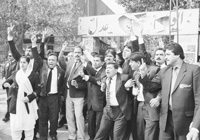 deliberate take when she said that the forthcoming elections will change the
context in 'pretty important ways'. She was replying to a question in a
recent interview regarding the reinstatement of deposed judges in Pakistan.
"It's going to be a different and new day in Pakistan and some of these
things I think are going to be resolved in the context of when those
elections are held and after those elections are held," she is reported
to have said. The hunch is she clearly knew what she was saying.
deliberate take when she said that the forthcoming elections will change the
context in 'pretty important ways'. She was replying to a question in a
recent interview regarding the reinstatement of deposed judges in Pakistan.
"It's going to be a different and new day in Pakistan and some of these
things I think are going to be resolved in the context of when those
elections are held and after those elections are held," she is reported
to have said. The hunch is she clearly knew what she was saying.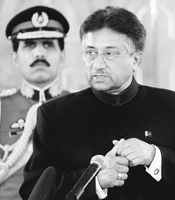 roughly the same time after the dissolution of the parliament around the same
time i.e. mid-Nov. That would be a different election though. The original
sin committed on March 9 and the lawyers' movement would have provided the
backdrop to that election. And chances are there would not be a neutral
caretaker setup even in that case nor an independent election commission. And
the local bodies would have kept functioning as well.
roughly the same time after the dissolution of the parliament around the same
time i.e. mid-Nov. That would be a different election though. The original
sin committed on March 9 and the lawyers' movement would have provided the
backdrop to that election. And chances are there would not be a neutral
caretaker setup even in that case nor an independent election commission. And
the local bodies would have kept functioning as well. been made to appear perfectly valid by using the term extra-constitutional,
which incidentally is not recognised either by the law of the land or the
constitution. A befitting start was offered when the 'emergency' was imposed
by the chief of army staff and not the president -- he was wearing both hats
then -- as provided in the constitution. Thence followed a series of
extra-constitutional orders. This is exactly why constitutions are made in
the first place -- to prevent such situations.
been made to appear perfectly valid by using the term extra-constitutional,
which incidentally is not recognised either by the law of the land or the
constitution. A befitting start was offered when the 'emergency' was imposed
by the chief of army staff and not the president -- he was wearing both hats
then -- as provided in the constitution. Thence followed a series of
extra-constitutional orders. This is exactly why constitutions are made in
the first place -- to prevent such situations.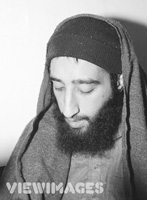 extradition hearing in a lower court.