


|
|
|
|
 |
 |
   |
cricket Pakistan
cricket in fresh crisis after Mumbai attacks swimming Brett
Lee joins the 300-wickets club What
conclusions can one draw from this year's events?
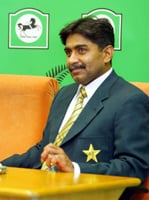
In a time of turmoil, Javed Miandad turns focus on domestic cricket 'My utmost effort will be to revive domestic cricket which has been destroyed in the past seven years due to unwise steps taken by previous regimes of PCB' By Gul Hameed Bhatti In a cricketing world gone topsy turvy following the
terrorists attack in Mumbai in late November, as the Asian region's
cricketing boards assess the resultant damage, perhaps it is Pakistan
that has suffered the most. Or at least stands isolated and expects to
be the worst affected. By December 11, Test cricket will resume in India
with the match against England at Chennai. On the same day, New Zealand
host the West Indies in a Test match at Dunedin. In another six days
time, South Africa will be playing at Perth, in the first game of a
fresh Test rubber against Australia. The carnage that left around 200 dead in its wake in Mumbai, ironically, didn't even take place on Pakistan's soil. Yet, as the Indian government has pointed the finger of accusation directly at Pakistan, saying that the terrorists appear to have links with several banned religious groups in Pakistan, the axe found its first victim in the Indian team's tour of Pakistan, that would have got under way early in the New Year. Already having suffered a fate that would amount literally to a kind of cricketing death, Pakistan have gone without playing a single Test match throughout the year 2008. Australia earlier postponed a Test-playing tour citing security reasons. The India series is off for the time being. One-day International cricket shifted to the safer environs of Abu Dhabi but Pakistan's opponents there -- the West Indies -- turned down the idea of playing some cricket on Pakistan's grounds. Still, last June, Pakistan had successfully staged the 2008 Asia Cup competition that included five other teams from the region, including India, without any untoward incident. Earlier, two limited overs series, against Zimbabwe and Bangladesh, had been hosted and both were completed with remarkable ease. The Mumbai attacks have left the area in turmoil. For the first time, it appeared that foreigners residing in the sub-continent were made the targets. Naturally, the paranoia was going to get enlarged a thousand times. But India, where the incidents happened, is already getting back on its feet with the resumption of a Test series against England. And Pakistan? They have been left with nothing to do for quite a while. Of course, in July-August in the year 2009, Pakistan will be going off to Sri Lanka for a rubber that includes three Tests and five One-day Internationals, soon after taking part in the T20 World Championship in the West Indies. Right now, however, they are missing being represented in the Champions League Twenty20 event in India which has been postponed. The Sialkot Stallions, three-time national champions here of the twenty20 game, would have landed in Mumbai just two days after the city got under attack. Several Pakistani players were taking part in a World Series following the successful completion of another session of the breakaway Indian Cricket League (ICL). A whole lot of others had started their travel plans for the lucrative Indian Premier League (IPL). All tournaments and events have been put off for later dates. What does Pakistan do in the meantime? Naturally, if we can look at the alternatives in a positive light, attention should be now focused on the various domestic tournaments that are on the anvil. From December 15, the inaugural Pentangular Cup one-day championship is being launched in Lahore with the bulk of the matches to be played at National Stadium Karachi. With nothing else to do, all the national cricketing stars are available to play for their respective provincial sides (the fifth team Federal Area includes players from Islamabad and Rawalpindi), which in the circumstances is a matter to rejoice. If Pakistan's next international assignment is not going to turn up for the next six months, then for the first time in many seasons the international players will also be available for the impending Quaid-e-Azam Trophy Championship and the National One-day Cup event. Some players may also want to represent their departments in the non-first-class Patron's Trophy Grade-II Championship. Even though the cynics may simply scoff at the idea of having the leading stars playing at the domestic level, and not having any international cricket to turn their attention to, it is imperative that we look for some positives in the situation that's been thrust upon us due to the prevailing circumstances. Thus, it was interesting to note what Pakistan Cricket Board's newly-appointed Director General Javed Miandad, the former star batsman and captain, had to say about his vision of 'building the nation through cricket' in a press conference that he held in Lahore this Thursday. Miandad underlined his message by saying that he wants to strengthen domestic cricket by motivating departments, banks and business houses to form their teams besides making the cricketing associations more active. "My utmost effort will be to revive domestic cricket which has been destroyed in the past seven years due to unwise steps taken by previous regimes of PCB," he told the news conference. Miandad stressed the need to make all out efforts to address the problems cricket was facing at the grass roots level and said in the past the needed efforts were not made to keep the departments, banks and business houses involved in the game -- domestic cricket -- which resulted in the overall destruction of the game. He talked of "a glittering past in the game from 1983-97 after which we followed a decline as the previous regimes of PCB made a lot of experiments to ruin domestic cricket and the interest of the departments gradually faded away to remain associated with the game". The former Pakistan captain said he will endeavour to lure departments to form their teams including their junior teams to supplement PCB's efforts for the revival of the game. "Besides, we also need to concentrate on associations and clubs cricket and in my opinion they should be given the chance to organise cricket in their respective districts and the PCB should concentrate on helping them and to monitor them under a systemised programme," he added. He didn't agree with a questioner that according to former captain Imran Khan the involvement of departments was the main factor for the decline of overall cricket in Pakistan. "What Imran has said is his own thought and I have my own ideas and way of doing things and it is not necessary that I should agree with him," he said. When his attention was drawn that most of the departments and banks today are without their regular cricket teams and they are getting lesser chances to play in domestic cricket, he said there are a lot of business houses which have shown interest to form their cricket teams and to take part in domestic tournaments. "Of course we will encourage them and I am confident that as more of them join us the better cricket will be, because players will get more jobs and they will be having ample opportunity to excel at the domestic level as in the present region-based cricket the talented cricketers are overlooked owing to certain reasons," he added. He said efforts would be made to have an expanded domestic cricket system by modifying the existing tournament programme so that they should play more cricket to expose aspiring cricketers to a high quality game. "I want to see associations and clubs in a better role and we will be doing our best to keep them along by having more teams from provinces under a new formula because big cities like Lahore and Karachi need more representation in domestic cricket," Miandad added. Like all his predecessors in the PCB -- the post of Director General is a brand new one though -- Miandad is aiming for the future and sincerely wants Pakistan's cricket to assume a more meaningful stature. But, in fact, there's nothing new in his basic ambitions though how he will go about his plan could make all the difference. The current domestic cricket system is based firstly on an Inter-District style, with tournaments contested by the country's 82 cricket-playing districts at the Senior as well as the Under-19 level. Then, there's a 11-team Inter-Region non-first-class level-II competition and the Patron's Grade-II event. The national first-class tournament for the Quaid-e-Azam Trophy had as many as 22 teams bunched together in the 2007-08 session. These comprised 13 regional association sides in addition to nine of the leading departmental teams. Later in the season, five teams competed in the prestigious Pentangular Cup competition. Most cricketseers believe putting the regions and the departments in the same tournament is not a very good idea. The system leaves the regional associations without their best players, who are playing for their employers instead, and thus there is not even a ghost of a chance for the associations to finish anywhere near the top. Perhaps, it would be a good idea to restore the first-class Patron's Trophy Championship for the best departmental sides of the country playing. Surely, teams like Sui Northern Gas Pipeline Limited (SNGPL) -- who won their first national title last season -- deserve to be in a tournament of their own. Then, there are Habib Bank Limited (HBL), National Bank of Pakistan (NBP), Water and Power Development Authority (WAPDA), Sui Southern Gas Company (SSGC), Pakistan Customs, Pakistan International Airlines (PIA), Zarai Taraqiati Bank Limited (ZTBL) and Khan Research Laboratories (KRL). The country's regional associations -- there are 11 of them with the teams totalling 13 as Karachi and Lahore are allowed to field two sides each -- should be contesting the Quaid-e-Azam Trophy with all their best players available. Apart from the nine departmental teams mentioned earlier, there are as many as 22 others that competed in last season's Patron's Grade-II tournament. Six of them were brand-new entrants on the domestic scene and one of these same sides, the Port Qasim Authority (PQA), went on to become the new champions. The other five teams were Medicam Group, Pakistan Oilfields Limited (POL), Pak Saudi International, Fauji Fertilizer Company Limited (FFCL) and Warid Telecom. Unfortunately, it had already been decided by the PCB's domestic authorities that the champion side will not be elevated to the first-class circuit. Thus, PQA are still unaware of their fate. The Patron's Grade-II teams include United Bank Limited (UBL), Dewan Farooq Motors Limited (DFML), Karachi Electric Supply Corporation (KESC), Pakistan Steel, Pakistan Television (PTV), Pakistan Army, Capital Development Authority (CDA), Pakistan Ordnance Factories (POF), State Bank of Pakistan (SBP), Pakistan Air Force (PAF), Pakistan Navy, Higher Education Commission (HEC), Karachi Port Trust (KPT), Pakistan railways, Service Industries and Pakistan Education Boards (PEB). HEC and PEB are, of course, not departmental teams in the true sense of the word. They don't pay their players as they are all students from various schools, colleges and universities. Over the years, a large number of 'departmental' teams have withdrawn their outfits from the domestic circuit for various regions. These have included sides like Pakistan Telecommunication Company Limited (PTCL), Allied Bank Limited (ABL), Defence Housing Authority (DHA), Public Works Department (PWD), Attock Refinery Limited (ARL)/Attock Group, Saga Sports, Leo International, REDCO Pakistan, Pakistan National Shipping Corporation (PNSC), National Development Finance Corporation (NDFC), House Building Finance Corporation (HBFC), Income Tax Department (ITD), Muslim Commercial Bank (MCB) -- now known as the MCB Bank, Pakistan Automobile Corporation (PACO), National Highway Authority (NHA), Pakistan Military Accounts (PMA), Combined Services and Industrial Development Bank of Pakistan (IDBP). While the PCB's new DG will be well advised to look into the causes of the withdrawal of certain departments, he should be devising a system that will help him keep the new departments interested in Pakistan's domestic cricket for a longer period than several others in the past. The writer is Group Editor Sports of 'The News'
Pakistan cricket in fresh crisis after Mumbai attacks Pakistan, which is already experiencing a vicious circle of postponements and cancellations of international sporting events, could face a long international cricket drought at home if India refuses to tour next month By Ghalib Mehmood Bajwa The recent Mumbai attacks jolted not only the bilateral relations between Pakistan and India but also the entire sporting community particularly the cricketing world. After the sad shooting incidents, all the
international cricketing and other sporting activities in India had to
be postponed or cancelled with immediate effect. Remember, the England cricket team flew back to London after the final two One-day Internationals against India were cancelled in the aftermath of the terrorist attacks in Mumbai that killed 195 people. The Indian Cricket League (ICL) World Series T20 event, which was under progress at Ahmedabad at the time, and the Twenty20 Champions League were also postponed after the Mumbai carnage. Mumbai was due to host three of the 15 games in the six-million dollar tournament featuring the leading Twenty20 teams from Australia, South Africa, India, England and Pakistan. However, the chief organiser Lalit Modi strangely insisted that the inaugural Twenty20 Champions League was postponed due to logistical problems rather than security fears. The sequence of withdrawals and postponements is not restricted only to cricket. The World Squash Federation (WSF) has also postponed its Doubles Championship scheduled for December 15-20 in the southern city of Chennai in response to security concerns. WSF decided to put off the event after Australia announced it would not be sending its players for the championship. Now, Pakistan's arch-rival can feel the pain of postponement or cancellation of international events. Remember Pakistan has been undergoing such an agonising situation for the last couple of years in the name of inadequate security. It may be mentioned here that the security situation could get worsened anywhere in the world at any time. This practice has been observed many a time in the past in different countries by people from different religions and sects. In 2005, the Ashes went on in spite of multiple bomb blasts in England, and just last season an IPL match took place at Jaipur days after multiple explosions had claimed 80 lives. The security situation in India and Sri Lanka has been similar to Pakistan since long but almost all the Indian and Lankan cities have been hosting international matches on a regular basis. Apart from several international cricket series, Colombo hosted the South Asian Games successfully two years ago. In 2008, Bangalore and Ahmedabad staged Test matches and ICL games in spite of serial bombings in those cities. Recently, Bangalore hosted a Test match against Australia. The bomb blast incidents also occurred in New Delhi and Guwahati during Australia's recent tour. Even there was a two weeks time in early November when national cricket teams of Australia and England were simultaneously present in India. Not only this but dozens of top cricketers from around the world were also busy in the ICL for over one month in spite of such defective security. Here one can feel that Pakistan has been a victim of a biased approach from almost all countries in this regard. At this critical stage of Pakistan's sports history, the role of neighbouring India in particular and South African Cricket Board has been very questionable. It may be recalled here that both Indian and South African cricket teams have played full Test and ODI rubbers on more than one occasion in Pakistan during the last six years without any untoward incident. But now strangely they refused to tour Pakistan for bilateral matches and the Champions Trophy tournament. India also refused to cooperate with Pakistan in its bid to hold some top level competitive cricket in the recent past. Though Pakistan hosted two bilateral cricket series against Zimbabwe and Bangladesh and then organised the six-nation Asia Cup cricket tournament in 2008, unfortunately our previous cricket administrators failed to convince the top cricketing nations to travel to Pakistan for the elite cricket tournament. Set aside cricket, in the present circumstances no other international sports team is ready to tour Pakistan. It may be recalled here that the Pakistan Hockey Federation (PHF) also could not convince the leading teams for the Champions Trophy tournament and resultantly the FIH shifted the elite tournament from Pakistan in the recent past. Moreover, top cyclists also withdrew from the recent Tour de Pakistan cycle race. Leading squash players also preferred to stay away from Pakistan's international sports competitions because of security fears. The cancellation of the junior hockey Test series against India at the eleventh hour is another painful chapter in Pakistan's sporting history. The much-awaited five match junior hockey Test series was cancelled suddenly without informing or mentioning any reason. Pakistan had made strict security arrangements for the Indian junior team but Indian authorities refused to allow their junior team to enter Pakistan just one day before the series. The Indian team had reached Amritsar to cross to Wagah border but was told not to proceed till further instructions. It is to be noted here that Pakistan and India had agreed to play bilateral series in a bid to prepare their teams for Junior World Cup to be played in Singapore and Malaysia in June 2009. According to some reports, the Indian government has refused permission to send a cricket team for a full tour of Pakistan early next year. According to Indian TV, the tour was cancelled amid a government probe into the Mumbai assaults. Indian cricket team was scheduled to play three Tests, five One-day Internationals and a Twenty20 match during the five-week tour from January 13 to February 19. It would have been the fifth bilateral series between the two countries since 2004. World champions Australia also cancelled a Test tour of Pakistan in March and the International Cricket Council put off the high-profile Champions Trophy in September due to security concerns. Pakistan, which is already experiencing a vicious circle of postponements and cancellations of international sporting events, could face a long international cricket drought at home if India refuses to tour Pakistan next month. The unwanted India decision could leave Pakistan without a Test from December 2007 to June 2009, when they are scheduled to visit Sri Lanka. Both India and Pakistan are victims of terrorism and games like cricket and hockey can provide much-wanted relief to the people of two countries. At this critical time, both the countries should placate each other by extending friendly support at least in the sports field. The writer is a staffer at 'The News' in Lahore
Brojen Das has been the pride of Pakistan and Bangladesh He was the first Asian to swim the English Channel and the first person to cross it four times. In addition, in 1961, he also created a world record for the fastest swim across the Channel from France to England By Dr Ijaz Chaudhry Brojen Das, the King of the English Channel, who started his conquests 50 years ago is South Asia's finest ever swimmer and pride of both Pakistan and Bangladesh. This year open water swimming (10km) marked its debut
in Beijing 2008, as the newest Olympic sport. The most famous and the
most prestigious open water swimming race is of course the English
Channel Swimming, the "Everest of Swimming". The English Channel is 34km (21 miles) at its shortest point. Since 1875, 1013 people have successfully swam the English Channel, completing 1418 crossings to date. In comparison, Mount Everest had been climbed 2,049 times. Swimmers have been using the same type of gear since 1875: swim suit, swim goggles, swim cap. Technology has rapidly advanced to the advantage of mountain climbers. And also this year, Bangladesh observed the tenth death anniversary of 'The King of the Channel', its greatest sporting hero, its only sportsperson of international recognition. The fairy tale of a small man from a country which has never won an Olympic medal in any sport, has never come close to winning a swimming medal of any colour at even the Asian Games, yet it produced a swimmer who took the world by storm around half a century ago. Brojen Das who left this world in 1998 was an open water swimmer par excellence. He was the first Asian to swim the channel and the first person to cross it four times. In addition, in 1961, he also created a world record for the fastest swim across the English Channel from France to England -- when his sole aim was to create the record. Easily the greatest swimmer ever to come out of South Asia (India, Pakistan, Bangladesh, Sri Lanka, Nepal etc.), a region which houses more than one fifth of the world population. Born on 9 December 1927 in Kuchiamora village of Bikrampur, Munshiganj, in East Pakistan, now Bangladesh, Brojen was an adept swimmer from his boyhood. The turbulent water of river Ganga (Buriganga) was his first training ground. Ironically, he first distinguished himself as a short course swimmer. His competitive career started with winning the inter-school competitions in 1943-45 and inter-college competitions in 1948-49. In fact, it was his swimming ability that motivated the East Pakistan Sports Federation to introduce the annual swimming competition in Dhaka. The first East Pakistan swimming competition took place in 1953 and Brojen made a complete sweep of freestyles events: winning the 100m, 200m, 400m and 1500m freestyle events. In 1955, Brojen became Pakistan's national champion in 100 and 200 metres freestyle. He had even made into the Pakistan's swimming squad for the 1956 Olympics but an injured arm suffered in an accident in Dacca, ruled out his entry. However, Brojen decided to make the transition to the much gruelling long distance open sea swimming. He made the most turbulent part of the lower Meghna River as his training field. His swimming career took a new turn when he got the opportunity to take part in the English Channel Swimming Competition in 1958. Seeing it as the chance of a lifetime, Brojen Das intensified his training. He felt confident when he finally swam from Narayanganj to Chandpur, a distance of about 46 miles. He also accomplished with credit a non-stop 48 hours swimming, covering approximately 60 miles in a Dhaka swimming pool. Prior to the English Channel competition, Brojen successfully completed the Mediterranean swimming competition from Capri to Naples. That gave him added confidence and an opportunity to acclimatise himself with the Oceanic waters. Brojen arrived in England in June 1958 for the Billy Butlin Channel Swimming Competition. He was the only contestant from the South Asian countries. The swimming began at midnight of 18 August 1958 and it came to a close in the afternoon of the next day. Twenty-one out of 30 swimmers had dropped out due to various reasons, mostly due to sheer exhaustion but the undaunted Brojen continued with the strongest determination and joined the ranks of the heroes crossing the Channel. He not only secured the first position in competition but also became the first Asian to cross the English Channel. The following year, Brojen again successfully swam the channel and bettered his timing of the previous year. Moreover, he also did the channel from the other direction, England to France as well! His exploits were not confined to the channel: he repeated his last year's success in swimming from the Capri Island to Naples in Italy besides three other long-distance international swimming competitions. In 1960, he completed a hat-trick repeating the feat for the third consecutive year. Ironically some of his detractors, especially the press of his own country, termed it as a 'failure'. 'Brojenda', as he was popularly called, said in a press interview, "My fourth Channel swim in 1960 had dragged me down to the bottom of the ladder. I took 14 hours and 44 minutes for my France to England swim. Even in 1958 when I had competed in the Bultin Channel Swim Race in my maiden attempt, after being training in the warm waters of East Pakistani rivers and swimming pools, I had clocked for the same France to England swim, 14 hours, 25 minutes. In 1959, I had bettered my own timing by doing it in 13 hours, 53 minutes. And again the same (1959) year I had further bettered my own time for England to France swim (which is more difficult than the other way round) by doing it in only 13 hours and 26 minutes. "So I was under great pressure. Even the press in Pakistan had started predicting that the 'Brojen era' is about to end." MORE NEXT WEEK The writer is a freelance contributor
Brett Lee joins the 300-wickets club After a difficult tour of India where he took only eight wickets with a high average of over 60, Lee found his form in the two-Test home series against New Zealand in which he claimed 12 wickets at an average of 21.83 By Khurram Mahmood Last month during the first Test against New Zealand at Brisbane, opener Jamie How became Australian fast bowler Brett Lee's 300th Test wicket. It was Lee's 73rd Test match. Brett Lee is the fourth Australian bowler after Shane
Warne (708), Glenn McGrath (563) and Dennis Lillee (355) who has taken
300 plus Test wickets. Overall, he is the 23rd member who joins the 300
Test wickets club. In One-day Internationals, he has also completed 300 wickets at an average of 22.95 in 173 ODIs he has played so far. His batting average (17.44) with a strike rate of over 80 is quiet reasonable for a lower order batsman. He also hits 25 sixes in the limited version of the game. After a difficult tour of India where he took only eight wickets with a high average of over 60, Lee found his form in the two-Test home series against New Zealand in which he claimed 12 wickets at an average of 21.83. After the home Test series against New Zealand, Lee's total Test tally stands at 309 at an average of 30.11 Brett Lee, 32, is one of the fastest bowlers in the world along with Pakistan's Shoaib Akhtar. He is also a handy batsman in the lower order with an average of over 20 including five fifties. His athletic figure supports him to bowl with pace regularly. His fastest delivery was recorded with a speed of 99.9 mph which he bowled against New Zealand in March 2005. Only Pakistani speedster Shoaib Akhtar has bowled at 100.2 mph which still stands as the fastest recorded delivery. Brett Lee made his Test debut in 1999 against India at Melbourne. He announced his arrival in international cricket with a bang. Bowling first change Lee took a wicket in his first over in Test cricket when he bowled Sadagoppan Ramesh with his fourth delivery. He also captured Rahul Dravid's wicket in his first spell before returning to take three wickets in six balls to finish the innings with figures of 5-47 from 17 overs. Australia had batted first, and Lee had earlier made 27 runs. Lee took thirteen wickets in his opening two Tests at the low average of 14.15. In 2001 he remained out of cricket after he broke his elbow and on his return to international cricket in 2002 there was a question mark on his performance. He took five wickets against Pakistan in the home series and dropped from the side in favour of Andy Bichel for 2002-03 Ashes series. Lee's speed with accuracy didn't give much time to the opposition's batsmen to adjust. On the 2000 tour to New Zealand, he was reported for a suspect illegal bowling action by umpires Venkataraghavan and Jayaprakash, but later he was cleared of the charges. Lee also played for the Australian Under 17 and 19 teams and was awarded a scholarship to attend the Australian Cricket Academy. He made his first-class debut for New South Wales against Western Australia in a Sheffield Shield match in 1997ñ98 and took three wickets for 114 runs. After just one month, Lee was selected for the Australian A team on a tour of South Africa. He claimed two wickets but got stress fractures in his back and was out of cricket for three months. In 1999, in a Sheffield Shield match at Perth, Lee bowled his fastest spell. After watching him bowling, the then Australian captain Steve Waugh and his deputy Shane Warne made up their minds to include Lee in the Australian Test side. Lee took 42 wickets in his opening three series, the most by any Australian bowler in the seven matches he played. After the retirement of Glenn McGrath and Shane Warne, Brett Lee now is the front line striker for Australia. In his first series as chief striker he took 16 wickets in two Tests at an average of 17.5 against Sri Lanka in 2007. He won Man of the Match award in both Tests. Lee continued his form in the next series against India where he had taken 24 wickets with the average of 22.58 in four Tests. For his excellent performance he won the Player of the Series award in the Border-Gavaskar Trophy 2007-08. He also won the Allan Border Medal, the award given to Australia's best cricketer of the season. Lee got his 100th wicket in his 27th Test against England at Sydney in 2003. He completed his 200 wickets in his 51st Test against South Africa at Durban in 2006 while his 300th wicket was in his 73rd Test against New Zealand at Brisbane last month. Lee's best Test bowling figures of five for 30 came against the West Indies at The Gabba, in 2005. Surprisingly, his bowling average against Pakistan is 46.80 against his career average of 30.11. His home average 27.53 is better than his away average of 33.42. He has taken the most 62 wickets against England in 18 Tests. Lee wants to become an all-rounder, his batting performance in recent years has been improving, averaging over twenty in both forms of cricket in the last two years. In 2006 he scored his Test best 64 in just 68 balls against South Africa at Johannesburg. Lee's ODI highest score (57) is also against South Africa at the Gabba in 2006. During his career Brett Lee has won many awards for his outstanding performances. In the years 2000 he won the Donald Bradman Young Player of the Year and The Wisden Young Cricketer of the Year honours. In 2006 he received the Wisden Cricketer of the Year nomination. He also received the VB Series Player of the Series awards in 2002 and 2004. In 2008 he got the Australian Test Player of the Year and the Allan Border Medal. Lee was also selected in the Test and ODI team of the year 2008 at the ICC Awards. The writer works in the art department at 'The News' in Karachi What conclusions can one draw from this year's events? People like Qadir and Aamer need to realise that poor, proud, hot-blooded, cruelly cold-shouldered Pakistan has produced more brilliant and unsung cricketers than any other country By Dr Nauman Niaz You could draw all sorts of conclusions from this year's events in Pakistan cricket, which reached its now customary rousing climax with several appointments primarily all ex-Test cricketers, but the clearest of them all was the fact that if the PCB intended to go ahead they needed to do something. Not just a brigade of ex-cricketers or people who had
somehow just missed the lucrative international gravy train or who had
been pitched off it into the undergrowth of cricket in Pakistan, like
Sultan Rana or Shafiq Ahmad but technocrats are also required to take
the game to a springboard from where it could take off, like in the
1970s, mid-1980s and early 1990s. With rollicking stars such as Javed Miandad, Wasim Bari, Abdul Qadir and Aamer Sohail in the management teams, there are several other washed-up veterans trying to transform the fortune of local, domestic and national cricket. People like Qadir and Aamer need to realise that poor, proud, hot-blooded, cruelly cold-shouldered Pakistan has produced more brilliant and unsung cricketers than any other country -- only they don't have the systems and as it was with the previous boards, they had more politics than productivity and a disastrous group of people not tuned to development of cricket; they evolved mechanisms such as self-service, personal and vested interest and a succession of phenomenal joy-riders. Resultantly, the chemistry of the team's success remains intriguing. A potent system really does seem to be an important part of it, given the lifelessness of people who ran it, in the past. All this is all very well, the broader-minded follower of the local and Pakistan game may say, but what about producing Pakistan players of the right quality? The new PCB needs to weigh its priorities and commitment to the regional/association teams, the National Cricket Academy and to identify player pathways. There is much talk of the importance of grooming young home-grown products. The best teams need young men of potential, older ones of ability, locally produced players whose heart and soul are in the clubs and regions, and yes, two or three well-chosen players of outstanding ability from the NCA. That leads finally to the now well-documented viewpoint: that players gleaned from the national team are fine so long as they perform and are not blocking the way of other naturally talented lot who need to get experience if they are ever to fulfill their potential. If there were sufficient high quality young players, no one would stick to the erratic cricketers likes of which we now often see in television commercials. Why aren't there enough? Because, we claim, Pakistan cricket did not have its development structure right in the 2000s. If we get them right now -- and the NCA and regional academies should be achieving that -- it will still be another five to ten years before we get a sufficient number of Pakistan quality cricketers, like India, England, South Africa and Australia have now. We have 170 million people, so a couple of centers of excellence are not too many, but if the 18-to-23 age group are not playing first-class cricket they are not going to become regular Pakistan players in the future. In one corner slumps the Old World, aching for the days when it had a decent punch and dominated the ring, did much as it pleased, reaped most of the profits and took no crap from nobody. In the other bobs the New World, several ex-chairmen leaving stamps of prejudice, subjugation and subservience; our previous chairman Dr Nasim Ashraf stalled towards India and quite unnecessarily banned the players defecting to the Indian Cricket League endorsing support for the BCCI backed Indian Premier League. It was ironic. Some of the smart lads were disallowed to represent their local teams in first-class cricket. A simplistic, needlessly alarmist view of the relationship between the BCCI and the PCB; Maybe, but maybe not; India surely didn't reciprocate. Like their junior hockey team they would have tried to shy away from playing in Pakistan in January 2009 had not terrorism exploded Mumbai last week -- on the face of it, the two nations appear keener on each other than ever. But to judge the situation in such terms is to misunderstand and underestimate the nature and extent of the behind the scenes maneuvers between the BCCI and the PCB that so upset an ex-Test captain. The previous PCB regime looked like an offshoot of the BCCI. Realistically, I differed with the ex-captain as it is difficult to sustain a worthwhile counter-argument. Money has never talked as loud as it is doing in cricket now, and as the producer of an estimated 70% of the game's income, the BCCI is certainly flexing its muscles, acting in its own interests and calling a goodly proportion of the shots-much like the MCC and the TCCB once did. A little humility and a great deal more caring and sharing would not go amiss, not to mention a firmer grasp of the principles of enlightened despotism, but the inescapable fact remains: the New World holds every bit as many cards as the Old World once did; all of them. Notwithstanding the PCB couldn't stand up to the ICC and other boards of the developed countries, even asking for the rightful presumably because people contesting the cases such as ICC Champions Trophy being deferred, Darrell Hair's return or a succession of tours declined by Australia, West Indies and very recently India clearly indicated their submissiveness. On the contrary BCCI's fondness for appealing against disciplinary rulings, Australia tended to accept the new order, for reasons strictly related to the financial and the pragmatic. However, if only because it wields considerably more economic power than Cricket Australia or the England Cricket Board -- which sees eye to eye with the BCCI solely on one subject, namely the extremely prejudicial termination of the ICL-is not going so quietly. Pakistanis couldn't even cause a ripple, meekly accepting what was being dictated by the other boards. Regrettably, people like Dr Nasim Ashraf tried to please the BCCI to strengthen him as an individual rather to see country's interests. On the contrary, despite a chaotic decline Sir Allen Stanford loaded the West Indies cricket with billions making her stand on its own feet. Even West Indies declined to tour Pakistan such was the apathy and passivity of PCB's top tier. With Ijaz Butt in things should change. Such is Stanford's character that not only he sold cricket to the United States of America but the ECB sees him as an ally in its attempt to resist the advances of the Indian Premier League; hence what many Pakistanis intellectuals see, somewhat harshly, as the pantomime that was the Indian Cricket League. Whilst Pakistan abhorred the ICL and banned its cricketers from taking part in first-class and international cricket, towering people like Stanford ensured support for the WICB at ICC meetings, another happy by-product. While PCB condemned the players defecting to the ICL, Stanford's reforms were tainted as news broke from Venezuela, where intelligence officers raided the Caracas branch of his offshore bank over claims that employees were paid by the CIA to spy on the defiantly left-wing country in South America and it did little for the prospect of a beautiful relationship, much less a lasting one. The BCCI has become as powerful as they could by making ECB to agree to a two-Test home series. It seems BCCI has become strong enough to dictate terms having the potential to make or break a series in another country. BCCI, at the backdrop were agitated by ECB's softer stance on the players defecting to the ICL -- it was abruptly as one should say coercion and blatant use of financial strength. With Pakistan cricket on the edge, time has come that we need to regroup and stand up to political and power play by different boards. We shouldn't be meek and we need to resolve the core issues, taking them on one by one. Ijaz Butt has stiffer challenges and problems to cope with and it wouldn't be done in a day or two. However we need to draw lines and start doing the spade work such as lifting the ban and allowing people like Abdul Razzaq, Rana Naved-ul-Hasan, Imran Farhat, Imran Nazir, Shahid Yousuf and Mohammad Sami to return to the national team. We should stop signing the same aggrieved hymn sheet. BCCI is wielding influence so much so that Sri Lanka's IPL commitments could scupper their next tour to England. Dr Nasim left a huge load of problems for his successor, PCB's forthright Chairman Ijaz Butt. Not a man who attracts fence-sitters. While many in the country believe he has the vision, verve and commercial nous to fur-line Pakistan cricket with money and prosperity, there are others livid at what they see as the short-term expedient of changing things rather than seeking the widest possible audience, flogging off the family jewelry in exchange of a mess of potage. Mr Butt needs to realise we have yearned for strong leadership for years and now he has come along. We don't want some loose cannon flying round the world shooting from the hip. It's a titular role, about flesh-pressing. The tail shouldn't be wagging. With India not coming for the series, though weighed politically, Mr Butt shouldn't even talk about shifting to the off-shore venues. He has to fire many a dart at the BCCI. Second, support to the BCCI backed league IPL shouldn't be stopped but at least downgraded, far more practical, ends. Mr Butt is a sharp, resoundingly successful businessman/entrepreneur, and hence something of a realist, is not quite the loose cannon, as I perceive. Recent evidence, indeed, suggests he is keen to keep up a placatory front; an attitude that cricket craves. |
|