


|
|
|
|
 |
 |
   |
issue It
ain’t over till its over Taal
Matol comment Bush
vs. Al-Zaidi RIPPLE EFFECT
A close call From war hysteria to near-war. Experts share their opinion on whether it makes sense to talk war at this point
By Aoun Sahi The tension between India and Pakistan assumes varying levels of intensity as you open the day’s papers or switch on the news channels. Of course, there are lean days for the war hysteria, but they are followed mostly by its return to the extent that military aircraft can be seen hovering over major cities of Pakistan. One wonders as to how close to ‘war’ we get during such times in the two countries and how easily? We might blame the Indian leadership for initiating the
war hysteria, but Pakistani leaders also wasted no time in declaring that
they would defend their homeland with full force. This raises a few important
questions. What exactly has been the role of the media in extracting
jingoistic responses from the political leadership of the two countries that
took a more responsible position in the immediate aftermath of the Mumbai
attacks? Why were the peaceniks not on the media or the streets after decades
of lobbying for their cause? And finally, how real is the threat of war and
do the people who talk war know what it really means? To find answers to these questions, The News of Sunday talked to a number of experts. The prevailing war hysteria in India and Pakistan, according to most of them, suits extremist elements and will help make them stronger. "These elements were marginalised during the last five years or so and they do not want to let this opportunity go, because they know only war or a war-like situation can re-strengthen them," says Gen (r) Talat Masood, a leading defence analyst. He says the role of the media, especially TV channels, is critical in creating the war hysteria in the subcontinent. Masood was in India on Nov 26 and recalls how the situation totally changed in just a few hours for the two countries. "The Indians immediately started pointing fingers towards Pakistan and the peace endeavours of the last six or seven years became ineffective. The Mumbai attacks have also made it almost impossible to start them again." Masood thinks that war between India and Pakistan is almost out of question at this point of time. "My assessment is that India is using its military option as a diplomacy tool to grind more wheat." He thinks that the lack of trust between the two countries is mainly responsible for the current situation. "One such incident rolls back all kinds of confidence building measures (CBMs) and that is the real dilemma." Masood also believes that the situation this time is different than in the past. "The absence of massive troops’ movement like the one we saw in 2001, for many in Pakistan, means that India is thinking to lodge air strikes on specific targets inside Pakistan." Akram Zaki, a former foreign secretary, tells TNS that India is using coercive diplomacy and trying to create war hype. "India is doing so to pressurise Pakistan to succumb to its demands." According to him, Indian intentions are clear after the country’s aircraft violated the Pakistani air space. "The government should take a firm stance against the Indian aggression and if it fails to do so, the people of Pakistan should force it to do so." Zaki adds that peace is our desire but "it has to be on both sides". There are also people in the two countries who advocate the use of nuclear weapons to make the war ‘meaningful’. A recent report, however, suggests that even a first generation nuclear bomb dropped over a city like Karachi or Mumbai could result in 800,000 to two million immediate deaths. On top of that, a radioactive cloud would engulf the whole region and also spell disaster for the other countries bordering the subcontinent. Pakistan and India are estimated to have 70 and 150 nuclear bombs, respectively. "The problem with the rulers in the subcontinent is that one cannot provoke the war hysteria and then retract. They need to understand that their own rhetoric can force them to go for war, which means endless devastation, because a nuclear war cannot be totally ruled out," says Asma Jahangir, chairperson of the Human Rights Commission of Pakistan (HRCP). Jahangir visited India last week and closely observed the prevailing war hysteria there. "For the first time, I even heard some voices lobbying for the army rule in India, because they were not satisfied with the civilian government’s response to Pakistan after the Mumbai attacks," she tells TNS. "Nevertheless, there are also people who do not want war in the region. For example, to counter the war hysteria in India, renowned journalist Kuldip Nayar recently arranged a protest in favour of peace in front of Taj Hotel. So you cannot say that nobody is raising a strong voice against war between India and Pakistan," she contends. "The extremists want to get their purpose served, which is giving the Taliban the charge of the NWFP and teaching a lesson to civil society in the rest of the country," she says. "Unfortunately, no country in the world is standing by Pakistan right now," she regrets. Jahangir thinks that Zia and Musharraf are responsible for this grim situation. "They really have made the country ungovernable. We need to tell the people that in the present scenario no country can survive with the help of nuclear warheads alone. Still some people are trying to force the government to go for war. Do they know the meaning of war? If they want to know, they should go to the heirs of those army men or common people who were killed in the past wars between Pakistan and India." Jahangir suggests that the Indian government should also use tools of diplomacy, instead of using aggressive language against Pakistan, to solve the problem, "because aggression can never solve problems."
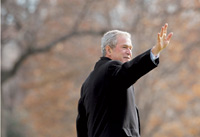
The man in the White House, the Commander in Chief of the world’s most powerful country is still George W. Bush. And he’s making his last days count
By Usman Zafar Many of us feel relieved thinking that the Bush’s presidency is finally over. Eight years of failed wars, costly mistakes, financial crises, human rights abuses, horrendous foreign policies and decrepit legislation has made his administration one that stands outs in the history books. What we might not realise is that he is not history yet.
Even in the advent of a new administration that has come riding on hope and
change, we receive reminders that the Obama administration is still a few
weeks away. The man in charge, the man in the White House, the Commander in
Chief of the world’s most powerful country, and the so-called leader of the
free world is still George W. Bush. And he’s making his last days count.
Why? Because, like any other outgoing President, he’s desperate to be relevant. As a result, Bush has made a number of trips to strategically important regions. In his last months, he has engaged in policy dialogue with Israel and Palestine, trying desperately to restart the peace talks between them. Strangely enough, that’s something so many outgoing US presidents do. It’s seen as a nice way to make a mark in the history books, though little is done after a new president comes in. Unless you’re Jimmy Carter, in which case, you get criticised for trying to make peace after your tenure. In addition Bush has made a final "War on Terror" tour; that is, visiting Iraq and Afghanistan in surprise visits as a farewell to the troops to assure them that the new president will be just as supportive of the war as he will be. When asked when peace and security will return to Afghanistan, he simply replied "Ideological struggles always take time to end". Translation: this war is going to last far longer than you think. A similar fate awaits the war in Iraq. Despite a security agreement that says forces have to start leaving the country by next year, the military command has other ideas. Bush continues to oppose the troop withdrawal, and Iraq’s top commander General Raymond Odierno agrees, which may signal that the security agreement will be breached. Despite his visits and his words, Bush can do little to mask the reality that his invasion of Iraq was a massive intelligence failure. It cost the country thousands of soldiers, over a trillion dollars, and little to show beyond the stability in Anbar province. Bush’s most notable struggle for relevance came in the recent wave of drone attacks in Pakistan, which increased by the dozens in the last three months as his tenure approached its end. The one question that continues to defy Bush remains "After eight years, why is Osama Bin Ladin not captured?" Desperate to show results, the US has conducted several unsanctioned attacks in Miranshah, Buner, and areas along the Pak Afghan border. Despite repeated assertions that the drone attacks are hurting rather than helping, they have continued unabated, killing innocent civilians and provoking tribal unrest in the region. The reason for this simply is that the Bush Administration wants to show some tangible results of their efforts against Al-Qaeda before it leaves office. Hence one sees the Pentagon lauding the attacks, saying prominent Al-Qaeda leaders, militant commanders and masterminds have been killed. But the ever elusive Bin Ladin is still at large, and that is why, no matter who else Bush captures, it will not change the fact that he’s failed to find the man seen as the poster child for terrorism. Domestically, the Bush administration is making a slew of changes that are sure to cause Obama and his team quite a few headaches in the months to come. He has issued a record number of "midnight regulations", legislation that is implemented quickly without much notice. Once again, this is not out of the ordinary, since outgoing presidents often implement such rules to assist the sectors that supported them, or to appease their parties. But Bush has done this far more than his father George Sr., or Bill Clinton. In fact, he is on track to issue more "midnight regulations" than any other US president in history. One of these regulations will make it easier for coal companies to dump debris from strip mining into valleys and streams. Another will allow coal-fired stations to increase their emissions without installing new anti-pollution equipment. Such legislation is being harshly criticised by the Environmental Defense Fund, which says that the practice is highly hazardous to the environment, but then again, the coal and energy sector has supported Bush tremendously in his eight years as president. A farewell gift was certainly apt here. In fact, the energy sector is just one of the industries being benefited by Bush’s last minute changes. He’s giving farewell gifts to all the industries that have supported him through the years, such as passing a law which legalises carrying loaded guns and concealed weapons in parks, aimed at benefiting the gun lobby, which has always supported Bush. Another regulation clears millions of acres to mining for oil shale, which is certainly going to favour the oil industry, a sector that Bush is so close to that he actually hired one of its CEOs as his vice president. One might think that the Obama administration will easily reverse these changes. But the law is more complicated than that. Undoing the damage could take months or even years, which may prove even more detrimental to an existing quagmire. It will certainly tarnish his approval ratings, which have slid to 28 percent this year, the lowest for any US President. But it was the 2008 financial crunch that was the final nail in the coffin for Bush and his struggle for relevance. The mortgage crisis, followed by the massive failure of major financial institutions showed that the free market had finally hit a wall. This is certainly not Bush’s fault, since massive deregulation was being pursued by Ronald Reagan in the 1980’s and has continued ever since. Regardless, he still perpetuated the very policies that led to its failure. The market system collapsed, because no one had regulated the system to foresee its demise. With financial disaster on everyone’s mind, Bush found his last chance for vindication in a $1.3 trillion package, which was hailed as the solution to the crisis. Despite outrage from the American public, a refusal in Congress and little policy to determine the structure of the plan, the administration went ahead with the bailout, and emptied its pockets as a result. The sad truth is that the bailout did not work the way it should have, primarily because no one knew where the money was going. The administration had to admit it had little idea of where the bailout plan was going, or what was being done with the taxpayer dollars. Bush failed yet again in an attempt to create a positive embodiment of his legacy. The surprise visit to Iraq on Monday showed us a glimpse of the Bush heritage, when on his farewell tour to the country an Iraqi journalist hurled his shoes at him, shouting "here’s a farewell kiss you dog!". Those words will resonate whenever Bush or his impact is assessed. It exists to show that despite all his attempts to remedy his mistakes, there are some things that are irreparably damaged, and it is these that form the Bush legacy, rather than his failed last ditch efforts. Bush is indeed relevant, but not in the way he wishes to be. Help!
By Shoaib Hashmi Somebody help! They say when children enter their second
year of life they enter the ‘terrible twos’! We know! We have a
two-and-a- half year old granddaughter in the house, and she is sweet and
loving, but she has a very clear idea of what she wants to watch on TV, and
it is her favourite channel Baby TV. Each time the household sits down to
watch anything, she barges in, snatches the remote control and hands it over
to whoever she thinks will switch to Baby TV. No one has seen anything else
in months and the cook while at work keeps humming ‘head and shoulders
knees and toes’! In fact the whole household has no idea what is going on around us as no one has watched the news in months —- we are well up on ‘Pitch and Potch’ though —- and for entertainment we are reduced to reading old newspapers and among those I came upon an old item. It came out in dribs and drabs and one had to piece it together but it is an eye opener. It seems in the oldest and largest hospital in town, there is a ‘School of Orthopaedic Technology’ which has been around for eighteen years and is the administration’s pride and joy. Until they decided to look into it! That made them look some more, and the whole story came together. It appeared it was set up by a Swedish expert, by the name of Person, who intended it to teach the latest in cutting edge technology and made sure it had all the facilities for the purpose, including a fully stocked library headed by an expert librarian who had been there for seventeen year, except that he didn’t have a subordinate staff, because they couldn’t find qualified people. He explained that it did not matter because in all this time no one had actually asked to use the library – and that was because since its inception the institute had neglected to actually admit any students! Not one! Of course it had a fully functional and qualified staff, but they never had any students. Perhaps the reason was that in their haste to staff the place fully, they had gone and appointed as principal the only one they could find with the required qualifications — an ear, nose and throat specialist. He, not wanting to burden himself with students whom he didn’t know what to teach, simply sat back and lorded over his staff and his office, who were only too happy to go along. So for all these years there has been this institute with full staff paid for by the exchequer and no students. For all I know it is still there. If it has been on TV, I wouldn’t know!
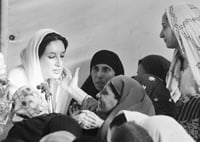
comment Bhutto and Feminism Benazir lived life the way she saw it and in that lived out one of the underlying principles of feminism which is to break the dichotomy of the public and the private
By Nighat Said Khan Apart from many other questions that dogged Benazir Bhutto
for most of her life was whether she upheld the rights of women and what she
did to further this agenda and as in most other aspects of her life this
debate was contentious. There are no grey areas in the positioning, no
dispassionate analysis, no nuanced understanding of what her contribution was
in its totality. The argument has simply focused on her policies and/or
legislation when she was the prime minister. Her detractors insist that she
did "nothing for women" and that she was "not a
feminist"; her supporters that she did initiate a series of measures
that would have seen fruition had her governments not been dismissed as soon
as they were. Feminists especially those of us who lived through General Zia
ul Haq years in power have tended to be more ambivalent. I was always more partial not because I knew Benazir or was associated with the PPP but I had an awareness of her during the Zia years. I watched her struggle first for the life of her father and later as a leader of the PPP. I saw her abandoned by her own leadership and recall wondering even then what propelled this young woman to take on the Zia ul Haq state. I remember thinking of her struggle as a woman’s struggle and not just that of a politician. Her election and her victory was a vindication and an affirmation, that despite the long years of a state ideology that sought to marginalize women the people of Pakistan had voted for a young woman to lead them. Like many others I admired Benazir Bhutto for her courage and her resilience but I also admired her for her feminism and her personal challenges to patriarchy that often made her vulnerable to vicious criticism as a woman. Many of these make people uncomfortable still and many are a threat to patriarchal structures and norms since they open up spaces that women can aspire to. Benazir lived life the way she saw it and in that lived out one of the underlying principles of feminism which is to break the dichotomy of the public and the private. How many daughters take on the mantle of their father’s legacy when they have brothers? How many of the most liberated of feminists challenge their brothers? How many politicians have had to go on an election campaign while in advanced stages of pregnancy? How many have been pregnant while fulfilling their responsibilities of a prime minister? How many have given birth while being prime minister? Yet she only did what most women have to do that is to carry the triple burdens of patriarchy and in that gave validity to women’s realities. Benazir Bhutto was not able to bring about significant legislation enabling the equality of women. But her leadership and her larger than life presence on the national stage gave women a sense of their own worth. She was also instinctively supportive of women’s rights and empowerment and instinctively progressive and in that gave women confidence and strength. She did that for me. One of my proudest moments was in Beijing at the World Conference for Women in 1995. Benazir Bhutto had been invited to be a plenary speaker for the opening of the conference. There were over 20,000 women at the main UN conference with 30,000 in the parallel NGO forum. Only a few could actually get into the conference hall. Several of us from Pakistan stood outside to watch the opening on the large screens showing the event. The atmosphere was electric. Women from around the world were watching her. She talked about the importance of economic independence for women and inheritance rights adding that she would not be at this conference if her father had not given her a share in his property. She then spoke dramatically about the significance of the moment, the importance of women’s equality in every field. "The time was now" she said, "for the world to make a choice". Quoting Dante she ended by declaring that "the worst places in hell are reserved for those who in times of great moral crisis, chose to remain neutral." Women from different continents, different countries hugged each other laughingly, tearfully, and hopefully. As Pakistani women we stood tall that day. Benazir Bhutto made her compromises as a politician, but chose not to remain neutral. Not on women or minorities, not on forces of retrogression, not on terrorists. She gave her life for that. The writer is a feminist political activist and academic. She is also Director ASR Resource Centre and Dean Institute of Women’s Studies, Lahore Email nskhan46@yahoo.com
Surrogate expressions of free will are good catharsis but...
By Saeed Ur Rehman Let us look at the consequences of their actions first. In
2000, Bush came into power through electoral fraud, with utter disregard for
the due process of law, and by stealing and forging the ballots of Democrat
African-Americans and Latinos into Republican votes. Then only for the first
few months of his presidency, his popularity rose and then went into a
nosedive until September 11, 2001, which gave Bush a chance to bomb, in
cowboy style, every country he deemed to be an enemy of "freedom"
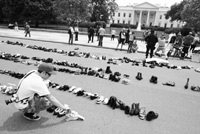
or constituting an imagined "axis of evil." Bush created emergency legislation which legalised military trials of war prisoners by assigning them a new identity of "enemy combatant" and allowed the army to imprison them incommunicado in Abu Ghraib and Guantanamo Bay. Many people were held in Guantanamo Bay on flimsiest of charges which could not be proven and they had to be released. The innocent people came out suffering from post-traumatic stress disorder and regrets over years of life wasted. Bush and his team presented false intelligence reports about the existence of weapons of mass destruction in Iraq and invaded Iraq in clear violations of the international law. The toppling of Saddam did not lead to any stability and democratisation of Iraq and the country imploded. At the same time, American citizens were subject to countless violations of their privacy because domestic spying was institutionalised by Bush when he created the Department of Homeland Security. At the same time, the American economy had started bleeding because the war in Afghanistan and Iraq were not showing any clear signs of "victory" or "liberation" of the Afghans and the Iraqis. Bush showed contempt for global environmental concerns, unionised workers of America, civil liberties, fair trial, law, justice, equality, and only supported the military-industrial complex and the elite. He shamelessly supported dictators, such as Musharraf, and their disregard for an independent judiciary. In the countries where his army had toppled the regimes formerly supported by America (Saddam and the Taliban were cold-war US allies), Bush installed puppet regimes which had no grassroots support. All this went on for eight years, driven by the unbridled greed unleashed onto the world by Bush and Co. Countless books, documents, testimonies, protests, and marches tried to register their disagreement with contemporary American imperialist hysteria. Countless effigies of Bush, Karzai, Musharraf and Maliki were burnt. But nothing expressed the global sentiment against American hubris better than the pair of Ducati model 271 size 10 shoes thrown at Bush by Muntazar Al-Zaidi. The so-called "objective" opinion-manufacturers called it an unprofessional act – as if Bush was a totally professional chief of the greatest war machine in the world. Muntazar Al-Zaidi had chosen his mode of critique with care and, according to his relatives; he had gone to buy a special pair of shoes for the occasion. He was also aware of the consequences of his actions and the political message he wanted to send. That is why he refused the offer of legal support by the lawyer of the former dictator Saddam Hussain. According to the brother of Al-Zaidi, he has not apologised for his actions and will do it again if given a chance. The only problem with Al-Zaidi’s defiance is that it may not lead to a complete recuperation of the lost dignity of the people’s invaded countries and, perhaps, will only serve as a surrogate expression of the undefeated will of the people. The real restoration of the loss of self-respect in the Arab world and Afghanistan can only come through getting rid of their indigenous systems of exploitation and client rulers and recuperate the collective will of the people. In many postcolonial societies, real freedom does not exist and the departure of foreign colonisers often leads to the exploitative hold of a native oligarchy, which continues to extract profit in the same manner as the former coloniser. Even though Al-Zaidi has achieved the status of a hero in the Arab world and, if the popularity of online games which allow players to throw shoes at Bush is a reliable indicator, among the world of cyber-activists, the Arab world has to do a lot more to be able to make their voice heard. For example, they have to stop blaming the West for all their problems and carve out their own sovereign space in the global polity. The best revenge for the exploited is, in addition to the cathartic use of a pair of shoes, to become indispensable to a large number of people all over the world by acquiring and producing leadership in science and social justice. Wherever justice and prosperity exists, people start migrating to that territory. At the moment, Muslim countries are only good for leaving. People have to make them suitable for living for themselves and others. Then they will not need to throw any shoes. Until then, surrogate expressions of free will are good catharsis —but nothing more.
Where the hell is the law?
By Omar R. Quraishi I can’t help but notice this garish building which has slowly but surely come in front of my apartment complex in Bath Island. It is quite an irony that the area which contains the main residential enclave for government officials has perhaps the highest rate of building violations in a city known for not exactly enforcing the law when it comes to zoning and construction regulations. The building that I live in has four stories so it’s probably not so illegal, but this new building which is in the last stages of construction has eight stories and I can bet a million rupees that much of the construction is a violation of the Karachi Building Control Authority’s code. Also, to make matters worse – though this is apparently the norm in Karachi – it’s not as if the construction ceases in the evening. At midnight, or sometimes even at two or three in the morning, I would hear the sound of a dumper bring cement or a truck depositing bricks and this would last for well over an hour. In a civilized country, this kind of ridiculous nonsense would never be allowed by the municipal authorities and perhaps for that very reason residents in neighbouring buildings would be – in case of such a noise disturbance – quick to call the police. Here, however, it is completely a different story. Most residents wouldn’t say anything and the handful that would, were made to feel as if they were doing something wrong or crazy. For instance, just the other day, after parking my car at around 12.30 am I was heading towards the building’s gate when I heard loud music coming from a car parked on the other side of the road – right in front of the under-construction building. I walked over and asked the man standing outside – he must have been in his 20s – why in the world he was listening to such loud music past midnight, and that too on the open road around several flats – and his answer was that when else was he supposed to hear it! Needless to say, it was with great difficulty that I was able to rein in my very strong urge to give this man a tight slap. At least this did have the requisite effect and the moron (what else do you call such a person) did switch off the loud music. Of course, one doesn’t have to be a rocket scientist to figure out just why the building bye-laws are so brazenly flouted. The KBCA looks the other way although how a building constructed in such an obviously illegal manner gets past its scrutiny is difficult to understand, unless one considers the fact that in all likelihood the builder must be paying off someone in the authority to look the other way. Also, if I may add, every day I see a mobile of the Boat Basin police station come to the building site. A constable gets out, goes inside and comes back out after a few minutes – sometimes the foreman himself goes to the mobile. As it turns out, the police mobile comes every day – more or less – to get its bribe money; so that the building work can go on uninterrupted. Also, a tea khoka has encroached on the sidewalk right in front of the building and instead of being asked to shift elsewhere is patronised by the local police. This isn’t all. There are several other newly-constructed or under-construction buildings in Bath Island which are clearly illegal but the law surely isn’t something that their builder cares or worries about. And talking about the issue of construction brings one’s attention also to another matter that has been in the news of late. Many of Karachi’s streets and neighbourhoods have over the years built barriers – apparently to keep out thieves and criminals. However, over time these barriers have evolved into a kind of system where the local residents keep out unwanted desirables and also to exclude useful people such as scavengers and raddi-wallahs. Personally I would be against having to visit a friend somewhere and be asked for my identity card and satisfy the – often needless – curiosity of the guard at the barrier. The issue whether these barriers should be removed or not has become a debate of sorts and let’s see what happens. However, readers may – or may not – be interested in knowing that the street in Defence Phase V where the speaker of the National Assembly and her spouse, Sindh’s home minister, have a house has been barricaded on both sides. ****** A male colleague who is single was complaining the other day about how as a single male individual he is denied entry to some of Karachi’s best-known shopping malls. Even the hip and happening Cineplex does the same as do several cafes – in fact I was subjected to just this kind of discrimination when I decided to take out an old school friend and now a banker in Dubai, to late-night coffee. We were refused entry by Espresso because we were not ‘a family’. How odd! As for the shopping malls, one friend managed to get in one after convincing the guards that he had gone there to exchange something he had bought from the bookstore – and he had. ****** Something worth quoting – got this from a newsgroup mailing list. It’s by Yusuf Nazar, someone who writes in the papers quite regularly. It’s on the current tensions with India: "The jingoism is bad and destructive. The main issue is that many people are scared or shy of talking about the role of our military leadership and the role in the context of its close relationship with the Pentagon and the CIA. The connection is too old, too deep and too murky to be denied or ignored. MMA stands for Mullah, Military and America. Why do we just discuss the Mullah bit... Amir Kasab is just a foot soldier. These columnists cannot write the whole story. Which militant organization in Pakistan does not or did not have connection with the agencies? Name one! We want to discuss the soldiers but are too chicken to talk about their generals?" The writer is Editorial Pages Editor of The News. Email: omarq@cyber.net.pk
|
|