|
|
| |
Critically
Yours
Only fools & horses
Nadeem F. Paracha
|
| |
|
Welcome to the machine
Every time a "serious" and "meaningful"
pop/rock act in the west gets into a lucrative sponsorship
deal with a corporate sponsor, they at once are faced with
outcry and cutting criticism from their fans and the press.
This is nothing new. Musicians who have, through their music,
lyrics and celebrity leverage, espoused causes beyond puppy
love, partying and sex, are automatically taken as players
who stand above the many commercial formulas of success weaved
and enforced by general corporate mechanics.
In other words, an act like Britney Spears, or Michael Jackson
or Justin Timberlake will only gather nothing more than a
few cynical chuckles when and if they sign a deal with a corporate
sponsor, whereas, whenever players like the
|
 |
|
| Beatles,
Bob Dylan, Led Zeppelin, Pink Floyd, U2, Radiohead, Metallica or even
Coldplay were even rumoured to do the same, music fans and the press
came down hard on them. |
| |
 |
| l |
The
logic in this respect is simple: Britney Spears and the likes are
"industry manufactured" acts with nothing serious or intelligent
to say; they are created by the industry just like any corporate brand;
they are projected as being "hot," "cool," "sexy,"
and "in" through expensive advertising campaigns and similar
deals cut with gossip and show-biz magazines and youth-oriented corporate
brands.
The interesting thing is that major league acts in the "serious"
and "meaningful" music category too rely on various types
of corporate marketing techniques and tactics. The difference is they
were not manufactured by the industry. Instead, each one of them emerged
from thriving underground scenes.
When acts with 'integrity' start using the same marketing and media
tools being used by their more overtly corporate counterparts to get
into the mainstream, their reputation only stands to be publicly tarnished.
The logic remains clear: No matter what corporate marketing tools
and ways these acts' record labels are using to sell their albums,
the albums themselves are full of songs that both directly and indirectly
talk about things in ways not particularly liked or appreciated by
world-views projected by multinationals and their economic and political
allies.
Thus, the biggest contradiction in this respect is not serious acts
reaching record stores and the charts the same way as all the corporate
pop acts do, but rather, when and if, they decide to sell part of
their cherished and meaningful art to a corporate sponsor.
|
| |
In
cola we trust
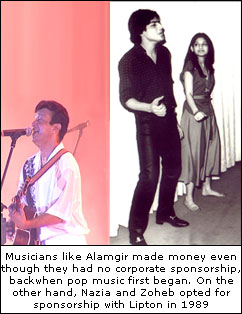
Arriving first with Imran Khan's deal with Pepsi in 1987 and then
Nazia & Zoheb's signing with Lipton in 1989, the whole concept
of corporate sponsorship in the Pakistani showbiz arena took a more
serious and focused turn when Pepsi managed to bag the Vital Signs
in 1991.
Gradually over the next fifteen years, cricket and locally generated
pop music and acts became the main arWeas of interest for a growing
number of corporate concerns.
Not that the new music scene was not producing any worthwhile acts
before corporate intervention and interest, the truth is, Pepsi's
signing of the Signs suddenly (and a tad too early), changed the rules
of the game.
Whereas until the early 90s most new acts were signed by EMI-Pakistan
on royalty basis (just like their predecessors were), right after
the Signs-Pepsi deal, the attention of the musicians shifted away
from the royalty-based system that was in practice in the market for
many years.
|
 |
| |
Suddenly,
every new act was chasing after corporate sponsors for a fast buck.
Ali Haider landed a deal with Pakola, Awaz arrived with a Pepsi contract
in their hands even before they finished recording their debut album,
and what is still a lesser-known piece of history, even Junoon who
in 1993 were at the peak of their angry-young-band phase, cut a deal
with Close up (toothpaste).
The new brigade of musicians went on the attack, denouncing EMI's
"slow" and "low" royalty system, not realizing
that the same system had served well scores of musicians ranging from
Ahmed Rushdi to Alamgir to Nazia & Zoheb.
Nazia & Zoheb came from wealthy backgrounds, but this did not
mean their contemporaries died of starvation. In fact, royalty from
album sales and money earned from concerts pretty decently sustained
many pop musicians even during the stifling and myopic Zia years.
So, it can be said that if matters like piracy and "low and slow"
music labels did contribute in the growing skepticism in the musicians,
one can also suggest that a total lack of vision, any serious commitment
or interest on their part to tackle the issue was also a leading reason
behind the gradual but firm takeover of the scene by corporate concerns.
Of course, as the musicians continued to beat their chests decrying
piracy and "mismanaged" music labels, they took little or
no action apart from running after interested sponsors.
In fact, none of the major league players which were also sponsored
by big corporate concerns ever bothered to ask their wealthy corporate
patrons to stop investing in individuals and instead invest in the
scene.
That's why today the bulk of Pakistani pop scene and so-called "music
industry," is nothing more than a total sum of various sponsors'
money and corporate interests. Take these out and there will be little
or no scene whatsoever.
Any question that did arise in the press regarding the situation was/is
usually answered by the sponsored artists with even wilder and louder
exhibition of chest beating and fears of dying of starvation. The
truth is, by starvation most of these acts believed (and believe!),
that instead of a 1400cc car, they will be left stranded in their
old 800cc automobiles.
Of course, nothing wrong in aspiring for better, bigger things, but
make this as your main reason for going for that faster corporate
buck instead of all that chest beating about piracy and bad music
labels. |
| |
Dragon
stories
It was these musicians' responsibility to improve the system that
they had inherited and were criticizing. It was their duty to encourage
their sponsors to put some of their economic muscle and influence
in the making of a scene that was becoming so apathetically dependent
on corporate patronage.
In 1996 Junoon's leader Salman Ahmed went (when invited), to Coca-Cola's
headquarters in Lahore, with the intention of making the giant cola
company invest not only in Junoon but also in the fledgling Pakistani
music scene. The deal was struck, but after seven years or so, Junoon
ended up becoming one of the biggest contradictions to what they had
set out to do.
Ironically, the Vital Signs who had shown absolutely no inclination
of asking Pepsi to invest beyond the Signs' material well being in
the five years they were with them, the band's leader, Rohail Hyatt,
finally managed to convince his former corporate patrons to invest
some of its financial muscle back into the scene the cola company
had so much benefited from. |
 |
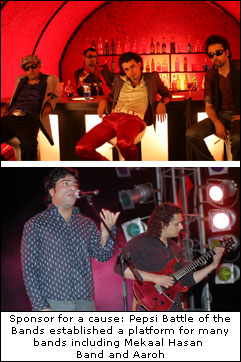
This
came in shape of a platform for aspiring new artistes called Pepsi
Battle of the Bands. However, since the cola company did not generate
the kind of commercial mileage it had for its brand when only investing
in the Signs, Awaz and Fakhr-e-Alam (in the 90s), the experiment
was short-lived, so much so, Pepsi eventually pulled out of the
scene all together in the new millennium!
No Signs, no Pepsi deals. What music or music scene?
There are acts that are aware of the apathetical state of the scene.
They know if one takes away the sponsors' money, the scene which
so many young (over) enthusiastic Pakistani pop fans gloat about
as "expanding," will almost cease to exist.
Who's to blame? Piracy? Lethargic music labels? Or the convenient
apathy and hypocrisy of the musicians themselves?
Unfortunately, chest beating and relating apathetical scenarios
(in case of having no sponsors), is still most musicians' reaction
when questioned about their insistence on retaining a sponsor.
Former Junoon singer, Ali Azmat, decided to actually do something
about it.
Early last year, he decided to form an artistes' union and was enthusiastically
joined by both major league and as well as struggling players. A
few months down the road Ali Azmat is a disappointed man. Why? Because
most of the unions' major members are simply refusing to do what
Mr. Azmat is suggesting, especially the boycotting of any TV-channel-
related or multinational sponsored event that is paying the musicians
a lot less than what they are worth. After all, these events are
generating tremendous amounts of money for the channels (through
advertising), and great advertising mileage for the corporate brands
sponsoring them.
However, so far, instead of Ali Azmat himself who recently got in
a tussle with the management of a music channel for this very reason,
most other members of the union have simply refused to do the same.
One of the leading reasons given by them: "Our sponsors will
get angry!"
The point is, Ali Azmat who (though grudgingly), defends corporate
sponsorship in Pakistani music scene, rather ironically finds his
plans for a powerful music union burn down to the ground because
his contemporaries' sponsors wont allow it. It's a catch 22 even
a character like him is left stumped by.
That is the bane of the matter. Thanks to the indifference exhibited
by the genuine music labels and the apathy shown in this respect
by the musicians themselves in the '90s, today the whole agenda
of corporate sponsorship is such that it will not allow the functioning
of genuine music labels or for that matter, a scene run by aggressive
unions.
They won't do so because the revival of a clean royalty system and
the emergence of organized unions will take away the clout, influence
and power the corporate sponsors exercise over musicians.
This influence stretches beyond the companies' doling out cash to
meet the musician's studio and video bills and other perks. Many
leading sponsors are also known to have claimed the right to intervene
and influence the artistic content and direction of the sponsored
musicians.
With the sponsorship dragon now stronger than ever, one is not being
too skeptical to suspect that the music being made by most sponsored
players today is more or less a compromise based on the demands
dictated to them by the hovering presence of their sponsor's corporate
interests.
How much
more is too little?
Each and every sponsored artist in Pakistan makes a decent living.
They are in the forefront of defending the practice of corporate
sponsorship in music.
However, apart from only Ali Azmat, none of the others ever seem
to detect the obvious contradictions and artistic and aesthetic
fall outs that come along with being sponsored by multinationals.
What is even worse, still none of them is prepared to ask their
sponsors to invest in the scene.
It is as if they do not want to face up to such contradictions and
this is why their approach towards this issue has been more reactionary
than anything else.
They will lash out at anyone questioning the ethical and artistic
contradictions between the social and aesthetic content of their
art and the cynical economic interests that they enthusiastically
undertake on part of their sponsors.
Much chest beating takes place and a number of rhetorical questions
are asked but the issue is never seen as a problem to be solved.
Instead, it is actually seen as a solution, without ever being realized
that this solution is one of the main reasons (along with piracy)
that is keeping at bay the whole idea of a system based on organized
and clean royalty-based structure led by genuine music labels.
One of the most frequent rhetorical questions asked by the sponsored
artists is how are they to survive as musicians in a country like
Pakistan?
Simple. Exactly the way Alamgir, Mohammad Ali Shaki and Sajjad Ali
did. None of them was ever sponsored and yet none of them died of
starvation.
Of course, today musicians who become popular seek higher standards
of living and bigger financial rewards. But can it be said that
they get this quicker than they would, had there been a well-organized
royalty-system placed in the market?
In such a case, one can also suggest that most of these players
would not really appreciate such a system. In other words, why would
they question or change the status quo in the scene mainly maintained
by multinational bucks and sponsored artists?
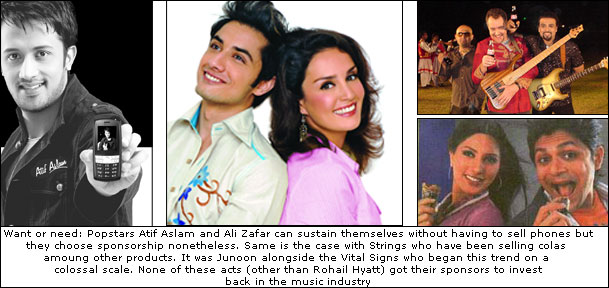
On the other hand, one can also question major players like Atif
Aslam, Strings and Ali Zafar, who in spite the fact that they draw
huge amounts of money as concert attractions, still decide to get
into hasty, cold cut deals with mobile companies who only see them
as dancing, singing sales people.
Working to change things in this context by allowing corporate sponsors
to rule the roost has failed to do anything whatsoever for the scene
as a whole. Time has come for major players to stop playing the
role of slippery pragmatists and do something innovatory instead.
They must come together to make their respective sponsors realize
the importance of investing in the scene as a whole and not only
in individual acts.
It must be realized that it is these companies and their media allies
that need the musicians and not the other way round.
The answers are out there. We are just looking for them in all the
wrong places, no matter how more glitzy and financially rewarding
they may seem. |
| |
The
good, bad & the company ...
"Musicians are the software most television channels and multinationals
can not do without. We should understand this and make the best
of it, instead of letting them treat us as if they are doing us
a favour by playing our songs."
--Salman Ahmed (Guitarist, ex-Junoon)
On many occasions,
we felt stifled by sponsorship, but this was the only way we could
survive as musicians. But when Pepsi agreed to do Pepsi Battle of
the Bands with me, I proved that a sponsor could be used in lots
of different ways as well."
--Rohail Hyatt (Music producer. ex VS keyboardist)
"I personally do not have huge qualms about corporate sponsorship
in music. However two things do disturb me, first that corporate
sponsorship tends to take the edge off music and make it generic
because that safely plays into the hands of brands that do not want
to be associated with political or social comment. Second, whatever
the artist endorses, it should have some semblance of continuity
with the persona of the individual, otherwise it jars on an aesthetic
level."
--Fasi Zaka (Music critic, radio RJ) |
 |
| |
"In
this country for a musician it has become a necessary evil. How
else can I survive? We don't get any royalty money from the sale
of our albums, concert organizers want you to play for peanuts,
and TV channels want us to play whole sets without giving us any
money at all."
--Ali Azmat
|
| |
|