



|
|
|
|
 |
 |
   |
cricket Australia's
concern over Pakistan tour exaggerated Zimbabwe
baffled but what about Australia? cricket Shaun
Pollock says goodbye to all levels of cricket The
ifs and buts regarding our hockey colts
'Cricket is entering a new paradigm, in which rupees and the free market are kings and players and entrepreneurs are the beneficiaries' – Former England captain Michael Atherton By Khalid Hussain Australia may be the undisputed world champions but it's the Indian money that is making the cricket world go round these days. This fact was more
than aptly underlined on a pleasant January afternoon in Sydney Normally the International Cricket Council (ICC) stands by its umpires but the Bucknor case made it clear that the world cricket bosses do not have the final say any more. It is the Board for the Control of Cricket in India (BCCI) which now calls the shots. Not very long ago, a much bigger controversy should have forced the ICC to take similar steps. But it didn't. In the summer of 2006, another ICC elite umpire Darrell Hair committed a mistake much more serious than Bucknor's umpiring errors in Sydney when he wrongly charged Pakistan of ball tampering in their fourth Test against England at The Oval and later when the visitors protested he forfeited the Test in the favour of the hosts. It was the first time that a match was forfeited in the history of Test cricket. Most cricket buffs were convinced that Hair had acted wrongly but the ICC said that the umpire's decision was final. The Pakistan Cricket Board (PCB) was furious but the ICC boss Malcolm Speed continued to stick by Hair, a fellow Aussie. It was only after the PCB played the 'Asian bloc card' with the support of the Cricket Sri Lanka, the Bangladeshi board and more importantly the BCCI, that the ICC showed some sympathy to Pakistan's cause. For Hair, however, it was his greed that hammered the final nail in his coffin as he was sacked from the ICC elite panel of umpires after it was revealed that he had demanded US$500,000 from the ICC to step down following the Oval fiasco. As far as the Pakistanis are concerned, they are still licking the wounds suffered at The Oval and the PCB is now demanding that the ICC should change the result of the forfeited Test. On the other hand, the BCCI has no such problems. It can virtually dictate terms and the ICC can't do anything counter its influence. As they say, these days 'India gets what India wants'. What makes the Indian cricket board so powerful? In a single word, money! Just recently the BCCI flaunted hundreds of millions of dollars while revealing financial details of the Indian Premier League (IPL) -- a twenty20 spectacle it owns. ICC bosses must have heard, with envy, the fact that the IPL television rights were sold for a billion dollars. The board then added dollops of glamour and power to the IPL by inviting bids for the sponsorship and made a cool $724 million from celebrity bidders, making it the biggest franchise auction in domestic sport's history. Bollywood superstars Shahrukh Khan and Priety Zinta were among the celebrities, who opted to buy a piece for IPL. Shahrukh now owns Kolkata while Zinta is at the helm of Mohali with her boyfriend Ness Wadia and a couple of other partners. The BCCI also announced that a purse of Rs 100 crore has been allocated for a three-month period (from February to April) to promote the tournament, one of the biggest publicity budgets for a corporate event in India. India's emergence as the financial engine of international cricket has been rapid. Just last year Malcolm Speed told reporters: "India has the biggest cricket-watching population and it's the financial powerhouse." It was actually an understatement. Cricket-mad India, with a population of 1.1 billion, a growing middle-class and booming economy, has been the financial engine of international cricket for more than a decade. In recent years, a money-minded regime led by BCCI president Sharad Pawar has turned Indian cricket into a powerful business animal. Today, India accounts for 70 percent of the game's worldwide revenues. The television industry estimates that an international cricket match featuring India draws, on an average almost 450 million people. The sponsorship such matches attracts is actually mind-boggling. A 10-second advertising spot for the India-Pakistan final in the inaugural Twenty20 Worlds in South Africa last September cost US$30,000 each and were all sold out in advance. Pakistan's cricket officials have learnt that having such a powerful cricket board in your neighbourhood can be of some help. The PCB benefited from the power of the BCCI when the so-called 'Asian bloc' proved too strong for the Australia-New Zealand partnership and won the right to host the 2011 World Cup. Now India, Pakistan, Sri Lanka and Bangladesh will jointly host the next World Cup while the trans-Tasmanian neighbours will have to wait till 2015 to have the Cup land on their shores. But in the larger interest of the game, is it beneficial to have one Test-playing nation enjoying such sweeping powers? Talking about Pakistan's interest, it might suit us till the PCB has a good relationship with the BCCI. But what if they fall out? Will the ICC be allowed to remain neutral in case Pakistan and India end of with a serious quarrel over some on-field incident? Considering the history they have, it's a big possibility that such a problem can and in fact will arise. PCB officials, however, are not intimidated by the giant size of the BCCI. They are happy being friends with the most powerful board in the cricket world and are planning to learn from it the art of making the big money. Working closely with the BCCI's financial wizards, some PCB officials are working on preparing a model of the proposed Pakistan Premier League which they plan to launch within a year. The PCB's official league will be based on the IPL model, offering franchises to the highest bidders. But unlike in India, the market is quite limited in Pakistan and it is highly unlikely that it would attract hundreds of millions of dollars like the IPL did. The PCB will realise it soon that it is no BCCI. The
writer is Sports Editor of 'The News' Karachi khalidhraj@gmail.com
The selectors certainly deserve praise for showing faith in so many youngsters and giving them a chance to make their presence felt at international level By Imran Farooqi Zimbabwe's tour to Pakistan has ended without any major rather untoward incident. On the one hand the one-day series allowed Pakistan to try a load of fringe players, while on the other it taught a tough lesson to the visiting team that included several players who would have struggled to qualify for a first-class outfit had they been born in a Test-playing country. More than Zimbabwe it
seems to be the host country, Pakistan, who have benefited The modest nature of the contest ensured all players barring Karachi's middle-order batsman Naumanullah got chances to showcase their potential in an atmosphere where they were under no pressure except the one that is usually experienced when one is making one's maiden appearance for one's country at the highest level. Apart from that it served as a perfect occasion to impress those who matter with their potential and discipline. And almost all those who got chances made their mark except opener Khalid Latif, who played in just one game and could not get going. The guys who really stood out were left-handed opener from Lahore Nasir Jamshed, Karachi's Khurram Manzoor, all-rounder Kamran Hussain, and pacer Abdul Rauf. Although debutant pacers Samiullah Niazi and Sohail Khan had bowled well in the tour opener they were not as threatening in the one-dayers that followed. In fact, the former, who had engineered Zimbabwe's defeat in Karachi's first-class game, could not get a single wicket in a couple of games that he played. The selectors certainly deserve praise for showing faith in so many youngsters and giving them a chance to make their presence felt at international level. But with more than a couple of rookies performing creditably the selectors may find it a bit tricky to pick the squad for the coming assignments. Pakistan, as expected, took the series quiet easily and were always in control barring the game in Multan where at one stage half of the team were back in the hut before they had crossed the 100-run mark. Shahid Afridi's superb knock that contained no less than seven hits over the fence ensured the tourists could not deliver the killer blow and lost in the end. With so many contenders out there to prove their worth and make an impressive start to their international careers it looks good from the competition point of view, but poses a serious dilemma to the selectors regarding whom to pick and whom to leave. The panel need to exercise absolute caution as although some of the debutants did impress with their technique and temperament nobody can overlook the fact that they were testing their skills against one of the weakest sides in the world. Their runs and dismissals against Zimbabwe do count and must certainly have boosted their morale a fair bit, it is the performance against the best that invariably decides the fate of an upcoming player who is willing to make his mark at international level. Technique, temperament, and discipline are the key, and one blessed with these qualities is bound to succeed no matter how many or few runs or wickets he has under his belt. Induction of fresh blood is always a healthy sign, but the same must not come at the expense of those senior professionals to whom the country comes first and national duty is always at the top of their priority list. Those who make the same claims, but act otherwise must not be considered again if the selectors are sincere in raising a team that fear nobody. These players will be under a tougher scanner if Australia agree to go ahead with their March-April tour to Pakistan. Keeping in view their senior players' reluctance to make the trip and the prevailing law and order situation in the country, prospects do not look very bright. The PCB might not suffer financially as the series is already insured for a hefty sum, cricket will definitely be poorer if the world's top-ranking Test and one-day outfit do not honor their commitment. In past, too, Australia have opted out of their assignments in Pakistan citing security reasons, and instead preferred to play on a neutral venue. However, this time round the PCB have already stated quite categorically that they are not willing to contest the series in a third country. Not only that they have also told their counterparts, CA, that Pakistan would not be going ahead with their proposed tour to Australia in 2009 should the latter shun their visit starting next month. Australia have previously played in India and Sri Lanka -- the two countries where the law and order situation is not exemplary -- without any difficulty, so they must not exaggerate things and be overly worried about doing the same in Pakistan. On their part they have assured to review things after the general elections, but any incident after the installation of a new government would give them an excuse to pull out of the tour. This is really sad as Pakistan have promised the Aussies the best possible security cover throughout the tour. Though nobody can guarantee a trouble-free event in any part of the world, the visits by South Africa, England, India and Zimbabwe to Pakistan in recent years do make it clear that sportspersons are not generally targeted here. These trips and others undertaken by teams from other countries for various sports competitions also show that Pakistan is safe place for sportspersons and the authorities concerned are capable of protecting their guests and holding mega events in a smooth and peaceful manner. Pakistan have done their bit to allay Aussie fears, it's now up to the authorities Down Under to stand up, be brave and tour Pakistan so that this strife-torn nation could get some much-needed relief.
If all the ongoing controversies, attitude problems and in-house troubles are sorted out before the Aussie assignment, one can be sure of seeing a rejuvenated Pakistani side giving Australia a lot of trouble By Muhammad Shahbaz Zahid Our national cricket team, at last, has started to show some good performances on the field. And they did so after winning the five-match One-day International (ODI) series cleansweeping the visiting Zimbabwe side on home turf. Pakistan had been on
the downfall after consecutive series losses. The visiting Proteas The ODI and Test series defeats to India did not augur well for the team and its captain too. The fact remained that losing to their arch-rivals isn't accepted at any cost and the significance of the Indo-Pak ties is of utmost importance. Calls for sacking the captain came to the ears and started making the headlines. But the Pakistan Cricket Board (PCB), in a kind gesture, announced further expansion of national team captain's tenure and said they will further wait for things to come good. Skipper Shoaib Malik had to show his credentials at every cost then. And nothing better than a one-day series against lowly-ranked Zimbabwe could have happened for him. Zimbabwe, who were deprived of their Test status by the International Cricket Council (ICC), were on a comeback trail to the international scene. After hosting West Indies for a few matches earlier this season, they were seeking to prove their worth against a strong Pakistani side. Things got a twist before the start of the series when the Pakistan squad was announced for the five-match tie. Pacers Shoaib Akhtar and Mohammad Sami were left out of the squad. Umar Gul wasn't present in the line-up either and with Mohammad Asif nursing an injury, the bowling department looked very out-of-sorts. Knowing the fact that Zimbabwe, even at their full strength, won't cause much trouble to the home side, the team management and the selectors decided to try out upcoming youngsters. Several of the players, who had shone in departmental cricket for the past couple of seasons and were continuously knocking on the doors of international cricket, were given a golden opportunity to prove their mettle. And the first opening that came their way was the tour match between Patron's XI against the visiting side. Shahid Afridi, the all-impressive all-rounder, was given the captaincy for this match. Afridi remained in the headlines since then as news came up that he was not happy playing under Malik's captaincy and himself wanted a shot at the position. Though denials came up fast enough that this wasn't the case, insiders and sources still confirmed that surely was the reason. During the whole Zimbabwe series, this remained the hot topic for discussion. During the Patron's XI match in Karachi, players who impressed a lot included young opener Nasir Jamshed. The swashbuckling left-hander overpowered the depleted Zimbabwe bowling line-up and cemented his chances to represent Pakistan in the coming ODI series. His 182-run innings certainly showed he had the class to play for the national team. Others to impress were Naumanullah and Fawad Alam, who is now a permanent member of the ODI squad. Amongst the bowlers, Sohail Khan and Samiullah Niazi bowled brilliantly which also earned them a call-up to the ODI squad. Pick of the bowlers, though, remained Afridi who took six wickets in the match. The first match was played at the National Stadium in Karachi, which again saw glimpses of Nasir. The batsman mesmerised the crowd with some breath-taking shots and gave an attacking touch to the line-up. He hit boundaries at will and certainly overshadowed his senior teammates. Nasir showed how it is to be done at the top of the order against weak bowling line-ups and scored his first one-day fifty on debut, just missing out on a wonderful century. Along with Nasir, who hit 61 in Pakistan's mammoth total of 347 and grabbed the man-of-the match award, Samiullah was also given the debut. But he failed to take a single wicket in the match and also gave away 60 runs. Younis Khan, Malik, Mohammad Yousuf and Misbah-ul-Haq also joined Nasir in the party with all of the batsmen scoring half-centuries. Spinner Malik and Afridi then took five wickets between them to secure an easy 104-run win. The home team then retained the same squad for the second ODI match in Hyderabad. Niaz Stadium hosted an international match again after a long gap of ten years and saw an impressive performance from Pakistan. Sohail Tanvir, playing an anchor role in the absence of leading pacers of the country, took 4 wickets in Zimbabwe innings and restricted them to 238. He also won the Man of the Match award for his effort. Pakistan went on the counter attack in their run chase with Nasir again providing the team with some brilliant batting display. His 74 at the top of the order helped Pakistan's cause and the team won comfortably with five wickets in hand. The third match was played at the Multan Cricket Stadium. With Pakistan gaining a comfortable 2-0 lead, all-rounder Kamran Hussain was given an opportunity to play in this match and he took the chance with both hands. It was the first time in the series that Pakistan were seen in a bit of trouble. Batting first, they lost their openers quickly and were reeling at 78-5 at one stage. Tawanda Mupariwa destroyed the top order taking 4-46 in the match. But then came a knock which every Pakistan cricket fan wishes to see. Afridi came to the crease and suddenly, the whole weight of the match tilted in the home team's favour. Afridi, later announced player of the match, hit six massive sixes in his whirlwind innings of 85 and along with identical 28-run innings from wicket-keeper Kamran Akmal and debutant Hussain, he took Pakistan's score to 272. Zimbabwe did give a fightback in the runchase but lost the match in the end by 37 runs. Malik, who wasn't bowling on a regular basis in previous series which affected his status as an all-rounder, bowled well again taking 2 wickets. After taking an unbeatable lead in the series, Pakistan again gave debuts -- this time to two new players for the fourth ODI in Faisalabad. Khalid Latif and pacer Sohail Khan, who had made a name for himself in the last edition of the Quaid-e-Azam Trophy competition after taking the highest number of wickets, were amongst the three changes made in the squad for the match. The third was that of Sarfraz Ahmed, who replace Akmal as the wicket-keeper. The replacement of Akmal was a move, some lamented, should have been made earlier as he was lacking the touch he once used to have. And when so many people were been given chances in the series, youngster Sarfraz, an under-19 World Cup winner, should have been named the starting XI much earlier. Zimbabwe batted first and it was the first instance in four matches that Pakistan had all the Zimbabwean batsmen out -- and that on just the second last ball of fifty overs. Malik was again the pick of the bowlers with three wickets while Hussain picked 2. Sohail Khan picked one in his first match. Pakistan chased down an easy target of 245 with seven wickets to spare. Yousuf, the backbone of the Pakistan batting line-up, scored yet another century -- his fourteenth in ODIs. Malik secured the Man of the Match performance with an imposing batting performance this time -- scoring 88 before being run out. Khalid Latif made just 19 opening the batting with Nasir, who made 11. The last match of the series was played at the Gaddafi Stadium in Lahore which saw an astonishing figure of debuts being made in a single match -- 4 in all for Pakistan. Abdul Rauf, Khurram Manzoor, Rizwan Ahmed and Wahab Riaz were introduced to international scene this time. Bowlers Abdul Rauf and Wahab Riaz made a day to remember for themselves as they ripped apart the Zimbabwe batting line-up. Rauf picked three while Riaz had two wickets to his credit. Malik again had wickets in bag -- two this time. With Zimbabwe skittle out for a meagre total of 181, Pakistan's easy runchase was never in doubt. Though Nasir missed out again (scoring 19), it was another opening batsman who made a name for himself. Khurram came to the party this time and scored a half-century on debut. Younis, announced Man of the Match afterwards, then made his 31st fifty in ODIs to help Pakistan achieve the target with 19 overs and 7 wickets to spare. It was a job well done by the home side. Though Zimbabwe aren't a strong side, they still can give you a run for your money. This they certainly showed after outclassing Australia in a World Twenty20 match last year. Still, a 5-0 result is always impressive. This was the fourth instance in Pakistan's history that they had achieved a 5-0 whitewash in one-dayers. And with Malik adding this feat to his tenure now, things will start working nicely for him. Malik, who was announced Player of the Series, still doesn't seem to get away from controversies. An alleged controversial marriage issue is haunting him these days which can place a black spot on his reputation. And with a daunting task ahead -- a home series against the mighty Aussies -- all the things, both on and off the field, should be kept in order if Pakistan are to pose any threat to world champions' supremacy in Test matches and ODIs. It's true that Pakistan overpowered the visiting Zimbabwe side but Australia will prove to be a totally different opposition. Australia, currently playing a tri-series against Sri Lanka and India at home, just grabbed another Test series win. Though their winning streak was brought to a halt by India, they still are the force to beat. They won the four-match Test series 2-1 amid all the controversies and are looking to further strengthen their side. With the likes of Shane Warne, Glenn McGrath, Damien Martyn and Justin Langer retired and now Adam Gilchrist deciding to say farewell, the Aussies still look strong. If Gilchrist is set to retire, they have Brad Haddin ready to replace him. Langer retired but it didn't worry the Aussies. Phil Jaques took his place and showed the world what he is capable of. McGrath departed but paved way for Mitchell Johnson and Stuart Clark. Australia just doesn't seem to run out of fire. And with the opposition just so strong, Pakistan certainly need to pull up their socks, sit down, pencil in strategies, work out-of-the-box and name such a squad that is strong enough to handle the pressure. They need to strengthen their bowling line-up. Obviously not many of the debutants from the Zimbabwe series will be named in the squad for the Aussie one, so Pakistan need to call back Akhtar and Gul immediately. If Asif recovers quickly, he is a must for them as well. The batting line-up isn't that bad. Rather it is pretty good at the moment. Pakistan just need to bring a little bit of consistency to their game. And if they do so, they are always very dangerous. If all the ongoing controversies, attitude problems and in-house troubles are sorted out before the Aussie assignment, one can be sure of seeing a rejuvenated Pakistani side giving Australia a lot of trouble. The
writer is a staff member at 'The News' Karachi shehnu@gmail.com
Samiullah, Kamran, Wahab, Sohail and Rauf, all belonged to mediocrity – you just can't challenge Australia with them alone, so it seems By Dr Nauman Niaz Concrete, as it seems, is the new deity that Dr Nasim Ashraf's regime adores with an unending passion. Building of tinsel class facilities and commercial enterprises is going ahead full steam. For the saleable product preparation of the CDA project to be constructed on 40 acres of land along with a sizeable commercial area in Islamabad, PCB intends to hire NCA graduates. Why couldn't the board
authorities consider giving such a contract to accredited It seems erosion of policies has not been causing sleepless nights amongst PCB's powerful power-business brokers. Countless letters and articles have been written but with the same common result-Nothing. The powerful couldn't be moved, the available policies couldn't be applied and mass-scale destruction of our cricketing environment couldn't be prevented. Just a little rustling of feathers and then it's back to business. Presently cricket's development is just like having mountains of concrete, one ugly structure replacing another never mind the tinted glass and the chrome plating facades. The policies, whatever they may be, are not being overlooked with impunity because surely that hardly describes what is actually going on -- enough to say that everyone who is part of this massacre is either far too powerful to heed the conventions or far too well-connected to care or simply apathetic. Where strong men running the game could keep entire lot at bay, at times couldn't satisfy individuals -- scheming, skeptical men, who want their policies to run their way and gobble that, then want more. Do they spend tortuous nights that the restless are reputed to bear? Banish the thought. They sleep like lambs. It's the honest, self-effacing, decent critics are tossing and turning all night. People often maintain that there is no point moaning and groaning about the environment when the very existence of millions of Pakistani cricket fans is at stake, clobbered as they are with declining team performances (give a 5-0 win against a meekly Zimbabwe a miss), galloping uncertainty, total absence of solid and honest future plans, a hopeless bench-strength, wavering work ethos, an infrastructure that creaks and caves in now and then, a rampant power-abuse -- all this and more is the new reality that we all live with daily. It's not a bad cricket board or the fraternity, by half but my God how we have plundered it, not only of its material goods but its sustaining core of goodness and decency. Today, every Pakistani cricket fan you see on the street is spoiling for a fight, the anger seething and foaming at the surface, the rage and frustration leaping like dancing flames of great intensity. It is frightening but we are still going to India and telling our players to disengage from their signed contracts to join the Indian Premier League (BCCI Sponsored). Have we been serious; we haven't been. As we dig into the details we hear that during the meeting of the Board of Governors at Karachi, someone tried to deny that Rs ten million were paid to Inzamam-ul-Haq with regards to his last appearance in Tests against South Africa at Lahore. Allegedly and surprisingly, the original receipt signed by Inzamam on October 27th, 2007 has gone missing from the finance department of the PCB. It is a rare happening in a fully corporate organisation when important evidence is lost. The copies are still available, though not with the PCB anymore. The cricket management bless its cold heart, seems least concerned. It seems to be the sole regulating authority because the entire game falls within its domain and if a rat wants to take a leak here, he has to ask the board authorities. While the board is busy developing the game, they are disinterested in employment rules and regulations. It seems, mostly based on rhetoric and run by handpicked people seem to have a little heart and mindful strategies to develop cricket when they arrive and subsequently, as they grow into their power seats, the business of a fair deal is obviously a philosophy they mostly do not subscribe to. The Pakistan Cricket Board, in this case, is not in some remote backwaters of the city of Lahore where silly things like rules and regulations have little existence or they are interpreted in accordance with self-preferences. Whilst there has been deliberate pilferage of news such as the one regarding the ban imposed on the players having joined the Indian Cricket League some were kept home. PCB's five year media rights contract worth US$48m expires and fresh tendered document in this regard will be floated after Australia's tour to Pakistan. Two leading companies have been rejected by the committee as told during the recent meeting of the Board of Governors of the PCB at Karachi and Mr Eshan Mani, the ex-ICC Chairman, would be provided media and marketing consultancy for the Pakistan Cricket Board for five years. One wonders what the huge and progressive Marketing Department of the cricket board would be doing then. PCB 'bundled' marketing rights of more than US$8m with Nimbus are also expiring shortly and a new expression of interest for these rights would be sought soon. Here we are poised to teach the rest of the world a thing or two, balanced precariously it would seem on the edge of another century, beckoning the world to come and taste our hospitality. We don't have enough bench strength to go round. I mean it is hilarious except that it is not. The world is heading for the end of the galaxy and we are fast-forwarding in another direction -- to a stagnating space. And to consider that we have anointed ourselves as the chosen ones. What great irony at play here. The spin doctors, long departed, insisted that actually there wasn't any shortage of talent, but simply a need to readjust its distribution. Thus, the cricket government and players had this ambiguous relationship going and shared everything, including the meager opportunities they were then producing. This year, either the talent has fallen fast and free or from first-class cricket, the players have decided en masse not to stop being so damn obliging and making themselves available at the drop of a hat, so that the national team reserve benches could be full, the levels rising high and the ambitions sort of brimming with happiness or the sun hasn't been strong enough or the snow is too deep -- whatever, there has been absence of real high quality talent but hey presto someone sharp on the take has coined a great philosophy out of this predicament and the curious word, 'rebuilding', arrives in our midst. We saw nine players given the Pakistan cap. Let us see the batters first -- Khalid Latif was picked for a solitary One-day International. The characteristics of the classical style in cricket, or in anything else, are precision of technique, conservation of energy, and power liberated proportionately so that the outlines of execution are clear and balanced. Mohammad Yousaf is the best example to be seen at the present time of the classical style of batsmanship. He is a model of emulation of the young. You cannot say as much of, for instance Younis Khan, who is the best stroke player of the moment; it would be perilous if a novice like Latif or Manzoor tried to educate himself by faithfully observing the play of Younis. A sudden snick through the slips by Younis might cause us to lift an eyebrow, but we wouldn't think that something had gone wrong with the element in which Younis naturally revels; for it is understood that Younis and all cricketers of his kind live on the rim of their technical scope. A snick by Yousaf is a sort of disturbance of a cosmic orderliness. It is more than a disturbance, it is a solecism in fact, as though a great writer of prose were to fall into an untidy period, or actually commit bad grammar. The classical style admits of no venturing into the unknown, of no straying from first principles. A dissonance is part and parcel of romantic excess and effort; all right in Latif, impossible in Manzoor, where not a star of a semi-quiver may fall. The exponent of the classical style observes, and is content to observe, the limitations imposed by the environment, restraint, taste. They couldn't find their liberty within the confines of equipoise. Nasir Jamshed plays preconceived shots -- who could expect him charging Bret Lee over his head -- one too many flaws, not the temperament alone. Bowlers -- Samiullah, Kamran, Wahab, Sohail and Rauf, all belonged to mediocrity -- you just can't challenge Australia with them alone, so it seems. And Rizwan Ahmad, the leggie -- have mercy on Danish Kaneria! What is it? Are we really out at sea, tossed about by angry waves under an endless horizon having lost all idea of time and space, or are we just too narrowly focused on the multitude of events which have us in a vice and are dictating verdicts to us which are out of proportion to the reality of things? I don't have as usual, a clue, but seem like everyone else to be part of a huge pile of flotsam that is drifting about without any direction. The present cricket government is taking great pains to explain to a perplexed audience as it gropes in the dark, that the time to rejoice is well at hand. I suppose we should not be too surprised if someone suddenly remembers this and sells the concept to the public again. We won't even need likes of Dr Nasim Ashraf and his team of great minds at Lahore to do the Houdini number. Shaun Pollock says goodbye to all levels of cricket The South African finished as only the second player after Wasim Akram to complete the double of 3,500 runs and 350 wickets in One-day Internationals By Khurram Mahmood South African all-rounder, Shaun Pollock announced his retirement from international cricket, following the second day's play of the third Test match against the West Indies last month and, after the fifth One-day International at Johannesburg last week, he also hung up his boots where the shorter version of the game is concerned. Pollock was dropped for the first two Tests against West Indies but came back with match figures of 5-85 while he didn't bat in the sole innings in the third Test match. Shaun Maclean Pollock made his Test debut against England in November 1995 at the Centurion Park. Due to rain only two days' play was possible in which England declared after scoring 381 runs for the loss of nine wickets. Pollock took three major wickets for 98 runs in 29 overs. His first Test victim was Graham Thorpe. But he truly made his full form known in the fifth Test in Cape Town, taking 5-87 as South Africa won the match by 10 wickets and the series by 1-0. After that he became a regular member of the South African team and played a vital role for his team's success. Pollock and Allan Donald took the maximum responsibility of the South African attack till Donald's retirement in 2002. Pollock, 34, is a match winning bowler on his day; his average is nearly four wickets per Test. He is also the first South African and only the tenth player in the world to take 400 Test wickets. His 100th wicket was Courtney Walsh of West Indies, the 200th was Nuwan Zoysa of Sri Lanka, the 300th Michael Vaughan of England and the 400th was Rahul Dravid of India. He is able to move the ball both ways at a lively pace but Pollock is more dangerous for the right hand batsmen due to his out-swing bowling while against left-handers he is not much impressive as his average goes over 40 against the left-handers. Michael Vaughan and Rahul Dravid are among the batsmen whose wickets Pollock has captured the most times. West Indian opener Chris Gayle and Australian wicket-keeper batsman Adam Gilchrist (both left handers) have always bothered Pollock. Gayle has fallen to Pollock just once while surprisingly Gilchrist has not been dismissed by him even once. Pollock made his One-day International debut against England in 1996 at Cape Town along with another great all-rounder Jacques Kallis. He proved his selection right and received the Man of the Match award in his first ODI for his all-round performance. Pollock scored 66 valuable runs in South Africa's 211 and remained the highest scorer of the match. On the bowling side his match winning figures were 4-34 in 9.5 overs. Pollock finished his ODI career with 393 wickets at an average of 24.50. He has the lowest economy rate of any bowler to have taken 300 ODI wickets. His best ODI bowling figures were 6-35 against West Indies in 1999 at East London. Apart from being a fine bowler Shaun Pollock is also a dependable batsman in the lower order. He took some time to score his fist Test century though and it was against Sri Lanka at SuperSport Park in 2001. In the very next series against West Indies he improved his batting skills and managed a 75.50 average including a century in the third Test. Pollock was one of the key players in the South African team, and undoubtedly one of the top all-rounders in cricket today. Pollock is the fourth all-rounder in Test history after Richard Hadlee of New Zealand, Imran Khan of Pakistan, Ian Botham of England and Kapil Dev of India to have reached the remarkable milestone of 3,000 Test runs and 300 Test wickets. Pollock finished as only the second player after Wasim Akram to complete the double of 3,500 runs and 350 wickets in the One-day Internationals. Pollock played in four World Cups, but unfortunately South Africa never went beyond the semifinals of 1999 and 2007. He was also declared one of the Wisden Players of the Year in 2002. Shaun Pollock also led the South African side after the Proteas' most successful captain Hansie Cronje had to be put out of the game after his involvement in the match fixing scandal. It was a difficult time to lead a shocked and demoralised South African team and as expected world champions Australia whitewashed the home side by 3-0 in 2001-02. But the most horrible time for Pollock came in World Cup 2003 when the host side failed to qualify even for the last six. As a result, Pollock was immediately removed from the captaincy and Graeme Smith took over as the new skipper. Pollock led the South African side in 26 Tests and 97 ODIs, his win ratio being 53.84% and 64.06% respectively. He played consecutive 89 one dayers as skipper. Cricket is a family game for Shaun Pollock as his father Peter represented South Africa in the 1960s as a pace bowler while his uncle Graeme, an exciting left-handed batsman, possesses the second-highest Test batting average in history. The
writer works in the art department at 'The News on Sunday' in Karachi
khurrams87@yahoo.com SHAUN POLLOCK'S INTERNATIONAL CAREER Batting and fielding averages Mat Inns NO Runs HS Ave BF SR 100 50 4s 6s Ct Tests 108 156 39 3781 111 32.31 7198 52.52 2 16 412 35 72 ODIs 303 205 72 3519 130 26.45 4059 86.69 1 14 248 58 108 T20Is 12 9 2 86 36* 12.28 70 122.85 0 0 4 4 2 Bowling averages Mat Inns Balls Runs Wkts BBI BBM Ave Econ SR 4w 5w 10w Tests 108 202 24353 9733 421 7/87 10-147 23.11 2.39 57.8 23 16 1 ODIs 303 297 15712 9631 393 6/35 6-35 24.50 3.67 39.9 12 5 0 T20Is 12 11 243 309 15 3/28 3-28 20.60 7.62 16.2 0 0 0 ---- The ifs and buts regarding our hockey colts One is not totally disappointed as Pakistan youngsters have time and also the potential to improve ahead of the Junior Asia Cup By Gul Nasreen Conflicting news and
views have been flowing from the front of hockey, which is our But the irony is that despite being our national game, hockey could not get the 'required' sponsorship and 'at par with cricket' attention among the viewers and the sponsors at large. As a result, things continue to worsen on this once a 'super rather a supranational' front of Pakistan sports. Sportsmen like Samiullah who was known as flying horse, Shahbaz, Hanif Khan and Hassan Sardar were in a way a manifestation of 'supernatural play' at times. But now the situation is quite contrary to the 'glorious past'. We can only bemoan about the 'lost glory' as in present circumstances it seems a bit difficult to rise to that hockey stardom and again 'reign supreme'. It's not that we are not capable to rescale the heights of hockey, but the thing is that we need a lot of consistent hard work, dedication and a 'flawless' short and long term planning for that. Right now, not only our senior team is off the track, but the juniors too are following suit. While the seniors finished at seventh place -- the lowest for Pakistan in the history of the CT -- in the 29th Champions trophy hockey tournament in Kuala Lumpur in December last, the colts could grab a poor fifth place in the recently-concluded eight-nation Youth Hockey Tournament in Malaysia, putting up an unimpressive show. Though the Kuala Lumpur battle was tougher than the previous outings of the colts, as Australia, Germany, the Netherlands too were part of the tournament, yet finishing fifth was by no means a 'satisfactory' show at all. In this backdrop, one is not sure whether the inexperienced colts will qualify for the next year's Junior World Cup to be hosted jointly by Malaysia and Singapore. However, one is not totally disappointed as Pakistan youngsters have time and the potential to improve ahead of the Junior Asia Cup which will serve as the qualifying round for the Junior World Cup. The Junior Asia Cup is scheduled to be played in New Delhi in October this year and the top three teams from the contest will win the right to play in the Junior World Cup. After viewing the performance of the junior minutely, one is convinced they are capable to do 'wonders', but for that they need an enhanced international exposure and a lot of opportunity to gain enough experience. It is worth mentioning here that Pakistan colts had toured Kenya and Egypt in March-April last year and had won both the series but in the six-nation juniors' tournament in Singapore, they won a bronze medal. India and Australia had also featured in that event.
THE COLTS CAN COPE Reviewing minutely and optimistically, the overall performance of the colts in the Kuala Lumpur from January 17-27 provides us a hope that they can bounce back. Though finishing fifth was not a 'pleasing performance' but not that bad as by the seniors team who finished seventh in the Champions Trophy in December last. The way the youngsters fought back on a number of occasions and countered with attacks showed room for improvement. Pakistan were said to be the most inexperienced side of the tournament. "Most of our boys had limited international experience and that was our biggest handicap," junior hockey team manager-cum-chief coach Jahangir Butt was quoted to have said after the tournament. It may be mentioned here that Pakistan were outclassed 5-1 by Germany on the first day of the tournament and the match was a one-sided affair, with Germany totally dominating the game in the second half. Pakistan were also beaten 6-4 by Australia. They, however, did fight back to hold formidable India (1-1) and Holland (1-1). They trounced Malaysia (4-1), South Korea (4-1) and New Zealand 6-1. Again, in the play off for the fifth position, they outplayed New Zealand 8-3. Having a look at the minute details of Pakistan-Australia encounter, it brought forth the real essence of the junior -- the fighting spirit. Though Australia beat Pakistan 6-4, looking at Australia's current form and standings in world hockey, it was a better show by the Pakistani colts to register as many as four goals against them. Australia led 4-0 at half time. In the second half, our colts made counter attacks and reduced the margin at one stage to 4-5. They would have equalised the match had the umpire did not disallowed a 'goal' when the ball struck clearly from inside the circle. The way Pakistan made swift counter attacks against the champions Australia was a treat to watch. As for the match against The Netherlands in which Pakistan held them at 1-1 in their fourth match, it would have been won by Pakistan, but again an umpiring decision denied them that crucial win as he disallowed a 'certain' goal. Erroneous umpiring at crucial jointures of all-important matches also deprived Pakistan of a better standing in the eight nation event. Poor goalkeeping is also blamed for the 'unimpressive show'. There was more than one such occasion when the goalkeeper failed to rise to the occasion and do what was required of him. So this very area also needs to be taken notice of before the Junior Asia Cup. On the contrary, Pakistan forward line played aggressively and netted as many as 21 field goals. Pakistan along with India ended with second highest goal-scorers with 29 goals in the event with Aussies topping 31 goals. The most striking feature of their game was the 'fighting qualities' during the matches and came back from behind to record exciting victorious against Korea and New Zealand which is a positive sign. What is needed right now is that the PHF should try to give an international exposure to the colts by giving them opportunity to feature in as many international matches as possible ahead of the Junior Asia Cup so that they can gain the required exposure and practice ahead of the all-impotent event. One would agree with the junior team coach-cum-manager, Jahangir Butt, who in a recent newspaper report has called for 15-20 matches before going into the Asia Cup. The above-proposed twenty-match exposure is very necessary as it can prove a prologue to Pakistan's success on the hockey front after a dismal 2007. As the seniors have miserably failed, one hopes the juniors bounce back in the coming Asia Cup to qualify for the Junior World Cup in style.
|
|
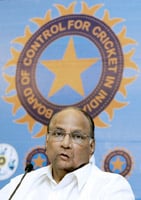 when the international cricket bosses had to succumb to Indian pressure
and decided to sack veteran umpire Steve Bucknor following a strong
protest by the tourists who though they were let down a series of poor
umpiring decisions in their second Test against Australia.
when the international cricket bosses had to succumb to Indian pressure
and decided to sack veteran umpire Steve Bucknor following a strong
protest by the tourists who though they were let down a series of poor
umpiring decisions in their second Test against Australia.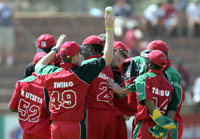 from the trip which not only provided a timely break to the fun-loving
people of this country to watch a young and inexperienced African side
taking on their team in front of them, but also offered the selectors
and team management a terrific opportunity to test the young and
upcoming players in a low-profile series.
from the trip which not only provided a timely break to the fun-loving
people of this country to watch a young and inexperienced African side
taking on their team in front of them, but also offered the selectors
and team management a terrific opportunity to test the young and
upcoming players in a low-profile series.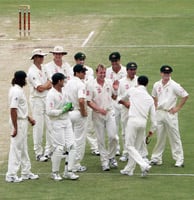 had overwhelmed them in both the ODI and Test series before India,
welcoming their neighbours, outclassing them as well.
had overwhelmed them in both the ODI and Test series before India,
welcoming their neighbours, outclassing them as well. marketing firms of high skilled professionals? Allegedly, in this regard
a trip by the top people from the Pakistan Cricket Board had to be made
to Dubai on January 11th, 2008 adding some burden to organisation's
exchequer.
marketing firms of high skilled professionals? Allegedly, in this regard
a trip by the top people from the Pakistan Cricket Board had to be made
to Dubai on January 11th, 2008 adding some burden to organisation's
exchequer. national game and also a 'lost glory' for which we need to work hard,
sincerely and persistently to regain the same. We have a craze for
cricket, but have emotional attachment with 'our national game'.
national game and also a 'lost glory' for which we need to work hard,
sincerely and persistently to regain the same. We have a craze for
cricket, but have emotional attachment with 'our national game'.