



|
|
|
|
 |
 |
   |
A
unique Election campaign Yours
judiciously! On
the domestic Frontier... economics Raising
issues or doubts? But
where's the colour?
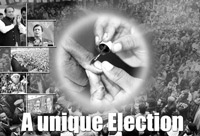
Editorial If election 2008 is to be compared with one previous election in Pakistan in terms of sheer significance, it would be the one held in 1970. Back then, the problems of this country could not have been solved by anything short of a free and fair poll that was supposed to lead to a constituent assembly and a constitution to possibly keep the country together. We still go by the same
1973 constitution, unrecognisable some may say, but it's there as a Why? Because the anomalies in the constitution cannot be rectified without an election. The constitutional aberrations cannot be undone outside the parliament. Extremism cannot be fought unless a representative government convinces the people to put up a united fight against it. Judiciary cannot be restored unless the parliament so decides. Electricity, gas and flour will not reach the people unless their genuine representatives are given this task. And most of all, the federation cannot be saved without a fair poll. In terms of significance then, election 2008 surpasses the one held in 1970. But it is unique in many other ways, mostly in the context of campaigning. We have randomly picked up a few trends which, in some cases, are a fruit of the seeds of discord sown in previous years. This is an election minus big rallies because big rallies mean more people getting killed. By the time we finish with the polls, this one will have the distinction of more firing incidents on campaign rallies, hopefully with less human loss. The reference point, of course, is Oct 18 and Dec 27, 2007. So the mode of campaigning is largely technology-driven because the choices to go the traditional way are limited. Advertisements on television, spur of the moment corner meetings, telephonic addresses by big leaders and text messaging are some of the new modes being adopted. Because the air is insecure. Some say it is duller than ever before. Party offices are not as formal as they used to be and the duration of free meals has been considerably reduced. But does being dull mean less money spent on electioneering? No, it doesn't. The new means of campaigning may have been invisible to the public eye but they are much costlier. What about the issues? You step into the domain of the king's party, and the issues for the National Assembly candidates have got nothing to do with national politics. Incumbency which usually is a burden is being campaigned as a blessing because the MNAs or designates are making roads and drains and schools in their constituencies, thus stepping into the area of local governments. Moving a step up, they remind their voters of the jobs they got them in the last five years and the more jobs they will bring once they are elected. Basically, patronage a part of politics has become politics per se. They like to call it 'constituency politics'. Other parties are contesting the election under protest, and the issues behind this protest are structural -- including the constitutional and institutional matters, judiciary being an important one, role of military in politics, and power to the people instead of the establishment -- and campaign-related: including charges of pre-poll rigging. Here lies the difference: the incumbents in this election are hardly pushed to touch the structural issues confronting the polity and campaign on their performance which they promise to 'repeat' if re-elected. There are some interesting asides. Election 2008 does not boast of many colourful contestants which only adds to the overall dullness of the scene. The absence of characters like Dr Amber Shahzada, Mussarat Shaheen and Saleem Kirla is being seriously felt. And lastly, we are told, the MMA candidates who ran their whole campaigns riding bicycles in 2002 now move in landcruisers. This too is probably for security reasons. And, of course, there are the boycotters. Unique, not without reason. Although the customary 'election fever' or 'hysteria' is still missing, the campaigning is expected to get a shot in the arm with some innovation in style and design By Usman Ghafoor 'Main beti hoon Zulfikar
ki, mera naam hai Benazir!' goes a paid TV advert, launched on air a day Certainly, there's no overt, strictly 'political' message here. Not even that of "democracy" being PPP's "best revenge". The ad is a little tribute to the 'martyred' leader and, of course, the Bhutto 'dynasty', and it is meant to elicit an emotional reaction. In fair contrast, the PML-Q's longest-running TV advert, with its unabashed 'Farq toh parrta hai achhi soch sey, achhi qiadat sey' slogan ends up looking like a road map of the party's little, big achievements. A rather desperate attempt at self-glorification by a party that is losing credibility by the day. For, the people, directly or indirectly, hold the government (aka the King's Party) responsible for the current crisis of atta, gas and power. The opposition parties accuse PML-Q of using state machinery and money for its campaign which, they insist, is a very expensive proposition in today's times. The party is also held guilty of pre-poll rigging in the name of postal balloting. PML-Q's earlier campaign was famously designed to malign the opponent in order to inspire support for its own candidates. It resulted in a fierce blame game in print media, rumouredly forcing Chaudhry Shujaat to later render an apology. The catchily composed ballad 'Merey desh ka pahiyya' is proof of the party's modified campaign policy. The Sharifs, on the
other hand, were lying low post-Benazir's killing on Dec 27, 2007, as a
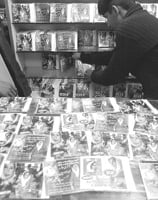
gesture Security is another major issue that has lately kept most political leaders from holding rallies. The opposition blames the Musharraf government for talking up the threat to candidates in order to stifle the electioneering. Sherry Rehman, Secretary General PPP, told TNS, "We've been struck by a tragedy that can actually change the entire course for political parties. We don't want to put the lives of our people in danger. (Hence, no rallies). "But, we are not an armchair party. The very fact that we're going to participate in elections under protest shows that we don't want to leave the field open for anti-democratic forces." Ahsan Iqbal, Secretary Information PML-N and a party candidate from Narowal, voices a similar note, "Because of security reasons, no party is willing to announce its movement. "The government is cleverly using terrorism as a political card to keep the voters indoors," he said, talking exclusively to TNS. Maulana Fazlur Rehman recently made headlines when he addressed a rally in Peshawar on telephone. Maulana is also said to be using compact discs for the purpose. VCDs carrying Benazir Bhutto's public speeches -- recorded overtime -- can also be found in the market. The use of mobile phone to influence the people's opinion -- in favour of or against a party -- is a newer phenomenon that is becoming increasingly common. Political jokes also make popular sms material. For the most part, the sender's source is not identified, but the wisecrack is designed in a way that it amuses and also imparts a certain political message. PPP is not quite pushed. "We're banking on our ideological vote," declares Prof Ijazul Hassan, former secretary general of the party's Punjab chapter and a close Zardari aide. "Our campaign needs not be a party advertisement of sorts. It revolves around the party manifesto. Period." PML-N has already embarked on a three-tier campaign for the polls. To quote Ahsan Iqbal, "We have the advantage of our leadership being very much around. Secondly, our message is that of change since we are the only party that has never wanted to strike a deal with the existing president. And, thirdly, we're talking about our performance in the past, the economic reforms we introduced. That speaks volumes for us." He also spoke of a fresh, "approved" ad campaign that would be launched on the electronic media a few days ahead of the polls. 'Taranas' (theme songs) have always marked a PPP election campaign. These polls are no exception. But this time most of the ditties are carry-overs -- recorded in Benazir's hey days, by folk singer Shaukat Ali and Afshan. The few new tracks that have hit the airwaves are an obvious stint to cash in on the sympathy wave. Controversy dogs first-timer Moonis Elahi who is said to be resorting to 'injudicious' ways of wooing the voter The pre-election activity going on in Punjab Assembly's constituency PP-152 has caught the attention of many, including the election monitors and observers. There are allegations that the Election Commission's code of conduct has been violated in this constituency the most. The constituency has
been the second home constituency of the Sharif family -- besides According to the initial plan, main contesting candidates in this constituency were supposed to be Hamza Shahbaz Sharif and Chaudhry Moonis Elahi, sons of ex-Punjab Chief Ministers Mian Shahbaz Sharif and Chaudhry Pervez Elahi respectively. But later, Hamza Shahbaz withdrew his candidature from the constituency and decided to contest elections from NA-119 -- a stronghold of Mian Shahbaz Sharif. Though he can give a hundred reasons for moving to a new battlefield, the locals in the constituency believe that Hamza had realised that Moonis could not be defeated. "In fact, the PML-N has taken a prudent decision. The position of Moonis is so strong in the area, thanks to the resources, funds and state support available to him that no one can dare to contest him," says Israr Ahmed, a resident of Model Town. Israr tells TNS that all the election gatherings of Moonis Elahi are attended by low-ranking government servants. Besides, he says, the payment of Kafalat Fund from Bait-ul-Maal, on the instructions of Moonis, to people at their doorstep is also a major violation of the EC code. He further says that the distribution is made by the employees of Post Office who go from house to house and make the payment to the payments. The payment is accompanied by a letter signed by ex-Punjab Chief Minister Chaudhry Pervez Elahi that glorifies him. Former MNA and minister for minorities Akram Gill is spearheading the campaign in localities where the Christian community is in abundance. As per a careful estimate, there are no less than 27,000 Christian voters in PP-152. A PML worker denies charges saying that only those people are condemning his party who have done nothing concrete during their term in government. He says that the letters accompanying the payments from Kafalat Fund carry Chaudhry Pervez Elahi's pictures for the reason that he launched this pro-poor scheme. "Credit must be given where it's due," he adds. Dr Saeed Elahi, PML-N candidate contesting against Moonis after Hamza's exit, however, refuses to agree with all this. He tells TNS that around 200 complaints about the violation of the EC code have been filed from this single constituency. "But, it's a pity that these people have little or no respect for law." He says that the Moonis Elahi group is distributing flour bags, sugar and registries to dwellers of kachi abadis, in addition to a variety of gifts and alms money to the common people. "On the other hand, we are visiting people from door-to-door and asking them to caste their vote judiciously and without fear," he adds. --
By S Irfan Ahmed MMA or no MMA? That's the question being raised in the context of NWFP's fresh political scenario By Javed Aziz Khan The North West Frontier Province is witness to some interesting 'show of power' by leading political leaders. A lot of the candidates who ran their campaigns in the last general elections on bicycles are now riding luxury cars. Though a host of them like to wear their no-money status on their shirt sleeve, the rest -- whose financial status changed literally overnight -- are happy going around in their pajeros and land cruisers. The political pundits are already equating this with the downward graph of Jamiat Ulema-e-Islam (Fazlur Rehman)'s popularity. They even predict that the party's 'card' of Muttahida Majlis-e-Amal (MMA) is not likely to work this time over. In 2002, it was the 'simple living' of the party candidates that the common voter found identifiable and was attracted to. Over the last five years, he (the voter) seems to have developed some insight and is not ready to go by mere promises. He has grown averse to the VIP culture that is now a common phenomenon. It is quite rare in the history of NWFP that a single political group formed a government after sweeping the general elections. Aside from MMA that was in power in the last five years, the Awami National Party (ANP), Pakistan People's Party (PPP) and Pakistan Muslim League (PML) have also had a fairly strong presence in the province. The campaigns by candidates fielded by their respective political parties for the forthcoming elections and the response of the voters once again point to the development of a complex situation in NWFP. The nationalists are flying high after a long time, hoping they would win a clear majority to form a government in the province. PPP and JUI-F (which is exploiting the name of MMA despite its chief Qazi Hussain Ahmad announcing a boycott of elections) also foresee a stronger position for them. Electioneering in most parts of the province is yet to gain momentum -- thanks mainly to threats of suicide attacks and bomb blasts. Though senior police officers did not confirm it, some media organisation recently released the news that an alleged suicide bomber nabbed by the Dera Ismail Khan police had confessed to have been commissioned by his outfit to kill the JUI-F chief in a suicide attack. The Maulana and his party leaders do not agree with the tip-off and believe such reports are part of the government conspiracy to create a misunderstanding between the militant groups and the religio-political parties. Whatever the fact behind the act of intimidation may be, the fact is that terrorist attacks on senior politicians have restricted the top leadership to address only corner meetings. Maulana Fazlur Rehman, Asfandyar Wali Khan, Aftab Sherpao, Amir Muqam and heads of various other political groups are yet to address major political gatherings in the city in connection with the election campaign of their candidates. PML-N chief Nawaz Sharif visited the city only once recently and the law and order problem did not let him address any big rally. Benazir's was the last time that Peshawar saw a large election rally, a day before she was killed in Rawalpindi.
Elections bring a lot of related economic activity. However, when billions are being spent there are millions who benefit -- directly or indirectly By Shahzada Irfan Ahmed Contesting an election is no child's play and consumes lots of energy, resources and money of those treading into this tough arena. Although the Election Commission of Pakistan puts bars every time on spending on a candidate's canvassing beyond a certain limit, these instructions have never been followed in their true spirit. On the contrary, in practice, there is no such bar and the amounts spent by the candidates for national and provincial assemblies can go as high as one can think of. This trait of our
politics may be wrong but what happens is that every time these elections
are held This year also the candidates are out to spend endlessly but in a totally different manner due to the extraordinary circumstances in which the elections are being held. The biggest difference is that the candidates have accepted the fact that the voters are not going to show up at the congregations they address. They know that this time they will have to reach the doorstep of their voters. Besides, the elections are being held amidst uncertainty and there is little or no traditional fanfare, especially because of the tragic killing of ex-prime minister Benazir Bhutto. A major result of these factors has been the turning of candidates towards mass media to get their message through to their voters. Khalid Husain, a caterer-cum-event-manager, tells TNS that this time his company could not get big orders as there were very few political gatherings. People who would once come in hordes to attend such gatherings are now confined to their drawing rooms where the candidates are holding occasional corner meetings, he says. Another direct affectee has been the big transport sector. Unlike in the past when buses and vans were used to transport people to the rallies etc., rented cars and 4x4 jeeps have been in great demand. They were available in 2002 general elections, too, but at that time they were not in as much abundance as they are now. The banks in Pakistan had not launched their aggressive auto loans scheme then. Sheikh Asif, a rent-a-car dealer, tells TNS that the candidates and their supporters are booking vehicles for the election campaigns. Many companies have introduced attractive packages including the provision of various luxury vehicles, 4x4 and sedan cars. According to estimates, the rent for luxury vehicles including 4x4 jeeps ranges from Rs 100,000 to Rs 300,000 per month. The charges for sedans for the same period are between Rs 30,000 and Rs 100,000. These vehicles are in great demand as the candidates and their supporters have to travel to every nook and corner of their constituencies to reach the houses of their prospective voters. Islamabad-based Center for Civic Education (CCE) has conducted a study that focuses on the changing trends in canvassing techniques. The report says, "The cost of communication with the advent of technology has increased and now functional parties have to maintain websites and run advertisements on media channels -- newspapers, radio, TV, and cable networks -- to communicate with the voters. Candidates need money for electoral campaigns." The same report adds that the cost of communication goes up in countries like Pakistan where the majority of the population lives in rural areas and political parties and candidates have to use a variety of traditional and non-traditional ways to reach out to the diverse groups of people with varied lifestyles and standards. Shahid Ali, Joint Direct, Zeb Publishers, Urdu Bazar Lahore tells TNS that the printing sector which has been the major recipient of election-related finance has lost in terms of revenues but not in terms of profits. He says that this year 100 per cent printing orders were delivered on cash basis. There was hardly any printer who was ready to work on credit, he says, adding: "This was for the reason that the people were not sure whether elections were going to be held or not. They feared that in the event of the postponement or cancellation of polls their investments would go down the drain." Shahid says that paper printing has become a thing of the past as the price of flex printing has come down drastically. He adds that it has fallen from Rs 55 per square foot in the last elections to Rs 15 per square foot today. This is the reason behind candidates choosing this mode of printing. Besides flex sheets are water proof and resistant to sunlight and minor tears, he adds. These elections have seen collective campaigning of party leaders instead of individuals, especially when it comes to running ads on electronic channels and in national newspapers. There is no check on the amount of funds spent on this publicity, though under the Political Parties Order 2002, parties have been barred from taking donations from any one other than individuals. Under the order there is a strict bar on receiving donations made directly or indirectly by any foreign government, multinational or domestically incorporated public or private company. Last but not the least, the cellular companies are also out to get their share in the pie. A leading cellular company has made arrangements to send latest election results to their subscribers on the election day.
The leaders belonging to different political parties are out canvassing for the upcoming elections and also, in the process, raising a variety of issues to convince the voters to support them. A party's manifesto is a
document that highlights its priorities. All the parties -- in the race
for the Interestingly, PPP also cared to include all the 36 points of the Charter of Democracy in its manifesto. Briefing about its main points, the late Benazir Bhutto said that the educated youth of the country would be given a one-year employment on trial basis. She also spoke about enhancing micro-finance and giving special concessions to the elderly. "After coming into power, we will construct small dams to overcome the water shortage in the country. Besides, power generation will be promoted and the menace of load-shedding ended," Benazir said on the occasion. She added that PPP would also "remove the ban on student unions" and assured to fight against terrorism with a tough hand. Later, Benazir also hinted at provincial autonomy. PML-Q followed suit and launched its manifesto for the elections '08 that revolved around '5 Ds' -- democracy, development, devolution, diversity and defence. It also carried the mottos of 'Live and Let Live!' and 'Giving Hope to the Hopeless!' The manifesto of PML-Q defines extremism, terrorism and sectarianism as "the biggest security threat to Pakistan" and lays stress on moral values and character building besides a strong rejection of the 'Sifarish and Khushamdi culture'. Summing up, President PML-Q Ch Shujaat Hussain said that the party had taken major initiatives for the benefit of the common Pakistani, particularly the poor and those living in rural areas. In this regard, he referred to the village development initiative for integrated development of rural communities, promoting self-reliance through a skills promotion trust, giving access to easily available small loans for persons keen to transform their skills for generating income on self-help basis as well as a revolutionary programme for the provision of low-cost housing which is being termed as a 'Cheap homes initiative'. Nawaz Sharif's PML-N launched its own 21-point manifesto for elections '08 on Dec 14, 2007. Through the manifesto, the party said that it had pledged to restore judiciary, introduce sustainable democracy and provide provincial autonomy, as per the 1973 Constitution. "The document pledges a law-abiding executive, a vibrant economy and a free media," said Nawaz Sharif at the launch of the manifesto. He gave the reassurance that if PML-N won the elections and came into power, it would reinstate all the deposed judges including chief justice Iftikhar Muhammad Chaudhry. Nawaz Sharif also blamed the country's military for the coups and constant steps against democracy that had damaged the otherwise strong socio-economic and geo-political condition of the country. The manifesto also promises to provide jobs, reduce poverty through various measures, introduce reforms in education, health and agriculture sectors, revive genuine democracy, the rule of law and good governance, eliminate corruption and prevent military interference in politics. The manifesto also promises to take measures that will check the menace of extremism, ensure industrial development and protect the rights of women, youth, labour and minorities. On paper it seems that the three major political parties of Pakistan have a very positive agenda up their sleeve. But practically speaking, a majority of political leaders seem least interested in advocating the same manifestos among the voters to win their support. Instead, they are commonly found bashing their rival leaders. Benazir was the first to break this taboo in Pakistani politics. Before her brutal killing on Dec 27, 2007, she was the only political leader who was campaigning for elections on the basis of her party's manifesto. In fact, she was the only mainstream leader who would be addressing big election rallies in different parts of the country despite serious threats to her life. She was quite hopeful of change, but her death seems to have changed the total complexion of politics and electioneering. The focus of the campaign has once again turned towards mud-slinging. PPP's own focus of campaign seems to have changed and it is actually holding the leaders of PML-Q responsible for the assassination of their leader. In the course of the current election campaign, however, it's the two once-rival parties -- PPP and PML-N -- that are saying virtually nothing against each other. Both parties can't wait to see the dictator's end -- one major issue that unites them, in spirit at least. They have a different stance on the judicial crisis. PPP is a supporter of the independence of judiciary while it has no clear view on the reinstatement of the deposed judges. PML-N, on the other hand, is all out for the reinstatement of the judiciary. Nawaz Sharif is also all criticism for President Musharraf and denies having any word with him on any issue, but PPP is now sending out feelers that it may work in tandem with the President if it wins the elections. PML-Q's election campaign is spearheaded by Ch Pervaiz Elahi, the president of the party's Punjab chapter who is bent on Nawaz- and Zardari-bashing. Experts believe that the former CM Punjab is trying to attract the anti-PPP voters to prove himself as an alternate leadership.
But
where's the colour? By Naila Inayat In every country the announcement of elections brings with it a lot of action, activity and anticipation and a share of colourful characters -- candidates who bring life to the otherwise dull scene and become a source of added attraction. Seems we have not been very lucky on this count for the Feb 18 elections. As the campaign and canvassing for both national and provincial assemblies comes into full bloom, the omission of personalities like Nawab Amber Shehzada, actress turned politician Mohtarma Musarat Shaheen, and late Salim Kirla is being strongly felt. There haven't been many film and televison actors contesting these polls either, though many from the field have joined MQM in Karachi but not awarded party ticket. In the past elections
what brought these colourful personalities close to the hearts of people
was At least in one case, of Dr Amber Shehzada, boycott is what has kept him from the election scene. "My style of electioneering was always liked by people and it was for this reason that I was able to make way into their hearts," says Shehzada, the 'only leader' in Pakistan who has contested provincial and federal elections from as many as 27 constituencies. 'Leader bay zameer.. awam baywaqoof', 'Corruption zaroorat kay tehat na kay khawaish kay tehat' are some of the slogans of his Aap Janab Sarkar Party. He explains this by saying that the politicians should indulge in corruption if it's for the development and welfare of the society but here politicians do it for their self interest. 'Thori rishwat kam zyada... Wazire azam Amber Shehzada' is another gem by him. "The people want to see me as the next prime minister of Pakistan because they and I both know that it is only Amber Shehzada who is going to take out this country from the present turmoil," he insists although he is not part of the Feb 18 polls. He believes that he can support President Musharraf and help him win the battle on socio-economic fronts. He further reiterates that Musharraf should at once make him the prime minister. "I know that these elections are not going to be fair, free or transparent. In fact if these elections are held then the assemblies won't even last for a year because: a) if Musharraf brings his favourite party into power, a strong opposition won't let it work b) if today's opposition wins, then Musharraf won't be there. So in both the cases the assemblies won't last long," is how he explains his absence. In many countries famous actors have become famous politicians too. We also have our Musarat Shaheen, who stepped into politics wanting to play a vital role. But now she has disappeared. So many blogs and interactive websites these days want to see Musarrat Shaheen become the prime minister of the country. But many are left wondering where has she disappeared?
|
|
 supreme law. And so a general election must be held.
 prior to the Chehlum of the slain Pakistan People's Party leader. A
surefire tearjerker, this 30-second spot serves up a melange of images
depicting Benazir Bhutto in all her political glory -- addressing mammoth
rallies, waving vivaciously to the mobs, cheering them with her very warm,
alluring smile; holding on to her consistently white dopatta draped
gracefully around her broad shoulders; wiping a tear from her face as she
alights from the airplane (on her Oct-18 homecoming); gliding through a
horde of minders and supporters with the posture of a brave, gallant
leader. It also offers glimpses of the young, slender Benazir from her
early days in politics through the late-80s when she famously wed Asif Ali
Zardari and, more recently, as a doting mother of three children being
raised in a protected, family environment. Finally, images of a hauntingly
quiet Bakhtawar, a clueless Asifa and the 19-year-old, bespectacled
Bilawal, looking a picture of sorrow, follow each other in a slow-motion
dissolve. The mournful ditty in the background comes to a close.
prior to the Chehlum of the slain Pakistan People's Party leader. A
surefire tearjerker, this 30-second spot serves up a melange of images
depicting Benazir Bhutto in all her political glory -- addressing mammoth
rallies, waving vivaciously to the mobs, cheering them with her very warm,
alluring smile; holding on to her consistently white dopatta draped
gracefully around her broad shoulders; wiping a tear from her face as she
alights from the airplane (on her Oct-18 homecoming); gliding through a
horde of minders and supporters with the posture of a brave, gallant
leader. It also offers glimpses of the young, slender Benazir from her
early days in politics through the late-80s when she famously wed Asif Ali
Zardari and, more recently, as a doting mother of three children being
raised in a protected, family environment. Finally, images of a hauntingly
quiet Bakhtawar, a clueless Asifa and the 19-year-old, bespectacled
Bilawal, looking a picture of sorrow, follow each other in a slow-motion
dissolve. The mournful ditty in the background comes to a close.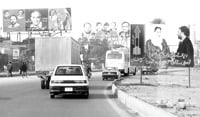 of solidarity with her family, but now their campaign has picked up steam.
Suddenly, you see a greater number of slogan-ripped banners, posters and
hoardings on the streets, flashing PML-N's election symbol with life-size
portraits of a party candidate or two staring down. And, even though what
one would call 'election fever' or 'hysteria' is still missing, the
campaigning is expected to get a shot in the arm with Zardari stepping
into the arena.
of solidarity with her family, but now their campaign has picked up steam.
Suddenly, you see a greater number of slogan-ripped banners, posters and
hoardings on the streets, flashing PML-N's election symbol with life-size
portraits of a party candidate or two staring down. And, even though what
one would call 'election fever' or 'hysteria' is still missing, the
campaigning is expected to get a shot in the arm with Zardari stepping
into the arena.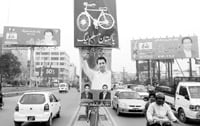 Gawalmandi -- as the family members have lived for long in Model Town that
falls within this constituency. Later, they moved to Jati Umra, near
Raiwind.
Gawalmandi -- as the family members have lived for long in Model Town that
falls within this constituency. Later, they moved to Jati Umra, near
Raiwind.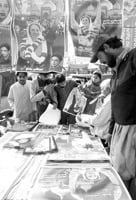 there is a lot of (election-related) economic activity. When billions are
spent there definitely are millions who benefit from them directly or
indirectly.
there is a lot of (election-related) economic activity. When billions are
spent there definitely are millions who benefit from them directly or
indirectly.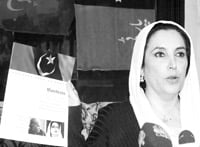 2008 elections -- have published their manifestos that throw light on the
important issues being faced by the people of Pakistan. They also proffer
solutions as per their own particular ideology. PPP was the first to
release a manifesto (for 2008 elections). This was on Nov 30, 2007. It
focused famously on the '5 Es' -- employment, education, energy,
environment and equality.
2008 elections -- have published their manifestos that throw light on the
important issues being faced by the people of Pakistan. They also proffer
solutions as per their own particular ideology. PPP was the first to
release a manifesto (for 2008 elections). This was on Nov 30, 2007. It
focused famously on the '5 Es' -- employment, education, energy,
environment and equality.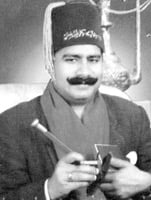 their people-friendly rhetoric. These local 'colourful' leaders did not
have to do much to craft the magical words.
their people-friendly rhetoric. These local 'colourful' leaders did not
have to do much to craft the magical words.