


|
|
|
|
 |
 |
  
|
visit
Halfway up the Alps A day in the eastern French town of Chamonix Mont-Blanc, culminating in a dream-like train-ride up to Montenvers -- a site that is said to have inspired many painters, writers and poets
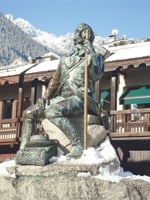
By Awais Manzur Sumra Fading, dark green and black statues of Horace Benedict de
Saussure, perched on blocks of rocks, occupied two frozen intersections in
the town's centre. The statues, hotels with sloping roofs and wooden
balconies with the mountain chain of Le Brevent forming the backdrop, forced
us to turn around and take another look at the imposing ice-covered Mont
Blanc in pale November afternoon sunlight. We were in the eastern French town of Chamonix Mont-Blanc, largely deserted at that time in freezing temperatures, but home to nearly 100,000 visitors a day in summer. This was our last full day on a short trip to parts of Italy, Switzerland and France and we had driven that morning from Geneva, a drive of just over an hour, past snow covered fields. Chamonix Mont-Blanc, a town of less that 10,000 inhabitants on the foot of Mont Blanc, lies at an altitude of 1,035 metres and was the site of the first Winter Olympics in 1924. Described as "the death-sport capital of the world" by John Krakauer in his essay in his collection Eiger Dreams, Chamonix is ideal for outdoor activities like ice climbing, rock climbing, skiing and paragliding. The town affords a number of opportunities to go up the mountain. The most spectacular is said to be the cable car up to the Aiguille du Midi (3,842 metres), constructed in 1955 and, at that time, the highest cable car in the world. Having found a spot in an underground parking next to
Place du Mont-Blanc, one of the central intersections in the town, we had
wandered on to Rue du Docteur Paccard in search of a tourist information
office. All we found were myriad souvenir shops and some bakeries,
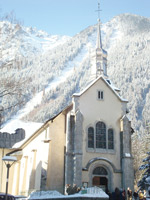
interspersed by largely empty restaurants. Clearly, not many had ventured into the town on a cold, working day. Finally we located the tourist information office, in front of a large concrete open space with benches buried in snow. As we stood waiting for the tourist office to open after its hour long lunch break, the church Eglise St-Michel loomed over us further north, just across the road, with mourners, clad in black, waiting to pay their last respect to someone. The church bells chimed and the mourners filed somberly behind the coffin into the church. Behind us, the tourist office opened its doors. The lady at the information office spoke little English and did not seem to be in a hurry, something perhaps typical of that part of the world in November. She managed to guide us to the sole McDonald's in town and inform us that in the limited time at our disposal before dark we had only one option left - to venture up into the mountains. Back in the square, the statues of Horace Benedict de Saussure, an 18th century Swiss aristocrat and Alpine traveller considered to be the founder of alpinism, again greeted us. These statues face the mountain for whose ascent he had offered a reward during his first visit to Chamonix in 1760. Two locals from Chamonix, Dr Michel Paccard and Jacques Balmat, eventually achieved the feat on Aug 8, 1786, followed the next year by de Saussure himself. These ascents traditionally mark the start of modern mountaineering. Exactly a century after the first ascent, in 1886, the future U.S President Theodore Roosevelt led an expedition to the peak. The ownership of the Mont Blanc, French for white
mountain, the tallest mountain in the Alps at 4,810 metres (15,781 feet), has
been debated since the French Revolution, before which the whole mountain was
part of the Kingdom of Sardinia for centuries. The latest commissions to
redefine the Franco-Italian border, in both 1947 and 1963, tactfully ignored
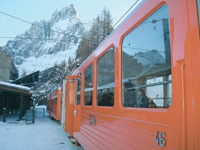
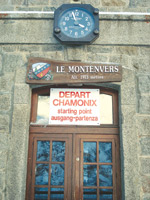
the Mont Blanc issue. As advised by the tourist office lady, we decided to take the rack-and-pinion Montenvers railway. Leaving the sole McDonald's in the town, just across the intersection from one of the de Saussure statues, we walked east past rows of souvenir shops and bakeries that lined the length of snow-covered Avenue Michel towards the Chamonix train station. Just to the left of the train station, a rusting steel truss bridge led across the railway line to Gare du Montenvers, the starting point to the spectacular journey up the side of Mont Blanc to a point overseeing the Mer de Glace, meaning Sea of Ice. The two-compartment, bright red train with basic wooden benches clambered lugubriously on to the side face of the rocky mountain, chugging its way past cars buried deep in snow, ski enthusiasts ploughing their way up a steep slope to the right, their equipment making their ascent all the more difficult. Snow flakes glistened in the sun light managing to pierce through dense foliage as the train made a sharp U-turn and headed into a dark tunnel. Slowly, the Chamonix valley began to spread out before us as the train gained height and moved away from civilization into the unknown. Within minutes even the valley disappeared as the dark, unwelcoming façade of the Montenvers Grand Hotel-restaurant loomed above. The Montenvers station lay just 100 metres beyond, coming to life as the passengers disembarked, their excited exclamations and camera clicks the only sounds breaking the eerie silence of the Mer de Glace. The Montenvers rack and pinion railway has been in
operation since 1908 and takes 20 minutes to cover the distance of 5141
metres and reach the foot of the Mer de Glace, Europe's largest living
glacier. The Montenvers station at 1913 metres, complete with its fast food
outlet Buffet de la Gare, overlooks the glacier which is 14 km long and
covers an area of 40 square km. The Montenvers site is said to have inspired
many painters, writers and poets. In 1818, Mary Shelley wrote Frankenstein
after having visited Montenvers and the Mer de Glace two years previously. As
we stood on the oval terrace the other side of the station, rocky cliffs hid
the Mont Blanc while the rocky peak of Les Drus, 3754 metres high, shone in
the receding evening sunlight, a jet flying high above, its passengers no
doubt enjoying the entire panoramic view. The entire Mer de Glace spread out
in the distance and down below us, a sheer, roughly triangular, white and
grey sea of ice and rock disappearing into the distance towards the valley
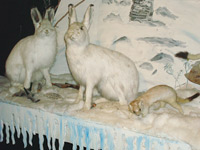
below. One hour at Montenvers is perhaps too short a time to appreciate the outdoor scenery and visit the indoor excursions available. We were able to appreciate only the Musee de la faune alpine (the Alpine Fauna Museum) and the Galerie des Christaux (the Crystal Gallery) before the last train of the day left for the valley, taking with it the railway workers and restaurant employees, and leaving darkness and stillness behind. The Alpine Fauna Museum is housed in a small, non-descript building just behind the Grand Hotel. The museum exhibits stuffed mountain animals in two small chambers with dark background. There were alpine ibex and marmots, bearded vultures and golden eagles. The Mont Blanc range is home to a rich diversity of flora and fauna with more than 1000 species of plant life listed and all the classic alpine animals present. But there were not many visitors in the museum, just three ladies who had followed us in. If there were few visitors at the Fauna Museum, there were
absolutely none at the Crystal Gallery, located just 50 metres beyond the end
of the train track, dug into the side of a rocky cliff. All our fellow
passengers had, after taking snapshots as proof of their visit, preferred to
stay in the warm comfort of the Buffet de la Gare and sip coffee. The Crystal
Gallery, presenting a collection of some of Mont Blanc massif's most
outstanding pieces, is actually a narrow, unlit passage into the rocky cliff,
stones and minerals exhibited on both sides in dimly-lit chambers dug into
rocks, the floor damp and slippery. We had to hurry back halfway to prevent
being locked inside for the night by an overzealous employee in a hurry to
shovel away the fresh snow, shut the rickety wooden door and take the last
train back to civilization. The return train ride back to Chamonix was a relatively subdued affair, some passengers already relishing their visit to Montenvers, others looking forward to the warmth of their hotel rooms or homes, the calm broken every now and then by a couple of gaunt railway workers speaking animatedly while pointedly trying to locate some invisible animals in the rapidly darkening foliage. They had, no doubt, to take the first train up the next morning while we had to drive back to the comforts of Geneva that same night. The writer can be contacted at amsumra@gmail.com |
|