



|
|
|
|
 |
 |
   |
review Amid
books in Jaipur Zia
Mohyeddin column
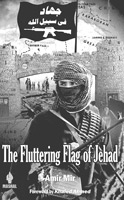
A reporter's account A dramatic, authoritative account of the menace of terrorism now convulsing Pakistan and sending shock waves throughout the world
By Waqar Mustafa The Fluttering Flag of Jehad By Amir Mir Publisher: Mashal Books, 2008 Price: Rs700 Pages: 306 Gone are the days when shocks were rare. And the jolts we would get came only from tremors and military takeovers. Now we have them in plenty, courtesy the dictators that left the nation with some new malady to whine about each time after they were off the saddle. So abundant they don't surprise us anymore. We know things have changed for the worse. Now terrorism is the word. The bell keeps tolling by the day, and sometimes by the hour. The year 2008 has mowed down more than one thousand people in suicide bombings. And with people being killed in blasts in one city or the other in the country and so many schools being destroyed each day in the areas called breeding grounds for terror, no hope is in sight this year either. Hail Bonapartes! "Islam does not promote terrorism. Indeed, in its doctrines, Islam is the most tolerant of the world's monotheistic religions," said US journalist Robin Wright once, perhaps in 1993. However, she said: "Religion in opposition and in conflict will play an ever greater role through the end of the twentieth century, particularly in the Third World. Among the traditional powers, religion is too often viewed as tangential factor in Third-World political developments. But all major monotheistic religions preach equality and justice, which makes them natural forces of opposition to dictators and in many countries -- where opposition politicians are imprisoned, exiled or even executed, and where opposition, often outlawed -- the mosque, temple, synagogue or church increasingly become the only centre around which to voice dissent. To Muslims as well as members of other faiths living under military rule or in one-party states, that often applies literally as well figuratively." The Quaid-e-Azam Muhammad Ali Jinnah once remarked to army personnel, "Never forget that you are the servants of the state. You do not make policy. It is we, the people's representative, who decide how the country is to be run." But it's a pity that Pakistan's road to democracy has always been rocky, courtesy coups and machinations. The country's experiments with democracy are always shortlived and its democratic leaders hanged or exiled. With doors shut on opposition, debate and public welfare, poverty, terrorism and intolerance grow wild. While blaming dictatorships for the ills facing us today, one cannot spare the US either, which champions democracy at will. General Zia-ul-Haq was held in contempt by the West when he hanged Prime Minister Zulfikar Ali Bhutto -- but he was elevated to the status of an ally and friend the moment the US needed his help in the anti-Soviet war in Afghanistan. However, by 1993 Pakistan was almost declared a "state sponsor of terrorism" by the United States because of its support for Kashmiri guerrillas. "When President Clinton paid a state visit to India, he gave General Pervez Musharraf -- who had still to declare himself president -- only a few hours, favouring Pakistan with a one-day return trip, a lecture on the evils of Osama bin Laden and an appeal to General Musharraf not to hang the prime minister, Nawaz Sharif," reminisces Robert Fisk, famed English journalist and author. "Then came September 11 and [the US Secretary of State in the George Bush administration] General Powell produced a new song sheet. "President Bush,'' he told us on October 16, "asked me... to demonstrate our enduring commitment to our relationship with Pakistan... we're truly at the beginning of a strengthened relationship, a relationship that will grow and thrive in the months and years ahead." All of which just goes to show what the loan of a few airbases and the arrest of a few government-sponsored Islamists can do. General Musharraf had taken 'bold and courageous action' against 'international terrorism.' "And in the blinking of an eye, there was General Powell promising to take up the Kashmir dispute with India -- the very nation that almost persuaded America's State Department to put Pakistan on its "terrorism" list in 1992. Newsweek outlined the US government's view with alarming, if unconscious, frankness. "It may be a good thing that Pakistan is ruled by a friendly military dictator,'' the magazine concluded, "rather than what could well be a hostile democracy," says Fisk. As dictatorships prospered, so did terrorism, gnawing at the vitals of the state of Pakistan. Amir Mir has earned fame for his investigative reporting and for facing odds during the recent dictatorship. Mir's latest book The Fluttering Flag of Jehad is a dramatic, authoritative account of the menace now convulsing Pakistan and sending shock waves throughout the world. Mir lucidly explains its roots. His extraordinary firsthand and secondhand reportage takes the reader into mountains and plains, to shanty towns and capitals to know the guerrilla fighters, militant religious leaders, and terrorists. His clear-eyed discussion of the repercussions of dictators' policies points to possible future courses of action. No one has covered the terrorist attacks, including the one which killed a democratic leader and former prime minister Benazir Bhutto, as Mir does, detailing the origin and larger political and ethnic context in which they took place. The book should be a required reading for the architects of Pakistan's often disastrous foreign and domestic policies. Mir's rich combination of experience, sources, research and interviews has produced a significant body of knowledge about a deeply misunderstood subject. This is very much a book by a meticulous reporter, mercifully free of specialist jargon. What makes his book worth reading is the way he treats his subject without sensationalizing or patronizing it. Mir manages, against all odds, to get a fix on a phenomenon that is complex, elusive and kaleidoscopic. Moreover, his style of writing is so vivid that the book reads like a novel. Most impressive, however, is his ability to assess the situation with a clear eye, objective attitude and enormous intelligence. Future peace and stability requires sustained investment in solid secular democracies -- not in stable dictatorships. In a lecture recently on Democracy and Authoritarianism in South Asia, Ayesha Jalal compared and contrasted state structures and political processes. She evaluated and redefined democracy, citizenship, sovereignty and the nation-state. She argued for a more decentralized governmental structure able to arbitrate between ethnic and regional movements. "There should be a more nuanced appreciation of citizenship rights, not merely political but also economic and social," was the recipe she came up with. Could we try it? Amid books in Jaipur A literary festival in India shows the possibilities and pleasures of dialogue and debate
By Huma Imtiaz Held at the centuries old Diggi Palace, located just
outside the famed Pink City of Jaipur, the DSC Jaipur Literature Festival,
2009, spanned five days of books, talks and music. Authors from all over the
world, many of whom met for the first time, spent hours discussing issues
pertaining to their lives, their books, and the everyday problems they
encountered. Key speakers included the charming Vikram Seth and Pico Iyer,
Amitabh Bachan, former UN diplomat Shashi Tharoor, Vikas Swarup, author of
the book Q & A that was adapted to make the award-winning Slumdog
Millionaire and Mohammad Hanif and others. Despite being in India at a time when Indo-Pak relations have taken a turn for the worse, amid news reports that pressure from right-wing parties had led to books by Pakistani authors being pulled from stores, I was pleased to observe that the Pakistani authors were feted by an extremely curious and welcoming audience; their books sold like proverbial hot cakes at the stall set up by a leading Indian bookstore chain. The Pakistani stars of the festival were undeniably Daniyal Mueenuddin, whose debut novel In Other Rooms Other Wonders sold out minutes after it was offered for sale and Basharat Peer, the Kashmiri journalist whom Pakistan claims as his own. Peer's debut novel Curfewed Night, a brilliant account of life in Kashmir, was nowhere to be found either after being available for less than a day. Mohammad Hanif, of A case of Exploding Mangoes' fame reportedly gave over two dozen interviews to the curious Indian media. The festival kicked off on Jan 21, as sponsors of the event and the festival directors spoke passionately about how the festival has grown since its inception in 2002. William Dalrymple, another acclaimed author, who was the Festival Director, said the festival had three times more authors this year from the last year. The best feature of the festival was that one could flit from one session to another, hearing Shining India being discussed in one hall, and Shakespeare's life in the other. Discussions varied between travel writing to V.S. Naipul's life to the US elections to fundamentalism. The most interesting debate though was undoubtedly in the Kashmir session, featuring Basharat Peer and Hari Kunzru. Basharat, a journalist by profession, has spent many years of his life in Indian-held Kashmir. Hari, on the other hand, is of Dalit descent, but his father migrated to London before he was born. The session was presided over by Tarun Tejpal, journalist and author. While one liked the eclectic mix of authors at the session, Tarun Tejpal decided he would blame the Pakistani government and military for destabilising India, and sidestepped the issue of the atrocities committed by the Indian state forces. While Basharat did try to interject with the fact that the focus on Kashmir has shifted in Pakistan amongst both the country's citizens and its government, Tarun, whose understanding of Kashmir seemed dated by at least a decade, brushed aside the suggestion. As Tarun played the role of the State of India in the discussion, one thought it was time one accepted the fact that the valley of Kashmir has been wrecked apart by decades of state-sponsored violence. And it was not just Pakistanis that were the talk of the
town. Acclaimed poet and lyricist Gulzar's session was so crowded that people
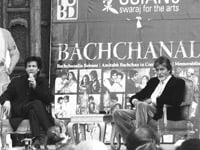
had to stand outside the hall, watching Gulzar recite poetry on Amitabh Bachan, who many felt was only there to pull in crowds for the festival, exuded tons of charisma, but his words left a lot to be desired. Even as there was a sense of elation in the air that Slumdog Millionaire had just been nominated in a slew of Oscar categories, Bachan failed to mention the actors or the director, and only expressed hope that A.R. Rahman would be the second Indian to win an Academy Award. Sour grapes, it may be. Vikas Swarup commented earlier that night that he was looking forward to meeting Amitabh Bachan, as bitterness lingered in the air after Bachan had reportedly badmouthed the film on his blog and retracted his statement a day later. Another interesting element that came out in the Defining Diaspora session, which featured Hari Kunzru, Tahmina Anam, Naderem Aslam and Tash Aw, who belong to various countries, recounted tales of how publishers stereotype their work. Tahmina, who hails from Bangladesh and is currently based in the UK, was irritated at how publishers wanted to use a picture of henna stained feet as the cover of her book, which had little to do with the book's content. According to William Dalrymple, they may not be able to accommodate more than the authors they had this year, but the festival organisers are hopeful that next year they will be able to make better use of the space available and invite folk musicians from Bhit Shah to perform at the festival. The festival was not all about seriousness though. Many an observer looked on in disbelief as a transvestite traditional Rajasthani dancer performed. Then there were the one-liners: Vikram Seth recalling how he'd been rejected by over 30 publishers and stated "a dressing gown, whisky and a hot water bottle are essential for being a good writer". Mohammad Hanif called former President Musharraf's book In the Line of Fire "a good piece of fiction", a comment that was met with resounding applause. As the festival drew to a close on Jan 25, and weary yet happy authors, delegates and organisers packed their bags to set back to their homes, I wished that a similar festival, if not on this scale, could be organised in Pakistan because everyone I met, from authors to members of the media, were eager to visit Pakistan. The writer works for Geo TV as a correspondent and can be reached at huma.imtiaz@gmail.com
A letter I did not write " To The Editor… Sir, I am grateful to your drama critic for lauding my latest production ("Khwabon ke Musafir" by Intizar Husain) and calling it a "memorable watch." I am, however, constrained to point out that by referring to the play, continually, as a melodrama, your critic is misleading her readers… I stopped in my tracks as I realised that the last time I wrote to the editor of a prestigious daily pointing out a few solecisms committed by his drama critic, he wrote back, rather tetchily, "Dear Zia Saheb, be grateful for small mercies that the event was covered by our uneducated media in the first place rather than cringe at misspellings and butterfly remarks." A melodrama is a theatrical entertainment (usually with a happy ending) which is characterised by crude appeals to emotions, sensationalisms and spurious pathos. You could say that the entire stock of Urdu drama written between 1858 and 1920 is melodrama. It is a drama with interspersed songs and orchestral music accompanying the action, a drama in which action and utterances are always extravagant. Intizar Husain's play is singularly devoid of all these ingredients. It is a play as far removed from melodrama as Murlidharan is from the art of batting. I am not suggesting that a reviewer should be thoroughly familiar with all forms of drama, i.e. "tragedy, comedy, pastoral-comical, historical-pastoral, tragical-historical, tragical-comical-historical-pastoral, scene individual, or poem unlimited" (the list was drawn by the loquacious Polonius), but I do expect a reviewer to be able to distinguish between a play and a melodrama. In a third and final review that appeared in this very newspaper (it is flattering to receive so many notices) the critic says that my introductory note in the playbill suggesting that Khwabon ke Musafir is a play in the Chekhovian mould is off the mark. "In Chekhov's plays", she writes, "the tension is high wired and the ending wraps up to a startling and moving climax." This is revelation indeed. Chekhov survives as the founder of a type of drama in which nothing happens and little people drift in and out remarking that their lives are empty, a drama in which plot has been replaced by mood, a mood of nostalgia and defeat. His plays are suffused in emotion. I revere Chekhov for his muted lyricism, his gentle pathos and his gentler humour. The thoroughness of Chekhov's dramaturgy is manifest in the fact that any part he has ever written becomes luminous and prominent by being well-performed. Chekhov enjoys an enormous literary reputation. Much has been written about his art but what does that art consist? To begin with, he does not settle the fate of his characters (most dramatists do). In his play, Uncle Vanya, for instance, nobody dies; nobody is paired off; the characters do not live happily ever after because that is not Chekhov's view of the truth. His view is that life knows no endings, happy or tragic. His climaxes are an anti-climax. They are moving because they come at a time when we are in complete empathy with the characters. In the Greeks, in much French drama, and in Ibsen, the fortunes of the protagonists change towards the end of the play. Nobody's fortune at the end of a Chekhov play is as good or bad as it might be, nobody is conclusively loving or hating. The surface of everyday life is not a smooth deception; it is itself a tragedy. The tragedy is not that things will change drastically but that they will remain to be the same. Chekhov avoids the black and white, the tragic and the comic; he prefers the halftone, the tragicomic. Unfortunately, Chekhov has, too often, been presented, as a moody writer. His characters have been presented as dreamers (therefore weaklings) and his plays, as a result, have acquired the reputation of being plotless, monotous, drab and intellectual. Chekhov's people are no weaker than any of us. They are weak, of course, but there are also elements of protest and revolt in them, traces of will-power and some dim sense of responsibility. If his characters do not reach fulfillment it is not because they are always without potentialities. His characters do not dream of what could never be or what could only come after thousands of years; they dream of what their lives could actually have been. He enriches his dramas in ways that belong to no school. Other dramatists have tried to revive poetic drama by putting symbolist verse in the mouth of their characters or simply by imitating the verse drama of the past. Chekhov finds poetry in the world of realism. The most forceful aspect of Chekhov that I have realised, having seen his plays in several continents, is that the dramatic element in his plays will always best release itself through what seems most undramatic. Chekhov is memorable because of innuendos, omissions and half-statements. These are the elements with which he weaves the fabric of his plays. The drama critic of the latest review ticks off Intizar Husain for not being able to get his story off the ground and for dissipating it to an unresolved end. She is unhappy that the protagonist, the father, "does not fit the bill of a respected father figure that everyone should be looking up to nor is he wise and erudite", as though this is a gross violation of dramatic grammar. She admits that the play is about nostalgia and loss of innocence and missed opportunities, but she thinks these are ingredients only for a short story or a novel rather than drama. If only she were to re-read Chekhov – or any member of other important dramatists that I can mention. Intizar Husain has turned the ineptitude of his protagonists, the father and mother – and the diffident nephew – into a dramatic energy that forms the crux of his play. The pace and rhythm of his play is leisurely, the succession of scenes mark simply an advance in our knowledge of a situation that does not change. Like a Chekhovian play it does not have dramatic turns and twists and upheavals to jolt you every now and then. I am not saying that Intizar Husain sat down to write a play in order to appear to be Chekhovian. He crafted the play by allowing his narrative and situations to leak out, so to speak, through casual domestic gatherings. His mastery of petty, realistic material is something to behold. It is with casual lines which are significantly precise, concrete and ironic and his profound understanding -- and placement -- of his characters that he has crafted a poignant tragic-comedy. The play was written some fifty-two years ago. I have yet to come across another play in Urdu which tells us that unhappiness can be more effectively conveyed by what is left out than by what is put in. |
|
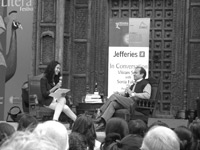
 large LCD screens. With each couplet he recited, it was met with a series of
hai's and spontaneous rounds of applause. Simon Schama, an acclaimed
historian and author, had just arrived after attending Barack Obama's
inauguration, and despite feeling that Obama had been very 'headmasterly' in
his inauguration speech was optimistic as to how the new US government will
fare.
large LCD screens. With each couplet he recited, it was met with a series of
hai's and spontaneous rounds of applause. Simon Schama, an acclaimed
historian and author, had just arrived after attending Barack Obama's
inauguration, and despite feeling that Obama had been very 'headmasterly' in
his inauguration speech was optimistic as to how the new US government will
fare.