


|
|
|
|
|
 |
 |
   |
Back
to bikes Riding
for peace MOOD
STREET Town
Talk interview Fresh
concepts Critical Mass aims to show the automobile users that cycling is a sustainable as well as environment-friendly alternative By Usman Ghafoor At first, they appear to be a rather 'cliquish' group
of English-speaking foreigners and locals, both men and women, out on the
road for a refreshing morning bicycle ride, dressed in their designer
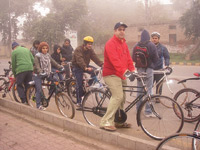
casuals' best - sneakers, hoods, caps, shades, and all. But this isn't exactly what this crowd is about. A brainchild of noted lawyer, academic and newspaper columnist, Ahmad Rafay Alam, this cycling congregation is Lahore's answer to the world's now very popular social event, called 'Critical Mass'. The idea is to raise awareness among the common people about the environment-'unfriendly' automobile culture in the cities. "Driving a car is the most polluting thing a person does in a day," argues Rafay. "It's far worse than what the ordinary person otherwise pollutes in a day. "Cycling these past eight months, I have noticed that, for my immediate needs, a cycle is a perfect way of getting around. Most of the things I need on a daily basis are found within a 30-minute cycle ride." Rafay finds it funny that people should drive to a gym to use a treadmill. "It's a sign of the Apocalypse!" he jokes. Now a weekly event, the purpose of Critical Mass is to establish the fact for automobile users that cycling is a "sustainable alternative" and that there is "no social negative in it". For the participants, it's also an occasion of getting-together. It allows them to mingle and chat with each other. Every Sunday, the 'massers' collect at Zakir Tikka in Cantonment area, at 10 am sharp. (Remember: There's no place for late-comers. If you didn't make it on time, you can always stay back and wait for the next week's event!) In the parking of what is one of the most famous eateries in town, you find lines of bicycles - an interesting mix of mountain bikes and the good ol' Sohrabs; a couple of foreigners and desis, all looking bright and cheerful, soaking up in the late January's Sunday sun and ready to explode on the road. It's a delightful sight. The choice of the route is made spontaneously. But, usually, the group takes off from the eating joint on Sarwar Road towards the Garrison Mess on Allama Iqbal International Airport Road, meeting entranced passers-by and the all-smiles traffic wardens at various intersections on the dusty lanes, sometimes detouring through the lush green military dairy farms that give off a peculiar stench of cow dung and St Anthony's brick-finish campus off Tufail Road with its occasional sound of bells, and back. According to Rafay, it's also "a great way to learn about the city". Himself a huge critic of urban planning and admittedly influenced by urban thinkers like Enrique Penalosa, Jane Jacobs and Lewis Mumford, Rafay says his basic right to access places is hampered by the way our cities have been allowed to grow outwards. It's called "urban sprawl", he explains, because of which the common citizens have been "deprived of a perfectly acceptable, healthy and environment-friendly form of transport". The Critical Mass is becoming known thanks to a great word of mouth. For his part, Rafay has advertised the event on Facebook which means the friends of participants and the friends of friends could have an idea what it is about. UK-based Alia Ayub is one such person who learnt about the event through the wonders of Facebook. Born and raised in the US, Alia is a frequent visitor to Pakistan and claims to have seen Critical Mass occur in cities all over the world. She says she's never been very confident on a bike, but going with the group "seemed like a fun adventure". Alia is still reeling from her first experience with the group. She says she initially went for it thinking it would be fun and also a good aerobic exercise. "I met new people and was moved by all corners of the city that I had missed out on when zooming past in cars. I now want to buy a bike of my own (I used my younger brother's bike for the event!)." Recalling an interesting incident, she says, "Once we were at a traffic light, everyone started ringing their bells. The policeman directing the traffic gave a huge smile, stopped the traffic and let us pass. "At a time when tensions are high and class differences lead to a lack of interaction among the layers of society, it was a breath of fresh air to actually be on a genuine person-to-person basis with fellow Lahoris." Rafay is also looking at participation beyond the Facebook community. "I don't want it (Critical Mass) to become a kind of an elitist event," he states candidly, "Anybody who wants to join us is welcome." Given the kind of no-membership structure that the Mass has, there's obviously no joining fee issue. At most you are required to bring your bicycle. Back at the Tikka outlet, it's time to mass up for a photograph. The participants merrily lift their bikes in the air and say 'Cheese!' It's a perfect Kodak moment.
Iranian couple who went round the world on bicycles to promote peace, believe women are more powerful back home
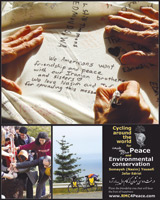
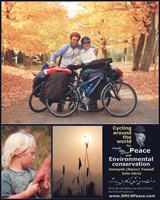
By Waqar Gillani An Iranian couple – Jafar Edrisi and Somayeh (Nasim)
Yousefi, both in 30s – are on the way back to their homeland after
successfully completing their adventurous round-the-world cycling trip
started from Tehran on April 29, 2007 to promote peace and raise
environmental conservation awareness. Pakistan was the last leg of their
self-funded international adventure. They reached Pakistan on January 21
and left it crossing through Iran border from Quetta, last week. The
couple travelled through Iran, Turkey, Greece, Italy, France, Belgium,
Germany, Netherlands, Canada, USA, Japan, Korea, China, Nepal, India and
Pakistan. The couple reached Lahore from India crossing Wagha border and
spent a couple of days in Lahore, hosted by Khana-e-Farhang-e-Iran
(Iranian Cultural Centre). TNS grabbed this opportunity to have an
interaction with them at Khana-e-Farhang Lahore to know about their
highly-interesting adventurous journey. Edrisi and Yousefi – computer science graduates but also keen rock-climbers – met each other while mountain-climbing in their countryside ten years ago. They became friends and then tied the knot after a period of four years. After brief introduction and congratulating them on having a successful exploratory and courageous trip of the world, my first question was how a woman from Iran, an Islamic country having an entirely different international image, is cycling round the world? Isn't it strange? Not at all, Yousefi said laughing. Iranian women love sports and adventures. Women in Iran, generally, like skiing, rock climbing, para-gliding, mountain climbing etc. They also ride bicycles and there is no ban or harm in it. "You have to respect the rules and ride bicycle wearing a small scarf, kurta and jeans like me," said Yousefi. "Women in Iran like cycling. They are almost 60 percent of the population and are very powerful in Iran. We can do whatever we want. For example I just need to inform Edrisi that I am going to a competition of singing outstation for 12 days. And that's all. What he needs to have is some food cooked in advance to eat during this time. We have the power in house and it is the man who needs to seek permission to go anywhere for some days," she said smilingly. Yousefi said their government also wants women on jobs. "You will see more women on roads than men. I was surprised to see Lahore as I could not see women on roads in Lahore as compared to Tehran. We planted a tree sapling in Johar Town, Lahore. There were very few women there. At the beginning of our journey when we planted our first sapling, there were more women than men." "This will also be interesting for you that in the
recent past a group of mountain climbers climbed Mountain Everest and a
woman led that group," Edrisi added. "Another recent group of
women only, climbed Nanga Parbat." Such news is never highlighted in
the world media and that is also one of the reasons of our journey to
portray a positive image of Iran, our homeland. He said the Central Bank
of Iran was full of women. Telling about their journey and their mission for peace, the couple said, now-a-days, it is necessary to work for peace, and also environment. "We have experience of war with Iraq which went on for eight years and the concept of peace originally came from that experience. Moreover, there is need to protect the environment of the globe and that is why we are planting tree saplings in each country and major cities during the journey." Talking about how they started this journey, the couple said the trip was self-funded and to begin the journey they sold their car. Their money finished in France. "Since Edrisi knows calligraphy and photography, he started taking photographs and doing calligraphy on photo-cards, selling them on nominal price, which people happily bought," Yousefi said. "We also traveled very cheap and lived in modesty." She was also surprised at the kind of hospitality people extended them the world over and showed their love to the couple and appreciated their mission. "When we started this journey from Tehran, BBC interviewed us and after that report we received as many as 300 emails in our account from different parts of the world, getting invitation from people to come and stay with them during the journey. We couldn't believe it," she expressed. The couple said it was a unique opportunity for them to show Iranian culture and introduce Iran to others. "We spent nine months in 15 states of United States of America and planted 35 saplings there." During the travel, the couple changed the tubes of cycles 10 times, replaced tyres twice and changed the whole wheel just once in their more than 20,000 kilometre cycle travel in two years. The couple will be ending this tour on March 5 in Tehran, the national plant day of Iran. They still remember a person in US who changed the whole bicycle spending US $2,000 against the original price of the cycles that was just US $600. But he did not charge a single penny from them. To the question if they had left their children in Iran, they said, "We have no kids but we believe that the saplings we have been planting during our world tour in different countries are our children," Yousefi said, adding, "So far we have 73 children, including three in Lahore, Pakistan." They have two objectives: one to plant sapling trees around the world to help the environment, and the other is to convey a message of peace and friendship to the countries they visit. The couple has a very good image of Pakistan too. "We were repeatedly warned by the people of the world not to travel to Pakistan but we saw people loving and hospitable here," said Edrisi. "We were not charged at Lahore Museum when we told them that we were from Iran." The couple, which was in Pakistan for the first time, also visited Wagha border, Badshahi Mosque, Iqbal Tomb, and other parts of the city including some educational institutions. He said even people in India love people of Pakistan and vice versa. The couple believes that people can make a difference by starting and practicing good things at their home. In future, the couple has planned to write a book on their experiences of this adventure and to start another tour in July 2009 to Eastern and Western Europe in collaboration with an international group of cyclists whom they met during this journey. MOOD STREET Reversal of roles?
By Yasir Mahmood According to the yin and yang theory, the male and the
female counterpart should be balanced in every sphere of life. The revolving
fish represent that the position of superiority is shared between the two and
that the two genders are the most essential part of the society –
represented by the engulfing sphere. Now, the society that follows the subtle
injunctions portrayed in this picture are bound to lead an essentially close
to normal life. However, those that refute this idea, are well into the line
of flowing down a life that is not just abnormal but highly eventful as well.
And which country can stand as a better example than our very own Pakistan? We can boast of little in the matters of economy or literacy but we can easily sway the world records when it comes to being a genuinely action-packed society. We are vivacious and lively, though the issues that really get us going are still quite vague. Gender issues are one such arena that has lent an extremely lively hue to the every day mundane life in our country. When women talk about their emancipation – a Victorian idea, quite redundant, too – they forget the general concept behind emancipation, and what they really understand is the word 'equality.' And if asked about equality, they are still not sure which areas need equalisation and which should be left as they are. Standing in the queue to pay your utility bills and being tugged and pulled by the men is what I guess not what they meant by equality, though this is where they have landed themselves after various protests and demonstrations. Now I am not a male chauvinist, but I do believe that one should stick to the work that one is made for. Go beyond the constraints of both the body and soul and you end up living a drained and fruitless life. Emancipation shouldn't have meant the reversal of gender roles and that is exactly where we are trying to land ourselves. Girls from the generation next to us – little teenage girls – believe that woman emancipation is all about acting like man. Though I totally disagree with those people who believe that the female sex is lacking anywhere in their mental abilities, they have proved to be excellent there. But where I disagree with the fair sex is that they have begun to enmesh themselves up in ideologies that are not their own, and which hurl them into perpetual dissatisfaction once the ideologies become a misfit in their homeland. Acting the macho is the feat of men women should refrain from it. The other day, while driving down one of the busiest roads in Lahore, an utterly amazing scene unfolded itself, when a woman started harassing a poor man in the middle of the road. I mean, I have seen men indulging in such petty violence; I have been a participant in quite a few of them as well. But who ever though of a young girl stopping her car in front of another car, jumping out, forcing open the door of the other car and threatening huge penalties to a harassed driver who was not courteous to let her overtake from the wrong side. If this is what women liberation is meant to be, then it leaves a lot to wonder why did she slink away when the policeman asked her to come to the station as she had disrupted the traffic for a considerable period? Equality should mean equal treatment, now shouldn't it? Life in our beloved country needs to be harmonised and both the genders should realise their own restraints and categories. A life that is the reversal of reality is commonly called abnormal, but what it lends us is a detrimental existence that shall have its after-effects for us to suffer for time immemorial. An earning, world-scathed mother and a rearing, nurturing father, is what awaits us if we do not even now try to disentangle ourselves from the tentacles of those issues that are already decided for us over fourteen centuries ago. What we have ignored is now becoming the beacon of hope for the western world that we have tried to follow so religiously. It's about time that we should be the first ones – at least in something, please – before the West does it for us, to start retrieving our lost dignity in gender issues. Both the men and women should celebrate the beauty of their existence as given to us by the Divine Authority. Town Talk • Puppet Show every Sunday at 11am at Alhamra Arts Council, The Mall.
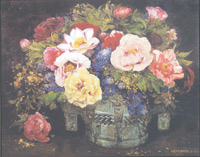
• Exhibition of Paintings: Group Show 2009 at Ejaz
Art Gallery till Thursday, Feb 5. Works of 12 artists are on display. They
are Ali Abbas, Asif Ahmed, Babar Azeemi, Waseem Ahmed, Khalid Saeed Butt,
• Seminar on Kashmir Dispute and Pak India Trade Relations on Tuesday, Feb 3 at Hamdard Centre, Lahore Chamber of Commerce and Industry at 3pm.
• Conference: 2nd Pakistan Botanic Gardens Conference from Mon, Feb 2 to Wed, Feb 4 at Government College University Lahore.
• Seminar on Biopharmaceuticals on Friday, Feb 6 at Lahore Chamber of Commerce and Industry from 10am to 4pm.
• Free Science Film Show at National Museum of Science and Technology on Sat, Feb 7 at 2:30pm.
• Fair: Top Gear Car Show today at Walton Airport from 10am to 11am.In the show there is going to be static car display of vintage and exotic cars and drag races between super cars and high performance cars. "An artist's work says everything" "To bring out real features of the personality in a portrait, an artist needs to do a lot of homework." Wei Chuyu, a painter from China, speaks about his work, art scene in his country and his visit to Pakistan
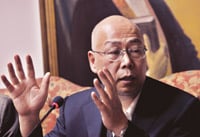
By Aoun Sahi Wei Chuyu, who specialises in oil painting, Chinese painting and calligraphy, was born in 1945 in Wenshui, Shanxi Province. Known as a "Painter of Great Men," he is now a professor of fine arts at Xu Beihong Fine Arts College People, University of China. Wei Chuyu is recognised particularly for his vivid oil paintings of Mao Zedong, the first chairman of the Communist Party of China (CPC) Central Committee. Last week he along with his wife Wei Ji Jun, who is a specialist in western as well as Chinese traditional medicine, was on a visit to Pakistan on the invitation of President Asif Zardari. The News on Sunday met him in Lahore. Here are excerpts of the interview, conducted through an interpreter:
The News on Sunday: Why have you paid so much attention to portraits? Can an artist bring out features of the personality in a portrait apart from the physical features? Wei Chuyu: I love painting portraits since my childhood. In fact it gives me real pleasure, I believe that to bring out real features of the personality in a portrait, an artist needs to do a lot of homework. You know it took me seven years to portray Chairman Mao in my famous painting "Searching the Truth". The painting depicts Mao reading among an enclave of books and magazines on a ragged, patched-up bed in his room at Zhongnanhai. Though I love Mao and know a lot about him, even then I collected bundles of source materials from Mao's relatives and former assistants to make sure that everything was accurate in the painting. So, if a painter wants his paintings full of expression and emotions he needs to get maximum information about his subject. TNS: You have painted Chairman Mao Zedong a lot, were you forced to pick him as your subject? WC: Nobody forced me to paint Mao. In fact I have been
inspired by his personality since my childhood. He is the founder of new
China and people of our country respect him a lot. Back in 1992, 16 years
after Mao's death, I was invited to visit the chairman's former bedroom,
which had doubled as his study. I went there and saw what it was like. I
was so moved by the chairman's unadorned lifestyle and work ethic that I
wanted to share it with others because ordinary people do not get a chance
to visit Chairman Mao's bedroom. As an artist, I only have the brush to
depict the great leader because an artist does not speak, his paintings
say everything and this is why I started painting the great leader to
express my feelings about him. TNS: Have you ever met Mao in person? WC: Yes, I met him once but at that time I was quite young. TNS: China is believed to be the biggest exporter and manufacturer of the world; can this be said about Chinese art as well? WC: After the Chinese revolution of 1949, China has been making a lot of progress in all the fields, arts as well. TNS: The language of art is believed to be universal. What are the peculiar features of Chinese art? WC: A special feature of Chinese art is that you can see through it. Even a simple viewer can get the real message of the Chinese art. TNS: And what are the features that unite Chinese art with the rest of the world? WC: China is one of the oldest civilisations of the world and its art also depicts the true picture of the society and that unites it with the rest of the world. TNS: Arts are supposed to flourish in an atmosphere of freedom, what is the situation like in China and how much censorship is there for the Chinese artists? WC: The art scene in China is very much different as most people think outside our country. The artists of China are free to express themselves. Chinese artists are very confident and if they do not indulge in some illegal activity, they are free to do whatsoever they want. The new generation of China is also very fond of art and they can go to other countries to study arts and related subjects freely. TNS: How do you view the Pakistani art scene and where you place it internationally? WC: I have seen the work of Pakistani artists and I think it is very nice. There are so many commonalities between Pakistani and Chinese art like calligraphy is given an important place in both the countries. TNS: What was your notion about Pakistan before the visit and what have you learned about Pakistan? WC: Believe me that when I told my friends that I am going to visit Pakistan, many of them tried to stop me from coming here because of security reasons. I consider myself lucky for not considering their views about Pakistan. I have found that it is a very beautiful country and the people are even more beautiful and they love art. I love Pakistani food, especially of Lahore. I am planning to depict original picture of Pakistan to my friends through my paintings.
A workshop on flower arrangement sheds light on the myriad ways of arranging flowers Recently Floral Art Society of Lahore held a workshop
on 'new concepts in flower arranging'. Yasmeen Suhail from Islamabad Club
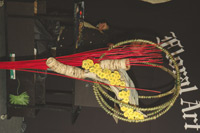
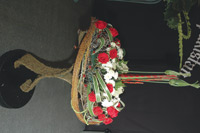
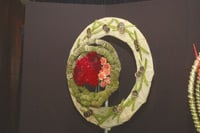
gave stunning demonstrations. Much to the delight of the enthusiastic participants, Yasmin showed new techniques using different and special plant materials. Frosty chrysanthemums encircled by Valentine roses which were displayed on a bed of entangled and coiled copper wires, ribbon leaves and a sparkling addition of crystal beads, contemporary and innovative designs, reminded everyone of forthcoming 'Valentine'. An essential part of a successful flower arrangement is an element of 'surprise' along with creativity and of course design! The 2nd exhibit had a blend of different techniques e.g. layering, clustering and weaving. The weaving technique used, was adopted from a village craftsman near 'Wah'. The participants were intrigued by this new addition. This was 'Bold n' Beautiful'. In the next design Yasmin used dried out cactus, drift
wood and yellow chrysanthemum. Coiled bamboo was used to cover the
designs. This design showed a sharp contrast of textures by the effective
use of clustering and grouping. In this last demo 'A Gift of Native', once again a modern design, Yasmin threaded leaves using wire. She then shaped it into circles. Bean pods and dried orange segments were attached on to the design. For colour & focus deep maroon celosia was used with peach carnations in the centre of the design. This workshop was well attended by ladies who shared a love of flowers along with landscape designers, florists and horticulturists. In the end the members were given plant materials and different design structures to produce their own creative work. Their work was later judged by Yasmin Suhail. This function was hosted by Lahore Floral Art Society
for the promotion of fine arts of flower arranging, using local flowers
and promoting local craft using plant material in Pakistan. Contemporary artist today has a vast range of plant material to choose from e.g. barks, long grasses such as bear grass, vines, mosses, kelp, pods, e.g. magnolias, lotus sea pods, pinecones, seed heads, reeds, corn, driftwood, cadiz shells in pink, orange, green, black or natural colours. Bleached acacia bean pods, lichen, natural okra pods, eucalyptus barks, flat or curled and umbrella palm sticks etc. Beside natural plant material tubes, wires in silver, bronze and copper decorative pins, crystal and wooden beads, wire mesh, sisal, angels hair for decoration, coloured sand etc can also be used. Sometimes mechanics are allowed to be visible in the form of decoration.
|
|

 Iqbal Hussain, Tassaduq Sohail, Meher Afroz, Mansoor Aye, Sobia Ahmed,
Sadaf Naeem, A.Q. Arif.
Iqbal Hussain, Tassaduq Sohail, Meher Afroz, Mansoor Aye, Sobia Ahmed,
Sadaf Naeem, A.Q. Arif.