


|
|
|
|
 |
 |
   |
cricket 'Our
earnest efforts won't go waste,' vows Asif Bajwa Sanath
Jayasuriya crosses the 13,000 runs milestone Syed
Ahsan Ali passes away Instead of resigning promptly and whimsically, Miandad should have established his doctrine that he could identify himself with the work he intended to do, with everything that was living in that space, that he could share the majesty of perceptions with others By Dr Nauman Niaz Javed Miandad has resigned as Director General of the Pakistan Cricket Board (PCB). We must acknowledge that there is nothing divine about sustainability in such a place; it is a purely reckless affair. If people are good only because they fear the end-point, and hope for reward, then we are a sorry lot indeed. What the individual can do is to give a fine example, and to have the courage to uphold ethical valuesÖin a place of cynics. From the late 1970s television cricket commentary went through a change in that it increasingly became a regular profession for ex-Test cricketers. Once this mode set in the 'club' effect gradually ousted the non-players from the field By Malik Arshed Gilani p.s.n. The Pakistan Cricket Board (PCB) must be congratulated for encouraging, organising and finally bringing the Sri Lanka team to Pakistan. Once again let me hope that the grounds are made friendly for spectators and that the ground tickets are priced so as to have packed stadiums. The tour needs to be managed with attention to even the minutest details so that full value is achieved from all possible aspects of the matches. A Journey to Glory: A splendid gift for
sports fans A Journey to Glory Pages: 86 Price: Rs 200 Published by: S M Art Press By Gul Nasreen With the onslaught of information technology marked by an excessive use of the internet, the habits of book reading and the art of book writing have suffered a lot. It would not be wrong to say that book writing has become a herculean task in these testing times as the writers have to make some extra efforts to come up with something special to attract the slowly but steadily 'diminishing' breed of book lovers.
Pakistan appears to have a passion of 'ramming' into crises In our society it's quite common to see leaders washing their dirty linen in public, and cricket is no different. Malik's untimely and uncalled for outburst against Shoaib Akhtar midway through the one-day series against Sri Lanka is a 'fine' example
By Imran Farooqi Pakistan cricket has come full circle -- albeit a tortuous one -- in less than two years and the situation looks to be as hopeless as it was then. No sooner does the game pull itself out of one crisis than it runs into another. As soon as Pakistan got over the thorny issue of captaincy, Javed Miandad parted ways with the PCB as its Director General to trigger further bedlam. Following Pakistan's unceremonious exit from the 2007
World Cup in the Caribbean and a comprehensive change in the Board and
team management one had hoped things would eventually get better. The
exit of Inzamam-ul-Haq and coach Bob Woolmer's demise had paved the way
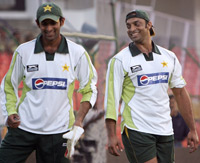
for younger replacements like Shoaib Malik and Geoff Lawson. The side did well initially under the new skipper, but kept falling apart with every new assignment. Apart from the Asia Cup triumph last year Pakistan never looked impressive against the stronger teams and lost badly. However, their record against weak opponents like Bangladesh and Zimbabwe may well be termed as 'enviable' during the period in question. The fact that Malik was not getting along well with his senior colleagues had become evident soon after his elevation to the top job. Shahid Afridi, Mohammad Yousuf, Shoaib Akhtar, and some other players did express -- privately or openly -- their unhappiness over Malik's handling of them. However, neither the Board intervened nor, apparently, the skipper made any efforts to iron out the differences or misunderstandings. Things took turn for the worse with each passing day as the captain continued to live too dangerously and court trouble endlessly. In our society it's quite common to see leaders washing their dirty linen in public, and cricket is no different. Malik's untimely and uncalled for outburst against Shoaib Akhtar midway through the one-day series against Sri Lanka is a 'fine' example and, eventually, led to his stepping down -- if it can be called one. He had chosen the wrong moment to vent his frustration and bit the dust. What he was saying was not totally wrong as Shoaib clearly looked nowhere near his best, but, honestly speaking, expecting him to be would have been unfair as he's making a comeback after a lengthy lay-off. The worst part was to follow when the captain made a U-turn, and denied criticising Shoaib although he had done so before a fairly large contingent of media personnel. It's not difficult to imagine what impression his remarks must have left on the visiting team and how demoralised his own team-mates would have felt over this somersault. Malik's anger over the loss was understandable and justified, but instead of analysing the situation and finding the reasons that led to the defeat he chose to target Shoaib without realising his act might bring terrible consequences. The right course would have been to focus on the task at hand and wait for the series to end before taking up the matter with the right people, i.e. the Board. And in any case before firing the salvo at his team-mate(s), Malik should have realised his mistake first. Who had asked him to invite Sri Lanka to bat after he had won the toss in the second game? Just because Pakistan had overwhelmed an easy target in the first match did not mean they had become good chasers overnight. Did not he know Pakistan feel more comfortable defending a target rather than going after one. With no Yousuf around and a rusty and untested batting line-up at his disposal, Malik still preferred to field. And isn't it amazing that a side who were struggling to cross the 200-run mark in their previous outings against teams who are languishing at the bottom of the ICC points table, were allowed by Pakistan to regain their form, put their act together, and post huge totals in the second and third one-dayers? Even before the series had begun, the Pakistan coach and captain were talking about their plans to deal with the twin spin threat of Muttiah Muralitharan and Ajantha Mendis. Moreover, batting under lights is not easy anyway no matter how conducive the conditions are. And when you add this to the threat posed by two of the best spinners in the world, the task becomes doubly difficult. Is it a secret that Pakistan usually struggle batting second even against not-so-decent rivals? Had Pakistan batted first in the second one-dayer in Karachi, the outcome could have been quite different as runs had dried up for the Sri Lankans before they landed here and things had not improved even after the first game. By opting to field, Pakistan provided their rivals a chance to begin proceedings without any pressure, and their opening bowlers' wayward showing meant the visitors made a decent start and those who followed wrested the initiative from Pakistan. The win in that game proved to be a turning point as Pakistan were completely outplayed in the third losing by a record margin. The country is in the grip of chaos, and cricket, too, looks set to follow suit. Therefore, Malik alone can't be blamed for the rotten state of the game in Pakistan. The Board, too, is responsible for allowing the situation to deteriorate to the extent it has. From top to bottom everything seems to be in a mess. What we have witnessed recently did not happen overnight and is the product of several years of absolute mismanagement. The chairman would be doing this nation a great service if he could ban his subordinates from issuing statements to the press that lead to nothing but confusion and make matters worse. Secondly, the ICL issue needs to be resolved at the earliest. Pakistan have already suffered a lot courtesy their unrequited love for the BCCI, and they now need to reassess their strategy viz-a-viz the ICL. Players like Yousuf, Shabbir Ahmed, and Abdul Razzaq are too good to be ignored for too long. Younis Khan has taken over the reins at a time when his team-mates, it seems, have wandered too far in pursuit of personal goals and are heading to, in fact, nowhere. The new captain will have to work overtime to introduce professional attitude and discipline in the dressing room. It's a tricky job and will remain so, but his experience of county and shield cricket must help him get over most of the problems he is likely to face in the coming weeks. Miandad's separation could not have come at a worse moment. With the mess all around Pakistan cricket is in dire need of a figure, who not only loves the game but can also run the affairs of the Board smoothly. A strong board is vital to raising a strong team. In the absence of a sound and regular set of professionals monitoring the game, no side in the world can hope to make any headway. 'Our earnest efforts won't go waste,' vows Asif Bajwa 'The PHF is fully committed to put national hockey back on track and a development roadmap has been prepared according to which coaches will be groomed to teach hockey to the present generation on modern lines'
By Ghalib Mehmood Bajwa It is a universal truth that proper, effective and
consistent efforts can bring success in any department of life.
Likewise, the Pakistan Hockey Federation (PHF) is also doing earnest
efforts for the revival of the national sport keeping in view the same
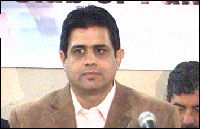
philosophy. It is no secret that Pakistan hockey requires plenty of enormous measures for its resurgence. As the results of the national junior and senior teams show, Pakistan has been struggling in the field of hockey for the past 15 years. To arrest this unwanted trend, the young PHF leadership comprising Olympians Qasim Zia and Asif Bajwa, is making fair efforts. Qasim Zia, President PHF, was a part of the last team that clinched an Olympics title for Pakistan. Similarly, Asif Bajwa, Secretary General PHF, was a part of the last team that won the World Cup. Only successful men can feel the glory of success and strive for instilling the same instinct when given leadership and operational roles. THis makes us believe that Pakistan hockey has started its journey towards its glorious destination slowly and the revival of Pakistan hockey is not decades away now. The duo has planned a revival programme at the grass-root level. As many as twelve academies have been established across the country at three levels -- under 14, 15 and 16s. Each academy has a set of coaches, trainers and selectors. This is surely a vision -- inaugurated at the dawn of the new year -- that is simply unprecedented in the history of Pakistan hockey. Such efforts are the need of the hour to change the gloomy scenario of Pakistan hockey. And now one can expect that Pakistan will resume its journey towards glory in hockey in the near future. "We have started our journey from scratch and insha-Allah in the coming months we will be able to strengthen the base of Pakistan hockey. This strong base of national hockey will definitely play a key role in winning laurels for the motherland in the future," this determination was expressed by Secretary PHF Asif Bajwa, when asked to describe the federation's planning to lift the declining sport. Answering a query regarding the role of academies and coaches in a team's success, Bajwa said properly-run modern academies and trainers equipped with scientific coaching can lift their teams to new heights. "Keeping in mind this great factor, we have spread a thick network of academies across the country. Not only this but we also involved former leading national and international players in this activity as coaches and selection committee members. We have also issued instructions to our coaches to introduce a new hockey culture to the young generation." Bajwa, while giving further details about the academies, said "Right now we have 12 academies in all major cities like Lahore, Faisalabad, Gojra, Sialkot, Bahawalpur, Peshawar, Bannu, Abbottabad, Quetta and Hyderabad. We have raised two academies at Karachi -- one at the Hockey Club of Pakistan (HCP) and the other one at the UBL Sports Complex. The trials at 11 academies have been completed while the same activity will be completed at the Quetta academy in March this year, he informed. "After initial trials at the academies, a raw but promising talent has emerged for the right grooming," he maintained. "At our academies we are providing the best possible facilities including schooling, sportswear plus a stipend of Rs 1000 per month to the chosen U-14, U-15 and U-16 boys," he revealed. To a query regarding the selection of the players at the academies, Asif said, "Coaches of the respective academies will check and verify the ages of the boys from their schools and then the PHF will countercheck the whole process to make the selection at the academies merit-oriented." Bajwa, who played 74 international matches for Pakistan, said, "The PHF is fully committed to put national hockey back on track and a development roadmap has been prepared according to which coaches will be groomed to teach hockey to the present generation on modern lines." While recounting Pakistan's wonderful past, Bajwa said, "In its glory years, Pakistan used to win the best of the titles almost at will. Pakistan -- once an unchallenged hockey giant for more than three decades -- has been struggling at the top level for quite a while now. "There are many factors such as the rapidly shrinking grass-root base, financial security issues for hockey players, diminishing sponsorships, inept administration in thepast few years and a lack of motivation, which can be attributed for Pakistan's dismal performance in recent years," he continued. He said such massive irregularities cannot be overcome overnight. "There is always a need of consistent will, thorough planning and the right leadership to reach the top. That makes things to move in the right direction." Asif Bajwa, who turns 40 on March 8, while highlighting PHF's efforts relating to international hockey activities in Pakistan, said the PHF is making its best possible measures to organise some bilateral and multinational events in Pakistan. "In this regard, PHF got early success by winning the right to host the first ever Asian Hockey Champions Trophy this year." The Asian Hockey Federation (AHF) has introduced this event on the suggestion of the PHF to further develop hockey in Asia. "The AHF also allocated the qualifying rounds of the World Junior World Cup for Women to Pakistan in 2010. The allocation of two international tournaments reflects the AHF's confidence in Pakistan," he added. Asif Bajwa, who was given Pride of Performance Award in 1995 in recognition of his services for Pakistan hockey, is the youngest secretary of the PHF. Regarding the Dutch hockey consultant, Bajwa said Tezelaar, 41, is a renowned hockey academician, who has developed software for coaches and management of the academies to run them on scientific lines. "His software is being used by a number of academies in Europe, South Africa and other countries. Tezelaar, a Dutch U-18 coach, would also impart training to both senior, junior, national women hockey teams besides training national coaches and trainers during his first 260 days stint with the PHF," he further said. When contacted Wouter Tazelaar, who is with PHF for two years, said, "Pakistan hockey is facing different kinds of problems including non-availability of international events in the recent past, so it is very hard to give any time frame for the revival of hockey in Pakistan. But the way the present PHF chiefs are making efforts, it can be predicted that Pakistan could be a challenging side in the very near future," he explained. He said Pakistan had plenty of hockey potential which is very encouraging for the future of the game in this country. "I'm really impressed with the commitment and promise shown by the young Pakistan hockey players and coaches at different academies," he said.
The writer is a staffer at 'The News' in Lahore
Sanath Jayasuriya crosses the 13,000 runs milestone 'It's tough to get 300 wickets and score over 13,000 runs. It's hard work and a lot of sacrifice in your career. It's not easy. Somebody who wants to achieve that feat will have to work really hard and be lucky'
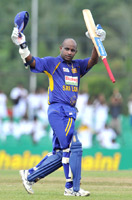
By Khurram Mahmood During the first ODI against India this Wednesday, Sri Lanka's master blaster opener Sanath Jayasuriya became the second player to complete 13,000 One-day International runs. Only India's little master Sachin Tendulkar is ahead of him with 16,427 ODI runs. The 39-year-old veteran playing in his 428th ODI also became the oldest centurion in One-day Internationals after cracking 10 fours and one six in his 107 runs innings in the first match of a five-game series and received the Man of the Match award. Jayasuriya scored his 28th century at the age of 39
years 212 days while the previous oldest centurion was England's Geoff
Boycott who scored his century at the age of 39 years and 51 days
against Australia in 1979. The fact is that Sanath is currently the highest-capped player in ODIs with 428 matches. Sachin is just behind with 420 matches. Jayasuriya is the senior most player among those who are still playing in international matches, only Tendulkar having played longer than him. At the age of 38, Jayasuriya scored 467 runs in the 2007 World Cup in the West Indies and he was also the oldest player in the World Twenty20 in South Africa. Now at the age of over 39 years, Sanath Jayasuriya is also the third highest wicket-taker (311) in One-day Internationals for Sri Lanka after Muralitharan (501) and Chaminda Vaas (400). Overall he is the ninth highest wicket-taker in one-day cricket. "It's tough to get 300 wickets and score over 13,000 runs. It's hard work and a lot of sacrifice in your career. It's not easy. Somebody who wants to achieve that feat will have to work really hard and be lucky," said Jayasuriya. In the field too, he has taken 119 catches in the shorter version of the game. After Sachin Tendulkar, Jayasuriya is the only player to have completed the exclusive record of over 13,000 runs, 150 wickets and 100 catches in One-day Internationals. He has so much power in his forearms that he is the only batsman in the world who consistently hits more sixes over the cover boundaries than any other player. He loves the game so much, that's what he's been doing since he started playing cricket when he was nine years old and never distracted himself from it. He was grateful to his parents, who have supported him right throughout his career. Jayasuriya made his One-day International debut against Australia at Melbourne in December 1989. Batting at number five he scored just three runs as Sri Lanka lost the match by 30 runs. He scored his first fifty (58) in October 1993 against Pakistan in Sharjah, while his maiden hundred (140) came in December 1994 against New Zealand. The left-hand opener has remained one of the idols of Sri Lanka's batting for almost two decades. He has been Sri Lanka's most prolific batsman in both forms of the game. He is also Sri Lanka's highest run scorer as he has made 6,973 Test runs, including 14 centuries and 31 half-centuries at an average of just over 40. He announced his retirement from Test cricket during the first Test against England in Kandy in 2007-08, with a cracking 78 runs in his final innings. He has been such a dangerous player, especially on the subcontinent's slower, flat pitches. Short in stature and powerfully built, he cuts and pulls with awesome power. After the first ODI against India when asked whether he would continue till the 2011 World Cup, he said: "I don't know, let's see how it goes." Only Jayasuriya can decide how many more years he wants to be on the field, but the spectators would want to see his game for as long as possible. He was also declared Wisden Cricketer of the Year in 1997.
The writer works in the art department at 'The News' in Karachi
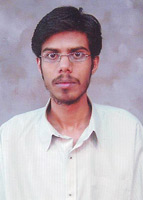
Syed Ahsan Ali, a young man only 29 years of age, passed away in Karachi on the morning of January 26. He was suffering from a heart problem since his birth on August 7, 1979. Ahsan had been a contributor to 'The News on Sunday' sports pages for a few years. A nice, courteous individual, he was afflicted with a
heart problem termed as Tetralogy of Fallot (TOF). Ahsan started writing
articles -- which were published -- on cricket about four years ago.
Being home-confined due to his heart disease, Ahsan's activities
remained indoors, in which cricket had a prominent place. Having no parents who had passed away several years ago, Ahsan, a boy of true grit, wrote for cricket websites and top-tier dailies including 'The News' and 'Dawn'. Sometime back he conducted the interview of Pakistan all-rounder Shahid Afridi for 'The News on Sunday' (TNS). A few months ago, the young writer had also started writing for the top cricket website Cricinfo. Ahsan earned a Master's degree in Economics from the Karachi University. When he was in slightly better health, he also taught at the city's Al Huda School for two years. He also contributed for books such as "Pakistan-England Cricket Series Since 1954" and "A Journey to Glory", both written by another regular TNS writer Khurram Mahmood. Other than these activities, the softly-spoken Ahsan was also involved in the translation of a book, a work which he would not witness if it is published sometime later. May the deceased's soul rest in peace. – The TNS Sports Staff
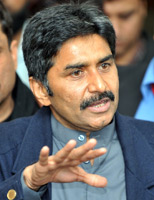
Javed Miandad: A victim of malice and envy Instead of resigning promptly and whimsically, Miandad should have established his doctrine that he could identify himself with the work he intended to do, with everything that was living in that space, that he could share the majesty of perceptions with others
By Dr Nauman Niaz Javed Miandad has resigned as Director General of the
Pakistan Cricket Board (PCB). We must acknowledge that there is nothing
divine about sustainability in such a place; it is a purely reckless
affair. If people are good only because they fear the end-point, and
hope for reward, then we are a sorry lot indeed. What the individual can
do is to give a fine example, and to have the courage to uphold ethical
valuesÖin a place of cynics. It is, as history delineates, those forces which govern the mindset of people in the top-tier, such as survival and malevolence, make everything their concern: no activity is so private or so secret as to escape their attention or their jurisdiction. From the apparent usefulness of the these 'acceptable' virtues, it has readily been inferred by skeptics, both old and modern, that all such distinctions arise from education, and were, at first, invented, and afterwards encouraged... in order to render men tractable, and subdue their natural ferocity and selfishness, which incapacitated them for society or an organisation. And in his course of retaliation against a system that he had initially decided to adorn, Miandad must have realised that in the Pakistani game, all things are parts of one single system, which is called the PCB; the individual life is good when it is in harmony with the powerful. Being one with the PCB is in accord with the power-brokers. It is precisely the rationale behind Pakistan cricket's lost focusÖpower accentuation, power-concentration, self-preservation and unharmonious working relationships. It is a peripheral insecurity that eventually hits the subliminal place. As insecure a place as it could be -- Pakistan lost to Sri Lanka by 234 runs, a huge margin of defeat and there it goes, otherwise a very patient His Excellency, the President of Pakistan, Mr Asif Ali Zardari tosses a few tight ones, the vociferous Senate's Standing Committee on Sports makes the scene mellow-dramatic, the PCB Chairman who had initially decided to stand behind a more volatile and impracticable Shoaib Malik leaves him amidst the roaring disapproval, Younis Khan, twice peeved seizes the centre of power and then Javed Miandad resigns -- panic and a story of total disarray? Our problem is about the failure to figure out solutions. We must understand, we are all part of the whole called by us the PCB, a part limited in time and space. We experience ourselves, our thoughts and feelings as something separate from the rest -- a kind of optical delusion of consciousness, and this delusion is a kind of prison for us, restricting us to our personal desires and to affection for a few persons nearest to us. Our task must be to free ourselves from the prison by widening our circle of compassion to embrace all living creatures and the whole of nature in its beauty. The true value of a human being is determined by the measure and the sense in which they have obtained liberation from the self. We shall require a substantially new manner of thinking if cricket is to survive. In this regard, Mr Ijaz Butt, his Chief Operating Officer Saleem Altaf and even now resigned to isolation, Mr Javed Miandad need to do one hell of a soul searching. It's not about an individual's survival, but it is about saving the rapidly declining Pakistani game. It's about time, that the top-tier dynamos of the PCB ascertain and figure out the fact that the world is given to people only once, not one existing and one perceived. Subject and object are only one. The barrier between them cannot be said to have broken down as a result of recent experiences, for this barrier does not exist. It is now very evident that we shouldn't say "I am Saleem Altaf", or "he is Shoaib Malik", "I am a Muslim, and he is a 'Roman'," it's time that we should say we are part of the PCB and it's our identity. Instead of resigning promptly and whimsically, Miandad should have established his doctrine that he could identify himself with the work he intended to do, with everything that was living in that space, that he could share the majesty of perceptions with others -- the sum total of this life was cricket. Man isn't at peace with himself until he has become like unto his aims. The endeavor to reach this state is the supreme, the only ambition worth having. And this is self-realisation. This self-realisation is the subject of the work-ethics as it is of all such scriptures... to be a real devotee is to realise oneself. Self-realisation is not something apart. It seemed that Miandad became brittle and unsettled once Saleem Altaf tried taking his share of prominence and power. I barely know Mr Altaf and during the course of sporadic meetings I haven't really found anything ostentatious about his working demeanor. Nonetheless, he must know that to be able to transcend the notion of separateness of oneself from the multiplicity of things and events in a work-environment and to identify all with the absolute reality is true enlightenment, true self-realisation. We have to treat others as part of who we are, rather than as 'them' with whom we are in constant competition. The most important characteristic of a practical view -- one could almost say the essence of it -- is the awareness of the unity and mutual interrelation of all things and events, the experience of all phenomena in the world as manifestations of a basic oneness. All things are seen as interdependent and inseparable parts of this cosmic whole; as different manifestations of the same ultimate reality. And a one liner for Mr Butt should be that there is nothing either good or bad but thinking makes it so. How could PCB be an institution if forms of top-tier have not a uniform influence upon the game? Where would be the foundation of policies and ethics, if particular characters had no certain or determinate power to produce particular sentiments, and if these sentiments had no constant operation on actions? I must quote Bertrand Russell who beautifully explained the societal issues: "Ever since men became capable of free speculation, their actions, in innumerable important respects, have depended upon their theories as to the world and human life, as to what is good and what is evil. This is true in the present day as at any former time. To understand an age or a nation, we must understand its philosophy, and to understand its philosophy we must ourselves be in some degree philosophers. There is here a reciprocal causation: the circumstances of men's lives do much to determine their philosophy, but, conversely, their philosophy does much to determine their circumstances." It's not that Javed Miandad is irreplaceable but his resignation would really hurt the PCB keeping in view in the straits it is presently. I don't deny Providence, but there has to be someone guiding the course of events, and punishing the vicious with infamy and disappointment, and rewards the virtuous with honour and success, in all their undertakings. But surely, I deny not the course itself of events, which lies open to ever one's inquiry. I with a more favourable reception from the critiques of the power-eccentric PCB top-tier, I am sensible, that, according to the past experience of management, practicality is the chief joy of running the game in Pakistan, and moderation the only source of tranquility and happiness. I never balance between the virtuous and the vicious course of life; but am sensible, that, to a well-disposed mind, every advantage is on the side of the former. And what can you say more, allowing your suppositions and reasoning. There has been a controversy started of late, much better worth examination, concerning Javed Miandad and the general foundation of his appointment as PCB's Director General; whether they be derived from reason, or from sentiment whether, like all sound judgment of truth and falsehood, they should be the same to every rational intelligent being; or whether, like the perception of beauty and deformity, they be founded entirely on the particular fabric and constitution of a work-space. Truth is disputable: what exists in the nature of things is the standard of our judgment; what each man feels within himself is the standard of sentiment. Propositions in geometry may be proved, systems in physics may be controverted; but the harmony of action, the tenderness of passion, the brilliancy of with, must give immediate pleasure. No man reasons concerning another's beauty; but frequently concerning the justice or injustice of his actions. That's what most precisely Mr Ijaz Butt should know. Was it Miandad's greed, or non-compliance and poor definition of his role that hit him like a sledgehammer?
From the late 1970s television cricket commentary went through a change in that it increasingly became a regular profession for ex-Test cricketers. Once this mode set in the 'club' effect gradually ousted the non-players from the field
By Malik Arshed Gilani p.s.n. The Pakistan Cricket Board (PCB) must be congratulated for encouraging, organising and finally bringing the Sri Lanka team to Pakistan. Once again let me hope that the grounds are made friendly for spectators and that the ground tickets are priced so as to have packed stadiums. The tour needs to be managed with attention to even the minutest details so that full value is achieved from all possible aspects of the matches. The television production which carries the pictures to all parts of the world is the one single aspect that can truly pass any desired message to the widest possible audience. For some years to date quality control over this has been lacking in Pakistan. The current producer of this signal should have much encouragement having earned a windfall extra of over 125 million dollars on an investment promise of a mere 42 million. The quality of production is very easy to judge as it can be compared to production by Sky or Channel Nine. These broadcasters set very high standards on the transmission even when teams representing their countries are playing in Pakistan. When matches are played in Australia or England the cricket boards of the two countries do not compromise on this aspect even when relatively lower market value teams are their opponents. This value is not based on cricket strength but on television market value. Currently the rating would be India, England, Australia, South Africa, Pakistan, New Zealand, West Indies and Bangladesh. The production quality is directly dependant on the quality of cameras, the number of cameras, the quality of the equipment (tape recorders, replay speeds, monitors etc.), the quality of the director and producer, the quality and standing of the commentators and finally the quality and use of latest add-ons (LBW mat, speed camera, super slo mo, etc.). Sky Television for England's tour to Pakistan required a 24 camera production. The number of cameras ensures that no part of the playing area is excluded or covered by players in their field locations. The speed of replays ensures that in the event a replay is required it leaves minimum doubt in the mind of the third Umpire due to the frames per minute or second that make up the picture. This facility also provides a better picture to the television viewer. The quality of the director and producer ensures that they are able to use their equipment to its maximum efficiency. The industry knows and is able to rank worldwide the best in these fields. Production companies pay high salaries to such individuals and treat them with kid gloves as they are important staff. In turn these individuals do not compromise on the equipment, commentators and cameramen all of which add up to govern their ability to manufacture a good transmission. Pakistan Television was assisted into developing great cameramen who were then regularly used against payment to the benefit of all. Production companies price into their costs the time and effort needed to make inventive additions like small 'Clips' showing shots of the city in which the match is being played, shots of places of interest in the country and other picture essays that all add up to make for interesting viewing. This is singularly important for Pakistan these days as we try and counter the negative perceptions held by viewers abroad. This approach needs much experience and obviously costs money. In cases where the rights buyer is also a producer, broadcaster and signal seller all rolled into one package it is inevitable that expense will be the leading consideration in his mind to ensure maximum income. This becomes even more pronounced when the company has contracted the 'rights' for a lengthy period on a 'buy out' basis and is not concerned with impressing the client. The cricket board of a country might well be smug about having got a guaranteed income, however the fact is that international cricket played in Pakistan is their 'product', which must be portrayed worldwide in the best possible way and any shortfalls downgrades the product and markedly reflects on the country from where the signal originates. It therefore requires the board to contractually require that the production is of the best quality and subsequently ensure strict compliance to contract. It was not very long ago that PCB senior staff that should have policed this requirement was ineffective due to divided loyalties; they were also receiving fees from the responsible company for other services that they were providing. The quality of commentary and the standing of the commentators in the world of cricket broadcasting clearly add greatly to the quality of production. It would be difficult even for diehard loyalists to deny that arguably Richie Benaud is the world leader in this art. In Pakistan, we have been fortunate to have had some of the best in this field especially in the media of radio. Jamshed Marker and the late 'OMO' Kureishi could be compared to the best of their times. The advent and growth of television altered the requirement as the need was to describe around the picture rather than simply describing what was clearly visible. The late Omer Kureishi did to a great extent make the jump. Pakistan Television regrettably neither encouraged quality nor development of this art in Pakistan. Expediency and our old enemy of favoritism due vested interests saw to that. English commentary as the words define is required to be in the English language. The accent used is immaterial as long as the spoken word is grammatically correct. In our case shortfalls are excused by the inane excuse of this not being the person's mother tongue. How bizarre is that. It is commentary in English is it not? From the late 1970s television cricket commentary went through a change in that it increasingly became a regular profession for ex-Test cricketers. Once this mode set in the 'club' effect gradually ousted the non-players from the field. In Pakistan this writer is proud to own that it was his efforts that brought about the use of our ex-Test cricketers into this field. The individuals who relatively had the most command of the language were encouraged, assisted and given direction on the job at one's request by the likes of Michael Holding and Geoffrey Boycott. Sadly those that led in this field were actively responsible for preventing the development of others but that is a story for another day. The current Pakistani commentators count amongst them the greats like Wasim Akram, Waqar Younis and of course Imran Khan. Their greatest success as rated by people in the business is their knowledge of the game and their conscious decision to speak within the limit of their commentating abilities. It is suggested and am informed first hand that learning a large number of colloquial words and expressions and then using them at all costs in the wrong context only makes for amusement of fellow commentators. It does not make for good commentary. The examples that are being quoted are: the use of the word 'stick' for the cricket bat when it is only used to refer to the stump; 'self explode' in lieu of 'self destruct'; 'ten wickets in the tank' in lieu of 'in the bag' when referring to the number of players yet to bat. One wonders whether the lack of pure cricket knowledge and judgment forces individuals to compensate by using such catch phrases. If this be so let us suggest that they also learn the correct usage! The writer is a freelance contributor
A Journey to Glory: A splendid gift for sports fans In a nutshell, it's a quality book, depicting both the
glorious moments of Pakistan cricket and also the period when the game
was at its lowest ebb
A Journey to Glory Pages: 86 Price: Rs 200 Published by: S M Art Press
By Gul Nasreen With the onslaught of information technology marked by an excessive use of the internet, the habits of book reading and the art of book writing have suffered a lot. It would not be wrong to say that book writing has become a herculean task in these testing times as the writers have to make some extra efforts to come up with something special to attract the slowly but steadily 'diminishing' breed of book lovers. However, the good thing is that there is not total doom and gloom as there is still a rare breed of writers, who have been keeping the art alive by whole-heartedly dedicating themselves to it. Prolific sports writer Khurram Mahmood's book proves the point. It is an act of devotion on part of the writer and a latest gift to the cricket enthusiast readers, who would definitely find the book both entertaining and informative. The book at hand, "A Journey to Glory" is the latest attempt from Khurram Mahmood, published last year. In the 86-page book has provided details of all cricket World Cup competitions from 1975 to 2007 in style. Having a number of publications to his credit on all kinds of cricket, this latest venture is a bit different and interesting in the sense that it has targeted the cricket's mega event, i.e. the World Cup. The foreword written by Pakistan's current cricket coach Intikhab Alam, who was also the manager and coach of the winning team of the 1992 World Cup, is also illuminating and an informative piece of writing, which provides us a peek into the writer's career and his mastery over the art and craft of book writing. Since the book revolves around cricket's most important mega event -- the World Cup -- it will definitely generate interest among the cricket lovers, who will love to go through each and every detail of the biggest cricketing event on earth. Since Pakistan has also had the honour of having won the event under the captaincy of Imran Khan in 1992, the book has special appeal to Pakistani cricket lovers, who will definitely look for the relevant details and love to go through it again and again. The section titled "Pakistan, Moderate, and Exception, Back to Square One" revolves around the Pakistan cricketers' show in the World Cup events. Details regarding players who featured in the World Cup like Asif Iqbal, Imran Khan, Javed Miandad (the second highest scorer of the 1992 World Cup), Asian Bradman Zaheer Abbas (the handy batsman whose art of run-making was also visible while featuring in the World Cup), Majid Khan (his prime show with the bat), Inzamam-ul-Haq (the one who was highly instrumental in Pakistan's 1992 World Cup win and then captain of the 2007 team which made a humiliating first round exit from the event in the Caribbean) and of course the ace pacer Wasim Akram (whose wicket-taking capabilities won Pakistan many an important encounter) are exceptionally good, informative and entertaining as well. There are also moments when the readers are made to lament like the tragic death of Pakistan coach Bob Woolmer in the 2007 World Cup which opened a Pandora's Box of investigations into the incident later on. Since Pakistan has been participating in all world Cup competitions since 1975, it finds a special mention in all the events. Though Pakistan's show in these tournaments varied from good to bad, yet it is all part of the game. The details regarding the Pakistan players' collective and individual show have been provided in a manner that keeps the readers' interest intact. The title depicting the image of the glittering World Cup is eye-catching. The pictures of individual players in the inside pages too are bright and beautiful. These are thrilling pictures and every single photo published in the book is definitely worth a thousand words. To be very frank, I myself am not very good at book reading, but since the details are apt, to the point and entertaining, I went through each and every details to quench the thirst for what the mega cricketing event was like when it started back in the 1970s and its journey down to 2007. The chapter titled "From the Caribbean to the Oval: flurry of crises" provides an in-depth analysis of the most 'testing times' in Pakistan cricket when the game was fraught with crisis after crisis, badly affecting the team's show at international events. In a nutshell, it's a quality book, depicting both the glorious moments of Pakistan cricket and also the period when the game was at its lowest ebb. To conclude, it's a valuable addition to a cricket books shelf and a must for cricket readers as it will keep them updated on the cricket World Cup competitions played so far.
|
|