



|
|
|
|
 |
 |
|
issue event No
risks involved From
indispensable to popular I have spent most of last week watching three labourers destroying a girls' college in Karachi. Actually, they were just three men assigned to break down a very solidly constructed building. They hammered away at the roof all day, making slow progress and leading me, the bemused onlooker, to reflect on why such a solidly constructed building which really did not look very old needed to be knocked down anyway.
Silent sufferers Ninety per cent of North Waziristan residents are suffering from some kind of mental illness By Mushtaq Yusufzai Frequent drone attacks on suspected militant hideouts in
tribal belt along the Pak-Afghan border are having a negative impact on the
minds of the locals. This is particularly true for children and women. The first CIA-operated spy planes operated on June 18, 2004. These planes intruded into Pakistan's restive South Waziristan tribal region, slamming two Hellfire missiles into a mud house where top Pakistani militant commander Nek Muhammad was hiding with his accomplices. The rebel commander, who had then signed a much-maligned peace pact with the government following a series of bloody clashes with security forces, was killed in the assault. The maiden missile strike did not prove the last one as the US forces stationed in Afghanistan made it a routine affair. Continuous flights of pilotless aircraft over the tribal
areas, particularly North and South Waziristan and Bajaur, have been a source
of consternation for the dwellers, bearing the brunt of an unrelenting
insurgency and a string of deadly military operations. The worst-hit by these
unchallenged attacks have been women and children, appallingly traumatised.
"The tribals are literally sandwiched between the hardened Taliban
insurgents and security forces," complained Haji Niamatullah Dawar, a
Mirali inhabitant. Hundreds of villagers, who could afford to leave their
hearth and home, had already shifted families to safer places in Bannu, Karak,
Tank and Peshawar, he added. With life in the region having become miserable,
many have also moved to Rawalpindi and Karachi. In North Waziristan, the psychological impact of continued drone attacks is leading to mental disorders, especially among women and children, observed Dr Munir Ahmad, a 50 year-old psychiatrist from Miranshah. "The aftermath of drone hits is alarming, far as its impact on the psyche of women and children is concerned." "The daily intrusion of drones, flying in Pakistan's airspace for hours, and the deafening noise of missiles have frightened women and children to the extent that even a loud door slamming now scares them into tears". In an exclusive telephone conversation with TNS from the Gomal Medical College (GMC) in Dera Ismail Khan, Dr Munir Ahmad confirmed a sharp rise in mental ailments. Two years back, he examined about 10 patients with different mental disorders during a single visit to the area. As the number of such patients has dramatically shot up, the psychiatrist now sees 160 patients a day. Uncontrollable fears and short temper are common corollaries of the murder and mayhem spawned by the drone raids. "The real worry is long-term effects on children, "observed Dr Munir, who hails from North Waziristan but visits his native town once a month to examine patients. "After disappointment, the next stage is aggression followed by violence," Dr Munir elaborated, reckoning 90 per cent of North Waziristan residents were suffering from some kind of mental diseases due to violence in the region. "I don't have the resources to see so many mentally disturbed people. And they can't afford to be without help, as they wait for me to see them. Thus many take their patients to distant districts like Bannu, Peshawar and Dera Ismail Khan." An official revealed over 30 high schools had been closed
in North Waziristan over the past two years, as frequent drone attacks
continued frightening children and their parents. Schoolteacher Muhammad
Yaqoob said: "Children are the worst victims of this war. Students of
the Government Primary School, Danday Darpakhel, where I was teaching, would
always look up at the sky." Jan Bahadur, belonging to Miranshah, voiced concern at the situation in the evening, when the drones fly at pretty low altitude. Children and women shiver in fear and panic, according to him. Nobody knows who the target is. "They usually spend nights in basements for fear of being hit by the drones," Bahadur said. "We usually assemble all the children and women of our family and send them to the basement, which almost every tribal family has built so they could remain safe in case of a drone attack." In adjoining South Waziristan, lying cheek by jowl with the militancy-plagued Pak-Afghan frontier, drone raids have instilled a sense of insecurity among the ordinary people. "As scores of innocents are mown down just to target a suspected individual, who is not often present at the place pounded, ubiquitous security concerns are natural," commented Khayal Muhammad, a retired paramilitary soldier living in Karikot village near Wana, the headquarters of South Waziristan. Many locals opine the attacks tend to be counterproductive, promoting militancy and terrorism. Relatives of the people killed in Predator strikes eventually become suicide bombers, they argue. Mohammad Saeed, hailing from Bajaur Agency's Mamond subdivision, recalled a suicide bombing in retaliation for a US attack on a seminary. A week after the massacre of 80 religious students (most of them minors) in Chingai village, an elder brother of a victim staged a retaliatory attack. At least 42 Pakistan Army recruits were killed in the suicide blast at a military training camp in Dargai, Malakand Agency. A farmer by profession from Mirali town of North Waziristan, where dozens of people lost their lives in drone incursions last year, Mohammad Wali recalled his neighbour lost four blood relatives in one such instance. Shell-shocked by the killing of his mother, two sisters and a seven-year-old brother in Khaisura village, he decided to avenge the irreparable loss. "In retaliation, he rammed an explosive-laden car into a military convoy in Nawrak village in Mirali and killed 12 people, 10 of them army soldiers and two civilians, on September 20, 2008." Syed Kalim from Danday Darpakhel village disclosed a drone strike on a madrassa last November had caused miscarriages in two women in the neighbourhood. "The women were living close to the Mulla Mansoor madrassa in Danday Darpakhel village, where the raids created cracks in people's houses," claimed Kalim, who deals in medicines in the Miranshah bazaar. "I had to send my spouse and three children to my father-in-law's home in Dattakhel village for a week, as they were extremely terrified by the missile strikes. They were no more in a position to spend even a moment at home."
Pushing the frontiers Partitions may be all about boundaries, restrictions, and violence but they also provide 'productive spaces' for visual artists to creatively explore issues beyond words
By Beena Sarwar There is no dearth of Partition literature in Pakistan. But what struck Hammad Nasar, international banker-turned-art curator, was "how little Partition's shadow has impacted our visual culture." With national boundaries continually being re-drawn in the
post-colonial world, he felt the need to deal with the issue and find a way
"to make peace with our partitioned selves. Visual artists help us to
understand on a deep level, where words fail us." In 2004, Nasar co-founded Green Cardamom (www.greencardamom.org), an international London-based arts organisation, its name chosen before its birth by the co-founder, his wife Anita Dawood Nasar (a former Karachi journalist). The aim is to develop and run visual arts projects, informed by a South Asian cultural perspective but in an international context. In December 2005, Green Cardamom organised a two-day symposium with artists, filmmakers, and historians at the Royal Geographical Society, London. "We wanted to think ahead to 2007, 60 years, of Independence and Partition, do a big India-Pakistan show. Then we agreed not to fetishise that moment." The result: "several small things that continue to build on each other like a constellation." Several of these things come together in the ongoing "Lines of Control" launched in 2007, featuring Middle Eastern and South Asian visual artists, with exhibitions, talks, films and a publication. Launched in Karachi at the VM Gallery (Jan 28–Feb 28), it is on in Dubai (The Third Line, Jan 15- Feb 8), and in London at Green Cardamom's own space, Feb 18 -Mar 27. A series of artists' talks took place with Shilpa Gupta, Bani Abidi and others. Nasar interviewed the Indian filmmaker Amar Kanwar whose powerful "A Season Outside" (1997) is in "Lines…" at VM Gallery. The only Bangladeshi in the show, represented at all three venues, is Naeem Mohaiemen. His meticulously researched 'Kazi in Nomansland' series combines words and images to underline how nations project what they want their history to be. Central to this series is how Pakistan, India and Bangladesh each sought to appropriate the poet Kazi Nazrul Islam – the only one to be represented on postage stamps in all three countries. For the 2007 launch, Dutch artist Sophie Ernst showed clips of Indian artist Nalini Malani and her mother, filmed over several days talking about the past. Clips of Malani sketching her mother's old house, their conversation accessible through headphones, became part of Ernst's final video installation, "Home" (2008) at the Karachi show. Other prominent artists (not all are represented at each) include Bani Abidi, Roohi Ahmed, Farida Batool, Rana Begum, Iftikhar Dadi with Nalini Malini, Anita Dube, Ahsan Jamal, Tariq Khalil, Ahmed Ali Manganhar, Raqs Media Collective, Rashid Rana, Seher Shah, Abdullah Syed, Hajra Waheed and Muhammad Zeeshan. Participation in the Dec. 2005 discussion and her interest in Indian documentaries led Nicole Wolf, who teaches Visual Cultures at Goldsmiths College, London to curate a film project 'No Man?s Land / Everybody?s Land – Glaring in Defiance', exploring the Partitions of India-Pakistan, Israel-Palestine, Ireland and Germany, through films screened at The Second Floor, Karachi. The starting point was Monica Bhasin's "Temporary Loss of Consciousness" (2005), which creates a dialogue with Saadat Hasan Manto, dipping in and out various partitions -- Punjab, Bengal, Kashmir -- using narrative and the voices of people from affected communities in their own languages. Close-ups of a house being manually demolished climax into a long shot only as the film touches the Gujarat carnage of 2002 and an entire wall crashes down. The films have a "productive refusal to show the usual documentary images," said Wolf. "They are looking for a new language to understand -- perhaps the only way is through Manto's 'nonsensical' approach (a reference to his famous 'Toba Tek Singh') rather than the traditional 'common sense'. The screenings include Shabnam Virmani's Had-Anhad: Journeys with Ram & Kabir (2008), part of the Kabir Project that explores the humanism and impact of the 12th century poet who defied religious divides and labels. (Complete list of films and details - www.t2f.biz/ events) Tensions between India and Pakistan precluded the Indians from attending "so it's a bizarre situation where I'm representing their work," said Wolf. "There was an incredible amount of enthusiasm, they were dying to come here," adds Nasar. "But since it is an ongoing project, we hope to be able to bring them over another time." Green Cardamom plans to eventually bring all the shows together in museum spaces in various countries, including Pakistan and "hopefully in India as well." Another project emerging from the December 2005 symposium is "60x60" curated by Ali Mehdi Zaidi, a National College of Arts graduate who runs Motiroti (www.motiroti.com). He co-founded this London-based international arts organisation with his then partner, Indian artist Keith Khan in 1996, to create and produce original works combining new media, visual and performing arts. 60x60 features sixty one-minute long films, 20 each from Pakistan, India and the United Kingdom. Funny, sad, banal, confusing, suspenseful… the 60-second films run through a gamut of human experiences and emotions, exploring issues of identity with refreshing candour. The British Council recently screened 60x60 in Ahmedabad, Chandigarh, Chennai, Hyderabad, New Delhi and Pune. Despite the lack of publicity, "people who saw it were full of excitement at the chance to see this work," says Zaidi, now back in snow-bound London. The project kicked off some exciting networking and collaboration among artists, including those from the same country who didn't know each other before, opening up spaces for new ideas and opportunities. An example: Zee TV showed 60x60 films during a competition of short films that led to a script writing workshop; one of the scripts is being made into a feature length film. Feb 5 onwards, 60x60 will be looped on a large screen at the Arts Council auditorium foyer as part of the ongoing Kara Film Festival. The writer is a freelance journalist and documentary filmmaker based in Karachi. beena.sarwar@gmail.com
A group show at Ejaz Galleries Lahore affirms the usual practices prevalent in our art scene today
By Quddus Mirza Several years ago, people in our cities began to install
steel gates on the roads leading to their houses. It was their response to
the crumbling law and order situation. They wanted to ensure their own
security and to ward off intruders. Though, in many a case, these steel
structures became a sort of nuisance, making it difficult even for residents
to reach their own house directly and forcing them to take long detours.
After initial protests, people living in these "gated communities"
became used to them. One recent morning, on my way to work, I discovered that all those gates were gone. Uprooted by civic authorities, these iron constructions were lying on the side like debris. Now every road and lane was open to enter and exit. I revelled in this new-found emancipation. It reminded of the normality erased from our minds after seeing these security structures for far too long. Looking at the space, free of barriers, I realised that human beings can adapt to survive with distorted reality, and in many cases tend to believe it to be the reality. This example of gates and their disappearance can be used for the world of visual arts as well. The barriers of ego, bigotry and commercialism are there and so are the occasions, albeit a few, of liberating oneself from them. Ironically, art supposedly a means of shedding the shackles of norms and investigating the new, has now trimmed down to repeating, reaffirming and rehashing old stuff. Not only the producers of art, but the promoters and the ultimate proprietors of art works, also rely on tried-out patterns and safe solutions. In this context, probably the word 'risk' is the most risky notion. Artists, galleries, critics, curators and collectors conform to previous practices and perceptions. Thus one finds a lot of re-production of old pieces going on around. Both curators and collectors focus and invest on the works of established artists, or new artists who have worked with a subject or imagery that is admired and appreciated for its traditional content and conventional appearance. The 'Group Show 2009' at Ejaz Galleries Lahore affirmed the usual practices prevalent in our art scene today. Like several other galleries this establishment also blended the high and the low. As it a normal custom in our midst, art of a kind that is defined as commercial is not shown separately (or away) from the works of artists who are respected for their ideas and uncompromising approach. So here, the works of artists like Mehr Afroze were placed in the same space as of Babar Azeemi's; or paintings of Iqbal Hussain were hung in the exhibition where one could glimpse those of Ali Abbas. Despite this scheme, still one could distinguish the artistic sophistication found in the art of Mehr Afroze. Her monochromatic etchings depicted the faces, flowers and attires, all alluding to the state of man in a society that is on the verge of annihilation. Afroze draws her symbolism from the Muslim past; thus the images of head, and the garment (actually 'Poshaak' written as a title on these prints) depicted the current situation, making use of a historic narrative/imagery. This technique of invoking the past -- or fantasy -- to explain the present was visible in the works of Tassadaq Suhail. His canvases portrayed a world populated by humans, demons and animals, often indistinguishable from each other. Iqbal Hussain showed works marked by his style. A series of loosely painted landscapes demonstrated his grasp on his subject and his ability of being a natural painter. Capturing light, tones and textures in deft stokes affirmed his position in this domain. The exhibition also included works of miniature painters, such as Khlaid Saeed Butt, Waseem Ahmed, Asif Ahmed and Sobia Ahmed. Except Butt who exhibited works, which could not be classified (due to the choice of imagery, content and technique) as part of the movement of new miniature; the young miniature painters showed a certain similarity in their approach towards forging their individual styles. Each painter was keen on using one animal to express his/her ideas as well serve as a signature mark. Asif painted a mousetrap, while Waseem drew a dog; and Sobia composed elephants and horses in her miniatures. This tendency was not specific to these three artists; it has become a common trait among many miniature painters. The show at Ejaz Galleries was not unique, as many of this type have been arranged – not only in our art world, but around the globe, but it signified the link between art and market – an old connection. Even the great masters of Renaissance created their paintings and sculptures as commissioned works, but it was the genius of those individuals which transformed the work of art into an example of classic.
Many singers have attempted to sing Ghalib and some have been more successful than the others
By Sarwat Ali Ghalib was not a very popular poet in his lifetime. He was
considered too difficult and convoluted to be appreciated by an audience that
was far more receptive to verses that had an instant appeal. It is probable
that he was not sung much by the contemporary singers despite the reference
to certain singers/dancers associated with the legend of the poet. It was
actually during the It is most probable that Ghalib starting being sung with greater readiness also in the twentieth century. For one ghazal became a more acceptable form of music only in the twentieth century as before that it was only seen as a genre popular with the courtesans charming visitors in their salons. The musical form of ghazal, too, may be quite ancient as references in both Persia and the Northern South Asia of the ghazal being sung at the courts and to the more general populace as well have been found. From the very beginning this form of music was not limited to one section of the population, neither to any puritistic tradition. It was meant to appeal to a broader section of the population. Ghazal was also given a facelift by the popularisation of film music. The films in this part of the world are mostly musicals where the story and the plots have to be interspersed by several songs. Since the films were being mass manufactured and meant for a cross-section of the population, the ghazal being a happy combination of word and the note assumed a special place for itself. The mass manufacture of discs made ghazal very popular and being on the lips of millions of people guaranteed and augmented its continuation as a form indispensable to the very popular form of cinema. By the 1930s Mukhar Begum and Begum Akhter became household names and the prestige and renown that comes with fame institutionalised the singing of ghazals in the films. Now most of the films has ghazal numbers and these then blossomed in greater musical richness in the hands of better practitioners of the higher musical forms. It was popularity of K.L Saigal as a singing start that ensured that what ever he sang was taken note of. He sang Ghalib and his singing of the ghazal placed him in the category of more serious vocalists than the connoisseurs would have liked to admit. "main unhain chairoon aur kuch na kahain" and "woo aa ke khawab main taskeen iztarab to dey" were two of the many ghazals of Ghalib that he sang. When Ghalib the film was made Ghulam Muhammed chose Surraiya and she sang many ghazals in the film some better than others like "nukta cheen hai ghame dil usko sunai na bane" and "reheye ab aisi jagha chalk kar jahan koee na ho". Talat Mehmood also sang well. His "ishq mugh ko nahi wahshat he sahi and "phir mujhe deeda-e-tar yaad aaya" were much appreciated. Begum Akhter or Akhtari Bai Fiazabadi sang the famous "zikr us pariwash ka aur phir biyaan apna" and it has been considered one of her better renditions. All great singers/vocalists have attempted to sing Ghalib and some have appeared to be more successful than the others. Ustad Barkat Ali Khan initiated a new era of singing the ghazal by his "aah ko chahiya aik umar asar hone tak" Lata Mangeshkar's effort at singing Ghalib was surely not her greatest piece of musical creation but it hit acceptable standard with " har aik baat per kehte ho tum ke too kiya hai." Muhammed Rafi was quite evocative when he sang "dard minnat kashe dawa na hua."and "baske dushwaar hai har kaam ka assan hona" while Mukesh provided the best example of singing within limits when he rendered "na hui gar merey marne se tasali na sahi". Mehdi Hasan also started his career by singing Ghalib when his now famous number "arze niaaz e ishq ke qabil nahi raha" was broadcast from the radio and it became obvious that a significant voice had been discovered, and later when he had become prominent he sang "dile nadaan tujhe hua kiya hai" much to the delight of experts and connoisseurs of music. Habib Wali Muhammed's output as a singer has been very limited but he was never able to match the brilliance of his earlier recordings. His "ye na thee hamari qismat key wisal e yaar huta" was admired by many people along with his rendition of Bahadur Shah Zafar's ghazal. Iqbal Bano too has sung some of her greatest ghazal numbers. "mudad hui hai yaar ko mehmaan kiye hua" and "dayam parah hua terey dar par nahin hoon main" and Fareeda Khanum has rendered "ye na thee hamari qismat key wisale yaar hota". Now where ghazal is concerned, perhaps, another kind of distinction has also crept in whether it is classical traditional or contemporary. In common parlance the style exemplified by Mehdi Hasan, for example, is referred to as classical. Not so many years ago the kheyal and the thumri singers thought it beneath them to sing the ghazal and some compromised with great deal of shame offering a thousand apologies and explanations. Ghazal had survived on the more popular forums more accessible to the people audience admitted on the basis of their ability to pay rather than rank, position or any other societal eminence. Very soon there will be a pop group singing Ghalib the same way Iqbal and Faiz have been sung in the very recent past.
Dear All, I have spent most of last week watching three labourers destroying a girls' college in Karachi. Actually, they were just three men assigned to break down a very solidly constructed building. They hammered away at the roof all day, making slow progress and leading me, the bemused onlooker, to reflect on why such a solidly constructed building which really did not look very old needed to be knocked down anyway. I was watching all this activity from the window of my father's hospital room. I am going through the phase of watching old age and disease ravage a parent and diminish them despite their courage or will to survive. It is a harrowing, terribly sad experience which not only makes you wish for a peaceful and painless death for your loved ones but also makes you desirous of somehow never having to fall into such a state of prolonged suffering yourself... Anyhow, apparently all this suffering is part of life, so I am just trying to deal with it as "part of life" by continuing with some sort of routine or semblance of normalcy. By having cake and tea and sitting in Karachi's winter sun when I am not at the hospital. By calming down my rather fraught mother. By looking out of the window of the hospital and watching the trains out of cantt station chug by and by, monitoring the progress of those labourers hammering away at that government college building. Why did they build such a solid building, complete with pillars for eventually constructing an upper story if they were just going to demolish it? Perhaps something went wrong with it? A structural fault? A bureaucratic error? Budget funds that had to be spent on new construction? The building was created and now, for some reason unknown to me, it was being destroyed in a painfully slow fashion. It seemed to me to be a metaphor for life and death. We humans are not quite sure of the purpose of our existence, and never know when the end will begin or even how long it will take. Will it be slow, deliberate destruction or a quick bulldozer like demolition? One sick parent, one hospital window, three labourers and many reflections on age and mortality... All "part of life" as they say. Best wishes Umber Khairi |
|


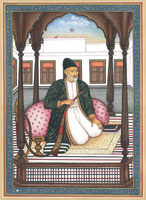 twentieth century that the star of Ghalib started to rise and then shorn with
great brightness and he was considered to be the greatest poet of the Urdu
language, leaving behind by a few leagues his contemporaries like Zauq and
his seniors like Dard. Only Mir could rival and that too barely his
popularity and acceptance till Iqbal was evaluated, at least in Pakistan, as
the next great voice of Urdu poetry
twentieth century that the star of Ghalib started to rise and then shorn with
great brightness and he was considered to be the greatest poet of the Urdu
language, leaving behind by a few leagues his contemporaries like Zauq and
his seniors like Dard. Only Mir could rival and that too barely his
popularity and acceptance till Iqbal was evaluated, at least in Pakistan, as
the next great voice of Urdu poetry