|
|
| |
The
dying art of Pakistani filmi billboards
The dying film industry combined with economic recession and technological
development has made it next to impossible for Pakistani film
billboard painters to make ends meet and carry on their trade
that has iconic significance to south-Asian cinema.
By Huma
Imtiaz
|
| |
 |
| |
They
once adorned our cinema houses. They were sometimes ridiculed, sometimes
loved. They were life-size and gaudy, but they displayed an art that
was truly South Asian. But now, this art of painting billboards for
Pakistani films has all but died, falling victim to the recession
in the local film industry, and the usage of new technology.
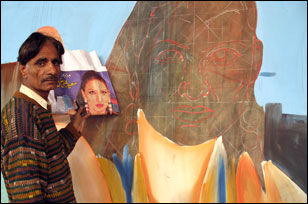
Wafa Hussain is one of the few painters left in Karachi, who are still
diligently making the life size posters for Pakistani films. Working
at the Lalazar Cinema in Quaidabad, Karachi for over 35 years now,
Wafa says he now gets orders for only two billboards a month and that
too for films that don't get Panaflex posters made. For each billboard
he makes a paltry 700 rupees each, which he says is barely sufficient
to make ends meet. Despite these hard times, he shows me how a film
billboard is painted, by using a picture as a model to create the
painting. He painstakingly mixes the colours to create the contours
of the faces and the gaudy colors of the heroines' costumes and manages
to create a close approximation. But the 700 rupees he is paid for
this work of art is inclusive of his labour and the costs incurred
in making the billboards and does not take into account the fees this
artist deserves.
Wafa, who has been a film billboard painter for the past 35 years,
reminisces about the time when film producers cared about the subject
and production of the film. He proudly shows off the poster he made
for a Sabiha Santosh film, produced by Eveready Pictures in the 70s.
"I used to be so busy making billboards for just two cinemas
that we wouldn't even know when the day had passed. I had nine people
working with me. Now I have one."
Today, Wafa is ashamed of the billboards he makes and averts his eyes
as he shows me around the cinema, with gaudy pictures from the newest
offering Vehshi Haseena (Barbaric Beauty). He wonders what kind of
people actually come to watch films with such titles. "These
films are terrible, they have no story and no character. In a cinema
that can seat 900 people, only 20 or so come to watch such films."
Wafa is also disillusioned by the promises made to him by politicians.
"I made a 40 feet painting of Benazir Bhutto that was put up
in Karachi when she arrived here in the 80s". Showing off a picture
of himself with N.D. Khan (a senior PPP leader and former Senator),
he is disillusioned with the government today. "N.D. Khan promised
us he would get us a store of our own and other facilities, but despite
the PPP being in government, nothing has happened."
Wafa says he has not taught his children this art. "There is
no point as there is no money left in this. I would rather my children
do something else."
His colleague Siddique's voice is tinged with sorrow at the state
of affairs. "We were treated with respect once, but no one respects
this art now. People who used to work with us now run grocery stores
or sell vegetables on a stall."
Wafa estimates there were once over 150 painters working in different
cinemas across the city. Now, many of them have taken on different
jobs. But for people like Wafa and Siddique, who are now both in their
late 50s, it is too late to learn a new trade. |
| |
And it's
not just the standard of films that have led a decline in Wafa's
income. Newer technology such as getting film posters printed
on scotchprint has led to a rapid decline in orders for film
posters. Technology may have made our lives simpler, for people
like Wafa and Siddique, it has been a curse and there has been
no remuneration or pension from the cinema owners, who too are
finding it extremely hard to keep their cinemas open. With the
recession hitting every industry in the country, there are fears
that the odd local film being made might soon end.
|
 |
|
| |
In
the past year only two major Pakistani films were released: Ramchand
Pakistani and Khulay Asmaan Ke Neechay. Both films were advertised
used newer technology like scotchprints, to advertise their film
in the country's major cities. The films produced by the Punjabi
and Pushto film industry runs to near-empty houses, which explains
why film producers rarely commission billboards to advertise their
film, fearing they will not be able to recover their losses.
Omar Khan, who is an avid lover of Pakistani cinema art, has amassed
a remarkable collection of local film billboards. His ice cream
parlor chain The Hot Spot, features a plethora of billboards, some
lurid and gaudy, that advertise Haseena Atom Bombs and gandasa-wielding
gujjars. But despite his best efforts to save this dying art, he
finds that it is now hard to keep the painters from putting away
their brushes forever.
"Our cinema industry has completely collapsed. It's sad what
has happened to the billboard industry, because it was full of life
and flavour, and an indigenous art that is almost gone. We need
to get art institutes like NCA to let the remaining few artists
teach this art, because they deserve recognition and prestige, even
M.F Hussain started off as a billboard painter! Apni cheez ki lekin
koi value nahi hai, if Angelina Jolie had bought two filmi posters
from me, then our society walas would have been running to get them
and hang them in their houses."
At the time of my visit, Wafa and Siddique are putting the final
touches on two billboards. They are not hopeful of any change in
their state of affairs, and are despondent at how their lives have
turned out.
As I wave Wafa goodbye, I wonder if on my next visit, I will even
see the Lalazar cinema, and if Wafa's assortment of paints and brushes,
and his small collection of old posters will be next found tucked
away in a dusty corner, victim to technology and time.
|
| |
|


