


|
|
|
|
 |
 |
   |
neglected Chawkandi
Tombs dying a painful death neglected fictional
fact water
heritage The bumbling attempts to save Moenjodaro One of the world's most ancient civilisation sites, Moenjodaro, is crumbling with each passing day as authorities concerned looks the other way. Hafeez Tunio reports
Hashim Machhi, 56, lives in Balhreji, a little
village just three kilometers away from Moenjodaro, the world cultural
heritage site of the Indus Valley Civilisation, but he has no idea what
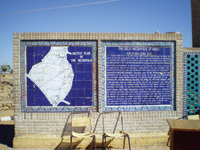
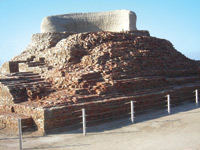
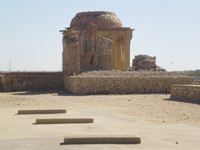
destroyed the city in the first place. Then again, few do. Everything Machhi knows about Moenjodaro is based on hearsay. The Hindu community blames the devastation on the wrath of God, while ancient Hindu scriptures stipulate it was a dust storm. Some say an earthquake did it while others believe the Indus River sank it. There are countless theories on the heritage site located just 27km away from Larkana city and 460km from North of Karachi, but the prevailing idea uniting archaeologists in the region is that not enough is being done to preserve it. A recent visit to Moenjodaro by Kolachi showed that the contention is not entirely baseless. Walls are crumbling and bricks are turning to powder. Debris has piled up everywhere. Many of the houses in the surrounding villages look suspiciously as though they have been built out of bricks lifted from this cultural site. It is a sight that pains archaeologists. "Nothing has been done to conserve the city," says Professor Ghulam Mustafa Shar, Head of Archaeology Department, University of Khairpur, in disappointment. Part of the problem is that many of those who have
forwarded recommendations for what could be done with the site have been
unskilled and unprofessional. Citing an example, Shar points out that in
a place where salinity is already dangerously high, saline mud bricks
were used to conserve the buildings, proving to be damaging in the long
run. "There is a dire need to lay down a Dam Proof Course (DPC) at the foundation of all the exposed walls to save them from further crumbling," says Shar, and stresses, "The salinity must be overcome." Shar adds that this is relatively easy to do, and can be achieved if the soil of the area is filled with sweet mud and sand from the Indus River. But Moenjodaro is riddled with more problems than just high salinity levels. Highly water-logged, its structures are liable to collapse at any moment. Syed Abbas Ali Shah, former Director General Geological Survey of Pakistan, explains that Moenjodaro is prone to water-logging for a variety of reasons: the existence of nearby canals, the flow of the Indus River, and stagnant water. Because of these, much of the water has come up to the surface, and upon evaporation, has left behind salt, adding to the rise in salinity levels. "If an underground water control system is put
in place, the water will drain out through automatic tube wells, which
should curb the water-logging and high salinity level of the area,"
he says. At present, anyone digging in the area will hit water at a
depth of mere 12 feet, making it impossible to excavate the site
further. "The level should at least be forty to fifty feet,"
says Shah. In this problem-ridden heritage site, there is one more factor aiding water-logging in addition to canals and stagnant water. "The cultivation of paddy crops around the site is another major reason the area is water-logged," points out S.M. Saleem, an agronomist. Saleem insists that the practice needs to be banned, but admits that this will be difficult. "The permanent solution is to drain out the water, of course," he says, and adds, "There is also a need to cultivate salt-resistant plants and crops." There is also a need to install a working drainage system to drain out any rainwater that accumulates in the area. It often clogs up the area for weeks. "There have been many projects launched to take care of the problem, but they all ended in vain," reveals Abdul Haq Pirzada, a local journalist. So far, there have been five attempts to explore
Moenjodaro, but these have all been fractured, to say the least. The
first took place in 1922 under the supervision of Sir John Marshall,
then Director General of the Archaeological Survey of India. Hashim
Manchhi says his father was part of this team, which went on to unearth
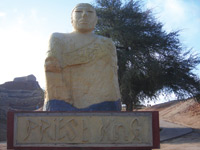
the statue of King Priest. The second attempt occurred in 1937, followed
by 1965, 1974 and 1987, and all of these attempts have caused further
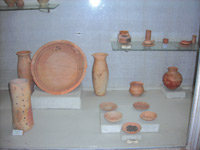
problems. "The problem is that more than 30 per cent of the excavated sites have been damaged with no thought for preservation," says Pirzada. "Occasionally antique items (such as old pots) are washed up during a downpour, but none of the officials concerned have paid any attention." On condition of anonymity, an official from the Archaeology Department told Kolachi that before Moenjodaro was declared a world heritage site, the Department of Archaeology and Museums (DOAM) prepared a master plan for its preservation in 1974, known as 'Save Moenjodaro'. As a result, UNESCO raised close to US$7 million in funds. Contributors included the USA, Japan, the Netherlands, England and Australia. The Pakistan government raised US$14 million and later that year, the Authority for the Preservation of Moenjodaro (APM) was established. Efforts to save Moenjodaro were in full swing, but records show that they all went in vain. "Statistics issued by the APM showed that US$23.50 million was allocated to the groundwater control scheme, the conservation of structural remains, landscaping, plantation and tourism, but in reality nothing happened," says the official. Finally in 1992, the Planning and Development
Department Division of the government of Pakistan expressed
dissatisfaction over the conservation of Moenjodaro, saying that the
work was slow and inadequate. By 1997, the APM was dissolved, and the
Federal Ministry for Culture and Tourism took control of its remaining
budget(Rs75 million) in addition to US $425,123 for future programs -
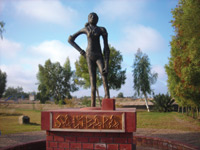
but again, there was no progress. Later, in 2005-06, both the Moenjodaro Research and Conservation Center (MRCC) and then National Fund for Moenjodaro came into being with a budget of Rs35 million. To prove that there is some development, Project Director Qasim Ali Qasim, says that the Master Plan for rehabilitation and promoting Cultural Tourism of Moenjodaro is "underway." "We have already started landscaping the area," he says. "A number of salt-resistant trees have been put on different places. Statues of King Priest, Dancing Girl, and others have also been put up. Lawns and huts have been built in different locations. In addition, the Archaeology Department has inserted a DPC to more than 70 per cent of exposed walls, measuring 50,000 meters in length." And this is not all, he says. Qasim indicated that before being disbanded, in 1986 the APM had introduced an underwater control scheme to push the water level down to 65 feet below the ground. To achieve this, 56 tube wells were installed - each with a capacity of three cusecs - in three stages. "In the first stage, around 14 tube wells were installed to lower the ground water by 20 feet. Later 12 more tube wells were added." However, the work did not last long. The project cost over Rs10 million, including electricity and maintenance charges. But later, the scheme was suspended for 14 months and then abandoned altogether due to a shortage of funds. "We are currently upgrading the museum and trying to repair the vehicle used by Sir John Marshall," says Qasim, adding that a Canadian company, Fort, has been hired for the job. "A total of 10 per cent of the sites at Moenjodaro have been excavated. We started excavation again a few days ago and found artifacts and two ancient walls from the First Street," he says, although many, such as Professor Shar, are convinced that the Master Plan has failed, since all earlier excavations are near collapse. Meanwhile, the present government has claimed that Moenjodaro will be converted into a tourism hub, but the results are not visible. For one thing, there is no tourist guide for the Indus Valley Civilisation. When contacted, Shams Jaffrani, Secretary Sindh Culture and Tourism, justified this by explaining that Moenjodaro comes under the Archaeology Department of Pakistan. "But very soon the archaeological sites will come under the provincial government," says Jaffrani. Regardless of which department the restoration of Moenjodaro comes under, experts have warned that if nothing is done to preserve the site, all existing excavations will crumble within the next 10 to 20 years and one of the world's most striking ancient civilisation sites will be lost forever.
9 years later: Stolen items from Moenjodaro still missing There has been no news of more than forty priceless seals stolen from Moenjodaro Museum on May 10, 2002. The seals, which were made of bones inscribed with marks of different animals, were stolen when a group of persons climbed over the museum wall using an iron ladder and broke in. Following a complaint by the assistant curator of the museum, an FIR was lodged against Ali Dost Brohi, Mumtaz Brohi, and Eijaz Tunio. Tunio was later arrested in Karachi and confessed to the crime, although he was released on bail a few days later. Since then, the Archaeology Department of Sindh has not pursued the case. During investigation, it was learnt that Tunio and his accomplices had sold out the seals to a businessman from the United Arab Emirates. According to Tunio, he and his accomplices initially tried to contact a black market mafia on antiquities in Britain, but failed. Currently, many antiquities from the museum have been moved out of the country or to other museums in Pakistan. The statue of 'Dancing Girl' is said to be kept in a museum in Bombay, while the Statue of King Priest is in the National Museum Karachi, although the latter has not yet been put on display. "Other museums in the world have also had items stolen from their museums," Manzoor Chandio, a historian, told Kolachi citing the example of Egypt. "Often, mummies and other artifacts of the Egyptian civilisation were removed from museums in Egypt to other international museums."Chandio added, however, that when the government of Egypt complained, they managed to retrieve all their historical artifacts from the countries. "The government of Pakistan should think along similar lines," said Chandio. Until that happens, their whereabouts will remain a mystery.
Chawkandi Tombs dying a painful death With barely any money being spent on the upkeep of historic tombs, it is not a surprise why the site attracts no foreign or local tourist
A survey of the Chawkandi Tombs showed that out of the four graves of people of great repute, three are dilapidated, with the roof having caved in decades ago. Others are fast deteriorating, with their edges having being damaged.
By Farooq Baloch Along one stretch of the National Highway stands the
site of the enormous, historical Chawkandi Tombs. Spread over an area of
50 square kilometres, the centuries-old graveyard has been declared one
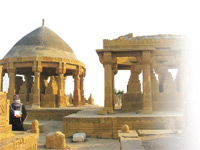
of the 130 Protected Heritage Sites in Sindh. A quick glance in the direction of the Chawkandi Tombs, however, is enough to show that protection is the one thing they have not received – a fact experts agree to. "The federal government has overlooked the historical site, since none of the master plans for protecting it were approved," they say. It is worth taking a look at why such a site warrants special attention. One of the largest ever cemeteries, the Chawkandi Tombs are unique in the Islamic world, having evolved purely from local traditions. Even at a distance, with some of the tombs dating back to six hundred years, it is easy to make out the graves of both men and women. The graves of women are decorated with drawings of jewellery and ornaments women of the time frequently adorned. In a similar manner, the graves of men have drawings of turbans and weapons (swords, cannons) engraved on them. There are at least 250 graves in total, all of which are said to be covered in 1,300 different designs. However, a recent survey of the Chawkandi Tombs showed that out of the four graves of people of great repute, three are dilapidated, with the roof having caved in decades ago. Others are fast deteriorating, with their edges having being damaged long ago. Any intricate designs engraved onto them are either blurred or gone completely. As a rule of thumb, the condition of the graves and tombs gets worse the further back into the graveyard they are. "The roofs of the tombs fell apart more than 10
years ago," says a mason working on the grave of Jan Murad Ali,
also a former sardar of the Jatoi Tribe. "They have never been
repaired." Neither has the boundary wall enveloping the site. It is broken in several places in the front and in some areas, like the rear, it has disappeared altogether, adding to the fear that land grabbers could take over at any time. The gaps are such that they have become a regular path or driveway for those living in nearby localities. As a consequence, the number of tourists has decreased significantly over the years. According to the watchman, who also doubles as a tour guide, it has been years since a foreigner set foot in the place. "Even locals visit rarely," he says. "There are a few people here on Sundays, but you'll often find someone taking a nap in the shade the tombs offer, or playing chess (and other games) around the graves in their spare time." Then again, visitors have little inducement to come in droves. The site of the Chawkandi Tombs is three kilometres from one end to the other, but nowhere is there a water cooler or canteen or any place for refreshments. What it does have is one dirty toilet, which is often given a wide berth. The same survey showed that in three hours on a typical day, a group of young tourists from Sahiwal were the only people who visited the historical site. "We had visited the historical fort and mosque in Lahore and heard about the Chawkandi Tombs," says M. Ali, who was part of the group. "Both places had one thing in common: they were both deteriorating." Others, however, were less critical and filled more with awe than shock. "I'm amazed at how big this place is," says Yasin, another tourist of the same group. "Can just one watchman take sufficient care of it?" Whether or not one watchman can take care of the entire site is, however, debatable. The federal government's Archaeology Department is divided into two sections: the Northern Circle, which covers heritage sites in Punjab and the North-West Frontier Province, and the Southern Circle, responsible for heritage sites in Sindh and Balochistan. According to Tanvir, a Circle Engineer in the department, there is a reason the Chawkandi Tombs and other heritage sites in Sindh are not maintained properly. "It is all because of a lack of funds," he says. "The federal government allocates a limited amount of Rs700,000 for the maintenance of all the 130 sites." The Chawkandi Tombs in particular require special maintenance, he adds. "The graves are made of limestone, which is already very expensive to maintain," explains Tanvir. "All the carvings on the limestone add to the cost. It is impossible to carry out such expensive repair work with the limited funds we have." It is a fact the federal government is aware of. "We have sent several master plans and PC1 to the federal government regarding the matter, but none were approved," adds Tanvir.
--Photos by the authors
At the mercy of land grabbers Right in front of the Chawkandi Tombs, land has been approved by the city government for the construction of a beautiful park, but much of this land has already been encroached upon by land mafia, Kolachi has learnt. "The land in question was meant to preserve the look of the historical tombs," says an official of the Archeology Department of Sindh. "The purpose of the park was to protect the land from being encroached so that the tombs could be seen from the highway." The official admitted, however, that encroachment could not be stopped. "There are officials within the department who go hand in hand with the mafia. They have allowed the encroachment for their own interests." Unlike in the past when the tombs were visible from everywhere, it is impossible to sight them from the highway now. Only a portion of the entrance to the graveyard remains untouched. The rest of the land has been encroached by the land mafia that has constructed buildings and set up roadside cafes (dhabas) as well as workshops for the maintenance of heavy vehicles. Hundreds of heavy vehicles – mainly dumper trucks, trailers and oil tankers – can be seen parked at the illegally set-up workshops hiding the centuries old tombs. There are even guards who have been appointed to watch the land that has been taken over. "This land has been paid for by our master," they say if anyone asks what they are doing on government property. "It belongs to them. We are just guarding it."
heritage Makli graveyard decaying away When it comes to preservation, the Makli graveyard is yet another heritage site that has received scant attention from authorities
By Adeel Pathan When Abdul Samad, a resident of Badin and the owner of a printing press, visited the historical graveyard on the hills of Makli, it was with a burning eagerness, but by the time he left, he was filled with bitter disappointment instead. "I don't know whether my children would be able
to see any of these graves or tombs before they crumble away," he
says ruefully. "Something needs to be done about them
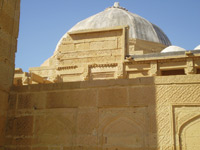
urgently." Abdul Samad has a reason to worry. Since 1985, the Makli graveyard has been included in the list of the United Nations World Heritage Sites, but if its current state of disrepair is any indication, it has received the scantest of attentions from authorities when it comes to its preservation. From a distance, the site looks very attractive, and keen tourists and scholars flock towards it to get a closer look and learn about the glorious history within. Many of them, however, leave disappointed. "I have been bringing a group of students here for the past few years," says Syed Irshad, principal of private school in Karachi when talking to Kolachi. Like Abdul Samad, he is unimpressed with the way things are being run at the Makli site. "There are no public toilets or shelters or restaurants, and the graves are falling apart" he complains. Tourists receive no inducement to stay either. This crumbling heritage site is located on the
outskirts of Thatta, some 90 kilometres off Karachi and 100 kilometres
off Hyderabad. Spread over an area of 912 acres, or approximately seven
square kilometres, it is home to half a million graveyards belonging to
the Indus Valley civilisation. Common people, as well as kings, queens,
saints and scholars, lie buried here, their headstones engraved with
floral patterns and inscriptions from the Quran. The tombs, mausoleums
and graves of the Mughal period (1592-1739 AD) are on southern side of
the necropolis, with those from the Tarkhan period (1555-1591) in the
middle, along with graves from the Arghun period (1520-1555-AD) and the
Samma period (1340-1520 AD). It is believed that the site was chosen as
a graveyard because of its high location: sitting on a plateau, it is
safe from the flooding of the Indus River. Kolachi has learnt, however, that a combination of lack of funds and pressure from influential locals has meant that the Archaeology Department of the federal government has been unable to maintain the heritage site. "The site is exposed to both natural and man-made hazards," laments an official from the Archaeology Department. "There has been no major repair work to prevent the destruction of the site." However, it would be unfair to blame only policy makers. Officials from the department point towards regional television channels and private production houses who have been caught using the site as a shooting location on a number of occasions. According to the law, a payment of Rs25,000 is required for such a venture, but it has been learnt that locals who hold considerable influence in the area have used their connections or positions to bypass the law. Initially the Sindh Minister for Culture and Tourism, Sassui Palejo, was recently accused of encroaching upon the land, although she and her family have denied the charges. "Ancient stones have also been stolen from the
site," further reveals the official. It is not entirely difficult
to steal from the site, as it has no boundary wall to speak of around
the site. Despite not By 2006, the site was declared 'dangerous' and measures were taken to protect it, but they were not enough. One estimate states that the site needs at least one billion rupees for it to be sufficiently restored, along with a museum to ensure visitors keep coming. It has also been learnt that locals have been treating the heritage site as their own graveyard today. "The cement they use has added to the decay of what is left at the graveyard," says the official from the Archaeology department. Regardless of all this, the number of tourists has
not dropped, even though many of them leave without what they came for
and complain of 'immoral activities' on the heritage site. The heritage site is the perfect representation of different eras and dynasties in the Muslim past, and a spectacular display of the masonry techniques they employed – if only it would be preserved. As the disappointed tourist Abdul Samad sums it up: "Something needs to be done about them urgently."
Urdu fiction that has sadly turned to fact Urdu writer Ibn-e-Safi may have written his action
novel "Teen Sanki" in the 70s but what he wrote then is
strikingly true in present day Pakistan. His book is a tribute to the
foresight of Urdu writers, some of whom wrote about conditions in the
country which have unfortunately come true, beyond our wildest
imaginations. Published in 1975, "Teen Sanki" is set in a fictional place called "Shakral" located in the tribal areas and revolves around a horrific experiment carried out on the locals by foreign elements. Decades before anything of the sort was seen in the area, the novel mentions cameras that can transmit images from deep in the forest. It was penned at a time when there was no hint of the trouble that would rip the tribal areas apart in the decades to come, but it rings hauntingly true in today's era of the War on Terror. Teen Sanki begins with the disappearance a group of men who had gone into the desert. Tribal chief Shahbaz Kohi, along with six companions, goes missing and is last seen going to Rehban, a place in tribal areas, to investigate the mysterious disappearance and return of 11 tribesmen. The 11 men eventually return from the desert, but start to behave very strangely. Without telling anybody why, they isolate themselves from everyone they know, and even start to shun the company of their families. Meanwhile, a shocking realisation dawns upon the locals as a number of them begin to change their appearance. They act and talk like normal human beings, but their body begins to sprout thick, dark fur, until nobody can deny that they have been transformed into gorillas. Through all of this, Ali Imran, the hero of the novel, remains wearily unsurprised. "What can I say?" says Imran, the hero of the novel. "Anyone who can make an atom bomb can surely turn human beings into animals for entertainment." The villains of the novel are foreign, and when Imran plaintively asks one of them why his tribal area has been chosen for the experiment, he receives a chilling reply: "The local are uncivilised and believe in superstition, but more importantly, we have space to do it here. It was a perfectly harmless experiment. Everything was being done for the welfare of humanity, but the present circumstances have made bloodshed necessary." For all his shortcomings, this foreign character makes an insightful comment. "These people cannot tolerate anything that doesn't conform to their religious views." If anyone in the novel could have foreseen this, it is Imran. Previously, Imran had warned a younger native that Shakral would run into trouble unless it learns to cope with the modern world. When the tribal chief snaps, "I can't trust foreigners!" Imran replies, "You have to. These Western people have an astonishing attitude. When one of their groups fires at us, a second group is ready to give first aid to the injured." The violence in this previously peaceful area escalates to a point where both sides hold hostages. Evocative of today's political "with us or against us" frame of mind, the leader of the foreign mission issues an ultimatum: if our prisoners are not released, the whole area will be bombed. Whether or not the area is bombed is left to the reader to find out, but what is certain is that the events that must have seemed so unrealistic at the time have proved to be prophetic today. As noted fiction writer Shakil Adilzada says of Ibn-e-Safi, "He had great vision and wrote about things that weren't present then but happened later." Adilzada, ruefully adds, "Writers can often imagine what will happen in the years to come, but compared to the West, fiction writers in Pakistan receive no importance at all." There are novels that exist strictly in the moment, and there are novels that are ahead of their time and read as though the writer could peer into the future. "Teen Sanki" has a firm place in the latter category.
woes Making money out of misery As residents of Bhitai Colony have been deprived of a proper water infrastructure, the area police continue to make big bucks by selling water through illegal connections By Tabassum Farooq Access to clean drinking water is the basic right of
every citizen, but almost every household in Sector 10 of Bhitai Colony,
located adjacent to Korangi Creek, has been deprived of this essential
need. The inhabitants of Bhitai Colony, which has been disowned by the
authorities concerned, are compelled to obtain water – mostly
contaminated – through illegal connections provided by police in the
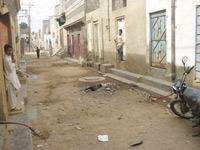
area by paying heavy bribes. During a visit to the area, Kolachi learnt that residents of the locality have been facing acute water shortage for the past three years. To overcome this shortage, every second house in the area has installed an illegal water connection which is being controlled by the Bhitai Colony Police Station. Given that both the Town Administration of Korangi and Cantonment Board Korangi Creek refuse to own the area, the area police have been exploiting the situation. Residents of the area, however, claim that the colony, established in 1992 and leased by KDA, lies in the jurisdiction of Korangi Town, but their complaints remain unaddressed by the town administration. As a result, most of the residents are compelled to arrange for drinking water on a self-help basis. For those who do not have access, the police have provided dozens of illegal connections in the area. Water pipes have been laid in a haphazard manner. Because of this, the drinking water often mixes with the sewerage lines contaminating it, leading to various waterborne diseases. Since the primary source of water supply is nearly a kilometer away from most of the streets in the colony, a secondary pipeline is needed to connect to each household, which costs approximately Rs30,000 per connection. Several households then share this expenditure which includes a bribe of Rs1,500 to Rs2,000 that goes to the Bhitai Colony Police Station near which lies the complex network of hosepipes illegally connected to the main water line. "Six to seven households pitch in money for one
connection," a resident of Street 18 told Kolachi. "The water
is sucked through electric motors by one or two houses per day so every
family has to wait for their turn for a few days, if not the whole
week," he said, adding that frequent power outage further compounds
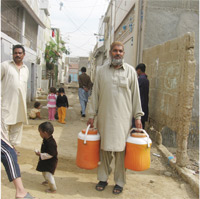
the problem. However, residents on Street 19 are better off and have managed to access the main water line with the help of the police. It is those living beyond this street that face hardship on a daily basis and are forced to borrow water, such as Ameer Khan, a senior citizen and resident of Street 23. His daily routine includes filling two water coolers by borrowing water from his neighbours. "I don't even have access to an illegal hosepipe," says Khan. "There are 12 people in my family and there is never enough drinking water for everyone. I have no choice but to borrow water from those who have connections." Sometimes he even has to make two rounds a day in his neighbourhood. "On the days I am lucky, I get water from the first door I knock on, but otherwise I have a lot of knocking to do before someone lets me in." He appealed to the City Nazim to address their water woes at the earliest. "One can live with improper roads, but not without water." Moreover, the limited supply of water residents of the area receive is mostly contaminated. As observed during the visit, the hosepipes have been laid only a foot or two below the ground, most of them leaking at different joints and passing through sewage water standing in the area. "Almost every family in this area suffers from some skin or abdominal diseases," complains Hajra. "Our children in particular suffer from gastroenteritis and diarrhoea," she adds. Rahim Jan, another resident says that they receive a limited supply of water from these makeshift connections. "We use that little bit of water for drinking and cooking purposes only. For washing and cleaning we use underground water (boring water), which is often saline and bears a stench. Most of our clothes stink even after washing." There is a simple reason for this: the boring mixes with sewage water. The majority of the residents Kolachi spoke to had similar complaints, saying that they have little power to change the manner in which the affairs of the colony are being run. Justifying their act, residents say "they want to survive", and if their survival requires them to opt for an illegal connection, then they would not hesitate to do so. "If the government had provided us with a proper infrastructure of water, why would we steal water like that?" they ask. Their frustration is apparent. "Even animals would not prefer to stay here, forget humans. Once I get the opportunity, I will leave this area," vows one resident. When contacted by Kolachi, Korangi Town Nazim Arif Khan Advocate initially expressed disinterest, claiming that the area does not fall in his jurisdiction. Later, however, he added, "Residents of the area should submit a written complaint if they have a problem." He maintained that action will be taken only if the specific area falls in Korangi Town jurisdiction – which he was unaware of. The cantonment authorities on the other hand also denied that Bhitai Colony is under their supervision. As residents of this low-income neighbourhood continue to suffer, it is unfortunate that none of the authorities have come forward to help alleviate their suffering. Moreover, the police, instead of teaching the residents to be law-abiding citizens, are seen violating the law openly by selling water through illegal connections and making money out of people's misery.
|
|

 being allowed onto the area, vehicles have ample access without anything
barring their way.
being allowed onto the area, vehicles have ample access without anything
barring their way.