


|
|
|
|
|
 |
 |
   |
event MOOD
STREET Town
Talk law I
want my basant back! Reveling in race The first drag race of its kind drew huge crowds which the organisers had probably not anticipated
By Aziz Omar Loud roaring sounds, clouds of smoke and dust, intense
speeds and thumping music are all excellent elements for an exhilarating
experience. For the past couple of years in Lahore, spurred on by films
such as TheFast and the Furious franchise, phenomenon of street racing has
been serving as an outlet for the rush associated with throttling an
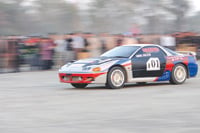
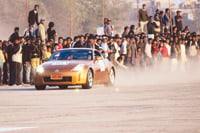
engine and unleashing its power through spinning The first of its kind drag race was held on the 1st of February recently. It promised just such an opportunity. The event had been organised by the Tourism Development Corporation of Punjab (TDCP), with the venue initially being a strip of Gulberg Main Boulevard that was later changed to Walton Airport. Though this option turned out to be stellar when it came to the requirement for open spaces and that too for a good part of the day, the concrete laden surface of the airstrip wasn’t exactly suited to high speeds as much as the tarmac would have proven to be. Nevertheless, as I made my way towards the now soon to be defunct Walton Aerodrome, the lines of cars also moving towards it started a good one or two kilometers in the narrow lanes leading up to its entrance. After moving at snail’s pace for a while, I decided to park my car in the first available parking spot amongst the rest of the vehicles lining the sides of the streets and set out on foot. Close to the venue, the number of pedestrians grew and as I advanced towards the airfield with the rest of the flow, I found out that a huge crowd of people had already been thronging the vicinity of the race track. Even though TDCP had made some arrangements for the
spectators by erecting tents and placing chairs, they neither could
accommodate the thousands that had come to watch nor did they provide a
decent view of the racetrack. An ideal solution in this venue’s case
would have been ad hoc stadium style seating replicated by step-like
seating structures. Nonetheless, this did not deter the teeming visitors
from standing along the track on either side for hours. The otherwise
jarring noises of revving engines were turning out to be music to the ears
of the watchers as they enthusiastically cheered every successive car that
passed by. It was a great pity that the cars were not racing head to head but instead the drivers were attempting to get the shortest possible time for covering a 400-meter distance. Be it your Nissan’s Skyline GT-R, Fairlady or 350 Z, Mitsubishi’s Lancer Evolution, Toyota Supra or Corvette, all were gunning their engines to produce the maximum thrust for shooting out towards the speed sensors at the other end. "My ride was doing around 180-190 km/hr when I went past the finishing line," claimed Usman, the driver of a Subaru Impreza with a 2.5 litre turbo charged engine that churns out 300hp. The cars of all the 57 participants had number IDs tacked onto their sides in order to keep track of their progress, especially for the official announcers/hosts of the event. These guys did fairly decent job of keeping the crowd informed of which driver was making his run, while constantly requesting the bystanders to come back to the seating areas away from the tracks, all in vain. One of the drivers, Zain, who is a student of LSE and was driving Mitsubishi Evolution 9, lamented the state of the onlookers. "The TDCP management should have anticipated the crowd numbers and their viewing preferences and made appropriate arrangements. They could have kept an entry ticket to regulate the spectators and provide better and safer seating." There were also little offshoot car antics taking place simultaneously to the main event. One’s ears would perk up at the screeching of driver attempting to ‘drift’ (move sideways, looks very cool) or undergo a donut (move sideways in a circle, looks even cooler). Then there was the arrival of two megastars of the sports car world, a Ferrari 360 and an Aston Martin DB9 that though didn’t race, had the onlookers drooling to their hearts’ content. As the light started fading, it seemed that everybody’s desire of witnessing a head-to-head car race would finally transpire. However, all those hopes were dashed as it became next to impossible to make the crowds move a safe distance back to make way for the two hurtling vehicles. Rana Mansur, another participant in the drag race claimed that he had invested around Rs. 2 Lac in his Mitsubishi Evo 8 just for this event and would have put in more had it allowed for two cars to race side by side. "I am one of the older racing enthusiasts and so am hopeful that such events shall improve with time". Exactly two years ago, I had written an article that was published in this very place about a motley crew of speed fanatics racing their mean machines across the roads of Lahore. They were always in search of new venues, of deserted roads to hold their races but soon would be chased away by the police authorities. An official recognition of this "illegal" sport in the form of this Drag Race for the first time is a highly welcome sign. Yet tragically, the venue of the Walton Airstrip itself is soon to give way to commercial high-rise buildings as the Punjab Government has cancelled the lease of this land. With the hope of a standardised race track also in doubt, that was going to be part of the sports city project started by the previous Punjab government, the amateur racers might have to revert back to their illegal activities. The current government of Mian Shahbaz Sharif has to take stock of the huge potential of generating revenue from this sport, the popularity of which has been well-established by the turnout. Similar to cricket, hockey and football stadiums, venues for staging car races, both in the street racing and Formula One style have to be constructed to foster this activity. The powers that be have to realise that even if they need to capitalise on a venture, a recreational rather than a commercial one would pay more dividends both from a monetary as well as a societal standpoint.
All of us want to be television characters
By Ali Sultan A few days ago while my wife and I were watching our favourite television series, which we download almost everyday, it hit me –during an emotionally draining scene - how well television hides the fact that it isn’t close to reality at all. How television dramas become so involving that you wait
for them every week, or buy them in DVD sets or download them from the
internet. Every decision of characters on television somehow changes their lives in some earth shattering way. Alas in the real world when was the last time buying a packet of milk changed yours? Their decisions, most of the time, are quick and decisive. Our decisions, on most days, are almost the same. They are boring and repetitive. On television, people say the most profound things. A boy telling a girl for how long and how much he loves her, melts our hearts. A dying father says his last goodbye to a daughter he hasn’t talked to in twelve years and we are brought to tears. We are filled with rage when a husband beats his wife. Television shows us the complexity of life with crystal clear visuals and crisp sound. We, on the other hand don’t say anything at all or if we do it’s at the wrong time and at the wrong place, our voices muddy and unclear. Most of us don’t even realize when life began and became so hard. Television attracts us because it shows us someone’s life in fast forward. Forty minutes and we know a character better, we know where they are headed. Television attracts the voyeur in us, it shows us how someone else’s life is more interesting than our own or how we should live our lives better. On every turn of life, we have some television drama or character showing us how to act in practical matters or changing our opinion and decision choices. Ever think why can’t life be over and done with in thirteen episodes or be so involving that it lasts for four seasons. Life isn’t like that. Is it? Sometimes it doesn’t move at all. On television everything is in order, when an episode or a serial ends, it resolves everything. Real life is the exact opposite, nothing is resolved until you are dead and even if you do, you’re forgotten. All of us want to be characters of television. The sad fact is that we can’t be.
Town Talk • Exhibition of new works by Fatima Naseer and Rabia
Anwar titled Composed-Decomposed in Nairang Gallery till Saturday, Feb 14.
• Exhibition of Zulfiqar Ali Zulfi’s works at Ejaz Art Gallery till March 3. Zulfi is at present Assistant Director Alhamra Art Gallery, Lahore. His work figures in the following collections: Governor House, Punjab Assembly, Administrative Staff College, National Institute of Public Administration, American Consulate, Lahore, Governor House, Nathia Gali, National Art Gallery, Islamabad, President House, Turkey.
• Young Leaders and Entrepreneurs Summit ‘09 at Lahore University of Management Sciences. Today is the last day.
• Book Launch: Burnt Shadows by Kamila Shamsie at Lahore University of Management Sciences (LUMS) tomorrow, Feb 9 at 5pm. Sweeping in its scope and mesmerising in its evocation of time and place, Burnt Shadows is an epic narrative of disasters evaded and confronted, loyalties offered and repaid, and loves rewarded and betrayed.
• Music Video Competition on February 18 at Lahore University of Management Sciences (LUMS). The theme for the Music Video Competition this year is "Life and its Shades". law Right of way – right away Lahore Development Authority removes hundreds of gates
By Waqar Gillani The Lahore Development Authority (LDA) – a government run body to regulate housing schemes in the provincial metropolis – has recently started a campaign against encroachments and illegally erected iron gates in various localities to clear the "right of way" to public roads, lanes and streets. LDA believes that this would restore the right of way of general public while the affected residents view the removal of gates as a threat to security in the backdrop of worsening law and order situation. Police, expressing surprise on the removal of gates being used as security shield, have urged the government authorities to take such steps in consultation with all stakeholders and agencies. Backed by political will, the quickly approved LDA campaign to remove illegal iron gates will be run in phases, the official concerned told TNS. Surprisingly, the campaign aimed to give the City a better look, has started from Allama Iqbal Town. In less than a week the LDA has removed 270 illegal gates from only that locality. LDA officials believe that they started this campaign to clear the "right of way" and encroachments from the different areas in the city. LDA also claims that majority of public has appreciated the authority for taking this step as the authority has also been receiving complaints against such gates from time to time. The Estate Management Directorate and Town Planning Wing of LDA launched its anti encroachment campaign in the City, including the agenda to remove iron gates. "The drive, targeting LDA scheme areas, is to purge these vicinities of illegal structures and other disorders that create hurdles in pedestrians’ movement and smooth flow of traffic," the LDA spokesman told TNS. The spokesman further said that LDA has urged the residents of its schemes for voluntarily removing all encroachments without further delay, failing which they will have to pay the demolition charges as well. He said they were dealing with such encroachments under sections 33, 34 and 40 of LDA Act, 1975. He said the LDA received a number of complaints on the issue from time to time. Apart from Iqbal Town, their operation teams have also eradicated a number of gates in Bhatti Colony, Model Town Link Road. The spokesman said the Lahore High Court has also stopped the installation of gates on roads, any barrier and construction of walls blocking entry from one society to another. The LDA schemes of the City include Gulberg, Johar Town, Model Town Extension, Faisal Town, Green Town and Township (called Quaid-e-Azam Town in LDA papers), Gulshan-e-Ravi, Gujjar Pura, Taj Pura and others. According to some reports collected by LDA authorities concerned, the majority of the private housing societies have also blocked entry of general public to their area and the culture, unfortunately, is growing day by day. To the question why this campaign has started all of sudden, the spokesman said it is up to the government. "Previously, influential people have been stopping this campaign whenever it was started or they reinstalled gates with the passage of time. LDA Senior State Officer, Arshad, talking to TNS said that they have got a good response of this effort. It is the responsibility of security agencies like police, to control law and order instead of doing illegal acts and creating hazards for others. "Now this has become a norm in every new society to deny entrance to general public," Ahmad Naseem, a senior resident of Model Town, who was sick of this ‘gate-culture’, seconded LDA’s point of view. This step would facilitate general public because it will open way for traffic. On the other side, the residents who are for iron gates on a road, say increasing street crime compel them to erect a gate. "We have known one theft and one robbery in a nearby lane that is without gate," says Imran Akmal, a resident of Allama Iqbal Town Nishtar Block. "For the residents of that lane gates mean proper security." They also question the sudden awakening of LDA when it remained oblivious for years. According to a recent police report that also appeared in the press, street crime increased by 18 per cent in January 2009. In the first two weeks of January as many as 18 incidents of crime were reported in the press in Iqbal Town division only including lifting and snatching of four motorcycles and two cars. Superintendent Police (SP) Allama Iqbal Town Division of the City, Syed Nasir Rizvi, talking to TNS on security concern of the people that compels them to erect iron gates on streets, said many of these gates were installed with the permission of police. "These gates have been giving a sense of relief and security to the residents," the SP said, while giving the example of Model Town Society in which they managed to install gates with the full consent of residents. Resultantly, this decreased the crime ratio to a significant level. The SP said such steps, if taken by involving all stakeholders, can decrease street crime in particular. He said the police does not have much strength to arrange fool proof security in every street. The step of installing gates significantly deceased car theft, snatching etc. By experience we know such steps helped in controlling crime, the SP said. He also urged the need to consider steps like community policing to make the situation better with the involvement of locals. He said though they are cooperating with LDA in removing gates it could be done in a better way if the society and police were also consulted. What is the priority, "right of way" or security.
This year, again, people are hoping the ban on basant will be lifted.
By Naila Inayat A: You know I have always liked the idea of basant but have never liked the festival itself. Why? B: I’m also confused what to say... hmm maybe because they say it is un-Islamic. A: That is what "they" say but what do you say? B: I also think that it is a Hindu festival A: Similarly how Valentine’s Day is a Christian event? B: Well Valentine is not a religious event. It is fun, it has elegance to it but basant is a sport enjoyed at the cost of someone’s life. A: But why reprimand the sport and deprive the people of this sole entertainment instead of addressing the issues associated with it? B: "I don’t know." And that is how like all other debates this class debate on basant ended. It’s that time of the year again - the arrival of spring has brought with it the usual basant: to-be-or-not-to-be debate. With it come a myriad of questions like, is it un-Islamic or why and how should it be celebrated? The debate is more like "you’re either with us or against us." After Shoaib Akhtar I think basant has the highest number of bans to its credit. It all started in 2004 when increase in the use of metallic string and tandi not only damaged electricity wires but also caused serious injuries to people. The issue was taken before the apex courts which banned kite flying in 2005. The ban was lifted by the Supreme Court for 15 days in March 2006 but on March 10 it was reverted by the former Chief Minister Pervaiz Elahi. On Jan 4, 2007 the Punjab government lifted the ban, yet again, for mere 24-hours. This year the Punjab government is considering to lift the ban on kite flying. In this regard the high command of Lahore police has already given a data presentation on losses caused by kite flying during the last few years. The CM has asked for a comprehensive plan of arrangements for kite flying after consulting the representatives of police and kite flying associations. The plan is said to ensure strict safety measures including the prohibition of the use of metallic wires and tandi. "I am not aware of any such plans as it has not been brought before the cabinet. It should be discussed in the assembly," said Provincial Minister for Sports, Culture and Youth Affairs, Dr.Tanveer-ul-Islam. Talking to TNS Islam said no doubt it is a good cultural activity but it should not be enjoyed at the cost of lives. The overall environment also needs to be kept in picture, he added. "On the one hand,’ he argued, "the Punjab cabinet has donated one day’s pay to the Palestinians and we also have earthquake victims of Balochistan. Is it right to celebrate basant at this juncture?" "Of course I want my Basant back! We don’t have anything else to ‘celebrate.’ Once upon a time we had cricket but now no international team wants to play here. Even the hockey teams are not willing to play in Pakistan, let alone cricket," Safdar, a kite flyer laments. "In Pakistan there is nothing to do besides eating out. There are not many cultural activities for common man. Everything related to fun is seen with suspicion. But it has never stopped people from having fun and creating outlets to vent," Professor of Cultural Studies, Saima Qureshi told TNS." District Kite Flying Association (DKFA) Secretary General Sheikh Saleem said, "We have given an application to the Punjab Government to give a date for basant which will probably be the 28th of this month or March 1." He further said this is one festival that is celebrated without any distinction of caste, creed, colour or religion. "Why would anyone have any objection to this event when we all know that Pakistan is an entertainment starved country? This is an opportunity to show our soft-image to the world. And other than that it goes without saying how it has been a source of revenue generation over the years," he said. The issue that needs to be addressed is that the Punjab Government under Prohibition of Kite Flying (Amendment) Ordinance 2007 has to make a proper law for it. "In 2007 that was not done and it is for this reason that all this is happening. It would be good if this issue is resolved once and for all," Saleem added. We also need to understand that basant is not just a cultural activity but a means of employment or money-making for many. One such case is that of Muhmmad Tariq, a 56-year-old twine-maker near railway station. Father of seven children - five girls and two boys, he says, "I feel basant is like crop — Akhir mein he saray saal ki adaegi hoti hai (it is at the end of the year that you are paid off). Last year because of the cancellation of basant and the year-long ban on kite fling my family suffered a lot. Especially my son, who is a Polio patient, was the worst victim because I had no money for his treatment. In fact two of my daughters couldn’t get married because, again, I don’t have any dowry to give."
|
|
 tyres. However, all such instances of street racing had been deemed
illegal and what had been lamentable was the lack of a proper venue where
race car drivers could compete in an organised manner.
tyres. However, all such instances of street racing had been deemed
illegal and what had been lamentable was the lack of a proper venue where
race car drivers could compete in an organised manner.