


|
|
|
|
 |
 |
   |
city calling viewpoint Sadak
Chaap arts
& craft maverick karachicharacter
Labour of love Many criticise the Valentine's Day commercialism which pervades this time of the year, but the day promises some extra money for the working class as well. Ahmed Yusuf elaborates Although Saint Valentine of Rome perhaps thought that
marrying young couples off to protect them from a decree issued by
Emperor Claudius II was noble, little would he have imagined that some
eighteen centuries later, the benefits of Valentine's Day would not
exclusively be restricted to love birds. "We wait for February 14 every year," says Mohammad Shakeel, a flower seller at Gizri, while speaking to Kolachi. "There are certain times of the year when there is an opportunity to earn a greater profit, and Valentine's Day is one of them." Shakeel recalls that when he began work as an
apprentice as a teenager, he would always be puzzled why on one
particular day, their flowers would attract a few rich men. "We
didn't know back then, but it slowly dawned upon us that this day they
called Valentine's Day was important in the lives of many rich
people," he said. However, over the past two decades, this trend of only the rich buying roses on Valentine's Day has changed, as Qaiser Zaman, a salesman at a flower shop in Gizri, explains. "We often have customers from humble backgrounds - cooks, drivers, clerks, barbers - who come and buy just one rose on Valentine's Day. They often come late at night, and we don't charge them as much, partly because the roses they choose are not as fresh." Shakeel narrates his own example: "When I told my wife about this Valentine's Day business, she automatically assumed that she would also get red roses. I don't end up giving her an elaborate bunch of roses, but I do make a special 'triple' Gajra for her." A normal Gajra has single or double bands, but the
special Valentine Gajra Shakeel puts together for his wife looks like a
dozen bangles. "For Valentine's Day, we have to work continuously
for two days and one night, and our wives know this. If we still don't
give them flowers, they'll slaughter us," he says with a wink. The trend of distributing Valentine's Day roses has spread to others in the same trade. As another vendor, Muzaffar Khan, adds, "My fiancé is in Rawalpindi and we have been engaged for almost two years. Last year, I made arrangements to send her roses and my cousin delivered them to her on my behalf, although he really didn't understand why." However, it is not just roses that get all the attention every February 14. A balloon seller, Kashif Munir, told Kolachi that his heart-shaped helium balloons are in great demand on Valentine's Day. "Normally, a balloon is sold for about Rs10, but on February 14, the profit margin is nearly doubled. A heart-shaped balloon can be sold for about Rs30, and people don't even question the price," he says. However, Shakeel says Valentine's Day last year was quieter possible due to the violence witnessed after the death of Benazir Bhutto. "Things weren't the same though across the city," he says. "My cousin's shop is at Jail Chowrangi, and last Valentine's Day, he made more than me. We had a net sale of Rs200,000, and he made almost Rs100,000 more." While vendors such as Shakeel blame the decrease in
flower sales on political happenings, many young married couples tend to
think that the fervour of Valentine's Day seems to enamour teenagers and "These days, instead of celebrating Valentine's Day, we just end up enjoying a relaxing night at home. I cook dinner for my wife, and we watch a movie together," he says. For those who are not married, chocolates and flowers remain the norm. Sameena and Hisham, a couple in their early twenties, became romantically involved in school, and have tried continuing a "long-distance relationship". Hisham studies at a university in Lahore, and Sameena is in medical school in Karachi, and the two have no choice but to courier flowers and presents to each other. "It's hard to maintain communication through
phone alone, but then there are some days that one makes the extra
effort of making their loved one happy. Apart from birthdays and
anniversaries, Valentine's Day is one such day," explains Sameena.
"Last year, I sent Hisham roses and a football jersey and he sent
me a chocolate cake, a bunch of flowers, and some Lahori trinkets
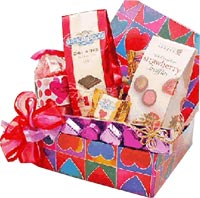
through a Sameena and Hisham are proof of the fact that apart from flower vendors, courier services often benefit at this time of the year. "On Valentine's, we have a lot of young people trying to send gifts to their loved ones," says Imran Nasir, a salesman at a courier store. The store charges for a consolidated service, and Nasir insists that the prices are reasonable, but admits that they are a little higher than the open market. "Normally, our company introduces special packages to incorporate roses, cakes, chocolates and gifts, and the price of the service range from anywhere between Rs500 and Rs4,000, although such packages have to be booked in advance," he says. "There are also customers who utilise the regular express service, because they want to buy something specific for their loved ones, and the cost ranges from anywhere between Rs600 and Rs3,000." Even amongst those who are married, roses still remain in high demand. Like Sameera and Hisham, Zarmeen and Fahd, a couple in their early thirties, also became romantically involved in school. "Back in school, Fahd courted me by sending me a bunch of roses on Valentine's Day as an anonymous admirer," Zarmeen recalls. "We have been together for so long that we have probably run out of ideas. From buying rings and watches, we end up buying household items now, but what has remained consistent is our tradition of buying each other roses." Fahd adds, however, that roses did not cost as much when he and Zarmeen started seeing each other. "I could get a dozen roses for about Rs120 but these days there doesn't seem to be a limit on how much," he says. "I often book them a week in advance to make sure I get a reasonable rate for fresh flowers." According to Shakeel, the flower vendor, a bunch of roses costs between Rs250 and Rs300 on ordinary days. "If a customer makes a booking for Valentine's Day early, he'll get the ordinary rates," he says. "For example, the roses that we supply to schools and colleges are bought at these rates, sometimes even lower, if the order is substantial. However, he warns that depending on the supply and demand, roses can cost anywhere between Rs350 and Rs500 on February 14. "In times of greater demand, we set our own price," he says. Salman and Ayesha don't have to go through such trouble. Ever since they "turned to Islam", they have stopped celebrating Valentine's Day. "When we started attending Dars, we came to believe that Valentine's Day is celebrated by Western cultures and religions and has no place in Islam," says Ayesha, a housewife in her early thirties. "There are already a number of days for spreading love in Islam, such as Eid Miladun Nabi. For us, February 14 is just another day now, and we don't make elaborate arrangements like we did when we got married some twelve years ago." The couple have three children, the eldest being ten years old. "You can't stop your children from knowing about these things. Schools celebrate it and their friends tell them about it. It's even on the media. But when Assam (the eldest son) comes home from school, he is encouraged to read the Quran instead. As parents, we don't make it an issue at home, and our children don't think of it as an issue." Zarmeen and Fahd disagree with this approach. "Wouldn't it be hypocritical of us to stop our children from celebrating Valentine's when we ourselves started going out on a Valentine's Day?" says Fahd." Islam has nothing to do with it; if anything, religion urges tolerance, and in times such as these, what's wrong with having fun?" For Fahd, it is essential for children to have fun, and if that means celebrating Valentine's Day, then so be it. "When we were children, we would go out and play cricket, go cycling, or just go outdoors with friends," he says, and regrets that children today cannot do the same. "City life has changed. Playgrounds have disappeared. Most children today are so intent on playing games and chatting on computers that schools are left as the major socialising venue. If children are having fun, who are we to stop them? Those who don't want to participate shouldn't, but no one should dictate why or why not Valentine's Day should be celebrated." --Photos by Zahid Rahman
Harmless fun? Religious parties argue that Valentine's Day is a Western invention and not part of Pakistani and Islamic culture, but not everyone agrees By Aroosa Masroor Debate over whether or not Valentine's Day is
'culturally acceptable' is not new. Every year, this day not only
attracts couples but also invites criticism from various quarters,
especially religious parties who find the celebrations abhorrent, or
worse still, a plot by multinationals out to impose Western culture in
an Islamic world. Many argue that the celebration is a harmless bit of fun, and that if one does not hesitate to adopt other Western trends, there should be no restriction in celebrating the day that has now gained popularity world over. "It's a cliché, but we can't deny that we are living in a global village," says Sabiha Afroze, a 22-year-old student of Business Communication. "Valentine's Day is celebrated everywhere else. What is the harm if Pakistanis do it too?" But religious parties argue that Valentine's Day is a Western deviation from the Pakistani and Islamic culture. "Why do we need to set a day aside to tell our loved ones what they mean to us?" is the common question Aliya Mansoor, Press Secretary of Jamaat-e-Islami, raises. "It is not part of our religion. The days set aside for celebrations [like Eid-ul-Fitr and Eid-ul-Azha] have clearly been mentioned. The rest of the days have been borrowed from the West." Mansoor admits that religious parties are deemed conservative by most, but insists that their intention is to tell everyone that love and brotherhood should exist throughout the year and not be restricted to a particular day. What concerns her especially is the negative connotations associated with Valentine's Day. "The celebration of Mother's Day or Father's Day promotes love between blood relations, and so is not criticised by religious parties," she says. "People go around saying Valentine's is also about expressing your love for your parents, siblings, or teachers, but let's admit it, we all know what the day promotes, and that is what I am against. Our younger generation should be stopped from the influence of the West," she asserts. However, Nuzhat Williams, President Young Women's Christian Association, believes there is no reason to be insecure. "Since Valentine's Day has become a part of global culture, it is wrong to associate it only with the West. Even Eastern states like Japan and Korea celebrate the day, as well and our neighbouring country, India," she says. Williams rejects the concept that the day has anything to do with Christianity. "Why is it assumed that the Christian community will mark the day differently? It is not a biblical festival and we have no celebrations in the Church nor does any priest sponsor this cultural event." However, there are some that say that since the Christian community tends to be more influenced by Western culture, the day carries special significance for them. Stacy Pereira is one such member of the Goan Christian community in Karachi who does not hesitate to admit that she looks forward to the day. "I think all big days associated with your loved ones like your mother, father, or teacher are commercialised. Why is there such a fuss about Valentine's Day?" Others believe that cultural festivals need to be seen through a broader horizon, rather than just be associated with religion. "Be it Basant, Mehndi celebrations during a wedding or Valentine's Day, I feel any cultural festival (borrowed from India or the West) that binds relationships and humanity should be welcomed with open arms," says Williams. "There is no harm in making your loved one feel special, because even Islam preaches us to love God and humanity."
Q. How do you celebrate Valentine's Day? By Sadia Hanif Arfeen Iqbal, 26, CEO: "I celebrate Valentine's
Day with my partner by giving her presents, like a Anum Opel, 21, student: "A good dinner with my date in a classy restaurant, loads of chocolates and a long stem rose is a prefect way to celebrate Valentine's Day and that is what I do. Also dressing appropriately and avoiding pinks and reds." Ayesha Asif, 28, freelance writer: "For me Valentine's Day is an occasion to take out time from your busy schedule and express your love for your loved ones, not specifically your spouse or a date. It can be your family or friends. I don't believe in spending too much money on buying precious presents, a single rose is enough."
Shaireen Aslam, 25, working woman: "I don't have a Valentine yet so I don't know how I will celebrate this day once I have a partner, but I think it should be about spending time with your loved one, having dinner and a nice chat. I also don't think there's any harm in celebrating it with one's mother, sister or even brother." Muhammad Hammad, 23, Officer Finance: "Nothing special because I think everyday is made for your loved ones and you don't have to wait for a particular day to express your feelings. This is day is for those who don't believe in themselves. For me everyday is like Valentine's."
Pital Gali: Reminder of the good, old days By Gohar Ali Khan Located behind the Sanitary Market in Gulbahar,
Karachi's Pital Gali is surrounded by sprawling but old buildings. The
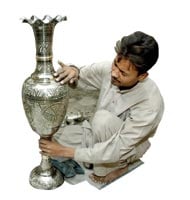
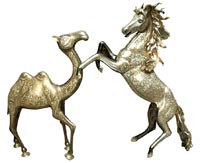
gali is known for housing shops selling brass items, skillfully crafted
by artisans. Pital Gali is the only market for fancy brass handicrafts
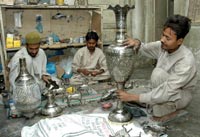
in the country, besides a few shops in Lahore. There are about 25-30 shops here with vases, animals, lamps, goblets, table candle holders, teapots, taverns, number plates, name plates, masks, mirror frames, lamp bases, carved ashtray, planters on hookahs for sale. Set up in 1956, most of the artisans and wholesalers-cum-retailers here hail from Muradabad, India. Saeed Akhtar, owner of Shalimar Enterprises (manufacturer and owner of brass handicrafts) in Pital Gali, said his business is flourishing because of foreigners who throng the street to buy brass items. In fact, he said that China is the biggest importer of brass handicrafts. From December to April, however, the import is suspended owing to snowfall (as the items are exported via road). Akhtar said there is a great deal of difference
between the items made in Muradabad and those crafted in Karachi. In
Muradabad, artisans make kitchen utensils, pots, bowls, colanders,
graters and sieves even today whereas in Pakistan, only decorative items
are produced. "It is more expensive to produce the latter," he
added. Recollecting the time when his business at its peak, Akhtar said
that many tourists visited the street to buy these decorative items.
"Our sales shot up to 95 per cent and this lasted between the
regimes of Zulfiqar Ali Bhutto and Zia ul Haq. Then the law-and-order
situation deterred foreigners from coming to Karachi. Now, we are just
dependent on exports for our income," he said. In fact, several
shops have closed down owing to the lack of foreigners. Mehboob Khan, a kiln owner in Gulbahar, said that there are now 30-40 brass kilns out of 100-125 in Gulbahar and adjacent areas – Duda village, Usmania Colony and Jehangirabad. Almost 5,000 people are directly involved in this business, while about 8,000-9,000 are connected to it indirectly. The crafting of such items, however, is not risk-free as the gas emitted from melting brass is injurious to health, with the result that many craftsmen succumb to lung disease. Thus, the children of these craftsmen are not inclined to follow in their predecessors' footsteps. So many kilns are closing down every day, he added. Some facts about brass: Brass is an alloy of copper and zinc. Some kinds of
brass are malleable only when it is cold; others only when hot while
some are not malleable at any temperature. All brass becomes brittle if
heated to a temperature near the melting point. The polish on brass products lasts for about one or two years, if care is taken to protect them from moisture. Brass sheets are brought from Gujranwala while local artisans buy old brass kitchen utensils at Rs200 per kg from locals and mould them into flower vases and planters. A single brass piece goes through about 10 artisans who melt brass sheets, weld, polish, paint, make designs and finalise it for sale.
Fuel-free power plant for Pakistan – if only someone would listen With rising number of protests against power shortages, the government should seriously consider the proposal of Anwar Ali to help generate fuel-free power By Adeel Pathan It is no secret that Pakistan is currently undergoing
its biggest power crisis in history. Authorities blame dwindling
finances while consumers blame the authorities for wrong policies and
mismanagement that leads to large-scale protests. But none of this
affects the authorities as consumers sink into What is a secret is that if Syed Anwar Ali's vision of a fuel-free power generation system were materialised, none of this would be happening. Ali, a father of four, is not a distinguished personality at his place of employment. He is a low-paid stenographer in the office of the general manager of the Water and Power Development Authority, and has few things to his name besides his small house in Latifabad Taluka, Hyderabad. But that has not dampened his zeal for stamping out the power crisis. Ali's fuel-free power plant is based on basic physics principles taught at Intermediate level. "All that is needed to generate power is to use combine gravity and velocity effectively," he informs Kolachi during an interview. "It is simple and cost-effective, if only the government would implement it. There would be no need for fuel, coal, or alternative energy." Ali is something of an authority on the matter, having researched it for 16 years. His truly is a novel idea – Ali swears he has checked everywhere, but not found any supporting research. However, this fuel-free power plant is relatively simple to install. "If a few billion rupees were invested into it, it can be done in any hilly or mountainous area and produce 100 megawatts of electricity," he says. Ali explains that the basic requirement for such a project is a 20-kilometre railway line, along with the conductor used in electric railways, 80 turbines (without an engine) capable of generating six megawatts of power each, four electric train engines, and 16 railway trolleys, apart from other materials. Six months ago, Ali submitted his proposal to WAPDA in Lahore, but is still awaiting a response. This is not the first time Ali has tried to bring his idea mainstream, he says. As long ago as 1992, he had submitted a similar proposal during the tenure of the then Prime Minister Nawaz Sharif, but to no avail. "I have requested the government to sponsor me," he says of his renewed proposal. To prove his eagerness, Ali has already submitted papers to all quarters detailing how his project would work, including President Asif Ali Zardari, the Water and Power Minister, but apart from Qazi Hussain Ahmed, Jamat-e-Islami chief, none have responded. Regardless of the lack of response from authorities, Ali is not ready to give up. He receives ample encouragement from both his family and from WAPDA engineers, and his next goal is to organise a conference for experts from universities to demonstrate his theory to experts of various universities. "Six months is all the project needs if it is implemented," promises Ali. "Then it will start producing results." Ali says he knew the country would soon plunge into a power crisis because of the rising population and rising cost of electricity that is why he sent a proposal in 1992. Had the government responded then, the sufferings of citizens could have been lessened.
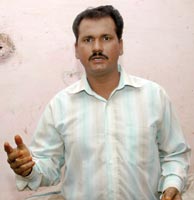
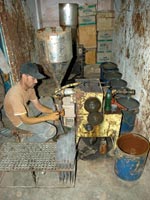
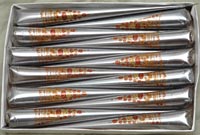
What goes into Mehndi, what people want out of it, and everything in between At the relatively young age of 30, Abd-ur-Raheem has firmly established himself in a trade of which most men know little about: Mehndi By Sabeen Jamil For seven years now, Raheem has been supplying mehndi cones at Meena Bazaar, and his clientele – wholesale shops at Meena Bazaar, mehndi girls, and beauticians from all over Karachi – swear by his special brand, also known as 'dhoom'. Meena Bazaar is widely considered to be the best
place in Karachi for high quality mehndi cones. Ten years ago, Raheem
started off there as the supplier of another brand of mehndi cone, but
since then, he has come a long way. Today, he has his own factory in
Orangi, where he and 12 other workers prepare, pack and supply their own
mehndi cones. He sells his cones to wholesale stores for Rs6 and for Rs15 at retail stores. Initially, he used to sell mehndi in bottles, followed by plastic wrappers, until he graduated to cones five years ago. Night and day, this is what Raheem does: produce, pack, and supply mehndi all over Karachi. Having done little else for a decade, Raheem is something of an expert on what goes into mehndi, what women want out of it, and everything in between. "A good mehndi cone is one that darkens for at least three days before fading away," he begins. "It should also have chemicals in just the right proportion – otherwise it can leave scars or cause itching." Raheem does not know how many different brands are sold at Meena Bazaar, but he does know that nearly all of them, such as Musarrat, Saira and his very own Dhoom, are of exceptional quality and high in demand. Like any mehndi cone worth its salt, Raheem adds that they all have a very pointed edge. "The women of today prefer more intricate designs," he explains. It may not seem like it, but preparing a mehndi cone
involves a host of different chemicals, including oxalic acid.
"Without the chemicals, you won't get a dark colour, and these
days, all our customers – especially brides – want a mehndi that
leaves a dark colour." All the chemicals that go into a mehndi cone can be found at Jodia Bazaar, and Raheem assures Kolachi that they are all of export quality. Mehndi makers, however, did not always have to resort to such measures before. For a start, a dark colour was not always the trend. Raheem points out that back when these chemicals weren't available, women would grind fresh henna leaves at home and leave the mehndi on overnight. For all their efforts, all they would be left with was a light mustard colour. "We don't get pure henna leaves anymore," says Raheem. "They are very expensive. Instead, we get a mixture of dry mehndi and other leaves from interior Sindh. Because the leaves won't produce a good colour on their own, we add our own chemicals to them." Raheem does not recommend that the chemical-mixed mehndi be applied to hair. "It can be harmful," he muses, but quickly advises, "You should check the quality of the mehndi first by applying it on your hands, because if it isn't safe in the first place, it can cause your hair to fall out. Also, it should be kept away from the eye, as it can cause infection." Apart from dark mehndi cones, traditional saadi
mehndi (plain mehndi), which looks green but leaves an orange imprint,
is highly popular. Also highly valued by his clientele are the red and
black mehndi, as well as what is popularly known as a 'glitter cone'. There is no 'typical' sales day for Raheem – all his sales depend on the time of year, such Eid and the wedding season. "Sales are usually high from the end of Muharram until Eid-ul-Azha," he says. "During that time, I manage to sell at least 4,000 cones daily." It is difficult to overstate just how big a role the right time of year plays, but the figures give some indication. "Out of season, I barely sell 50 cones a day," adds Raheem. Season or no season, Raheem has stuck to the trade for a decade now, and judging by how much in demand he is both in and out of Meena Bazaar, it does not look as though he will be shutting down his factory any time soon. – Photos by Naqeeb-ur-Rehman
|
|



 those in their early twenties more than it does to those in their late
twenties and early thirties. "Before we were married, we used to be
creative and thought of many different options," says Farooq Shah,
a banker in his late twenties. He remembers their time at school and
college when he and many of his friends were involved in societies that
celebrated Valentine's Day, although he adds that at times, they were
"juvenile".
those in their early twenties more than it does to those in their late
twenties and early thirties. "Before we were married, we used to be
creative and thought of many different options," says Farooq Shah,
a banker in his late twenties. He remembers their time at school and
college when he and many of his friends were involved in societies that
celebrated Valentine's Day, although he adds that at times, they were
"juvenile".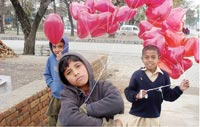 courier service. The chocolate cake wasn't very good, but it's the
sentiment that counts," she says, smiling at the memory."
courier service. The chocolate cake wasn't very good, but it's the
sentiment that counts," she says, smiling at the memory."
 bouquet of red roses, chocolates and by having a candle light dinner at
a fine restaurant."
bouquet of red roses, chocolates and by having a candle light dinner at
a fine restaurant."

 misery.