


|
|
|
|
 |
 |
  
|
Unpredictable,
never-ending tribute The
gypsy queen Art
of our time at another place
Pakistan once again is being asked to do more against the Afghan Taliban who may be hiding on its soil By Rahimullah Yusufzai Six years ago, Pakistan's armed forces launched their
first major military operation in the tribal areas bordering Afghanistan by
taking on the militants led by Nek Mohammad in Wana area of South Waziristan.
And right now the country's top generals are pondering their options at a
time of unrelenting pressure by the US and its Nato allies for further action
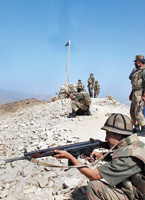
against al-Qaeda, Afghan and Pakistani Taliban along the Pak-Afghan border. A statement by military spokesman Maj Gen Athar Abbas on January 21 that Pakistan's "over-stretched" armed forces had no plans for undertaking any fresh anti-militant operations in 2010 could add a surprising new element to the situation and cause tension in Islamabad's often uneasy relations with Washington. In fact, his statement on the day of arrival of US Secretary of Defense Robert M Gates in Pakistan was seen as a snub to him and the Obama administration, which is pushing Islamabad to take action against all the militants, particularly the Afghan Taliban and their Haqqani Network, and everywhere in the tribal borderlands. Maj Gen Athar Abbas had a point when he argued that Pakistani military was not in a position to open new fronts as it was still operating in South Waziristan and in Swat and rest of Malakand region. The more than 150,000 troops busy in counter-militancy operations in several areas of the North-West Frontier Province (NWFP), including the Federally Administered Tribal Areas (FATA), cannot be prematurely withdrawn from still unstable places. Even Swat, Buner, Lower Dir and other districts in Malakand division where the military action was most effective aren't fully stable and would require the presence of security forces at least until 2011 or even beyond to keep the Maulana Fazlullah-led Taliban militants and ensure reconstruction of the damaged infrastructure and rehabilitation of the displaced people. Despite tough military action, militants in Bajaur and Mohmand tribal agencies haven't been fully defeated. In Bajaur in particular, the security forces claim on a daily basis that militants have been killed and their hideouts taken out in shelling by artillery guns and bombing by gunship helicopters. Attacks on security posts and roadside checkpoints are regularly reported, kidnapping for ransom have increased and thousands of uprooted Bajauris are still unable to return home due to insecurity and destruction of their villages. Displaced people from Bajaur constitute the largest chunk of population living a miserable life at the vast Jallozai camp in Nowshera. On January 20, the 72nd government school was blown up by militants in a campaign that has already targeted basic health units and other government buildings. All this is happening in spite of repeated claims by the military authorities, more so by the Frontier Corps officials, about the success of the operation in Bajaur. The situation in neighbouring Mohmand Agency is slightly better due to the rise of armed lashkars of tribal volunteers who, with the government backing, have taken on militants. Still militants in Mohmand Agency are often able to kidnap and kill heads of these lashkars, also known as peace committees, attack the security forces' outposts and plant improvised explosive devices (IED) to target military convoys and sometimes even civilians. The security forces are also busy in intermittent military action against militants in Kurram, Orakzai and Khyber tribal regions. The forces are also present in Darra Adamkhel and Frontier Region Bannu where military operations were launched earlier to tackle militants. The troops achieved success in evicting the militants from the Ferozkhel Mela area in Orakzai Agency and taking control of important roads approaching Kohat and Bara in Khyber Agency, which goes on Peshawar. There have been no vehicle-borne suicide bombings in Peshawar in recent weeks and this is largely being attributed to the militants' loss of control of Ferozkhel Mela and the unprecedented security measures on the roads leading to the city. However, the most important military operation in recent years was the one undertaken on October 17 last year in South Waziristan. It was much-anticipated and was launched after months of preparations. The military is now claiming to have taken control of 80 per cent of the targeted territory and killing scores of militants. However, most of the militants and their commanders managed to survive by moving out of harm's way and shifting to forested and mountainous areas in the remotest parts of South Waziristan or to other tribal areas. Until late last year, South Waziristan was headline news due to the military operation being carried out in that troubled region. Subsequently, reports about this volatile place started losing importance as the army consolidated its position in areas previously held by Taliban. Now parts of South Waziristan are again in the news due to the US drone attacks. The remote Shaktoi area is becoming known as a sanctuary of the militants affiliated to the Tehrik-i-Taliban Pakistan (TTP) who are fleeing the military campaign. It is the new hunting ground for the CIA-operated spy planes. Twice in three days last week the pilotless aircraft struck suspected militants' hideouts while tracking down the TTP head Hakimullah Mahsud. He survived but more than 30 people, mostly reported to be militants, were killed. As Shaktoi is still beyond the control of the Pakistani military, there is possibility of more US drone strikes in this mountainous area. Such attacks could continue until the military extends its control to Shaktoi or the militants opt to abandon this inhospitable place. It is possible that Hakimullah and some of his ranking commanders including Qari Hussain, the mastermind of suicide bombings, have already left Shaktoi and moved to a comparatively safer place. In the prevailing circumstances, such a place could be North Waziristan only. However, it might be a matter of time before the Pakistani security forces undertake some limited action against the militants in North Waziristan. This is now the major demand by the US and Islamabad has a history of doing, albeit reluctantly, whatever is demanded by Washington. It has been a while that US drone attacks have taken place in South Waziristan, apparently under a pact with the Pakistani military not to launch strikes in areas where the security forces are actively engaged in action against the militants or where uncertain peace agreements with the Pakistani Taliban are still intact. In the past though the US spy planes did attack certain targets in the Wana and Angoor Adda areas where militants affiliated to Maulvi Nazeer are in control. Thus fresh US drones strikes in the Wana, Angoor Adda and Shakai areas cannot be ruled out. The visit by the US Defense Secretary Gates to Pakistan for strategic talks couldn't have come at a more crucial time. He publicly stated in an article in this newspaper that only by pressuring all the militants' groups, whether the Pakistani and Afghan Taliban or al-Qaeda, and denying them safe havens on both sides of the Pak-Afghan border could Afghanistan and Pakistan with help from the US and its allies get rid of this scourge for good. His message was loud and clear and it was that maintaining a distinction between some violent extremist groups and others was counterproductive. And it meant that the US wanted Pakistan to expand its ongoing offensive against militants by tackling the Haqqani Network and other Afghan Taliban groups that launch cross-border attacks in Afghanistan. In plain words, Pakistan was once again being asked to do more against the Afghan Taliban who may be hiding on its soil and allegedly having close ties to the military and its intelligence agencies. This is now the most contentious issue between Pakistan and the US and its resolution or otherwise would define the future of their often unpredictable relationship.
Haqqani factor
By Mushtaq Yusufzai In their eight years of occupation of the war-ravaged Afghanistan, the US-led foreign forces have been facing the toughest-ever resistance from the Taliban, particularly the powerful Haqqani network, the Taliban faction led by Sirajuddin Haqqani. US military commanders admitted that 2009 was one of the deadliest years for the foreign forces since their invasion of Afghanistan in October 2001. The Taliban militia surprised their enemy with brazen and successful attacks on their military camps, which until recent past were considered safe and beyond the reach of militants. In the scenic and remote provinces of Nuristan and Kunar, the Taliban for the first time entered highly fortified US military camps and swooped on US and Afghan soldiers. Heavy casualties prompted US military commanders to abandon some of their outposts in Nuristan, bordering Pakistan's troubled Bajaur tribal region and Chitral district. Besides Kunar and Nuristan, Afghanistan's border provinces with Pakistan such as Khost, Paktia, Paktika and Helmand as well as the distant province of Logar and the capital Kabul turned out to be strongholds of the Taliban where they attacked US and allied forces repeatedly. The dominant Taliban faction, the Haqqani network -- as referred to by the western media -- is based in most of those troubled spots where the US-led forces suffered heavy losses. The fearless Taliban commander, Sirajuddin Haqqani, son of veteran Afghan Mujahideen leader Maulvi Jalaluddin Haqqani, is now leading the dreaded militant network. Maulvi Jalaluddin Haqqani is a jehadi commander and belongs to Afghanistan's most restive Khost province. He started his career as a military leader with radical Islamic group Hizb-i-Islami, led by Maulvi Younas Khalis, to fight against the Russian forces in 1979. Besides holding several other key positions in the Taliban regime, Jalaluddin Haqqani was minister of tribes and frontiers when their government was toppled as a result of US-led invasion. In the 1980s, he was an ally of US Central Intelligence Agency (CIA) in their joint war against the Russians. It was this aged jehadi leader who, days before the fall of the Taliban, had predicted "Afghanistan will prove to be a graveyard of US and its allies". Having close ties with Arab militants, particularly al-Qaeda leader Osama bin Laden, the influential Jalaluddin Haqqani easily raised his force and launched an armed struggle against the occupying forces. Osama bin Laden was reportedly his close friend and guest who helped him build the famous Zhawar training camps. The US and other Nato commanders consider the Haqqani network as a separate militant faction -- other than the mainstream Taliban led by Mulla Omar. There have been some reports of rivalry between Jalaluddin and Taliban leader Mulla Omar, and the exact extent of their military coordination remains unclear. With growing age, Maulvi Jalaluddin Haqqani stepped down, leaving the faction to be led by his eldest son, Sirajuddin Haqqani. Sirajuddin, 29, has so far interacted with the media twice. The US and Afghan government officials blamed his network for some of the biggest attacks, including the attack during national parade in Kabul in which President Hamid Karzai survived an assassination attempt and the suicide bombing at the Serena Hotel in the Afghan capital. His group is also believed to have helped the Jordanian double agent, Dr Humam Khalil Abu Mulal al-Balawi, carry out suicide attack on the CIA station in Khost province. In his latest interview with this scribe at a secret location in Afghanistan's Paktika province, Sirajuddin denied reports of Saudi Arabia-sponsored peace negotiations between them and the US. He termed media reports about the Taliban's talks with the US propaganda by the anti-Taliban elements. He said they had now acquired modern technology and weapons to inflict heavy losses on their enemy. Sirajuddin carries $5 million head money. Sirajuddin also travels freely around Afghanistan as most of the people do not recognise him because he has never been photographed. Asked about US allegations that the Haqqani network has helped al-Qaeda in establishing safe havens in the tribal areas between Pakistan and Afghanistan, he said Taliban were thankful to al-Qaeda and all other Mujahideen who had come from all over the world to fight alongside the Taliban to liberate their country. He claimed Afghan intelligence officials were sympathetic to the Taliban and they often communicate the movements of the occupying forces (US and Nato) to them. He said like Mulla Omar, he had always been pleading with his Pakistani militant brothers to focus attention on Afghanistan instead of fighting against their own security forces and killing fellow Muslims.
A thinking artist Combined with an immeasurable talent, Asim Butt (1978-2010)
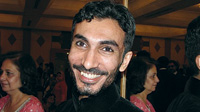
was an intuitively By Nafisa Rizvi The news of the death of artist and activist Asim Butt
sent a seismic tremour across the vast network of his friends, teachers and
family, in part due to the fact that the news was entirely unexpected but
more because he was a rare individual and a thinking artist. Asim Butt was born in Karachi in 1978 and moved to Singapore with his parents when he was only 9. There he took to the nurturing educational environment like a fish to water and was introduced to the arts — painting and theatre as well as environmental politics. He wrote of that time "my teenage bleeding heart gush(ed) for the plight of the dolphin and the culling of rainforests". He returned to Pakistan at 15 but was uncomfortable with the local school atmosphere and talked his parents into sending him to boarding school in Hong Kong where he attended the United World College. At the insistence of his parents, however, he returned to Pakistan and went on to do his B.Sc from LUMS, Lahore. Consequently, he enrolled in a Ph.D programme at UC Davis, where he connected with an artist and printmaker and participated in an exhibition of paintings which turned out to be a watershed in his life. He knew then that he had to pursue art as a career and returned to Pakistan once again and took admission at Indus Valley School of Art and Architecture, where he completed the four-year course with flying colours and received a distinction for his degree show. Asim Butt was as much an artist as an activist. He painted
a mural near Abdullah Shah Ghazi in Clifton Karachi as a response to the
US-led Shock and Awe military campaign against Iraq. While he was working on
the mural, he encountered many glue-sniffing children and began to campaign
for them through another mural with his friends. A year later he attended the
World Social Forum in Mumbai and worked with great zeal and urgency on an
anti-war mural with two Swedish graffiti artists. The walls on the streets of Karachi witnessed a lot of his resentment against the emergency in Pakistan as he painted the "Eject" sign in myriads of spots across the town. He was an active member of the People’s Resistance group. Asim Butt held a very successful solo show at Rohtas in Islamabad in 2009 and was preparing for a two-person show in March 2010 at Canvas Gallery in Karachi. Butt was unusually erudite for his young years. He engaged
himself prolifically with the theory of not just art but society and history
and philosophy — all of which enriched his art immensely. Combined with an
immeasurable talent, Asim was an intuitively gifted painter, although his
continually compelling need for analysis and harsh self criticism filled his
mind with unnecessary doubts. His teacher at Indus Valley and a sensitive
artist herself, Naiza Khan reminisced about her "There are some students," says Naiza, "who learn from their teachers but move on without looking back. Others, like Asim, become dear friends whom one can rely on for advice. He would always be there to talk me through the times I felt uncertain about a particular work I was doing. I will miss his generosity, intelligence and spirit".
In memory of Asim I want to live I want to be loved I want to return to innocence I want to be free "No, they said, that is not your lot Take this life of hurting and don’t complain So much talent would be enough we thought Now shoo! and don’t be insane" There’s so much to do, I’m getting late See that guy in the picture? I have left him undone but can he wait? He’s calling me, much to my discomfiture I walk the streets at night It’s quiet so I can hear my mind Get this on camera, the boys are starting a fight Ah! Meat for my next canvas, what a find! My day is coming, it will be exciting! I will bask in the glory of my paint They will revel and I will be thrilling This time, I’ll try not to faint! But perhaps it will not be so rousing Maybe there will be revulsion and distaste On the outside they will be smiling Yet needing to leave in haste The voice of doubt is my affliction They told me I was good at what I had begun But I need redemption For the sins I haven’t done Should I go or wake to another day The door is closed but it looks ajar I’ve held the impulse at bay But I’m tired and need to travel far I want to live I want to be loved I want to return to innocence I want to be free —Nafisa Rizvi
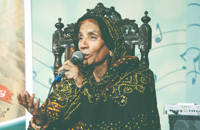
Folk artistes paid tributes to Reshma through their performances at a concert in Alhamra Lahore By Sarwat Ali Reshma is an artiste we all love. She has given us so much pleasure and satisfaction by rendering her repertoire of folk music which intoned the ethos of the area and the land that she belongs to. She has also carried the banner of the country to many a forum, performing before the mighty and the sensitive, always earning a bouquet of accolades in return. For some time, she has not been well and, unfortunately,
at times had to appeal for help which has been forthcoming from many quarters
including the government. It would have been better if all this had not been
done in full public view. A more appropriate path of helping her out was chosen by the Alhamra in Lahore last week when a concert was organised for her. It was a good gesture because other well-known folk artistes like Shaukat Ali, Arif Lohar and Surraiya Khanum also performed at the concert to pay their tribute to vocalists who had in some ways dominated the world of folk music for the past four decades. In other societies, one way of helping an artiste out is to organise benefit concerts and then there are many organisations and charities that can be approached for support in such dire circumstances. Here, the working of many organisations and also the government departments is not very streamlined and the support is often left more to personal contacts and initiatives. Reshma’s daughters, Shazia Reshma and Robi Reshma, also performed at the concert; it was a nice gesture but one only wished that they either had the talent or the perseverance of their mother. It may be a little unfair to judge the next generation in comparison with the parents for an outstanding artiste is a chance happening despite all the trappings of nurturing talent. Reshma comes from the family who, as gypsies, has roamed the large deserts of Punjab, Rajasthan and Sindh, moving from place to place in their nomadic style. They have also been repositories of some of our most ancient forms of the performing arts as they have carried with them the very traditional art of string puppetry and often seen performing with their tales and melodies which are centuries-old. At the same time, many of them have been the carriers of the very traditional music of the area and have learnt and developed their art forms though inheritance and sheer natural talent. Reshma too was spotted in a mela by an official of the radio and invited to more formal platforms to expresses her immense talent. Most of her life, even as a very well-known person, she lived in tents and temporary huts, set up on the outskirts of the cities, particularly Lahore. Many of the great performers of the past have hailed from the same background. One of the greatest vocalists, Gokhi Bai, instrumental in bringing together the flavour of her background with the classical forms — dhrupad and kheyal — was a gypsy whom the great Behram Khan heard in the desert and immediately decided to make a shagird. It is also said that the new emerging gaiki of the kheyal by Niamat Khan Sadarung was popularised by the gypsy women whom he had trained during the days of his hiding. These gypsies have been associated with the arts, particularly the performing arts, for ever. It is said that all the gypsies that straddle Europe till Spain originated here and then migrated over millennia. In those countries, too, they have been involved with the performing arts, particularly singing and dancing and in the process have produced great artistes. Our folk puppetry, too, has been practiced by the gypsies who originally were inhabitants of Rajasthan and then moved to the fringes of the big cities. They have carried their ancient art of string puppetry with their repertoire of stories that were popular in the Mughal or regional courts, and till very late were also quite apt at reproducing the songs which have travelled with their melodic structures through the centuries. In our culture also, many musicians have hailed from this background, the most prominent these days being Nasibo Lal. Her exceptional talent has sprouted in the environment that the family inheritance has provided. There are many others but not that well-known, who form the second and third tier of performers in our society. Unfortunately, as in other areas, their contribution has not really been documented and preserved. In ancient societies, the documentation was done either at the royal courts and probably religious institutions but very few could make it to the courts coming from their background, and here the religious establishment was certainly dismissive. Reshma sang some of her famous numbers as indeed did the daughters. The other artistes like Shaukat Ali, Surraiya Khanum and Arif Lohar, too, presented a mixture of their own popular numbers as well as those sung by Reshma. Usually, in our music tradition, the highest form of paying a tribute to another artiste is to sing his or her composition or chiz. In the same tradition the shagirds usually sing the chiz of their ustads and this over generations becomes a prized artistic possession of the gharana. Every one wished Reshma well and prayed for her speedy recovery. Alhamra does organise programmes from time to time and one only wishes that the frequency of the good quality music, which is not always supported by popular taste and commerce, is promoted more.
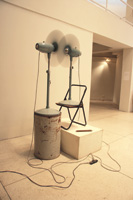
Art of our time at another place A rare exhibition of contemporary Pakistani art at Devi Art By Quddus Mirza As art can not be divorced from the changes in a society,
a number of influences and currents have altered the perception of artists
and the production of contemporary art in Pakistan. Like other areas of
culture, visual art has also changed - with the introduction of internet,
emails and cellular phones. An important aspect of communication development is the way it has rendered the sense of place meaningless. For instance, one can correspond to a man through email, without having a definite idea about the residence of the person; an email requires equal time, no matter if the addressee lives in Lahore, Laos or Lagos or even in the same street. Likewise for mobile phone; the person can be away from his own city or country, but can still convince you that s/he is very much at home sipping coffee or reading a book. This change in our living patterns, made possible by advanced technology, has been crucial in invoking a general sense of moving beyond borders, even while one is at a particular place. Interestingly, in the present times, one hardly hears the word 'root' in the context of art and culture the way it was used to decode art pieces and to describe the creative process in the past. "Roots" in the words of Amin Maalouf: "burrow into the ground, twist in the mud, and thrive in darkness; they hold trees in captivity… Trees are forced into resignation; they need their roots. We breathe light and covet the heavens. When we sink into the ground, we decompose." Correspondingly, artists of our era have recognised the restriction of being fixated in tradition, limitations of locality and inherent dangers of turning exotic both in their own land and outside. Responding to these changes in the society and thoughts, the work produced in the last decade of Pakistan reflects an international approach towards art and deals with the artists' position in a global village. All of this is visible in the exhibition, 'Resemble, Reassemble', being held from Jan 16- May 10, 2010, at Devi Art Foundation in Delhi, India. Curated by Rashid Rana, works of Pakistani contemporary artists have been selected from the collection of Anupam Poddar, the Director of Devi Art Foundation. For some years, Poddar has been acquiring contemporary art from Pakistan; the exhibition serves as a great sight - to view the new works created in the last 10 years, at one place, and in a different context. The works are arranged according to various themes, concerns and imagery. The exhibition confirms that, besides multiple subjects, the formal dimension of contemporary art in Pakistan, during the current decade, has transformed tremendously. A number of artists, being conscious of the vocabulary of our times, are now creating works in a variety of mediums, including digital prints, installation and video installation. Although some critics, artists and viewers still consider these techniques alien to its environment, ironically such forms of expression, especially video and digital printing, have been in use in the Pakistan's domestic context more than in the art world. Computer is now an indispensable part of an ordinary person's life. Thus, for a majority of population who uses computer, digital printing is not a strange process; for them printing a text or a picture on their computer printer is as simple and familiar as scribbling with pencils or applying coloured markers. Hence the artists, who prefer digital prints for their works today, are in harmony with a culture that has already adapted and accepted computer-printing and digital-photography. Likewise, the video installations do not remind of Western aesthetics as much as they are connected to the indigenous practice of documenting every important family function in video. Thus, the artists, employing video and other tools and techniques as their means of expression, are negotiating in a language that is widely understood by the public - both in Pakistan, India and other parts of the world. |
|

 association with him. "Only a shadowy second thought keeps me from
reaching instinctively for the phone to call him and say "Ab uth jao,
Asim, there’s so much work to be done. He was one of the most talented,
inquisitive, restless and challenging students I have had the pleasure to
teach in my 17 years at Indus Valley... always getting into scrapes with the
administration, and never one for authority".
association with him. "Only a shadowy second thought keeps me from
reaching instinctively for the phone to call him and say "Ab uth jao,
Asim, there’s so much work to be done. He was one of the most talented,
inquisitive, restless and challenging students I have had the pleasure to
teach in my 17 years at Indus Valley... always getting into scrapes with the
administration, and never one for authority".