



|
|
|
|
 |
 |
   |
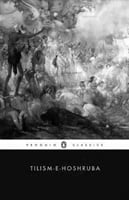
review By Sarwat Ali Tilism-e-Hoshruba Translated by Shahnaz Aijazuddin Publisher: Penguin Books, India, 2009 Pages: 906 Price: INR 650 Our literature, in its middle period -- from the onset of the Sultanate period till the 19th century -- went into obscurity during the colonial period and has remained so even during the post-independence phase. Even the literature that was written during the height of the Muslim civilisation -- the Umayyad and the Abbasid dynastic reigns had been pushed into the background and is not considered useful in the cultivation of the sensibility of our youths. A
word about letters
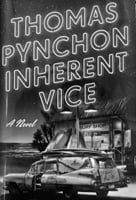
Master strikes back With his latest novel, Thomas Pynchon is having a late-career burst of productivity By Rafay Alam Inherent Vice By Thomas Pynchon Publisher: Jonathan Cape, London, 2009 Pages: 369 Price: Rs 1790 For some book enthusiasts, the American novelist Thomas Pynchon is the Mount Everest of authors. V, Gravity's Rainbow, Mason & Dixon are, but for the few bravehearted, dense, complicated novels with sub-plots, satirical asides, hidden analogies, quirky characters and, for fun, pizza! For those who manage to reach the end of a Pynchon Book -- and all will stop, at length, to tell you -- Pynchon is a master of his craft. An author's author. The Pynchon book is much like its reclusive author: Thomas Pynchon has, famously, never been seen publicly, does not give interviews and there are only a few, very old, photographs of him known to be in existence. Clearly, a desire to be adored, or read, does not concern Pynchon, who only likes to write better and better satires of the life and times of under-the-carpet USA. He corresponds almost solely through his agent and publisher, but this has not diminished his reputation as one of literature's living masters and stature as American cultural icon. Pynchon has appeared, for example, face either pixilated or covered in a brown paper bag, as a character in The Simpsons cartoon series. To paraphrase Alfred E. Neuman, you ain't no one until you've appeared in The Simpsons. Pynchon's latest fare, Inherent Vice, is a joy for those un-initiated, like myself, into his particular world. Inherent Vice begins as a clichéd "old-Los Angeles" detective thriller. A girl walks into a private investigator's office and so on. But the detective in question here, Doc Sportello, grown from beach bum into the "loan recovery business", has seen one too many joints in his experience, and is best described as halfway between The Big Lebowski and the Fletch series. Doc is asked by an old flame to watch out for her boyfriend, property developer Mickey Wolfmann. On the outset, at page 3, Pynchon puts both Doc and reader on guard with the following, brilliantly executed, passage: "Shasta named a sum. Doc had outrun souped up Rollese full of indignant smack dealers on the Pasadena Freeway, doing a hundred in the fog and trying to steer through all those crudely engineered curves, he'd walked up back alleys east of LA River with nothing but a borrowed 'fro picked in his baggies for protection, been in and out of the Hall of Justice while holding a small fortune in Vietnamese weed, and these days had nearly convinced himself all that reckless era was over with, but now he was beginning to geel deeply nervous again. 'This isn't just a couple of X-rated Polaroids, then. Dope planted in the glove compartment, nothing like 'at… " And throughout, observations stand out: "On certain days, driving into Santa Monica was like having hallucinations without going to all the trouble of acquiring and then taking a particular drug, although some days, for sure, any drug was preferable to driving into Santa Monica." I've never been to Santa Monica, but the sentiment sounds true enough to fit any number of cities. With the weirdness and wackiness, Pynchon draws the reader into an incredibly fun -- and accessible -- yarn of a who-dunnit. We meet crazy characters, are wound through the odd acid trip and are shown the intricacies of an underworld only the mind of Thomas Pynchon could imagine. At the same time -- though I'm only half way through and this is a mid-read review -- Pynchon tunes the reader into the paranoia that was the 1969 and The Summer of Love. Too many associate The Summer of Love with hippies and Woodstock, but few realize the repercussions Charles Manson and the Sharon Tate Murders had on the American mindset: "Wondering what this was about, Doc, trying to be helpful, said, "Well, what I've been noticing since Charlie Manson got popped is a lot less eye contact from the straight world. You folks all used to like a crown at the zoo -- 'Oh, look, the male one is carrying the baby and the female one is paying for the groceries,' sorta thing, but now it's like, 'Pretend they're not even there, 'cause maybe they'll mass murder our ass.'" Let's see what more fun and games Pynchon has up his sleeve. With one hundred pages to go, I'm convinced that Pynchon is going to turn this detective mystery on its head. I can't wait to see the Master at work. For the slightly intimidated, there's an Inherent Vice wiki explaining the puns and character spirals somewhere on the internet. Rafay Alam is a lawyer who spent the long weekend reading Inherent Vice Inherent Vice is available at The Last Word in Lahore and Karachi. The great dastaan Shahnaz Aijazuddin's restrained translation is surprising and admirable By Sarwat Ali Tilism-e-Hoshruba Translated by Shahnaz Aijazuddin Publisher: Penguin Books, India, 2009 Pages: 906 Price: INR 650 Our literature, in its middle period -- from the onset of the Sultanate period till the 19th century -- went into obscurity during the colonial period and has remained so even during the post-independence phase. Even the literature that was written during the height of the Muslim civilisation -- the Umayyad and the Abbasid dynastic reigns had been pushed into the background and is not considered useful in the cultivation of the sensibility of our youths. The reason at one level is quite simple and rests with our colonial encounter. The critical canons that were developed during the 19th century obviously placed novel and then subsequently short story above that of romance. The Aristotelian canon of the plot, having a casual relationship was not that easily applicable to the dastaans and hikayats that formed the main bulk of our fictional output. The dastaans and hikayats were considered bordering on fantasy and hence not worthy of the kind of critical attention that was needed in the changing and expanding landscape of knowledge. This may not entirely be true -- because the change of language has robbed us of the treasure trove of our literary background. The writings in Arabic and then Persian have become totally inaccessible to the readers fed on Urdu and English. This disconnects with our major classical languages and even regional languages have been a great tragedy that has not really being redressed since Independence. The colonialists, however, did make an attempt and a wholesale one to understand the classics of the languages that were spoken here through translation. Fort William College was one such institution where learned men of letters were employed to translate the classics of Persian, Arabic and Sanskrit into Urdu and some translations were also made in English. The great bulk of understanding of the literature of the middle phase has been through these translations done during the 19th century. There has been certain shyness about the wholesome acceptance of the artistic output of the past, because it does not measure up to the walls of prudery that have been enacted and collide with our reconstruction of the past. The past is dreamt of as a period that was idyllic, where milk and honey flowed and the tensions and conflicts that have besotted mankind were either not endemic or were seen as successful missions against evil designs of the enemy. Similarly, the concept of morality has debarred us from taking a look and understanding the past in far more liberal and human terms than the dictates of an ideological imposition. The greater part of literature and even the visual arts are been put to censorial editing -- may it be Rumi's poetry or the works like the Arabian Nights or Dastaan-e-Amir Hamza. There has been a revival of sorts of the classical languages -- Arabic and Persian -- and these probably have been reinforced by the changes in the literary canons which now seek freedom from the Aristotelian unities as reinvented through renaissance/neo-classicism. The stream of consciousness and then magical realism did open up the doors of the high literary establishment to the variety of literary outputs, the great cultural mix that facilitated and nurtured that creativity. Dastaa- e-Amir Hamza is an amorphous tale that covers thousands of pages and it draws from all possible sources, mostly from the Arabic and Persian treasure troves that basically were romances and which had a history that went farther back and dipped into the historical consciousness of the people inhabiting the area. These romances were transnational and transcontinental, and travelled with ideas and views of civilizations as they spanned across a territories and peoples. In India, during the Muslim rule, various romances were created and narrated and one such, which was asserted with greater authority, was Dastaan-e-Amir Hamza. Probably the great interest that Emperor Akbar took in the enterprise made it a more definite entity and was not left solely at the disposal of the narrators who in the manner of the oral tradition built upon their stock of information under compulsion of creativity and the performer's craft of improvisation. It may have become more tangible since the text too was illustrated and left less to the vagaries of time. The illustrations in the manner of the art of the book too have their worth in the development of paintings in the subcontinent. Tilism-e-Hoshruba is probably part of the encompassing romance of Amir Hamza and this too runs into volumes. When it was decided to have it printed in the 19th century in Lucknow, it was reclaimed from the memories of the great dastaangos of the time like Mir Ahmed Ali, Amba Prasad Rasa, Ghulam Raza, Ahmed Hussain Qamar and Hussain Jah. These dastaans were now in Urdu, which was the lingua franca of the people and probably part of a vibrant tradition of dramatically narrating the dastaans, an act that could have lasted an entire night. This living tradition lingered on till the early part of the 20th century. Since it is no longer a living tradition and is on the accelerated road to extinction, the need to preserve Tilism-e-Hoshruba was greater now. But one wonders what made Shahnaz Aijazuddin take on her monumental task. Other than her fascination for the Dastaan and Tilism, which she was exposed to as a precocious young woman growing up in an environment of great protection, the effort of Shahnaz Aijazuddin in translating the Tilms-e-Hoshruba into English is quite remarkable. She went back to the texts and the work of Rias Ahmed Jaffery in her great toil. She had been known for her flair for the written word but her patience and studied scholarship, which informed her restrained translation, is surprising and admirable. The thousand pages of translation are quite commendable and ease the journey into our historical consciousness.
By Kazy Javed New concept of history A British historian was in Lahore recently to remind us
that the concept of historiography has greatly changed and history is no more
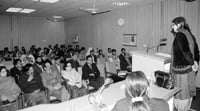
taken as a statement of achievements, failures and misfortunes of New trends of historiography are usually labelled as "new history." But the term is not new. Lacque La Goff, a noted French historian of the Middle Ages, used it as the title of one of his books. The new concept of history, however, developed during the seventh decade of the twentieth century when historians expressed reaction against the narrow framework of the traditional historiography. Many of them started thinking about new approaches in India, Japan and South America. They were guided by the ideas presented earlier by R.H. Tawney, Lewis Namier, Karl Lamprecht, Emile Durbhein and, of course, Karl Marx. Dr Sarah Ansari teaches history at Royal Holloway College of the University of London and her lecture in Lahore was arranged by Punjab University's Centre for Pakistan Studies which has emerged in recent years as the most dynamic department of the university arranging international and national conferences, seminars and discussions besides publishing books and journals since Dr. Mussarrat Abid took over as its director. "Pursuit and production of History" was the topic of Dr. Sarah Ansari's lecture who urged her Pakistani counterparts to get out of the traditional circle of history and throw light on various other aspects of the past. She expressed the view that while some Pakistani historians had done laudable work on the political past of their region, many other aspects of history have largely remained in the dark. History, she said, "was a living process and there was a lot to explore for historians in Pakistan."
Orwell's bungalow The collapse of Communism has turned George Orwell out of
limelight. He is no more talked about as much as he was during the days of
the Cold War. This is because his two novels, Animal Farm and 1984 were taken
as intelligent critique of the communist society and state. He is still,
however, The centenary celebrations of Orwell's birth were held around the dilapidated bungalow in 2003 where an Indian non-governmental heritage foundation announced to undertake the renovation of the building. But no progress was made. Now the Bihar government has come up with a plan to protect it. In a recent newspaper report, Bihar's art and culture secretary was quoted as saying that the state government "will not allow George Orwell's ancestral house, where he was born, to be lost to history. The government priority is to protect t it followed by renovation… The government has initiated the process to declare it as a protect site in early 2010 and to start renovation." Orwell lived in his father's Motihari house only for a year as a child before he left for England in 1904 with his mother and sister. He never returned to his birthplace and died in 1950. But it is said he cared for India all his life.
Poet and society Zahid Masood is proud of belonging to Wazirabad, the town known for producing orators, journalists and poets. He is a poet but says many of our poets are products of the Urdu Bazaar. They print their collections of poetry at their own expenses and distribute them among people to get fame. But, the tragedy is that their books are not read even by those whom they are given free of cost. After composing poetry for a quarter of a century and publishing it in a number of literary journals, Zahid Masood has now published a long poem in the form of a booklet. Published by the Book Home publishers of Lahore under the title Shahr-e-Aashob, it presents a critique of our contemporary life. The poet believes that our society has lost its creative energy with the result that the destructive elements have become terrible strong. They are now killing our social and moral norms. Amjad Tufail says the poem bears witness to our decaying society and will be remembered as such in the times to come.
Shaam turns 70 The friends and admirers of Mahmood Shaam will be
congratulating him for completing 70 years of a creative and successful life
on 5th February. I have been reading pieces of his poetry in various Mahmood Shaam is a good poet. However, he realised in 1972 that he could enjoy a more successful life as a journalist when, at the age of 32, he got the opportunity to visit foreign countries as a member of Prime Minister Bhutto's delegation. He has been paying more attention to journalism than poetry since then with the result that he is now serving as group editor of a daily. But he frankly admits that poeticising has greatly helped him in making his mark in the world of journalism that, in turn, has provided him with the opportunity to watch the world closely. The achievements of Mahmood Shaam have highlighted by the literary Journal Chahar so which was founded by the late Zamir Jaffery and is now published regularly by his son Gulzar Javaid from Rawalpindi. The current issue of the journal carries a special section on Mahood Shaam in its January 2010 issue.
|
 great men. Even the days of accepting it as, in the words of the famous
Cambridge professor of history Sir John Seeley, the story of the past
politics, have passed away. It has spilled out to many other spheres of life
and preference is now given to writing economic, social, cultural and
intellectual history.
great men. Even the days of accepting it as, in the words of the famous
Cambridge professor of history Sir John Seeley, the story of the past
politics, have passed away. It has spilled out to many other spheres of life
and preference is now given to writing economic, social, cultural and
intellectual history.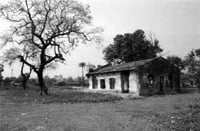 counted among the important writers of the past century and steps are being
taken to preserve his birthplace in the Indian state of Bihar where he was
born on June 25, 1903. Orwell's father Eric Arthur Blair was at the time
working as an employee of the opium department of the Indian Civil Service
and lived in a white colonial bungalow in the small town of Motihari in
eastern Bihar near the border of Nepal. Damaged in an earthquake in 1934, the
house in now occupied by a local schoolteacher.
counted among the important writers of the past century and steps are being
taken to preserve his birthplace in the Indian state of Bihar where he was
born on June 25, 1903. Orwell's father Eric Arthur Blair was at the time
working as an employee of the opium department of the Indian Civil Service
and lived in a white colonial bungalow in the small town of Motihari in
eastern Bihar near the border of Nepal. Damaged in an earthquake in 1934, the
house in now occupied by a local schoolteacher.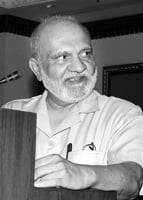 literary journals for many years but do not know exactly how many volumes of
verse he has to his credit. His first collection that I went through was
published in 1971 under the title Akhari Raqas. It carried Shaam's poems
besides Urdu translations of some foreign poems. His latest book is a
collection of poems written for children and was published a few months age.
They must be interesting as well as educative pieces composed during the
author's second childhood.
literary journals for many years but do not know exactly how many volumes of
verse he has to his credit. His first collection that I went through was
published in 1971 under the title Akhari Raqas. It carried Shaam's poems
besides Urdu translations of some foreign poems. His latest book is a
collection of poems written for children and was published a few months age.
They must be interesting as well as educative pieces composed during the
author's second childhood.