


|
|
|
|
|
 |
 |
   |
city 45
minutes in a public bus TOWN
TALK issue Signs
of hope
city Suggesting substitutes By Suhail Akhter & Ali Sultan The proposed Lahore Canal Road widening project from
Dharampura to Thokar Niaz Baig, aimed at improving transportation in the
city along the canal, is being widely debated. The court has sought
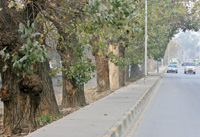
suggestions from different quarters to solve the problem. Some professionals and concerned citizens suggest all parties to interact with each other by exchanging information and ideas and benefit from the experiences of the outside world. People using 14 kilometres stretch of the road and residents on both sides of the road prefer spending a few more minutes on the road during rush hours to cutting trees. Suggesting a solution to the issue, an official of Nespak, requesting anonymity, says the organisation has sent different proposals to the CM Secretariat for ensuring smooth traffic flow on the road. He says the best way to end clogs on the road is to streamline the service roads along the canal and remove encroachments. "The residents on both sides have encroached upon a large chunk of the service road, thus making it impossible for commuters to pass through the road but unfortunately influential people living on both sides have opposed the plan which resulted in burden on the main road." The official says this will spare the chopping of over 5,000 mature trees and taking away of 51 acres of green land from the general public which is in violation of the city’s master plan. "The project is against the spirit of the Pakistan Environmental Protection Act, 1997." Abdul Razzaq, an agriculturist says felling of trees is a blessing in disguise. "Uprooting of eucalyptus would be beneficial because the trees consume more water and result in early depletion of underground sources." He says the government should go with the uprooting of trees and plant indigenous trees in an organised way. Abdul Razzaq adds that changing the place of trees is normal in most developing and developed countries whereas it has become a national problem in our country. In these countries trees are uprooted and placed in new places without any hurdle. Pakistan should adopt this technology instead of engaging institutions and departments on just the tree issue. Steel flyover is another solution suggested by some officials of C&W Department because they say the mechanism is easy to install and remove. This practice is in place in different countries of the world, they say. Imposing speed restriction and dividing the canal road in two lanes is another solution presented by officials of Traffic Engineering and Planning Authority. The officials say motorcycles, rickshaws and other vehicles should be kept in the slow lane and two lanes should be given to high speed vehicles. They say such requests are likely to fall on deaf ears, as has been the norm. It is appalling that the authorities out on an unnecessary road-widening spree should be so dismissive of the environment concerns. Environment impact assessment has failed to take alternative routes or transport options into consideration. They see certain steps of the government like the formation of Lahore Transport Company to sort out the traffic problem, assuring all parties that for every tree felled four trees would be planted, as positive gestures. For some concerned citizens, the solution lies in overhauling of public transportation system and improving traffic throughout the city, especially along the canal. "If we are successful in improving the alternative routes, secondary road network and branch roads, there would be less pressure on the canal road," says Saeed Asghar, a senior teacher at LGS.
"Decrease the number of motor vehicles" Kamil Khan Mumtaz (architect) Why are they thinking about widening the canal? Because motor vehicles are increasing by the day. If you decrease the number of motor vehicles, there will be no need to widen roads. The only solution is to decrease the number of motor vehicles by any means possible, whether by making zones which are totally pedestrian areas where motor vehicles are not allowed or by putting heavy fees on motor vehicles. The best way to do this is to put a better public transport system in place.
"Clean, cheap and dependable public transport" Col (R) Ejaz Nazim (landscapist) If you take the example of other parts of the world, e.g Rome or London, there is no widening in the old parts of the city. Where there is widening, its common sense that people will flock to that area and there will be more traffic there. In Lahore, there is one bus for 10,000 people. Why don’t we think about clean, cheap and dependable public transport? It is the key to solving this problem. There is also a problem in the system. When the army or any civilian government comes into power, they start making plans for cityscaping but the problem is that most of them are half-baked ideas and there are no extensive studies done to see if they are feasible or not. Also, when the government talks about chopping off all the trees on the canal and putting new ones in their place, they forget that for a tree to mature it takes about 25-30 years. These trees absorb dust and carbon dioxide and also provide shade and relaxation to people.
By Mazhar Khan Jadoon I had to run for a few yards, finally to be pulled up by
fellow passengers on board a public bus. Breathing heavily, I threw myself
into an aisle seat, next to a 45-year-old passenger who religiously kept
coughing and spitting out of the window without even realising what he was
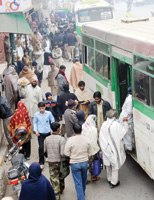
doing to other passengers. Welcome aboard a public transport bus. Buckle up for a noisy ride! Up above the window was written in bold; "Behave and show courtesy to other passengers". The advice kept me from asking a fellow commuter to remove his old dusty leather bag from the top of my head. My courtesy and patience could not match the weight of the bag and I had to finally make the request. This time he threw the bag into my lap, retorting that this is the best he could do. Next moment he was quarrelling with the bus conductor for the seat he was promised. The conductor was in no good mood either and was quick to retaliate. Soon after it was free-for-all. The gentleman sitting beside me again spitted out of the window after a long spell of cough and remarked, "The conductor has had a fight with his wife and is on duty without a breakfast." Passengers around guffawed and praised him for his guess probably most of them had experienced a day without a breakfast. The bus was full for a local route it means five to six passengers hanging at the door and footstep. The driver of the bus was courteous enough to wait for the passengers who had just planned to leave their homes for the bus stop. Even shouting passengers, who were getting late for their offices and destinations, could not convince him to move on. A man with a small bag hanging from his shoulder was desperately trying to get in. A terrorist, a suicide bomber? He turned out to be a mobile gastroenterologist trying to sell out his homemade remedies that cures all diseases a man can possibly think of. Give him credit for attracting a diverse crowd for a few minutes with the help of his well-prepared script — listing out a group of symptoms that miraculously matched the symptoms of most of the passengers. There lies the skill of the mobile doctor — to sell health to a crowd with little access to healthcare. Another vendor elbowed the standing passengers to make room for his on-board shop. The man was selling literature in the form of booklets of poetry, Naats and stories teaching morality. The price of a set of books was so tempting that I could have bought all of them, but something kept me from buying it. Perhaps I am not used to buy anything, except ticket, on board a bus. Still, the vendor found many readers for his books, owing to his skill of reading out interesting teasers out of the books. Another interesting feature of the ride – that kept my attention throughout the journey – was a public debate going on in the bus. Capitalising on the absence of an irritating moderator, everyone aboard was free to discuss anything from the Blackwater plot to stealing of Pakistani nukes to political wrangling in the wake of NRO. It was a pleasant surprise for me to know that the common man – a term sadly coined for the have-nots of society by those who matter – knows everything happening around, and they won’t let the rulers to take them for a ride anymore. As topics for the public debate grew wider, so did the crowd in the bus. It was time for me to get ready for another feast – that was to get off the bus. The conductor announced my destination and I started pushing the passengers around, just as everybody was doing. It was one of the rare moments when I really hated myself for frantically pushing passengers and stepping on their toes in a bid to reach the bus door. The fact that it is hard to be courteous and civilized on board a public bus saddened me. Once off the bus, I examined myself and thanked God for being in one piece, still wearing my woolen cap, shoes and jacket and still carrying my handbag. All I left behind was a noisy bus and my yearning for a society where we don’t need to remind people to "behave". TOWN TALK *Exhibition titled ‘Convergence’ at Alhamra Art Galleries, The Mall from Mon, Jan 25 to Wed, Jan 27 from 10-6pm. Paintings, murals and ceramics on display. Artists: Horeen Amjad and Zahir uddin Babar. *Exhibition of Paintings by Faraz Ali at Ejaz Art
Gallery on Fri, Jan 29. *An exhibition of artworks titled ‘Strange Days’ at The Drawing Room Art Gallery till Sat, Jan 30. *Exhibition of Paintings by Sumaira Tazeen & Roohi Ahmed at Rohtas Gallery till Jan 30. *Paintings by Amira Farooq on display at Nairang Gallery till Sun, Jan 31. *Calligraphy of Holy Bible by Shafique Shad Khan on display at Alhamra, The Mall till Wed, Feb 10 from 8-4pm daily. *Learning to See Art with Salima Hashmi on Fri, Jan 29 at Faiz Ghar from 5pm-6pm. *‘Weekend Cycle Ride’ today to start at 10:20am from Zakir Tikka intersection, Sarwar Road, Lahore Cantt. Will end at 1:20pm.
College mess Kinnaird College is in news again – whatever was
cooking behind the college’s four walls since the appointment of Dr
Bernadette Louise Dean – who succeeded Mira Phailbus in 2008 – is no
longer a secret. A series of allegations and counter-allegations have erupted after seven faculty members, including four heads of departments, were shown the door in December last year. On Friday, Jan 22, the Lahore High Court issued a stay-order in favour of the transferred teachers. The main issue, according to one removed teacher, is the appointment of Dr Naima Khursheed as the registrar by the Board of Governors (BoG). "Naima Khursheed is the de facto principal," she says. "We interfered only after we thought it is imperative to save our institution. Ever since Dr Dean took charge as the principal Naima Khursheed became her favourite. She became a mediator between faculty members and the principal — this allowed her to exploit situations to suit her interest. To say the least, she did things that had never happened in the history of Kinnaird." In November 2009 a few teachers from the faculty requested Bishop Alexander John Malik to look into her appointment but he, according to them, "turned a deaf ear." The current controversy seems to be a part of the simmering resentment the faculty members had for the new principal, especially those who have been working with Mrs Phailbus for decades. "She rebukes and humiliates senior teachers in faculty meetings telling them they don’t even know how to do a thing as simple as drafting a question paper," she says. Bishop Alexander John Malik, Chairman Board of Governors (BoG) of Kinnaird College for Women, termed the voices against the principal as reaction to "change." "Some elements are resisting the change in the campus – a change to improve the academic standards of the college after getting the degree awarding institute status by the Punjab government," he tells The News on Sunday (TNS) — "They want a status-quo". The board and the principal want to raise the academic standards of the college, introduce advanced curriculum and come with innovative methods to impart education for making the college a centre of excellence, he expressed, adding: "These are the similar elements who resisted the "change" when Ira Hasan replaced Mrs Phailbus". He defends Dr Dean: "The new principal joined the college in September 2008. She has a reputed career. She has been serving in institutions like National College of Arts and Aga Khan University". What disturbs many people is the sacking of senior teachers some of whom have been working with Kinnaird for as long as 20 years. Dr Dean has repeatedly denied the allegations of removing them because of personal grudge. More important is the student involvement and the absence of an academic environment inducing hostility and frustration among students. A bachelors’ student who is also a member of Kinnaird’s Student Council said the council members decided on their own to protest against the removal of teachers. "The bottomline is: there are too many students but few teachers; and the college administration is incapable of addressing student issues." Students complain of the administration’s bureaucratic behaviour. As for Naima Kursheed, students see her more accessible and a reasonable teacher but "not very helpful with non-academic problems." As far as the objection on the appointment of registrar is concerned, it is transparent, the bishop maintained. The dissenting voices also approached the board against the appointment of the registrar. The board, which comprises eminent people, heard them duly and decided the case on merit, he added. The bishop also pointed out that even the Punjab government’s Education Department official has approved the appointment of the registrar. He said day-to-day affairs of the college are responsibility of the chief executive of college, which is the principal. The board, he added, poses full trust and respects the decisions of the principal to run the college. She enjoys full freedom." The chairman of the KC BoG said the matter is in the court and the board would fully respect and abide by the court verdict. He said the board is also holding an inquiry into the matter, internally. The reinstated teachers have been alleged by the college administration to have involved the students in a purely administrative matter. Some students have also alleged the teachers of doing so. Another sacked teacher expressed her distrust over the proceedings of fact-finding commission of BoG. The Chief Minister’s commission, she held, is more transparent and reliable. Another faculty member said that the principal as well as some of the teachers believe their authority is being challenged. That an untimely pay raise has been given to some junior teachers, she said, is "not fair. The issue of pay raise was a pending matter but unfortunately the decision has come at the ‘wrong time’." For now, the two fact-finding commissions – one formed by the BoG and the other by the Chief Minister are doing their job, separately. They will present their finding in coming few days. The sacked teachers have been reinstated to their positions until the verdict comes. Mrs Phailbus was the longest-serving principal of Kinnaird who headed the institution for thirty years with favourable support from students and teachers alike. Dr Dean is not only new to the college but to the city and the whole set up. Such public opposition can tarnish her early years as a principal but what is more serious is the reputation of a decades old institution on which many take pride. Kinnaird has become a sub plot of the tussle between the institutions we have had a lot of in the recent years.
A chance to hear the noise made by deaf and dumb children in their own school… By Farah Zia If you happen to be on the roads in Lahore’s Gulberg
area in the morning and in the afternoon, you can’t miss this
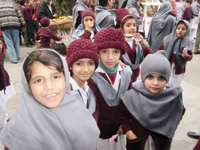
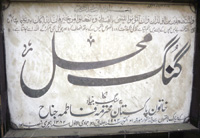
odd-looking oldish dark blue school bus. A normal bus generally carries silent commuters looking blankly out of the windows. And the curtained smart buses of elite schools do not allow you a peek inside to see what the children might be doing. But this one is different. This dark blue bus stops on the traffic signal when you get a chance to observe it more closely. It seems abuzz with activity. It almost vibrates with agile children inside. One sees them communicating with each other in sign language, their hands moving constantly. They look emotional as they talk, laugh, show anger and play. Like all children, they’re lost in their own world, so comfortable in each other’s company. The bus bears the name and address of a school for special children in Gulberg. It is better known as Gung Mahal. Officially the name has been changed but, for all practical purposes, the old name sticks. I am curious. I want to see these children more closely. To find out where do they come from and how did they end up in this school. And how come we never see them in our midst. Is it only a coincidence or whether the assimilation of the blind in our society is actually better than the deaf and dumb? Perhaps a visit to this rather insensitively-named school may help answer these questions. Gung Mahal (palace for the dumb) turns out to be two schools, one each for girls and boys, now with a college as well in the same compound. The school was founded soon after partition maybe but it is there in its present campus in Gulberg since 1955. Gul-e-Rana, the acting principal of the boys’ branch
is happy to see a person from the media. "We can only raise awareness
about the need for education of the deaf and dumb children through the
media. Often parents bring their children so late that we can’t do
anything about it," says Rana. Speech therapy, she says, works best
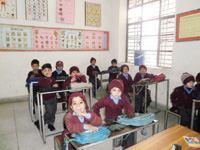
if it starts early. The strength of the boys branch is 256 and it begins with KG-I upto matriculation. "These children come from the poorest of the poor classes and from all corners of the city," says Rana. As I am shown a round of the school, the boys appear neatly dressed. "This is because they get two sets of free uniforms by the government and shoes as well. Their books and stationery is all free," she informs. The education is totally free and each child gets a stipend of Rs 200 to take home. I spot a van carrying milk in the compound. "The government provides a 250ml pack of milk to every child every day," the acting principal informs, adding that it is not mandatory to drink it in school. In the classrooms, one after the other, I notice children salute us by way of greeting. They have to. They study each and every word with signs and gestures. The teachers, I’m told, are all masters in Special Education. Majority of them don’t have a disability. Only a couple of art teachers have impaired hearing. These teachers must have an unmatched level of patience. The confidence of children shows these teachers are definitely there out of commitment. Majority of children studying in this school come with
profound deafness. Profound means they are more than 90 percent deaf. The
government has undertaken to provide them with hearing aids but majority
of the children in the school were without one. Some of these children are
sent for a surgery called Cochlear implant in government hospitals but the
queue is long. "The parents are generally not trained to maintain the
hearing aid," tells Rana. Apart from a speech therapist, the school now has a trained psychologist. She says, "These children are more self-centered. They like to interact with their own group. Their major problem is that they are more aggressive and need more attention and love." Parents in this class of society tend to ignore them, she says. I get a chance to be with the girls during the break in the school next door. The vendors come in the school premises during break for security reasons and their sign language is quite developed. The girls appear fascinated with the camera and want to be photographed. They try to communicate with me and I actually understand what they are saying. I try to communicate and fail. A little more time with them and things can get better. Gung Mahal needs better facilities. It needs a bigger building, a playground, a canteen, good quality education, vocational skills, follow-up facility on what they do after school. And perhaps another name.
|
|