


|
|
|
|
 |
 |
  
|
agriculture profile The
tangled life of Jackson Poet's
songs
The vicious re-cycle Untreated wastewater is being used for irrigation, despite serious health and environmental hazards involved, chiefly because it is a profitable affair By Aoun Sahi Malik Faisal Rafique, a 32-year-old farmer, owns 42 acres
of land in Hudiara village near Indian border in Lahore. He is among hundreds
of farmers who use the untreated wastewater of Hudiara Drain to irrigate
their crops. Hudiara Drain is a trans-boundary, natural storm-water channel that originates from Batala in Gurdaspur district, India, and enters Pakistan through the Laloo village in Punjab, meeting en route wastewater, sewage and industrial pollutants that are emitted into the drain -- now carrying high concentration organic waste and toxic chemicals. "We have been using this water for irrigation since
1971, the year we were allotted this land," Rafique told TNS.
"Thousands of acres of land on both sides of Hudiara Drain are being
irrigated by its water." He listed many reasons for using this water:
"increased and consistent availability, reliability of irrigation water
and the presence of nutrients like nitrogen, phosphorus and potassium which
replace fertilisers." He revealed that the average number of pests and the cost of pesticides had almost doubled as a result. According to Rafique, the crops which are irrigated by this water are better as opposed to those which are not. "This water is so powerful that if used in big quantities it can result in excessive vegetative growth of the crops. That is why it is mostly used to grow vegetables sold in different markets in Lahore or for fodder for cattle in the area." He admitted that crops and vegetables grown on this water weren't half as tasty as those irrigated by canal or underground water. "The flour produced from the wheat grown on this water also smells different. So does the milk of the cattle eating fodder from wastewater." Rafique also spoke of various waterborne diseases but insisted that he "still opt for wastewater because of the handsome monetary benefits". TNS spoke to a host of other farmers who had been using
the wastewater of Hudiara Drain. All of them seemed to understand the medical
and environmental hazards but were willing to give more weight to the
"input cost of agriculture which is minimised up to 30 to 50
percent." Broadly speaking, the usage of wastewater -- composed of municipal and industrial waste -- in agriculture is a global practice. Rough estimates indicate that at least 20 million hectares in 50 countries are irrigated with raw or partially treated wastewater. Currently, in developing countries, approximately 80 percent of urban wastewater is used for irrigation contributing to food and livelihoods to urban and peri-urban communities. According to Dr Sajjad Haider, Associate Professor, Institute of Environmental Engineering and Research, University of Engineering and Technology (UET), Lahore, wastewater is a complex irrigation resource, with both merits and demerits. "Wastewater and its nutrient contents can be used for crop production. It provides significant benefits to the farming communities and society in general. "However, wastewater also has negative impacts on communities and ecosystems," he told TNS. "The widespread use of wastewater with toxic wastes is likely to increase the occurrence of water-borne diseases and also cause a rapid degradation of environment and soil productivity." Haider said there were guideline values, set by the WHO and the UNEP, with restrictions on irrigating crops by wastewater that suggested primary treatment before its use. "But nobody cares. Treated wastewater can be an asset for water scarcity in a country like Pakistan. We can use the Combined Stabilisation Pond System to treat wastewater. This is method is relatively cheap and has a minimum running cost as no electricity is involved." Farmers have the alternative choice of underground fresh water even along the Hudiara Drain in Lahore. But in many cities, including Faisalabad, Kasur and Bahawalpur, the underground water is either saline or is too deep to extract. "Wastewater is a good option in these areas as canal water in Pakistan is subject to fixed rotations and the farmers get water once a week or twice a month," said Muhammad Ismail Malik, President, Farmer Development Association, Ahmadpur Sharqia, Bahawalpur, talking to TNS. "The timing and quantity of canal water is also controlled, irrespective of the requirements of the crop. Wastewater, on the other hand, allows farmers to be more flexible about their choice of crop and allows them to grow vegetables that will bring in more money." He said that farmers opted for wastewater because it was "full of nutrients". A recent survey conducted by the London-based researcher Jeroan Ensink reveals that given a choice, 86 percent of Pakistani farmers currently using regular irrigation water will use wastewater while only 4 percent of the farmers currently using untreated wastewater will prefer regular irrigation water. Another survey, a project of International Water Management Institution (IWMI), shows that wastewater in agriculture is used in more than 80 percent cities of Pakistan. Asad Sarwar Qureshi, a senior water expert in IWMI-Pakistan, told TNS that in Pakistan more than 35,000 hectare land was irrigated with untreated wastewater. "According to UNESCO, 41 billion cubic metres (BCM) wastewater per day is generated worldwide. Ten percent of the world's total crops are irrigated by untreated wastewater. In Pakistan, daily 7.76 million cubic metres' wastewater is generated, out of which 2.8 million cubic metres is used for irrigation purposes directly while the rest is discharged into river bodies. Twenty-six percent of total vegetables grown in Pakistan are irrigated by wastewater and research estimates that farmers using wastewater earn $300 to $600 more than non-wastewater farmers." Talking about the disadvantages of this water, he said Pakistan was facing a serious threat of environment and soil degradation because of the use of hazardous wastewater for irrigation. "This is because less than 3 percent of major industries in Pakistan are equipped with properly operating treatment plants. Continuous use of wastewater results in soil salinity and overall reduction in the productivity of soil. Generally, wastewater contains high amount of total dissolved solids (TDS) which contaminate the soil matrix and affect crop production. These salts can also leach below root zone and contaminate groundwater, the main source of drinking water in Pakistan." It is also proved that crops -- especially vegetables -- have a greater tendency to absorb heavy metals such as mercury, zinc, copper, chromium and potassium, if irrigated continuously by untreated wastewater. "So, the usage of wastewater in agriculture is a direct threat to environment, water and health of the human beings. It serves as the transmission route for heavy metals in the human food chain. Farmers who irrigate their land by wastewater are found to have a significantly higher prevalence of hepatitis, nausea, stomach aches, skin allergy, cholera, diarrhoea, typhoid and dysentery compared to those who irrigate their land by canal or tube-well water, because untreated wastewater contains a high concentration of helminth eggs and faecal coli form of bacteria wastewater. They also show an increased risk of hookworm infection and 'giardia intestinalis'. I am not talking on the basis of supposition; we have worked extensively on this subject in Pakistan." Qureshi suggested that the farmers should be educated about the adverse effects of this water. Nazir Ahmad Wattoo, a Faisalabad-based water expert and chairperson of Anjuman Samaji Behbood, an NGO working on water issues, told TNS that in Faisalabad alone more than 5,500 acres of land was irrigated by untreated wastewater. Using wastewater accrues more profits for the farmers using it. According to a study, the total cost of damages due to wastewater usage in agriculture in Faisalabad is Rs 1.2 billion per annum. Having included the cost of damages caused by wastewater, the cost of production in wastewater area has increased considerably. Wastewater creates a favourable environment for insects and diseases to grow. "High amount of pesticides together with wastewater is adversely affecting the quality of environment and the farmers have to pay a heavy price for that in terms of procuring medical services." It may be mentioned that the freshwater farmers spend four times more on fertilisers compared to the wastewater farmers. Besides, both the total cost and the gross revenue are higher for freshwater users while net benefits of wastewater users are higher in production. "The net benefits are almost four percent higher in wastewater area compared to those in freshwater areas. Untreated wastewater irrigation is not only deteriorating the soil productive capacity but also negatively affecting the farmers' health, especially those who are exposed to it during the various agronomic practices. The story doesn't end here. It also affects the health of those consumers using vegetables grown with untreated wastewater." Wattoo regretted the absence of rules and regulations to check this practice in Pakistan. Nasimur Rehman Shah, Deputy Director, Environment Protection Department, Punjab, told TNS that rules and regulations regarding wastewater were there "but they are not being implemented in spirit. "At present, we have only two treatment plants in Punjab, one in Faisalabad and another in Kasur; the situation is far from satisfactory. But we have been trying to build more treatment plants, including one in Lahore that has already been approved, while the ones in Multan, Rawalpindi and Rahim Yar Khan are in the pipeline. It takes a lot of resources to treat wastewater. We know that most of the wastewater is being used in agriculture and it has really bad effects on the environment and health, but most farmers do not have any other options. So we don't want to deprive them of their livelihood," he said. Email: aounsahi@gmail.com
Mapping life Using the leitmotif of cartography, artist and curator Roohi Ahmed's installations change their subject By Nafisa Rizvi Roohi Ahmed's fortuitous collision with art reaffirms the idea of cosmic consciousness and synchronicity. She studied assiduously to become an engineer and was
ready to join engineering school when fate stepped in and veered her career
path towards art. "It was truly serendipitous," she says with a Ahmed talks of the central elements in her work. "Cartography plays an important role in my work. It began when I took on a project to illustrate a geography book for a local publisher," she says. But it was not until the group exhibition of 1999 entitled 'Cityscapes' that addressed the issues of Karachi, that her interest materialised tangibly in her work to provide her with a vocabulary that was to become the mainstay of her art. Ahmed's pieces were based on the mappings of her long
apprehension-filled daily commute from her house to workplace. "Ethnic
and political violence had broken out and every morning friends and
neighbours would leave home saying to each other 'Dekh bhaal kay jaana' which
I used as the title for a piece." The maps trace the different routes
that she would take to avoid the areas where violence had occurred or was
likely to break out. In the 2001 Vasl workshop at Gadani beach, the site of a fishing village and ship-breaking industry, Ahmed joined a group of artists from across many countries to work and exchange ideas. "It was quite an idyllic setting for the fostering of aesthetic development," she reminisces nostalgically. Ahmed's thrill with this artistic habitat was evident in her installation. She created a mammoth-sized garland with styrofoam floats used by fishermen for nets, covered with psychedelic cloth that the women of the village were commonly found wearing. The natural rock formation that rises from the Arabian Sea at Gadani, about 30 metres from the seashore, became the object of Ahmed's devotion and she garlanded them in appreciation of the spiritual joy they had brought her. The site-specific installation behaved with a natural expediency pertinent to the environment floating and ebbing with the tide. For a residency in Karachi, Ahmed decided to address the issue of the plight of Muslims living in the west who, due to their external manner of dress or appearance as the women's hijab or men's beards, led people to be suspicious and fearful of them. To replicate their predicament, Ahmed chose four common objects of everyday use and imbued them with menace and fear -- a needle, a black tin box used for storing, a sieve or tea strainer and a grain checker. These objects play a recurring and essential role in Ahmed's work even today. "In its original form, the needle is a harmless object of functional value to the homemaker. Take that little object, add scale to it and you have an intimidating, damaging instrument more than capable of inflicting pain," she explains. 6/6 Labyrinths was a collaborative community project in
2006 that too to the streets of the city. Curated jointly by Roohi Ahmed and
Abdullah Syed, it showed works by six artists. But the central piece
consisted of 18 sheets of suspended plexi-glass on which were stuck myriads
of yellow post-it notes, scribbled and doodled upon by street-goers who were
asked to offer their views in pictorial or written form. The result was an
emotional, psychological and societal outpouring a kaleidoscopic artistic
enterprise. In the same year, Roohi exhibited in another two-pronged exhibition, the first 'Calligraphy' and the second 'Body'. Ahmed was entirely familiar with calligraphy, but the body -- that was new to her, as she had never looked to the human form for expression. "To add to the challenge, I had just nursed my mother through a protracted illness and watched her pass away. So the concept of the body was nothing less than morbid." But it isn't in Roohi's disposition to be morbid and she was able to handle the idea gracefully. With the angst of personal experience behind it, it is no wonder that the installation created became Roohi Ahmed's piece de resistance, which she went on to recreate in more detail for the launch of the National Art Gallery in Islamabad. The suspended part of the work consists of cloth stretched on a frame on which Ahmed has laboriously stitched a silhouette of a supine human form. From each stitch hangs long strands of thread that collectively create a gauzy ethereal curtain signifying the ephemeral quality of the spirit and the Islamic idea that purgatory or "Barzakh" is a curtain behind which the final resting places reside. Approximately 10 feet below on the ground is a reflecting pool into which the outline of the form creates a mirror image and into which the viewer can see his/her reflection. In 2007, Ahmed was invited for a residency in Liverpool where she worked with a group of international artists and created an installation, which captured the hearts of the local people. Using her customary leitmotif of cartography, she unearthed a map of the city of Liverpool and painstakingly cut out each street, avenue and crossing in the city centre and then repeated the image to create a larger image on which were integrated doilies of Irish lace. Thus the web of the city sprawled across the wall casting shadows of subversive underground city spaces. This surprised the locals who told her later that there once existed an underground city beneath the present one. "It was as if I had discovered an inner secret and they were thrilled," Ahmed recalls. Ahmed is a prolific artist and curator. In just 2008 to 2009, she has exhibited in New Delhi, Dubai, London, Bradford and Sydney, as well as held six group shows in Pakistan. She curated a spectacular show entitled "Simply Paper" in 2008 that included the installations of 17 artists with paper as the medium of construction. Talking about her career as a teacher, Ahmed reaffirms that she has a great love for teaching. "The atmosphere of an art school is one I always want to be associated with because it provides a pool where thoughts are born and developed both by the cumulative energies of fellow faculty members and by the enquiring minds of students. It keeps me going."
Issues of identity, sexuality and commercial manipulation piled upon a damaged child, producing a creative boy who never quite grew up By Dr Arif Azad If there is any truth in the phrase "dance to the tune of someone else's music", it can aptly apply to the music and dance style created by Michael Jackson. From three highest sold albums through to a relatively fallow creative period towards the end of his short life, he towers above other musical geniuses. His music shaped an entire era; no corner of life remained untouched by him. From Pakistan's comedy show Fifty Fifty to the restricted gulf region, his sound tracks shaped the comedy shows. People spun and shuffled to dance like him, and spiked their hair to imitate like him. So great was the imprint of his genius on an entire era
that it is impossible to imagine another figure like him. Beyond this,
though, Michael Jackson's life story is a cautionary tale of how a This combustible mix was to prove ruinous for his reputation and purse. One can plead in his defence that his relationship with children was wholly innocuous, but British broadcaster and reporter Martin Bashir's documentary revelation of observing some disturbing things at Neverland did not help in Jackson's public rehabilitation. Once rumours of previous out-of-court settlements on charges of child molestation began to circulate, his reputation and resultant record sales got a serious knock. The rest of the life was played out in the gossip pages of the newspapers and magazines. Born into a family of strict disciplinarian father, whose pushy ways with his children drove them to premature adult ambitions, requiring high-octane doses of physical and emotional reservoir. Michael Jackson followed this parental driven flight path, skipping the normal childhood which is owed to every child. Jackson's precocious stardom robbed him of normal routine and pleasures while gaining a whole new army of fans who insisted on Jackson behaving hysterically and childishly. Once this insatiable demand-industry grew around him, there was no getting out of it, thus scuppering the chance of forming mature relationship with his fans. Hollywood bigwigs connived in all this too. Film directors like Speilberg -- like a lot of other celebrities -- also praised his childish ways and inextricably tied them to his creativity. Thus a lethal combination of demanding fans and music industry's hunger to mint money out of his cherubic public persona placed a burden on Jackson which panned out in unpredictable direction, damaging the star irreparably. Just as the demands on him grew, he withdrew into his fantasy world, gradually sucked dry of his creative juices. This led to diminution of his musical creativity and enhancement of newsworthy celebrity whose life began to be picked over in unhealthy detail. Not surprisingly, this engendered strange and disturbing changes in Jackson's personality. The new personality denoted some deep-lying tangled web of sexuality and identity issues -- potent cocktail that produces confusion. After having successfully crossed the colour barrier to stardom -- much before Barrack Obama's ascent to presidential peak -- Jackson began on a long series of self-mutilating interventions to whiten his complexion. While previously successful black were gently reprimanded for acting white to get ahead in life, Jackson extended it to surgical interventions to look white. The upshot was a disfigured, much-experimented-upon white face, thin lips and childish speak. By doing so, he was pandering to the notion of white colour being of some superior vintage. No one has offered a convincing explanation for this skin colour reversal as yet. But the psyche underneath did generate concern among black middle class that saw him as role model of cross over success. Despite his wholesale switch to skin-whitening mission, Jackson did tap into his black roots when it suited him. He formed a close personal friendship with prominent black American leader Al-Sharpton who acted as a link with his black roots. When felt short-changed by the music industry, Jackson made a point to visit Harlem to mobilise black people against the alleged racism of music record industry which was out to rob a black of millions in royalty fees. In a similar vein, he also flirted with Nation of Islam. In the last years of his life, triggered by his reported financial problems and blemished reputation, he went on to live in Bahrain where he was rumoured to have converted to Islam. These rumours -- like everything else in Jackson's life -- remain mere rumours. The complexity that arose out of a damaged childhood continued to deepen with the passage of time. Issues of identity, sexuality and commercial manipulation piled upon a damaged child, producing a creative boy who never quite grew up. His last bid to salvage himself on the concert scene encompassed an impossible marathon of concerts which was always going to be a titanic task given his drugs-ravaged body. In the end he succumbed to the icy hand of death whose meanings are still being dissected by music industry and medical world alike. Despite tragic flaws inhering in a tragic hero of Jackson's fame, he remains, for me, a giant who changed the way we dance to the tune of music. In my happiest moments I spin and shuffle to dance like him while wearing the bottom-end of my trousers turned up. This injection of elation to human body through dance and music will remain Jackson's lasting contribution. You could not have this good, master Jackson.
A recent book celebrates the poetic credentials of Tanveer Naqvi who raised the level of film lyrics By Sarwat Ali In the equation of the vocalist, composer and the
lyricist, the latter is probably the most neglected in film music Time and again, books and articles have been published to establish the poetic credentials of a lyricist in the face of either low priority or neglect. One such book on Tanveer Naqvi titled Dil Ka Diya Jalaya by Sikkedar too was an attempt to raise his stature as a poet. Despite the great popularity of his songs, the vocalist and the composers had hogged most of the attention. Khurshed Ali whom the world knew as Tanveer Naqvi was born
in Lahore in 1919. His family lived in Iran for some time till it came back
and settled in Koocha Fakir inside Bhati Gate. When Tanveer Naqvi's poems
titled 'Sunehri Sapne' were published, he left Lahore for Bombay on the
invitation of A.R. Kardar who had read the poems and got associated with
Sarco Productions. According to some, the first song he wrote was for 'Swami'
in 1940, composed by Rafiq Ghaznavi while others believe he wrote for 'Nai
Duniya' composed by Naushad. In those days, the trend of songs was to present mostly geets and other compositions which were traditional or popular with slight alterations, either done by the composers themselves or at best lesser-known lyricists familiar with the idiom of the geet. It was rare that a poet was requested or engaged to rearrange the lyrics according to the situation or the popular requirements of the times. The established poets avoided writings for the films and if they were forced to or lured into like Josh Malihabadi or Arzoo Lakhnavi their effort was subject to much criticism by the followers of serious poetry. and It was actually Tanveer Naqvi who raised the level of film lyrics. He did not remain a part-timer poached from the world of literature but got involved fully to be recognised as a lyricist who could maintain a certain standard while keeping the musical requirements of the melody in mind. Another person who had attained legendry status as a lyricist of the films was Din Nath Madhok. He was, in the first two decades of the talkies, the leading songwriter and it is said that he also knew music very well. It is also said that many compositions attributed to the composer were actually given finishing touches by Madhok. So powerful were his aesthetics that could bring together the word and the note into an artistic union. One of the limitations of writings songs for films was the
two stock scenes or situations; one was called 'Love Call' and the other
'Love Spot.' The former was always in the shape of a song in which the
desperate lover yearned for the beloved. The beloved could hear this song
whether he or she was within hearing distance or thousands of miles away. It
was like a call and addressed to the beloved. Love Spot was the point where
the lovers met and the physical reality of the space had to be evoked through
a song. The limitations imposed by censorship were immense and most of the
romance had to be demonstrated in words. These restrictions in both the
situations did not always augur well for good lyrics, rather in rehashing of
the old and traditional stuff. In the early phase of sub-continental cinema, the classical forms were abridged so that its compositional part could be highlighted to fit in the time slot allocated to a single film song. Since these songs were also marketed separately, the technological limitation of the 78-rpm record too happened to be the determining factor in the song duration. It settled down to one aasthai and two antaras with a couple of interval pieces all adding up to about three minutes of music. The founding fathers like Jhande Khan, R.C Boral, Panna
Lal Ghosh, Ghulam Haider and Punkaj Malik and the second generation including
Anil Biswas, Khem Chand Prakash, Khurshid Anwar, Firoz Nizami and Naushad
served film music to the best of their creative abilities. This was the new
platform that had endless possibilities. It catered to popular music and
popular taste, avoided pure abstraction, heightened the dramatic conflict of
the film and did not really have to conform to the many limitations that
classical music imposed on itself. It was also extremely well paying. It
attracted talented composers and singers as the options of creating and
performing were on the decrease. In the second quarter of the twentieth
century the princely states were beset with their own problems of scarce
resources. Tanveer Naqvi became a sought-after lyricist and when the songs of 'Anmol Garhi' were released, he became the leading songwriter in the industry as most of the songs written by him and composed by Naushad became very popular. It set new standard for lyrics, which could be seen as a separate form or category-different from conventional poetry. Tanveer Naqvi also was asked to write songs for K. Asif's 'Mughal-e-Azam' and he did a couple but due to some misunderstanding an impatient K. Asif asked others to write songs for the same film. When Tanveer Naqvi got to know of it, annoyed he withdrew his geets. He had the same geet recorded in Pakistan for 'Anarkali'. And for the Indian film Shirin Farhad. At about partition, the songs of 'Parwana' were very popular and this probably was the last K.L Saigal film to be released. Most of his geets were composed by the likes of Khursheed Anwar and Rasheed Attre. In the later days some of the compositions of A. Hameed for film 'Dosti', Nisar Bazmi for 'Lakhon Mein Aik' with his lyrics became hugely popular. |
|



 smile. Roohi Ahmed completed her diploma in Fine Art from Karachi School of
Art and did an Advanced Drawing course from the School of Visual Arts, New
York. She has been teaching at Indus Valley School of Art and Architecture
since 1998 and is presently Coordinator for the Foundation Programme at IVS.
She is also a visiting lecturer at Karachi University's Department of Visual
Studies
smile. Roohi Ahmed completed her diploma in Fine Art from Karachi School of
Art and did an Advanced Drawing course from the School of Visual Arts, New
York. She has been teaching at Indus Valley School of Art and Architecture
since 1998 and is presently Coordinator for the Foundation Programme at IVS.
She is also a visiting lecturer at Karachi University's Department of Visual
Studies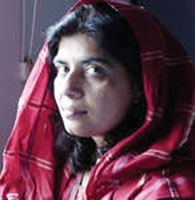

 much-thrashed child fell into the wiles of money-grubbing music industry.
This encouraged Jackson to remain wedded to his childish persona -- to feed
the appetite of his legions of fans. Dutifully, like the protagonist Oskar
Matzerath of Gunter Grass's best known novel Tin Drum, he refused to grow up
and ploughed in his childhood fantasyland.
much-thrashed child fell into the wiles of money-grubbing music industry.
This encouraged Jackson to remain wedded to his childish persona -- to feed
the appetite of his legions of fans. Dutifully, like the protagonist Oskar
Matzerath of Gunter Grass's best known novel Tin Drum, he refused to grow up
and ploughed in his childhood fantasyland.