


|
|
|
|
 |
 |
   |
review Foundation
of thought Zia Mohyeddin column
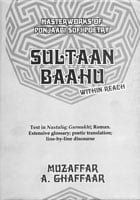
Bahu's message Muzaffar Ghaffar's commentaries of Sultan Bahu's poetry provides an ideal framework for each reader to make his own interpretation By Nadir Ali Masterworks of Punjabi Sufi Poetry: Sultan Baahu Within Reach By Muzaffar Ghaffar Publishers: Ferozesons Ltd Pages: 306 Price: Rs895 All great masters of Punjabi poetry have distinctive styles. Sultan Bahu, however, was among the privileged few who are frequently quoted among his followers all over Punjab. His idiom and imagery are also closer to folk. Folk is a vexed term, when used with reference to Punjabi poetry, connecting it with presumed anonymous and oral sources. Punjabi classical poetry is complex, philosophical and original; while belonging to a common humanist and anti-scholastic tradition, no two poets are alike. Very little has been written in English by way of
translation and commentary on Punjabi classical poetry. Najm Hosain Syed, in
whose discussion forum Sangat both Muzaffar Ghaffar and I studied, wrote only
one thin volume in English, Recurrent Patterns of Punjabi Poetry. His
monumental commentaries on Damodar, Waris Shah, Maulvi Ghulam Rasul and Mian
Mohaammed Baksh and five other books of critical essays about Farid, Nanak,
Bulhe Shah, Shah Hussain and Sultan Bahu, and Sedhan and Saaran cover the
whole range of Punjabi classical literature. The histories of Punjabi
literature written by Dr Duggal and Dr Mohan Singh Diwana leave a lot to be
desired. Seetal's writings in English are even poorer and in some cases even
the Punjabi text is not correct. Ghaffar's work is in a different league altogether, having drunk deep at the fount of Sangat; his Punjabi text has been meticulously edited. Romanised and Gurmukhi texts have been added and the meanings of all the difficult words are included with each passage and then have been alphabetically collected at the end of each volume. His commentaries are multifaceted, that provide an ideal framework for each reader to make his own interpretation. Notes on the poet's life and a critical introduction to Punjabi masterworks of poetry have been added to each volume. Ten volumes have been printed on Shah Hussain, Bulhe Shah, Guru Nanak, Sachal, Khawaja Farid, Baba Farid and Sultan Bahu and nine more on Heer Damodar and Heer Waris Shah are in the processs of publishing. The last two Heers cover the complete qissas, with the most corrected versions of the Heer texts, a most valuable feature of this unique publishing event. One of Ghaffar's distinguishing qualities is his command of the English idiom. I think it is difficult to translate a poem into another language in verse. Muzzaffar has superb versification skills and is as close to the original as is possible in another language, especially with no common basis as in Urdu, Sindhi, Hindi, Persian or Arabic. But the constraints of meter and rhyme and another idiom do compromise the meanings sometimes. I do not agree with adding Hu to the end of each line in
translation. He has done this to give a feel of the tone of the original as
it is sung. It is purportedly borrowed from Allah Hu, as chanted in zikr. It
is more likely the normal stretching of the concluding note when a vowel
occurs at the end of line. Vowels occur at the end of every line of Bahu. The
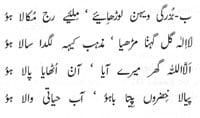
addition of the Hu even in the original is Elderlines to flowing waters consign, lets flourish black on the face Hu There's no deity ornaments the neck, is religion in brother-in-laws place Hu We drunk from Khizar's cup Bahu, the water of living grace Hu But God, then came to my home, all chill to efface Hu Elderliness is being thrown into the river and the face is
blackened, the ultimate humiliation usually reserved for a sex offender or
thief, in the first line. Sala is one of the worst abuses/slurs in Urdu,
Punjabi, Hindi and Bengali is used in the second line. How do you fit that
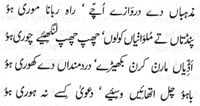
with the pious note of Hu. Najm Hosain Syed says in his essay on Bahu that we are not sure if Hu was written originally or added later. I find no justification for it in the original or the translation. Some researchers will do well to find some old manuscript and bear me out. All of Bahu's lines end in vowels that facilitate their stretching in the concluding singing note. All this "hu-ing" regurgitates against the spirit of Bahu's anti-mullah and pro-people poetry. Repetition is the mother of fascism and a mantra of the obscurantist, the very tendency that Bahu fought against. Unity yes, oneness yes, but this tolerant humanism is anathema to the priest and pir alike. Bahu certainly would not have liked the sobriquet Sultan with his name either. Neither Hindu, nor Muslim, who in mosque don't prostrate Hu In every breadth they see the Lord, in prayer they're never late Hu Sage they are, became frenzied, Nature's essence rightly assimilate Hu I'm an offering to them Bahu, Love play who consecrate Hu The translation of the first line can be misconstrued. In the original it says "they are neither Hindu nor Muslim, nor momin, nor do they prostrate in a mosque." Similarly the second line may mislead. The original says "In every breadth they see the Lord, therefore they never miss their prayer/don't need to attend any formal prayers." There is an obscurantist explanation of the name "Bahu" as Muzzaffar Ghaffar points out in his biographical note about the poet. It is said that it is "Ba Hu," a combination of Persian and Arabic words that purportedly means "with him." Bahu did not need any such propagation. He was with Him, because he was with his people, the common people, whose travails he sung about and to whom he spoke in the common man's language and not in the idiom of Persian or Arabic speaking elite. Religious portals are high Godly through a vent Hu We slink by pundits and priests stealthily we circumvent Hu Kicking with heels and wrangling for the afflicted they are bedevilment Hu Bahu lets go there and dwell, where other assertions are absent Hu Moree in the first line is the outlet in the city walls through which the sewage passed. Shah Hussain also used Asi morion lung piase (we have chosen/passed through the sewage outlet/vent.) In the villages when they have a large courtyard as they have in the canal colony villages, they keep a small wicket gate called tappan for the servants and women and for taking out the garbage. This tappan is also akin to the moree. The lords and men pass through the large main gate. The lords, like the mullah and the pundit are the respected elite. Bahu says I shall walk away from this lot, because they scare people, cause wrangling and they are enemies of the afflicted/the poor. How would such a man have Sultan added to his name? Bahu must have been a common single word name before the two and three worded names adopted from the elite Persian and Arabic names. Bahu means someone who makes an effort, uses his arms, banh in Punjabi. He chooses the way of the humble and of love for fellow human beings, (Ishq baazi chun litee, in the second passage above.) He labours on regardless of the army of "Sultans" who claim to be his successors. His message has endured for nearly four hundred years and hopefully may prevail one day. Foundation of thought Ahmed Aqeel Ruby has done a wonderful job by summarising Greek mythologies and literary masterpieces By Bilal Ibne Rasheed Yoonan Ka Adabi Warasa By Ahmed Aqeel Ruby Published by: Wijdan Publications, 2008 Pages: 336 Price: Rs350 We see, then, how far the monuments of wit and learning are more durable than the monuments of power or of the hands. For have not the verses of Homer continued twenty-five hundred years or more, without the loss of a syllable or letter; during which time infinite palaces, temples, castles, cities, have been decayed and demolished? -- Francis Bacon The Advancement of Learning
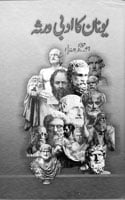
The ancient Greek thought is the foundation upon which the towering building of modern Western thought has been built. Philosophy, mathematics, politics, astronomy, logic, criticism and several other fields of knowledge have their origins in the Greek literary heritage. The modern Western concept of democracy finds its roots in the thoughts and practices of a Greek statesman, Solon (640– 559 BC) who framed laws for the betterment of common man. Trigonometry originated from the works of Pythagoras (6th century BC), who also suggested that the musical scales and mathematics were closely related. Anaxagoras (500- 428 BC) was probably the first man to state that the sun and the moon were not gods but mere rocks and mountains, and the poet Xenophanes (570–480 BC) was the first to claim that there is only one God and he is eternal. Unlike ancient Egyptians, the Greeks had made their gods in their own image. These gods ate and slept; lived on Mount Olympus; and had marked their favourite humans with whom they conspired against other gods and humans. Destiny or fate was an important religious concept and belief of the ancient Greeks. Even their gods were helpless in front of fate. According to the religious beliefs of the ancient Greeks, every man's life is driven by fate. If a man does not submit to his fate and craves for more than what has been granted to him, he is guilty of pride and therefore, justice takes him to task which results in his destruction. Literary writers of ancient Greece were highly inspired by this fatalistic concept and belief, and made it a major theme of their works. The surviving plays of Sophocles and Euripides are quintessential examples of this inspiration. Ahmed Aqeel Ruby has done a wonderful job by summarising Greek mythologies and literary masterpieces in his book Yoonan Ka Adabee Warasa (often mispronounced as Virsa or Varsa). The book is an outcome of the author's fascination with, and a thorough study of, Greek literature. The book is divided in six chapters and starts with the history of ancient Greece with special emphasis on religion, prose and oratory. The author then gives us an account of Homer's works and summarises his epic poems Iliad and Odyssey. Plato's Republic is also discussed and so are the Greek tragedies, with a focus on playwrights such as Aeschylus, Sophocles and Euripides. A complete chapter has been devoted to comedy and one of the earliest practitioners of this art form, Aristophanes. The last chapter discusses the theories of Plato and Aristotle. Yoonan Ka Adabee Warasa is a valuable effort and Ahmed Aqeel Ruby has done a great service to the readers of Urdu by giving them translations and summaries of the Greek classics. The book is frequently punctuated with quotations of Western scholars, but at times, one does find passages without any reference which shows a lack of professionalism and leaves a poor impression. The book also needs to be thoroughly proofread as there are numerous typos and spelling mistakes. On many an occasion, the book is repetitive which seriously mars its charm. The author seems to have a comfortable command over the Urdu language, but at times his prose becomes overly-romantic which gives an air of artificiality. Bibliography, which is a prerequisite of any scholarly work, is sadly missing in the book. Ahmed Aqeel Ruby is a writer of considerable repute. Apart from the book under review, he has also translated several Greek classics such as Oedipus the King by Sophocles and Medea by Euripides into Urdu. Also his biographies of Nasir Kazmi (Mujeh To Hairan Kr Gaya Woh), Mumtaz Mufti (Alipur Ka Mufti) and Qateel Shifai (Qateel Kahani) are of immense literary value. Although the author has an extensive knowledge of Greek myths, philosophies and literature, his understanding of Plato's theory of imitation is confused and flawed. On page 149 he writes," Plato declares all fine arts to be imitations. According to him every living being in the universe is an imitation of the Greater Truth. When a carpenter makes a bed, he imitates an imitation. He has imitated the image of the bed which was in his mind and was impressed upon his mind by God. This is why his creation is twice away from the reality." According to Plato's theory of imitation, there are three beds: one existing in nature (the idea of bed) which is made by God and is therefore the "real" bed. A carpenter's work is an imitation of the idea created by God, while a painter's work (or the work of any other artist) is an imitation of the carpenter's imitation and is therefore twice removed from "reality." This was one of the reasons Plato banned poets from his republic as he did not consider them creative artists but mere imitators. Despite its shortcomings, Yoonan Ka Adabee Warasa is an unprecedented contribution to Urdu literature and the author surely deserves a commendation for summarising the Greek classics in a single volume.
You stick me, I stick you When I look back upon my variegated life I cannot help feeling that the person who touched me the most was not a prep school teacher but a young boy who showed me how to live in the face of adversity. More than anything else he taught me a salutary lesson: do not ever inflict your worries onto others. In my drama school days in London I was once admitted to a hospital because I was stricken with quinsy. The only other occupant in the ward was a freckle-faced eleven–year-old lad, who had a weak heart. There were other beds, but they remained unoccupied for the duration of my stay. He was a comely lad with close-cropped hair and piercing eyes. I have rarely come across an eleven-year-old with sharper intelligence or a sunnier disposition. His mother had died and he lived with his grandmother, a sturdy Cockney lady, his sole visitor. His name was Ashby. I once made the mistake of calling him Ashby-de-la-Zouche and he winced at my lack of originality. It was obvious that he had had his fill of being dubbed as a town. I apologised, and he said "Oh you can't help it. No One can....." But he forgave me with a heart-warming smile. I owe a great deal to Ashby Salter for acquainting me with some of the oddities of the English Language. It was he who told me that to "put up or shut up" means to tolerate. "When you put up with someone, it means you can stick him," he went on to say. "Ha Ha!" I said, "that's daft. Stick him like what? Stick him in the back?" "No, silly," he laughed, "when you stick someone like that it means you hate him, but to say you can stick him means you like him," "So" I said "you stick me, I stick you?" "yeah" he beamed. I had no idea how serious his condition was until he told me one day, quite matter-of-factly, that he had a hole in his heart. "They say I'll make it. Make what?" He said and grinned, "they say a lot of stupid things like every cloud has a silver lining. Clouds don't have linings." He wasn't bitter when he said this. He didn't know what bitterness meant. The only time he ever twinged with an inner pain was when the night nurse, tucking him in, cooed "Now be good. Remember worse things happened at sea." This was her pet phrase. "Silly moo," Ashby said after the nurse had left, "Why do worse things happen at sea than on land?" Then as an afterthought, he said, "What are these worst things?" "Well, Moby Dick, perhaps." I tried to be flippant. "Aw, come on, it's naff. It's like saying all other things being equal. They always say it when they go over me. What other things? And being equal to what?" There he had the better of me. I could only marvel at his acute sensitivity. He confided in me that it only served to disappoint him when people told him to cheer up. He usually felt pretty cheerful anyway. "I wish they'd stop pitying me", he said, ungrudgingly. The rougher edges of his Cockney accent had been smoothened out by his schooling or his own efforts. He didn't drop his aitches like his grandmother; nor did he add them to words in which the aitches remain silent. You could trace the cockney lilt in his speech, but not the full range of undulating cockney sounds. Sometimes I wondered if it was his affliction that gave him a kind of wisdom unassociated with boys of his age. Some of his observations were truly amazing. I had no answer when he asked my why we have to change our clothes during the day when we wear the same pair of pyjamas night after night. He often used words that I had never heard of. All I could do was to register real surprise and this delighted him no end. "Hey, smudger," he once said to me and I looked at him quizzically. A "smudger" meant a friend, a mate; "brass monkeys" meant cold. "How come?" I asked and he assured me, "It is -- brass monkey's weather, don't you know?" I would learn later that in Cockney lore the racks of cannon balls on board a warship were called brass monkeys. Other words he taught me were: Rosie Lee (rhyming slang) which meant tea and "Kate and Sidney" which, of course, was steak and kidney. It certainly evoked the image of a dish more appetising than our canteen steak and kidney "pud," which tasted like cat food mixed with chewy stodge. When I came back to the ward after my operation, Ashby looked after me like an angel. He sat by my bed in case I needed a drink or a tissue. The two nurses who alternated their duties chided him, "Is he paying you a lot of money?" they said flippantly. He remained unnerved. He left my side only when it was time for his grandmother's visit. After she left, he would put the bunch of grapes, which she had brought for him, on my bedside table. I was so touched I nearly sobbed. I had no idea why he had taken a shine to me. Was it because I was at a drama school and he idolised actors? Or was it because I laughed with him and didn't try to patronise him or treat him as a little boy? It could have been all these things or none. His affection was so unalloyed, so wholehearted that I felt a pang of guilt for not being able to offer him the same amount of unbridled love. As I got better, his condition took a turn for the worse. He spent most of the mornings in an inner sanctum going through a series of tests and was only brought to the ward late in the afternoon. His face looked flushed and hollow, but he still smiled at my feeble jokes. When I took leave of him he didn't cry or snivel. "Goodbye smudger, will you come and see me?" he asked, his eyes ever so alert. It was I who snivelled. "Of course I will." Within a day or two, I had to rush off to a village near Farnham to start work on a farm. It was a two week stint. When I returned to London I went to the hospital to see Ashby. The ward was full of some old patients, but Ashby was not to be seen. I went to the reception. The matron at the desk informed me that the "poor boy" had gone to his maker. My "smudger" had, at last, made it.
|
|
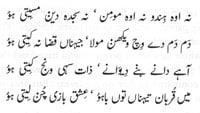 superfluous. A repetitive note like that distracts us from the focus on
meanings and mood, which differs in every four liner (Bayt, in Punjabi). Each
Bayt's meaning can be a different essay. To put them on the pious parade of
Hu (Him/God Almighty) clashes with meanings. Consider the following passage:
superfluous. A repetitive note like that distracts us from the focus on
meanings and mood, which differs in every four liner (Bayt, in Punjabi). Each
Bayt's meaning can be a different essay. To put them on the pious parade of
Hu (Him/God Almighty) clashes with meanings. Consider the following passage: