


|
|
|
|
|
 |
 |
   |
environment MOOD
STEET Town talk Shehr's
alternative guide
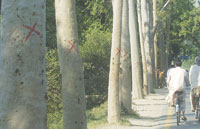
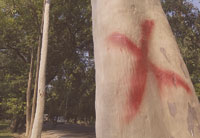
environment Tree's a crowd Lahore might soon be history if it continues to be planned and urbanised at the cost of parks and open areas By Noveen Abid The recently drawn up LDA plan for the
commercialisation of roads has incited more than a reaction from the
members of the Lahore Bachao Tehreek (LBT). The one-page-long
questionnaire distributed to the public through daily newspapers for the
proposed commercialisation along 58 roads is problematic. The report of
the Chief Minister requesting TEPA to revise the plan to widen the Canal
Road has also caused concern alongside the LDA commercialisation proposal. The meeting of the LBT held at Nairang Art Gallery on May 15 aimed at working against commercialisation of roads, saving the Canal Road and taking up the issue of planned cutting of trees at the Faletti's Hotel site and the construction of a 23-floor building at the same spot. LBT has been campaigning against the widening of the canal road ever since the project was announced. Their opposition to the plan forced the City District Government Lahore (CDGL) to formulate an EIA (Environmental Impact Assessment) of the project. The EIA has been questioned by the LBT as it fails to be comprehensive and the case is pending in the High Court. The move to commercialise and widen existing roads is not easily digested, Rafay Alam, an environmentalist and LBT member says, "the government expenditure is mostly geared towards making roads, widening the existing ones, which leads to uneven development. Public transport will not be able to keep up with the required demand for vehicles as the roads are widened." It is distressing that while urban planners throughout
the world are discouraging road widening to relieve traffic jams, our
government believes the opposite. Kamil Khan Mumtaz, an architect with an
interest in city development, feels that, "In an effort to push
commercialisation forth, motorised traffic in the concerned areas will
increase -- widening of roads will attract traffic rather than deflect it.
Unless buildings are subject to height and zoning restrictions, LDA should
not carry the plan forward." A city cherished for its rich heritage and vibrant history, Lahore will only exist in imagination if plans to 'develop' and urbanise the area are carried out at the cost of seizing parks and open areas, congestion along roads and residential areas and inadequate public transport provision. And this is just the tip of the iceberg. Air, Soil and water pollution have not been accounted for, in the effort to increase urban sprawl, environmental issues have been pushed back. Upon questioning, Director LDA Commercialisation, Sheikh Abdul Qayyum chose not to comment on the issue until the official meeting (scheduled for July 17) took place. Imrana Tiwana clearly pointed out that LBT is not against development or commercialisation. It merely highlights the need for chalking out a feasible method and involving professionals in the decision-making process. "The canal road is an environmental asset, besides, the Government's claim that the canal is the main traffic artery of Lahore and needs development is faulty as we are all witnesses to the fact that Lahore is growing at the periphery rather than the centre," she says. Tiwana commended the recent efforts of the CM against commercialisation and setting up of billboards, "it is clear that he is interested in doing well for the city and we want to support him with serious interest." Even from an environmental perspective, both these plans are not viable. According to the fact sheet revealed by the Pakistan Environment Agency under its Air Monitoring System, Lahore, tops the list of the most polluted cities of the with air pollution level of 121.85 micrograms per cubic metre that is three times higher than the safe standards. Commercialisation and the increase in high-rise buildings will not only increase energy consumption but will also double the amount of CO2 emissions. Rizwan Mahmood, a WWF representative and coordinator for the Canal Bank Project, tells TNS, "Not only will commercialisation have an effect on the micro-climate, it will also suffocate the sewage system." He proposes that the city should be divided into commercial zones to save our heritage, lack of planning has choked the urban centres -- it is hard to imagine where we will stand after 5 years. The plan that LDA has built is also faulty: The questionnaire includes technical questions that are beyond public comprehension. As Kamil Khan points out, "Urban planning is not done by a vote of public -- there are many important factors that should be taken into account. The LBT is opposed to such planning. It seems as though the local government and LDA are aiming to raise revenues by encouraging putting up billboards, building violations and commercialisation. As there is no subsidiary development being encouraged, growth seems to be concentrated in the real estate sector. Jalees Hazir, an NGO activist, highlights that a "sustained initiative needs to be taken to solve the issues, with a focus on expertise which in turn bring about a professionally prepared vision of Lahore, with input from both architects and town planners."
The real meaning By Mohammad Hyder Qayoom A couple of days back I got the opportunity to watch a
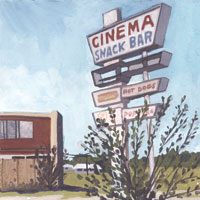
recently released Indian movie at one of the posh cinema houses in Lahore,
located in an affluent residential area. The show timings were morbid enough,
the movie starting at around midnight. If it had been entirely up to me, I
would have chosen a more decent time of the day to watch a movie but since
the wife's heart was set on this particular movie and this particular movie
was only showing at this ghastly hour, I decided like a good hubby to put up
an exciting smile and saunter along for whatever awaited me. I had been half expecting and half praying that at this time of the night, the cinema house would be reasonably deserted and we would be quietly ushered in by a sleepy gatekeeper. No undue commotion, no riff-raff crowd, no whistling urchins, just a couple of serious movie-goers. However, I was definitely in for a shock. Even the road leading to the cinema-house was jam-packed with cars and we had to do some serious searching just to find a parking space in the vicinity. After some tricky car-dodging & road crossing, we entered the cinema to be greeted by hoards of teenagers, uncles, aunties and clinging children. It seems no one in Lahore goes to sleep at 12 any more. It has become fashionable to stay up till late at night and even children are encouraged to follow in the foot-steps of their party-animal parents. Anyways, we grabbed a bucket of some pop-corn and colas, and settled down to the movie of the night. The movie was entertaining enough and I would be lying if I didn't admit I had a pretty good time. However, what struck me right from the start till the end of the movie was that it was liberally sprinkled with teasing scenes, dresses that could give a healthy competition to Victoria Secret ensembles any day, colorful language that made frequent use of the word s-- and so on. Everyone, including me and including all present: parents, elders, teenagers & children, watched the movie in great comfort and left joking about the little scenes. Before you start thinking that I am a fundo or some off-shoot of the Taliban advocating fanatical dressing, long beards, burqas etc, please stop. I am not preaching anything of the kind. However, I do find it all rather whimsical and amusing when I try to compare the cultural standards of today's Pakistan with those in vogue just a couple of years back. I remember the first time that PTN started transmission of CNN & BBC on the national network, somewhere in1991-1992. The transmission would be heavily censored so much so that whenever there was a break in the daily routine to show a few snaps of some happening fashion show, the screen would be immediately blocked. And we only got to know later, courtesy dish antennas, that the ramp models were usually properly attired even then. Then there was the fiasco on PTV where an actress was invariably shown wearing a dupatta, no matter what the scene or situation, and this even included if she was being rushed to the hospital after a terrible accident etc. Cinemas by virtue of largely showing foreign films were spared such ludicrous scenes. However, even while showing 'racy' movies such as James Bond flicks which have always been in rage, it was made sure that the movies were free of explicit language or scenes. All this has undergone a cataclysmic change or so it seems. It is understandable, nonetheless, that unlimited access to computers, cable and other modern day gadgets has made the world a global village. It is no longer possible or perhaps even advisable to restrict the young generation to zealous & narrow-minded interpretations of religion or culture. The more you restrict them, the faster & harder they will retaliate. However, this makes for an interesting debate. On the one hand, we have generation X, ultra-modern, suave, sophisticated with a liberal outlook on life and religion where everything is permissible provided the intention is right. It's all about your intention. If the intention is good, you are good. On the other hand, we have the religious zealots like Taliban fighting a life & death war, carrying out suicide bombings, killing everyone including their own kith & kin – all in the name of enforcing a strict and rigid interpretation of religion that puts severe restrictions on each and every aspect of life. Who is right & who is wrong? Perhaps, it would be difficult to answer this question in black & white. There are shades of grey to this debate which cannot be conveniently ignored. It would be more appropriate to ask: who is less right & who is more wrong? Have we ever considered as a nation: what would be the ideal mix of norms or values that we should all aspire to? We are just running blindly to whatever attracts us. There is nothing wrong with being modern or adopting new lifestyles that is best suited to today's open culture. However, there should be serious debate as to where we are headed or where do we actually want to go in terms of a liberal, Muslim society. It would be pertinent to look at Iran in this context since we seem to be headed in a similar quasi-religious, quasi-liberal kind of confusion that defines present-day Iran. The country is run by strict Mullahs whereas the young generation is sick & tired of it and the murmurs of dis-content can now be heard across continents. That is the nut-shell of it. We are confused and that confusion just keeps on growing. The debate between being modern & being conservative is now fiercer than ever before. What was previously drawing-room talk has now entered the arena of bloody fighting that is claiming innocent lives on a daily basis. What is the solution? Perhaps only that we teach 2 basic things i.e. 1) tolerance and 2) education. Tolerance because we need to learn to respect each others' values. There could be diversity of views & understanding but this does not mean that we should embark on a killing spree simply because the other person is not offering Namaz the way we do or watching a movie that we consider inappropriate. Education because tolerance can only come through education. Our last President cum politician was in love with the phrase: enlightened moderation, however, we have to go a long way still to discover its real meaning.
Event: The Early Birds. Cycling to start today at 5:30 am from Zakir Tikka shop. Host: Critical Mass Lahore.
Competition: PHA in collaboration with Lahore Arts Council will hold a photography exhibition and Competition at Alhamra Art Gallery, Mall Road on 20th July, 2009. Gallery timings are from 9 am to 6 pm. Discussion: LEAF discourses on Corruption & Accountability in Pakistan by Brig(r) Farooq Hameed Khan at Model Town Library Auditorium on 23 July at 5:45 pm. Learning to see: A guided tour of how to look at and enjoy art is a 3 part series of Art Appreciation Lectures by Prof. Salima Hashmi on 24 July from 6 pm to 7 pm at Faiz Ghar. Jahaan-e-Waaris: LEAF in collaboration with Lahore Arts Council presents 'An Evening with Waaris Shah' at Alhamra Cultural Complex Gaddafi (off Ferozpur Road), Hall 2 on 28 July. Talk by M. Sadiq Pervez. Heer Concerts by Liaqat Masih, Sohal Masih, Ramzan Shakoori, Taimur Afghani, Bodha Sain, Samina Hasan Syed and Risham Syed. Exhibition: Solo show of water colors by M. Gulzar will be held from 27 July at Alhamra Art Gallery, Mall Road, Lahore. The exhibition will remain open till 1 August. Violin Recitals: The students of Lahore Chitrkar violin class will perform in concert on Saturday 25 July at 8 pm. performers will include Irfan Ali, Michelle Hanif, Saad Ali, Shahbaz Abdullah, Muhammad Amir, Javeed Querashi, Mahanoor Khan, Farwa Anjum and Fizzah Niazi. Food Fair: Peeru's Cafe presents Sunday Family food and fun fair with puppet shows, art session, child art, museum visit, games etc. Every Sunday from 1:00 pm to 5:00 pm. Literature: LEAF Discourses in Literature on 'The World of Ameer Khusro" on 30 July at Model Town Library Auditorium at 5:45 pm.
Take a break from food. There is a lot more to Lahore than
meets the popular eye -- lessons in dance & music, book readings, film
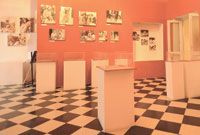
discussions and 'parking' Alhamra Art Council provides a wide variety of entertainment services. From art and music classes to theatre and exhibitions, they offer weekly programmes to the general public which are not only performances affordable but accessible to all. Alhamra organises mainly three genres of performing arts, namely, commercial plays and stage dramas which rake in crowds to private music concerts and conferences which cater to a select audience and finally, events by the Arts Council itself. Art exhibitions are held on a permanent basis in the Alhamra at Gaddafi but space at the Alhamra Mall Art Gallery is also allocated to budding artists, whether they are solo or group -- open for public display. Private plays, in addition to plays organised by the
Council take place throughout the year. Alhamra holds religious and
philosophical seminars regularly, often focusing on topical issues. There are
puppet shows and children programmes held every Sunday which are almost free.
So are classical and private music concerts. International troupes are called
in to perform and there are also programmes initiated for public holidays –
a recently held American Jazz night is an apt example of the wide variety of
entertainment that Alhamra provides. Buzzing with activity, Alhamra opens its
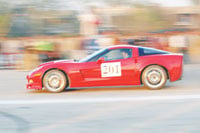
doors for all. Faiz Ghar also has a lot of activities for children and parents -- sing-along could be your child's favourite and so does yoga. Road racers Lahore is also famous for its enthusiastic racing aptitude. These racing fanatics normally put their mean machines on the roads of Lahore, always looking for new venues and deserted paths. For the first time, an official recognition of this 'illegal' sport has been done by making Drag Races legal throughout the city. People wanting to participate are welcome to bring their cars to these races. Recently provided with a legal racing track by the Tourism Development Corporation of Punjab (TDCP), the sport has taken on a new meaning. At the start of this year, TDCP organised a drag race event for the racers of Lahore. The venue was changed this year from Gulberg Main Boulevard to Walton Airport. This was a good decision because the airstrip is an open space unlike Gulberg's Main Boulevard which is mostly crowded. Racers now and then race in phase V and VI of Defence Housing Authority (DHA). Informal races are also held on the new airport road and in Jubilee Town in Raiwind on weekends. You don't need a car to enjoy the race!
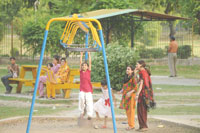
The weather in Lahore is tricky, especially the monsoon, but one has to make the best of it when it is on your side. Living close to Race Course Park -- the old name is much better than the 'official' Jilani Park -- I see people throng the place whenever the sun takes a break and allows the dark sky take the lead. Living in crammed city houses coupled with the unbearable heat and the never-ending load shedding, open space is bound to have a detoxifying effect. And if your pocket cannot bear the burden, who cares about Rs500-a-cup cafes? Lahoris are always complaining, and rightly so, about the
lack of open spaces. The longing to see the sky is often unfulfilled in a
city where 'adam aur loha' (humans and steel) are the only two things one can
see. Race Course Park tops for being the biggest, and probably one of the
most well-maintained, parks in the city. But if old trees and colonial times
fascinate you, Lawrence Gardens is where you should head. Unlike Race Course,
Lawrence Gardens has some worn-out swings for the kids. But I have seen kids
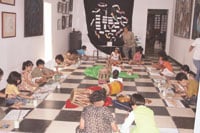
go bonkers seeing the open places. City kids! Most people like the Model Town Park for being less crowded although it could be a little far-off if you live around the Mall Road. For those in Iqbal Town, Gulshan-e-Ravi, Samanabad and its adjoining areas Gulshan-e-Iqbal Park is suitable but it is more of an amusement park rather than open space. If you just can't take the city anymore, take a long drive to Raiwand's Safari Park. Don't be fooled by the name. It is more like tigers' old home than a safari. But the area is on your side. Plan a picnic -- prepare your favourite food and call your favourite friends. Take along all the out door sports gadgets your children have and let them go crazy. Who knows, by the time they become parents this might be their best memory of Lahore. Mentoring music "The body of the arts," said Faiz Ahmed Faiz, "is the visible representation of a nation's identity or image, by which it is known and recognised." Let's face it, art is not the first priority in this beloved city of ours. Food is. But Lahore is opening up gradually to activities that can strictly be categorised as art. Lahore Chitrkar is one of the places where performing and visual arts are taught, shared and exhibited both at elementary and advanced level. Shahid Mirza conducts drawing and painting classes where he helps students prepare their fine arts portfolio addressing their individual needs. Music classes are held in classical vocals, tabla, flute, sitar, sarangi, guitar, violin and keyboard. Classes are also organised to develop the ability to render ragas. Classical music is taught in a traditional environment where students can develop the Ustad-Shagird relation. One of the major attractions is Khatak and Yoga classes by Nahid Siddiqui, a big name in Pakistan's classical dance. Again, she trains beginners as well as advance-level students. But if you represent the hip-hop generation, worry not.
This summer test yourself on the dance floor; there are schools who can give
you a chance to do that. Dance and music schools in Model Town, DHA and Johar
Town are offering salsa and hip-hop, kathak and classical, Indian item songs,
yoga dancing and even shaadi dance. The Performing Arts Academy at the Cultural Complex charges minimal rates for classes. Over the years, the Academy has branched out, boasting classes in violin, sitar, flute, harmonium, classical dance, drama and acting and even vocals. These mostly attract young blood eager to learn and involve themselves in this specific industry. These classes are open 5 days a week, headed by specialised professionals recruited by the Academy itself and are subsidised. Alhamra ensures that no section of Lahore's entertainment craving community is left out. Talking movies Lahoris crave entertainment in every waking moment of their life. Summers here make it impossible for outdoor activities. Hence, the favourite indoor activity is film or television. Yet, in a majority of cases worthwhile entertainment takes a heavy toll on your pocket. With cinema tickets costing a Rs200 to Rs300 going to Rs500 to Rs1,000 for theatrical and music performances – people from low-income backgrounds, students and those at the start of their careers feel marginalised. The Lahore Film and Literary Club (LFLC) was an initiative of the South Asian Free Media Association (SAFMA) and has been functioning for over a year now. The objective of the club is to engage an average reader in the literature. The membership fees is quite nominal and ranges between Rs500 for a student annual package to Rs1,000 for a general member. There are monthly options of Rs100 and Rs200 for those wanting to try out the place. However, apart from these one-time payments, there are no charges for individual events, giving the member a chance to immerse themselves in the offerings. The film screenings showcase a whole range of genres and eras and are held at the in-house mini-cinema that can seat up to 150 people. The films shown are often the ones that revolve around social, political, cultural and historically relevant themes and hence transcend geographical and linguistic boundaries. From contemporary Oscar winning pieces such as The Reader and Slumdog Millionaire to classical gems such as Casablanca and My Fair Lady, LFLC organises film festivals to highlight certain issues and movements in history. Documentary screenings are also held, such as the environmentally relevant The 11th Hour and Bowling for Columbine. Lahore Chitrkar also arranges slide shows, documentary and short film screenings. They are usually preceded by discussions or lectures on the subject.
|
|
 l'Story
Hour' at Faiz Ghar for children five years and above on Sundays, from 6-7 pm.
The event is followed by a sing along session with Zarah David on keyboard.
l'Story
Hour' at Faiz Ghar for children five years and above on Sundays, from 6-7 pm.
The event is followed by a sing along session with Zarah David on keyboard.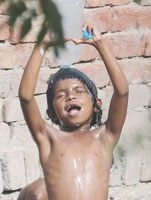
 Where
do you 'park'?
Where
do you 'park'?