


|
|
|
|
 |
 |
  |
feature
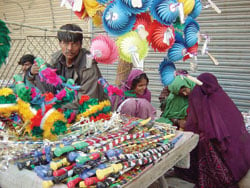
feature In Pakistan there
has long been a living tradition of indigenous popular toys. Yet despite its
great importance, this area of crafts for children is the most neglected part
of our cultural heritage. While looking for simple examples of good material
usage, one discovers the simple mela (funfair) toys, particularly the ones
that reflect our religious and ethnic rituals. These toys have a lot to offer
in terms of fun and learning. Traditionally such toys have always been
associated with festivals and fairs. For most youngsters, such toys sold at
melas (funfairs) and thellas (stalls) were once the only toys they wanted to
play with. However, things have changed radically in the past few years. Dynamic folk toys are
generally made by skilled as well as semi-skilled artisans all over the
country. Toy-making is not confined to a particular caste or community. In a
slum area of cities many people are found making their living by it.
Toy-making is relatively easy to learn, with a negligible investment in
tools, equipment and space. The marketing is done by the toymakers
themselves. Ittefaq, 40, is father of
six children and supports a family of nine that includes his mother Shanti
and sister Geeta. He says that he, his wife, sisters and mother make paper
and cardboard swords, parrots, knives, rattles, bows and arrows as well as
hats made of chicken feathers and other items. They make their handcrafts two
months before Moharram and sell them during the month of religious mourning.
Except for Moharram, the family earns very little for the rest of the year,
and often have to take loans to survive. The hand-crafted toys are
made with a lot of skill. When asked how he makes such impeccably beautiful
swords, Ittefaq says: “It’s easy. We cut the wood to a proper sword
length, and decide how long the handle should be. Generally, we use a
somewhat triangular- shaped blade (with one sharp side, the other dull) with
rounded corners. In the end, we wrap the handle with electric tape. This
makes the sword handle more stylish.” Rattles, simple drums, clay
animals and figurines are excursively made by women, while men make most of
the toys needing the use of even simple tools like pliers. Almost all the
animated toys, which need the assembly of parts, are made by men. The earnings of most
dynamic folk toymakers are very low. Their clients are largely from poor
communities for whom they have to keep the prices at a minimum. Low economic
returns are one of the reasons for massive dropouts from this profession. The
other factor is the inroads made by the mass-produced, factory-made plastic
toys. Despite the low returns and absence of any institutional support,
dynamic folk toy-making is still alive but flickering. “My children hardly get
dinner and they starve the whole day. We can’t even afford a jhonpri
(temporarily installed hut) and we sleep here in the open,” Ittefaq
explains. “One man has to stay awake the whole night to protect our
possessions from thieves. Our clothes, glasses, pots and pans have been
stolen many times.” The government has tried to
remove these people from this area several times but hasn’t offered them
much help in return. Some families were offered plots in khuda ki basti but
the dwellings of all 150 families have been demolished over and over again. Ittefaq claims that
government teams often visit them and demolish their temporary dwellings but
the moment they leave, all the families reconstruct their bamboo shelters
again because they have nowhere else to go. Ittefaq’s wife Amti
leaves her home every day and knocks on the doors of the rich and middle
class people in the vicinity for money and food. His mother Shanti suffers
from a severe eye infection that has left her half blind. “My mother-in-law
can’t go out and work. She just sits here the whole day and looks after my
children. Sometimes people give me their leftovers and I bring them home to
feed my babies. Today, I got masoor ki daal but the quantity was not enough
for all so I’m saving it for my youngest daughter Reshma,” shares
32-year-old Shanti. Though she says she is 32 years old, her tough life has
left such wrinkles and scars on her face that she looks 50. Jaitha, 85 is the eldest
among all the people here and he lives next to Ittefaq. He walks with a stick
in his hand, doesn’t sleep the whole night to guard the area and sleeps all
day till the evening. Then he leaves for Tariq Road with his wife Jaili to
beg. They take a bus at around 10 after having dinner at a cheap hotel and
feed their children at 11. Jaitha fell from bus last month and got severe
back injuries due to which he walks with limp “We hate to beg but
we’ve got no other option,” he says. “We’re not educated. I walk with
great difficulty but I have to go out every evening otherwise my children
will starve. I have eight children and I earn Rs 50-100 daily. It’s not
enough. The doctor has given me a prescription but I can’t afford to buy
medicines or get a thorough medical check-up,” he says revealing his
toothless mouth. Ittefaq showed Kolachi his
work samples, which were extraordinary. Nobody could guess that people with
such talent don’t even have a roof over their heads and food to feed their
children. “This sword is made of wood and steel. It is mainly sold during
month of Moharram. We earn Rs 4,000-5,000 every year during this month so
it’s a blessing for us. We buy chicken feathers for Rs 200 per kg to make
fur hats of but we’ve to take loan to buy that. So after selling our
products, we return the money with interest. That leaves us with a small
amount but still it’s a boon,” said Amti while making a feather hat. The procedure of making the
hat was extremely interesting. Amti first arranged the ends of the feathers
at the base of the hat, where the bottom of the crown met the brim. She then
glued the ends of the feathers in place with perfection. A screwdriver was
used to press the feather ends into the glue. To give the hat a beautiful
look, she made a bow with the help of a ribbon. “Layer ribbon, lace, silk
flowers or even beads could be used to adorn these hats. The purpose is to
cover any glued areas or bare spots with additional ribbon, lace or other
decorative material. Folk toys reveal in their
structure a relationship with basic principle of science and technology. If
we analyze any of these toys, we would find the application of one or more
laws of science: the basic laws of equilibrium and gravity, levers and
inclined planes, the concept of centrifugal forces, energy transformation,
the concept of sound, optical illusion etc. In fact, quite a few of these
toys would be very useful as teaching tools for illustrating the basic
principles of physics. These toys are remarkable
examples of ingenious ways and means of using the basic principles of
technology. The aspects of accuracy, precision and tolerance, assembly of
parts, linkages and mechanics- all these are taken into account to make a
drum, a puppet, a sword or a bird in flight. Dynamic folk toys are also
good examples of application of the popular arts. They tell a lot about
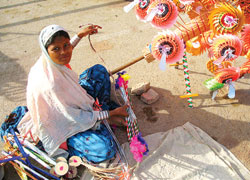
creativity as well as the use of color to express an idea. The cart drum is amongst
the most popular action based folk toy. When little children drag it behind
them, a drum starts beating. Cart drums are made all over the country. Another toy that fascinates
children is the Chirya (sparrow). It is also called ‘helicopter’. The toy
in fact doesn’t look at all like sparrow or helicopter. It is made of the
most frugal material like a paper blade, a tiny bamboo stick, and two metal
sheets and an arm’s length of thread.
When moved through the air, this inexplicable little thing suddenly
transforms itself into a bird-like creature. The toy is made in the millions
and sold at melas all over the country. It is very ingenious example of
simple yet effective design and technology. Most of these Hindu
families have been residing in this locality for 20 years. They claim that
their forefathers were involved in the textile trade in India. “We migrated
from Radhapur 20 years back and learned this art here (in Pakistan). But
since our wares are sold only during the month of Moharram, we sell birds
too. We buy one parrot for Rs 10 and sell it for Rs 12. It helps us buy food
for our children,” tells Ittefaq Extreme poverty makes these
people look twice their age. Survival is their only aim in life and they are
least aware of the tremendous skill they possess. Instead of promoting their
art, the authorities routinely demolish their homes. When asked what he would
want from the government, Ittefaq smiles and says if the government can’t
feed his children or give them shelter then it shouldn’t at least take away
their bread and butter. That, he believes, would be more than enough. “My children are hungry
and I can’t even give them water. What can I do with this tremendous skill
when I can’t even meet my basic necessities? Sometimes I feel so helpless
that I want to stab myself with these knives I make. My children’s future,
however, stops me from doing this,” he laments. A lot needs to be done to
heal the damage done to the field of artisan-made toys. It is necessary to
build toy museums, training centers and marketing tie-ups at the state as
well as national levels. It is
essential to create ways and means by which talented toymakers and committed
designers team up to salvage this sector of our design heritage.
|
|