


|
|
|
|
 |
 |

|
Aye Aye captain! Road to tennis stardom And so they meet again
Aye Aye captain! By Umair A Qazi The Pakistan
cricket team’s showing in the first leg of the Sri Lankan tour was
highly embarrassing and indicated disunity, particularly among the
seniors. Before I go ahead and
analyse the tour thus far, I must say that it’s the prelude to the
tour which plays the most important role in the performance of a team,
especially a team from the subcontinent. Much before the tour
started, a debate was created with the help of the ever-eager media
regarding a change in the captaincy in one or more formats of the game.
Shahid Afridi was the obvious choice as captain and many believed he
would return to the fold as ODI captain and possibly lead the team in
the soon to follow T20 world cup. However, much to the
dismay of Afridi’s fans the flamboyant all rounder turned down all
such requests for reasons best known to him. It was, however, not a
surprise given Afridi’s recent outbursts during and after
international tours and his ‘jazbati’ approach. Quite a few people had
expressed concerns about Misbah being the T20 captain after Pakistan’s
loss in the last T20 against England in the UAE.
Before I go further into the matter, it is only fair to analyse
Misbah’s contribution to Pakistan cricket ever since he took over the
reins. Misbah took over the
captaincy at a time when the then infamous Chairman Ijaz Butt had fallen
out with Afridi and the next obvious choice was Misbah since Younis was
not interested. It looked as if Misbah
had been waiting for the chance for a long time. He looked settled and
happy to take over the responsibility imbued with a sense of calmness
showing no sign of panic as is often the case in Pakistan cricket. After a long time
since the departure of Inzamam-ul-Haq did one feel a sense of reliance
trickling within the batting line thanks to Misbah’s ability to play
long innings with poise and a sense of calm even if wickets fell
quickly. His first eight
innings as Test captain produced scores of more than fifty which speaks
volumes about his commitment to the job. As captain of the one day side
as well, even though his scoring rate seems to be on the slower side, he
revived the team as he won a majority of the matches last year. In
recent times he won the Asia Cup. It is too harsh to
demand his ouster as the captain because of a few losses here and there.
In my opinion there is
little difference in the T20 and one day cricket since there isn’t
much difference in the playing eleven for both formats. A player or two
perhaps change unlike the prelude to the Sri Lankan tour wherein six
different players were selected for only two T20 games, a decision which
was as mind boggling as having Intikhab Alam in the PCB setup. Mohammad Hafeez is a
reborn cricketer. He made his debut in 2002 but struggled to keep a
permanent place in the team up until the 2010-11 season where he was
inducted in the side as an opener who could also bowl and it is actually
his bowling that has kept him in the side. He hasn’t really
solved Pakistan’s opening problems and continues to struggle as opener
as is evident from the recently concluded one day and T20 series. This is why in my
opinion Hafeez should never have been made T20 captain. Sure enough he
had a wonderful 2011, was Pakistan’s top batsman, but a closer look at
his success at the top suggests success was against weak and meager
sides and that too with them dropping his catches. Given the fact that
Hafeez has only shone against weaker sides, perhaps making him captain
was putting too much pressure on him. An example of such pressure is the
fact that he has stopped opening the bowling for Pakistan, a role which
he successfully fulfilled previously. A captain ought to lead from the
front which he failed to do. In any event, no team
in the world appoints fresh captain right before a World Cup. Instead
they carry on with the tried and tested which in our case would have
been Afridi or Misbah. The pressure of playing a World Cup is immense
and from what we have seen so far it would not be a piece of cake for
Hafeez. As an ending note I
must say that the board is being run more or less like the country. What
is even more worrying is the fact that the nation continues to have
faith in the board’s administration. No wonder we are ruled by the
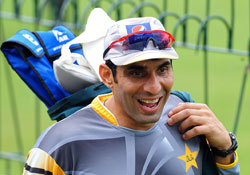
Gillanis and the Rentals! umairkazi@gmail.com caption COLOMBO: Pakistan
captain Misbah ul-Haq attends a practice session at the Sinhalease
Sports Club (SSC) Ground
Road
to tennis stardom Sports fans in
Pakistan have been eagerly following the ongoing Wimbledon Championships
at the All-England Club in London not just because all of the world’s
top stars is taking part in what is regarded as the most prestigious
Grand Slam. Another factor that has enhanced their interest is the fact
that Pakistan’s tennis ace Aisam-ul-Haq Qureshi is also featuring in
it. Tennis is really an
absorbing sport with colourful history. It began in 1877 has produced
some of the most prominent sports celebrities of the world who touched
the epitome of physical fitness and tactical superiority. There is a long list
of tennis stars starting from Fred Perry (1936) to Billie Jean King and
Ken Rosewall. The decade of 1970s
belonged to Jimmy Connors, Bjorn Bog and Chris Evert, where as the
eighties belonged to Boris Becker and Steffi Graf. The decade of
nineties witnessed Andre Agassi and Martina Hingis. From the year 2000
onwards the game of tennis has been dominated by some super fit players
such as Pete Sampras, Rafael Nadal and Novak Djokvic. In Pakistan,
Aisam-ul-Haq has achieved enough successes to kindle tennis interest
among the Pakistani youth. Tennis names such as
Roger Federer, Rafael Nadal, Andy Roddick, Serena Williams, Caroline
Wozniacki and Maria Sharapova are quite well known among the tennis
lovers of Pakistan. Most of them try to emulate their hair styles and
the attire, but unfortunately what they don’t know is that these stars
have not achieved this fame and fortune overnight and that behind their
success is a long road of struggle and hard work, combined with enabling
environment that made them emerge as world tennis stars. The way tennis is
played has changed significantly over the past thirty years. It has been
observed that players have now changed their closed stances and eastern
grips for open stance and western grips. Racquet technology has also, at
least partially, been responsible for players at the top level hitting
the ball harder and from more open stances. Serves are being hit
at 130 miles (209 KM) per hour and both forehands and backhands are used
as major weapons from almost anywhere on the court. To be able to handle
these modern strokes, players need a solid base of muscular strength,
flexibility, endurance, and power to enhance performance and promote
injury-free play. The field of
biomechanics, the study of forces and their impact on movement, helps
the players to understand the science of tennis technique. A tennis match can
last anywhere from 30 minutes to several hours. Matches on Wimbledon
grass courts are among the longest. One set during a
second-round match between Juan Carlos Ferroro and Radek Stepanek in
2006 lasted 83 minutes. Within the time period
of an average professional match, a tennis player can run three to five
miles (five to eight kilometers). And a tennis player
performs 300 to 500 bursts of energy during a typical tennis match. It is estimated that
up to 75 percent of all strokes hit at professional level are serves and
forehands, meaning certain muscle groups out of the 600 muscles in human
body, do the bulk of the work. Different tennis stars
are known for their different strengths and style of play. Tennis
requires hitting the ball from some pretty amazing positions. Watch Kim Clijsters to
understand the role of flexibility in tennis as she runs wide for a ball
and actually go into the splits to get that extra bit of extension to
get the ball. While playing the game
the player has to extend the body to reach a wide ball, retrieve a lob,
lung forward to cover a drop shot. All these positions require
flexibility and good flexibility will help a player get to ball more
quickly and efficiently while setting up to hit with both balance and
control. Alongwith flexibility,
strength and power are essential to become a good player. Watch how hard
today’s player hit the ball and Andy Roddick is the best example, if
you want to learn about the powerful service. He has hit a serve at 157
mph (253 km/h ) per hour and regularly tops 130 mph (209 km/h). Serena Williams, about
whom our naive sport experts think that she uses some steroids to build
muscles, in fact uses her strength and power to rip backhand winners
from essentially anywhere on the court. The United States
Tennis Association (USTA) looks at the strength from two perspectives.
First and most important is the sufficient muscular strength,
particularly in the legs, upper back and shoulders to handle the force
of game. This is called the base level strength. After developing the
base level strength a player can work on developing the power to cover
the court more efficiently and maximize the power in the serve. Similarly, having the
power in the core area and shoulder allows one to generate power behind
virtually any groundstroke. Strength and power do
not come naturally in tennis or any other sport. In fact, to truly
maximise these aspects of the game, one has to do more than just play
the game. Consequently, all tennis players should incorporate exercises
that build strength into their training programmes through the help of
qualified trainers. Injuries are part of
every sport and so is the case with tennis. One of the best ways to
prevent injuries is to develop muscular endurance. Players need to be
able to use the same muscular set over and over, ideally being able to
hit the ball with as much force at the end of each match as at the
beginning. A typical 5 second
point in tennis requires more than four changes in the direction, making
agility, or the ability to change direction quickly and effectively, a
critical component of the game. One should also strive
for the correct body composition i.e. how much fat, muscle, bone and
water the body should contain. Ideally speaking the
female tennis player should try for a body with fat percentage of 15 to
25, while men should strive for eight to 18 percent. Players need to eat
healthy foods with correct balance of proteins and carbohydrates and
engage in aerobic exercise (like squash) to lose body fat. The game of tennis
also demands stability and dynamic balance, which is more difficult than
staying balanced in a stationary position. Dynamic balance is a
difficult skill to master, and yet it is the ability that allows one to
maintain control of the body when hitting difficult shots on the run. By now the readers
must have realized that tennis is a tough sport to train and the road to
success is difficult but not impossible. Players in Pakistan
can also become tennis stars like Nadal, Roddick, Federer or Djokovic,
Sharapova or Serena Williams but for achieving the excellence they have
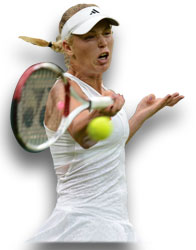
to follow correct work ethics and focus on their training. sdfsports@gmail.com caption Caroline Wozniacki
And
so they meet again First things
first; I will stick my hands up and say my call at the start of this
year’s European Football Championships had been that Germany and Spain
would end up contesting the final, with Germany my bet to win,
overcoming a Spain side who were in some few ways worse than they were
two years ago, while their own squad had gotten stronger in the
intervening period. Clearly that did not
pan out as I predicted, but to be fair, no one could have foreseen the
kind of football Italy have shown. Not only has it been amazing in terms
of the results it has generated, but the football has also been easy on
the eye and far from the stereotype of Italian football. Spain, for their part,
have also deviated from what one had grown to expect of them. Both sides
started the tournament presenting two very unique playing styles, at
least insofar as the showing from other participants was concerned. Spain were quick to
ditch their 4-6-0 from the first game, opting to bring in a striker for
the rest of their games, and using this more conventional setup to good
effect. Fernando Torres in particular has had a decent tournament, which
makes his omission from the semifinal all the more perplexing. Spain’s
pattern of substitutions has not helped much either. Against Portugal,
Del Bosque took off the ineffectual Negredo, who had suffered throughout
the game from a lack of quality service from midfield, and brought on
Fabregas, which meant Spain’s formation would revert to the 4-6-0
which would aim to congest the midfield and stifle Portugal’s counter
attacks. However, he then brought in Jesus Navas, who specialises in
hugging the flank and putting crosses into the box for the now missing
centre forward. As it was, Fabregas was ineffective, and some Spain’s
better chances came after Pedro was brought on later. The Barcelona
winger is far more adept at running onto balls played behind the
opposition back line, and while he was given adequate opportunity, he
could not make the most of it. Portugal, for their
part, showed that Spain can be rattled if they are made to contend with
a credible attacking threat, in that case, Cristiano Ronaldo’s speedy
runs on the counter attack. Despite having plenty of midfielders, Spain
were forced into making last ditch tackles and interceptions to thwart
the Portuguese, who defended and attacked with energy for the full two
hours of the match. Italy must learn from this lesson and implement a
strategy to similarly put the Spaniards to the sword. When the two teams
faced off in the group stages, Italy put forward a formation that
exploited Spain’s congestion in the centre of the pitch. Spain’s
goal aside, they were stopped time and again from getting through the
back line to test Buffon in Italy’s goal. Italy had a harder time of
it as the match wore on, finding that they lacked the raw energy
required to sustain the intense pressing and attacking game they were
trying to play. Now, having played a tiring tournament, and with a day
less of rest than their opponents, Italy are unlikely to attempt the
same formation. The option available to them is the same as in the
semifinal, where they played a 4-4-2, doing a good job of handling
goal-bound midfielders and Germany’s lone striker. Chiellini was used
at left back to provide more defensive steel on the flanks, rarely going
forward to join the attack. Italy’s 4-4-2, which
can be elaborated as a 4-1-3-2, will be different than Portugal’s
4-2-3-1, a formation similar to what Spain will look like, should they
start with a striker up front. Negredo and Llorente both thrive off of
crosses into the penalty area, much more so than Torres, whose natural
talent has proven to be diagonal runs onto through balls behind the
defence. Given Del Bosque’s aversion to fielding out and out wingers,
Torres remains the best option to spearhead this attack, with Silva and
Iniesta on either flank. The real quandary comes deeper in midfield.
Xavi’s effectiveness is unsurpassed in a deep role, from where he can
direct play. However, Spain’s double pivot of Alonso and Busquets
means that Xavi has to play higher up the pitch than the position he has
made all his own at Barcelona. To get the most out of him, one of
Busquets or Alonso has to be sacrificed, with Xavi dropping deep and
Fabregas taking his position behind the striker. On the other hand, this
gives Spain a relatively weaker defence. Italy’s attack has
carried a quick gear up in pace when the ball is played out of midfield
to the front line, utilising the pace of Cassano and Balotelli to carve
out space. This means that Spain can afford to allow Xavi the position
detailed above, and still get by. Then again, this leaves the question
of who will mark Pirlo. Spain’s own midfield will be troubled by 3 out
of 4 Italian midfielders pressing to disrupt their passing. Pirlo is not
expected to lend much defensively, but is always the option to play the
ball out to, and who can switch the ball from one area of the pitch to
another with consummate ease. All in all, it
promises to be a fascinating encounter. Both sides tested each other out
at the beginning of the tournament, and will look to put their knowledge
to good use. Spain are looking to repeat history by winning the Euros.
Italy are looking to do something similar; when they won the World Cup
in 2006, Italian football was reeling from the ‘calciopoli’ scandal
that engulfed multiple tiers of the game. Now, at the head of another
scandal, the Italians will be looking to recoup pride for their nation
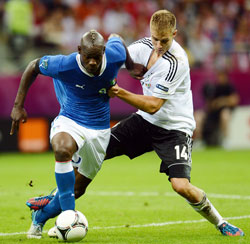
under similar circumstances. zainhq@gmail.com caption WARSAW: Italian
forward Mario Balotelli (left) vies with German defender Holger
Badstuber during the Euro 2012 football championships semifinal at the
National stadium |
|