


|
|
|
|
 |
 |


|
hockey Two giants bow out
hockey A remarkable victory Pakistan's Olympic triumph in Los Angeles earned them the last of their three hockey golds By Ijaz Chaudhry When the 1984
Olympics arrived, Pakistan held all the other titles: World Cup, Asian
Games and the Asia Cup. Yet they were far from being the favourites for
the Olympic gold. The team had been going through a lean patch since
early 1983. Replacements for two legends, centre-half Akhtar Rasool and
left-out Samiullah, had not been very satisfactory. Two other greats,
left-in Haneef Khan and right-out Kaleemullah, were getting slow. Even the reliable
right-half Rasheedul Hasan had been in and out of the team. Australia had beaten
Pakistan in as many as last seven tournaments, and were everyone's
favourites. Enter Brigadier M H
Atif, Pakistan's manager not only when they lifted the World Cup in 1982
but also at the last Olympic gold in 1968. Atif, as always,
started the homework meticulously. Pakistan had been conceding a lot of
goals off penalty corners. In the 1982 World Cup, the Russian goal
keeper had revolutionised goalkeeping on penalty corners. He rushed from
the goal-line and lied down horizontally close to the top of the
striking circle thus narrowing down the striker's vision of the goal;
drag flicks off penalty corners were not permitted by the prevalent
rules. Pakistani goalkeeper
Moinuddin had suggested employing the same tactic but the Pakistani
management hadn't agreed. Atif decided to adopt
the ploy. Both the goalkeepers, Moinuddin and Shahid, were trained but
Moin was to be the first choice because of his height and long steps. The important aspect
of physical fitness was also taken care of. Australia were the
greatest hurdle. It fell to Atif's genius to discover the secret of
their success against Pakistan. Through deep video
analysis, he concluded that Aussies made sudden forays into the
Pakistani territory. These attacks originating from their right side
invariably involved as many as seven players, including the right
full-back, the right-half and the centre-half. To counter this
strategy, Atif adopted the policy of 'nipping in the bud'. He told his
centre forward to tackle the Aussie centre-half as soon as he entered
the Pakistani half. Similarly, the left-in
and the left-out were assigned to counter the right back and right-half,
respectively. For the left-out
position, Khalid Hameed was selected. Khalid certainly didn't possess
excellent stick work of Waseem Feroze but had the stamina of a horse and
impeccable recovery. He was assigned to assist the left defence, a role
akin to one performed by Jehangir Butt in the 1968 Olympics. The last phase of the
training was done in Vancouver, Canada, with a similar climate as that
of Los Angeles. When the team reached
Los Angeles, they were physically, mentally and tactically
well-prepared. It is the dream of
every sportsman to be a part of the Olympics' opening ceremony. It was
to last five hours and Pakistan had their opening match the next day. Atif decided to send
only the reserves and captain Manzoor Jr — the flag bearer of the
Pakistani contingent. Pakistan were leading
3-1 against New Zealand with a couple of minutes left, when Kiwi striker
Dajji struck twice, receiving a long ball each time. The match ended in
a draw, and disappointment for Pakistan. Both Hasan Sardar and
Dajji got hat-tricks. In the second game,
Pakistan beat the lowly-rated Kenya 3-0. Next, Pakistan were
able to draw 3-3 with the strong Holland team, courtesy a fluke Manzoor
Jr goal in the dying moments. Celebrated
right-winger Kaleemullah had been mostly off-colour despite pep talk by
the management. It was a very brave decision by the manager to drop
Kaleemullah -- a regular since his debut in 1979 -- in favour of Saleem
Sherwani. In the match against
Canada, Sherwani didn't disappoint and the Pakistani forward line
displayed its true potential for the first time, winning 7-1; a goal
margin that proved handy afterwards. Pakistan needed a
victory against Britain in the last pool game to top the points table
and thus avoid Australia in the semifinals. Ironically, any other result
could also have jeopardised their chances of even reaching the semis. Pakistan dominated the
proceedings. Apart from wasting as many as eleven penalty corners, quite
a few open chances were also missed and the match ended in 0-0 draw. As in the first World
Cup (1971), Pakistan's making the semifinals depended on Holland not
making it. This time around, the
Dutch needed to beat Kenya by five goals. Kenya had their
pre-Olympics training in Karachi, so they were indebted to Pakistan.
They were also given defensive tips by Pakistani players prior to the
match. All this meant that the East African restricted Dutch victory to
three goals. For the semi-final
against the menacing Australians, who had won all their five pool games
easily, Kaleemullah was recalled. The Pakistan side
played with a definite plan and most of the attacks were repulsed
prematurely. Just before the end of the first half, Manzoor Jr sent a
parallel pass to Hasan Sardar -- arguably the greatest forward in the
game's history -- who scored with a measured half-hit and push from the
top of the 'dee' which went through the legs of the onrushing
goalkeeper. Aussies tried their
utmost to equalise in the second half but the entire Pakistan team put
up a remarkable show to hold out. Even the ageing
forwards such as Manzoor and Haneef showed tremendous stamina to fall
back and help the defence. All this doesn't mean
that Pakistan only defended throughout. In fact, they had more tries on
the goal; it was a well-deserved victory. Pakistan's first win over
Australia after seven successive tournament defeats could not have
arrived at a more opportune time. West Germany awaited
them in the final. After a scoreless
first half, Germans earned a penalty corner. Goalkeeper Moinuddin had
been virtually unbeatable while defending penalty corners through the
newly adopted technique. The Germans employed
an indirect drill to get past Moinuddin. The penalty corner striker
instead of hitting into the goal, sent the ball to Michael Peter who had
come forward after pushing the ball from the goal-line. With a first
time hit, Peter sent the ball into the goal. Shortly afterwards,
Pakistan earned a penalty corner and they too employed an indirect
drill. Qasim Zia pretended to take the hit and as the goal keeper rushed
towards him, passed the ball to Hasan Sardar on his right, who equalised
through an angular shot. The final entered
extra time. Pakistan's extensive pre-Olympic physical training seemed to
pay off as stamina wise they appeared the better of the two sides. On the tenth penalty
corner, Qasim Zia after evading an onrushing opponent was about to
strike but a German player struck his stick from the behind. Pakistanis appealed
for the penalty stroke. The ball meanwhile went to the centre-half Ayaz,
standing just outside the striking zone who passed the ball to Mushtaq
just inside the circle. Mushataq's not so
strong push found Kaleemullah on the way, who had come forward after
pushing for the penalty corner. And it was Kaleemullah who scored the
gold medal winning goal. The green shirts
played out the remaining time. Thus they completed the Grand Slam for
the second time as they already were the World and Asian hockey
champions. It was the last time
Brig Atif managed Pakistan at the Olympics or the World Cup. Under his command, in
three Olympics, Pakistan won two gold medals (1968 and 1984) and one
bronze (1976). He was also Pakistan's manager when they lifted the World
Cup in 1982. Some achievement!
Scorers: Hasan Sardar
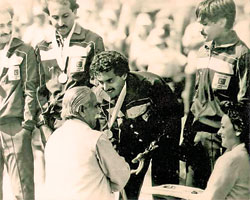
10 goals, Manzoor Jr 5, Hanif Khan 2, Khalid Hameed 1, Kaleemullah 1 ijaz62@hotmail.com caption Pakistan’s legendary
striker Hassan Sardar receives his gold medal after the final against
West Germany. On his right is Kaleemullah — scorer of the gold
medal-winning goal in the finale of the 1984 Olympics
Two
giants bow out On July 13 a
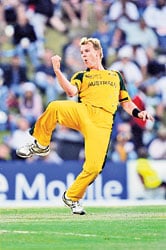
golden era of fast bowling came to an end as Australian pacer Brett Lee
announced his retirement from international cricket after a 13-year
career, saying his body and mind were no longer up to the stresses of
the game. Lee's calf injury was
the latest in a long line that punctuated his playing career, of 310
Test wickets at 30.81 from 76 matches, 380 One-day International wickets
at 23.36 from 221 matches and 28 wickets in 25 Twenty20 Internationals
at 25.50. In a match against
Durham during the Australian cricket team tour to England, Lee left the
ground after bowling just 2.2 overs. This proved to be his last
appearance for his country. He
also endured side strains, a broken toe, ankle issues, stress fractures
to his back, persistent elbow problems and appendicitis in the past. In 2001 he remained
out of cricket after he broke his elbow and returned to international
cricket in 2002. Brett Lee, 35, was one
of the fastest bowlers in the world along with Pakistan's Shoaib Akhtar.
His athletic figure
supported him to bowl with extreme pace regularly. His fastest delivery
was recorded with a speed of 99.9 mph which he bowled against New
Zealand in March 2005. Only Pakistani
speedster Shoaib Akhtar has bowled faster -- at 100.2 mph which still
stands as the fastest recorded delivery. Brett Lee stands as
the fourth most successful Australian bowler after Shane Warne (708),
Glenn McGrath (563) and Dennis Lillee (355). He was the 23rd to join the
300 Test wickets club. Lee became the first
bowler to pick up hat-tricks in ODIs and Twenty-20 internationals. Brett Lee made his
Test debut in 1999 against India at Melbourne. He announced his arrival
in international cricket with a bang. Bowling first change, Lee took a
wicket in his first over in Test cricket when he bowled Sadagoppan
Ramesh with his fourth delivery. After the retirement
of Glenn McGrath and Shane Warne, Brett Lee was the front line striker
for Australia. In his first series as
chief striker he took 16 wickets in two Tests against Sri Lanka in 2007
at an average of 17.5 and won Man of the Match award in both Tests. Brett Lee won many
awards for his outstanding performances during his career. He won the
Donald Bradman Young Player of the Year and The Wisden Young Cricketer
of the Year. He was nominated for the Wisden Cricketer of the Year in
2006. Just three days before
Brett Lee's retirement on July 10, another great player called it a day
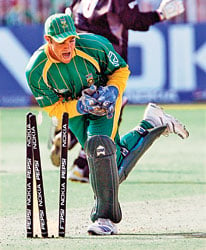
and that was South African wicket-keeper Mark Boucher who had to leave
after an eye injury during a side match in England. Later in a statement
Boucher said: "It is with sadness and pain that I announce that I
will not be able to play international cricket again, due to the
severity of my eye injury." One of the finest
wicket-keeper batsmen of his time, Boucher ended his international
career with record 999 dismissals, 555 in Tests, 425 in ODIs and 19 in
Twenty20 matches. He is only the fourth
South African after Shaun Pollock, Jacques Kallis and Gary Kirsten to
have 100 Test appearances. He played 75 consecutive Tests for South
Africa before being left out of the tour of India in 2004. He was then
recalled for a home series against England in January 2005 and since
then he has never missed any Test. The
wicketkeeper-batsman, who retired at the age of 35, made his Test debut
against Pakistan at Sheikhupura in 1997-98. His first victim was former
Pakistan skipper Aamer Sohail off the bowling of Shaun Pollock. He took
over as the first choice keeper when Dave Richardson hung up his gloves.
Only in his third Test
Boucher registered his name in the record books, sharing a world-record
ninth-wicket stand of 195 with Pat Symcox against Pakistan at
Johannesburg, saving South Africa from a disastrous position at 166 for
8. South Africa's present and past fast bowlers must be thankful to
Boucher for taking several difficult catches on their bowling. Shaun Pollock and
Boucher combined to have 79 victims, while Makhaya Ntini shared 57
wickets with Boucher. Former pacer Allan Donald took 53 wickets with the
assistance of Mark Boucher. khurrams87@yahoo.com |
|