



|
|
|
|
 |
 |
  
|
The
bleeding wounds theatre
Familiar themes A rare scholar
Ahead of her time Authority and countenance
are produced by the text, and Kishwar Naheed's text is masterly and
authoritative. That is to say she convinces us of the Born in Bulundshehr in 1940, she made a literary debut with 'Lab-e-Goya' in 1969 after her post-graduation in economics from Government College, Lahore. This was followed by 'Khayali Shakhs Se Muqabla', 'Saukhta Samani-e-Dil' and 'Mein Pehley Janm Mein Raat Thi'. The ghazals and nazms in them were unsettling in their freedom and bravura, as if the world they cared for existed on a level that was dizzyingly intimate yet heroic. Naheed was also a leading spirit in polemical anthologies, 'Aurat Khwab Aur Khak Ke Darmiyan', 'Dasht-e-Qais Mein Layla', etc., that took issues with the notion that female writing was bound to be informal, visceral, a revolt against the symbolic order, a breaking of the waters. There is nothing inchoate about her works; they are occasions for language to bubble up and cry. Naheed is, to use a trite term, a major poet. More than that she is exciting and true, and life practically spills from her writings. Here are excerpts:
By Aasim Akhtar The News on Sunday: What are your recollections of your childhood? Kishwar Naheed: My childhood is as horrific as my life -- full of adventures and dour happenings. I was born with the Pakistan Resolution followed by World War II that erupted soon after. War brought with it rationing -- one bottle of oil for one family. My brother and I would be told by our parents to get a bottle each, without daring to disclose to anyone that we were related. Paradoxically, this incident permeated into our psyche, and we were never able to tell anyone that we were brother and sister! This was followed by Pakistan Movement. Our Amma would participate in Muslim League rallies in burqa while we'd accompany her holding her finger. We had no idea why we were there except 'Ban Ke Rahey Ga Pakistan' and 'Le Ke Rahein Ge Pakistan'. I was born between two sons, the reason why my toys as a child were not dolls but sports like gulli danda and kite flying. When processions would leave from our school, we would turn the same danda into a flagpole. On the evening of the announcement of Pakistan's making, my father, secretary of the Muslim League, and my uncle, its vice-president, were arrested. For the next two years, we laboured in the shadow of death and horror that we might be attacked by the Hindu minority, as our men spent the nights on rooftops and our women kept busy reciting verses and saying prayers. As a child I would visit my father in prison which already familiarised me with the jail environment. TNS: Was it a patriarchal/conservative household? KN: It was a patriarchal setup in the sense that my grandfather would allow my uncles and brothers to join Aligarh University but for women it was the other way round; they should adhere to Sir Syed's principle of staying home, reading the Quran and 'Bahishti Zewar'. My mother, however, rebelled against her father and insisted to get her daughters educated. My father who had been a Tehsildar refused to bear the expense, and my mother decided to manage it within her meagre means. My two elder sisters had been sitting home after matriculation, waiting for a suitable proposal. After I had matriculated, I went on a hunger strike to convince my family to send me to college. The entire family came together and eventually agreed to getting me admission. Consequently, one of the sisters who'd been home for 8 years in spite of securing the top position from Allahabad University was also granted permission to join college. TNS: What compelled you to write? Was it the spirit of 'rebellion' against the 'norm'? KN: 'Rebellion' has never been a part of my vocabulary. How I started to participate in debates or write poems came about as a result of my teacher's insistence that I should 'read out' couplets in an inter-collegiate mushaira. As a custom, I used to do my reading late at night because literature and fiction reading were not allowed at home. This is how I finished Manto and Tolstoy. When I had already participated in 9-10 events and become relatively well-known, my father shut the door behind me and said, "Has anyone ever recited poetry in your house. You wished to become popular, and you have become popular enough. Now you may return these poems to the one who you borrowed them from." When I joined the Civil Service, years later, I had to face the same kind of resentment. I had to hide my cups and shields in flour canisters because the family would often argue that I bargained the family name for cheap popularity. TNS: How did the literary environment of Lahore of the 1960s inspire you? KN: To begin with, it was the literary environment of Aligarh, Bulundshehr and Meerut that impressed me. Majaz, Jigar and Jazbi were all there. I can still recall the first mushaira of my life, sitting in my mother's lap behind a bamboo blind. Years later when I reminded JaganNath Azad of the ghazal I had heard in 1945, he confirmed that that was his first ghazal recited at the mushaira in Bulundshehr. There was a milieu of mushairas, of literature, and of appreciation but none for writing oneself. When I finished high school, Sufi Tabassum who lived two houses away, became a routine visitor. Inter-collegiate mushairas became a regular venue to meet literary figures of the time, and my association with Radio Pakistan, led to a furtherance of acquiescence with the intelligentsia from Nasir Kazmi and Mukhtar Siddiqui to Roshan Ara Begum and Ustad Chhotey Ghulam Ali Khan. In a mushaira held in 1952, in the main auditorium of the Old Campus of Punjab University, attended by Josh, Faiz, Hafeez and Jigar, 17-year old Zehra Nigah recited three ghazals which set the house on fire. The next day, the rumour about town was: Who writes for this young woman? Retaliated by such response, the consciousness of writing myself awakened in me. TNS: We encounter a very mature poet in your debut collection 'Lab-e-Goya' which also won the Adamjee Award in 1969. Comment. KN: For the first ten years after migration to Pakistan in 1949, we did not have a permanent place to stay. My father had refused to ask for property in compensation. There were restrictions in the family and one was not allowed to converse even with one's male cousins. So books became my sole companions. I had finished a complete course of Munshi Fazil and Adeeb Fazil. I could read Persian fluently, and recall every important text in Urdu from 'Talism-e- Hoshruba' to 'Naye Puraney Chiragh' by Aal-e-Ahmed Suroor, from memory. You are conditioned through a language, the reason why my diction is tough. When I couldn't find anything else to read, I would pick up 'Lughat-e-Kishori' compiled by Naval Kishore to look into the etymology of words, their Persian, Arabic and Hindi roots. Such was the level of my fascination with words! My second collection 'Benaam Musafat' carried the lilt of N.M. Rashid, Mukhtar Siddiqui and Meeraji. TNS: It appears that you have always addressed yourself in your poems in the tradition of a soliloquy? KN: 'Mein nazar aaoon, jidhar jaoon, jahan bhi chahoon/ Yeh gawahi mein har ik aaina-gar se chahoon' People used to say I wrote my first poems in response to the feminist movement, failing to realise that these were written long before in the 1960s. In those days, verses would come like a river in flow. One would have to wake up in the morning to look for the ghazal written the night before. I used to keep a pencil and copy by my pillow and could not turn the light on for the fear of waking up the whole house. Often I would find the ghazal to be written right on top of another. Self-address in poetry can be interpreted in two ways: one is that you are a victim of narcissism, the reason why you end up addressing yourself; the other is when the need to hold a dialogue arises. It's ironical that most of my friends in life have been male, and I couldn't get the opportunity to interact with females following the etiquette of speech. To this day, women in this society have to justify themselves for holding dialogues. Poetry gave me the chance to speak to both the world and to myself. 'Mein shairi karti hoon kyun ke mein ne khud kushi naheen ki.' TNS: You have been accused of writing in the Punjabi idiom (mahawara) by the Ahl-e-Zubaan. Comment. KN: When Intizar Hussain's 'Basti' came out, it contained 10-12 words of Punjabi. We are not Ashraf Suboohi's descendants, nor are we living in Mohammad Hussain Azad's age. The language written in Wali Dakni's time was not written in Ghalib's time, and what was written in Ghalib's time is much different from Iqbal's time, and so forth. Languages change their tone in every epoch, and that's the beauty of Urdu language. Even Mushtaq Ahmed Yousafi who lives in Karachi, employs Punjabi words in his prose. It is the spontaneity of my writing style that one often feels I am talking to my readers. Hafeez Jullundhari says: 'Hafeez ahl-e-zubaan kab maantey the/Bari mushkil se manwaya gaya hoon'. Experimentation vis-a-vis language has always been close to my heart. Even though poetry of youth is rampant in Urdu, 'maturity of love' and 'love for maturity' are virtually absent. Old age brings with it its own set of emotions that no one's made the subject of poetry in Urdu, like Maya Angelou. The poets should record each generation's experience. TNS: What are your views about Ahmed Nadeem Qasmi's political stance as a writer? Do you see any contradiction in our perception? KN: Contradictions are a part of life and poets are also human. Z A Bhutto was hanged on April 4, and at the dinner hosted by Zia-ul-Haq on April 11 in honour of writers, Qasmi Sahab stood by the dictator and read out an essay. It was his weakness. People despised his decision in the same manner as Riaz Batalvi's who held advocacy against Bhutto. People feel emotionally towards certain events because they reflect on one's level of commitment. We have been very appreciative of Qasmi Sahab and his level of commitment -- he went to jail for a cause and became our hero. But when our hero went to see Zia, he fell to pieces. He was a great admirer of humanity and a great writer. No democracy can ever tolerate the insult of any individual especially of someone his stature. He was made to quit his job at Anjuman-e-Taraqqi-e-Urdu but he rejoined it perhaps because he had no choice. If he had any differences with the then regime, he could have resigned much earlier but to look for a justification or an alibi is not permissible. TNS: The journey from ghazal to nasri nazm to nasr is a long one? How did you manage to come such a long way? KN: When the war in Palestine was on in 1981, I was very upset. I wrote to one of my friends for help who sent me Layla Khalid's biography compiled by a fellow female writer. I set down to translating it immediately, sending in each chapter for composing as I would finish translating it. The book helped release my inner defiance and served as a point of catharsis. Next I thought about the book 'Mashriq-o-Maghrib Ke Naghmey' put together by Meeraji which included poetry from other parts of the globe that we hadn't heard or read before. So I started work on a book 'Baqi Maanda Khwab' which included translations of 50 international writers. I wished to tell the people what kind of subjects the world is focusing its attention on, and to make tiny windows open up in their minds. Didn't Krishen Chandra include the translation of T S Eliot's 'Shairi Kya Hai' as the preface to N M Rashid's book? TNS: What was the pretext to the long poem 'Farewell to Uterus' that appeared in 'Siyah Hashiey Mein Gulabi Rang' on your 50th birthday? KN: We have never assigned our uterus any significance other than a womb that carries the baby. I had gone to the US for six weeks where I had excessive bleeding. Upon consulting the doctor back home, I found out that my haemoglobin level had hit the rock bottom, and that I couldn't leave the clinic without hysterectomy. After the surgery, my uterus was sent for biopsy but the results were not disclosed to me initially. Eventually the doctor said that every single part of our body breathes. After giving birth to two children, I had not put my uterus to 'use' since 23 years. It was the cry of my uterus that it bled so fast because when you neglect your body parts, they react. I realised, at that point, that I who had been running after people's rights failed to listen to my uterus who had been crying for its rights. It had been lying away in my body, ignored and unattended, like 'unclaimed baggage'. This is how 'Farewell to Uterus' was born. TNS: Tell us about your involvement with Simone de Beauvoir's 'The Second Sex'. KN: Translating 'The Second Sex' was an uphill task. First I had to edit the entire book because there were too many references to the French society and culture which I deemed irrelevant for us. Then there were chapters devoted to issues such as abortion and free abortion rights that no one could touch even with the long pole here. There were references to French literature that I marked out and edited. The remaining book had character sketches of individual behaviour which I substituted for with Pakistani ones. For instance, how the tailor satisfies his latent urge by putting the measuring tape against the woman's body, and so forth. It was called 'Aurat Nafsayat Ke Aainey Mein', and 5,000 copies of it were sold within a month and a half of its appearance on the market. It was immediately banned, and was the first book to be banned by each province separately. The point to ponder is that while its English version is readily available on sale, the Urdu version corrupted the youth. This was followed by a court case on three different charges: i) pornography; ii) violation of copyrights act; iii) non-literary work by a serving government official liable to be prosecuted. Ejaz Batalvi took up the case before the court, and pulled out references from the Encyclopaedia Britannica, declaring the book to be a work of sociology and literature. I was arrested but soon bailed out. A commercial theatre goer is distinct from the one watching amateur English plays. The audience of a Nargis-studded play at Mehfil theatre explain why and how... By Ali Sultan Today theatre
going audiences are divided into three factions. The ones who Outside the Mehfil theatre everyone seems to be staring at the huge billboard. Larger than life images of actresses preening at odd angles seem to hold everyone's attraction. Three strange looking men who are holding hands are singing "Nargis is our favourite" over and over again and with this comes the uneasy realisation that a whole hour is left for the play to begin. Tonight at Mehfil theatre, the Punjabi commercial play 'Kudi lay gaye dil' (The girl who stole my heart) is playing for the third night and will continue for the next thirteen days. Comparing a Punjabi commercial play to an English play is like comparing Sultan Rahi to Talat Hussain. Anyone who goes to an English play knows that the play will most probably be sponsored and there will be free passes available. Going to a commercial Punjabi play means that a back-of-the-house ticket will cost Rs. 300 while the highest ticket will go up to Rs.2000. Every night, from 11pm at night to 2am this hall will be full. If the general vibe one gets from an English play-going audience is of a muted, conservative affair, tucked in dress shirts, fancy designer bags and hushed phone conversations, the audience of a commercial play win hands down for sheer visual pleasure . Here young boys prowl with gelled back hair and small skin-tight t-shirts matched up with orange track pants. Loud Punjabi songs pump out of large cars. Fake Gucci watches and gold chains, pot bellies and starched shalwar kameez are the order of the day. The only woman holding a man's hand wears a burqa. The audience of English plays and these other plays is limited to urban, high and middle class audiences. While "people all over Punjab come to see plays here", says Amjad Pervaiz, Manager Mehfil theatre. "They mainly come from Faislabad, Multan and Gujranwala." The audience here seems more relaxed. As the play begins there is loud hooting and cheering. Commercial plays are known to be distinct from English plays because of the element of vulgarity. "I don't understand why people go to these plays," says Jameel who has acted in several English plays. "Most of these commercial plays have no script. They are filled with bad and derogatory jokes." Asim Shah who is a viewer of both theatres begs to differ. "While the statement might be true to a certain degree, English plays also have their fair share of lewd jokes but because they are uttered in a 'cultured' language and they have such small audience no one seems to notice." "Commercial theatre is surviving this accusation and, in some cases, even thriving. This shows that people want entertainment and are prepared to watch these plays despite the hazards of doing so. This is like a classic demand and supply situation," says Amjad Ali who comes from Gujranwala every month to see one of these commercial plays. When the dances begin, which are termed to be the most controversial aspect of these commercial plays, the hall turns into a fashion show. Every third person in the audience starts clicking away photographs and shooting low resolution video clips. "Yes the dances are vulgar," says Abdullah, a young Pathan who has come to the show. "But what about all those English videos on television, aren't they vulgar as well?" "The biggest problem is the mentality of the people of this country", says Anjum. "The mindsets are very diverse. Thus what is decent to one group of people falls under the realm of indecency for the other." "I think comparing both these audiences shows a clear social divide," says Maryam Pasha who is a regular theatre goer and a student of sociology. "First of all is language; one is acted in the language of the masses, the other in the language of the elite class. The plots of English plays are usually lifted from English movies or are based on plays that were written from an alien perspective -- one that common people cannot relate with at all." In a recent documentary 'Theatre Sheatre' directed by Farhan Maqsood the eminent playwright Sarmad Sehbhai said "Commercial theatre is the most interesting. It shows society in its most grotesque form, where reality is inverted and reflected back at the audience." "I think there is no comparison between the audience of a Punjabi and English play," says Amjad Pervaiz. "One are the people who are the pulse of this country who work very hard and come here to relieve the pressure of life for a few hours. The others live in a bubble called Defense."
An exhibition of Argentine artists is a blend of global and local art, indicating the increasing practice of global art By Quddus Mirza At Shakir Ali
Museum, Lahore, a number of paintings, prints and drawings The exhibition in Lahore was a sequel of a similar show held earlier at the Embassy of Argentina in Islamabad. Except for the names of the artists, such as Jorge Canale, Ricardo Cinalli, Rogelio Polesello, Gonzalo Sojo and Marizu Terza, nothing appeared unusual. A contributing factor to the sense of familiarity was that a number of works were based upon the familiar themes of landscape, still life and the view of the sea. Likewise some other artists had created abstract surfaces with sweeping brush strokes in undulated streaks of colours. Ostriches, outlines of toys and shape of ships were the recurring motifs in some of the works on display. One of the most prominent part of the exhibition was a water colour by Benedit. In this work, a naively depicted horse and the rider were juxtaposed with carefully rendered portions of another horse's anatomy. The main figure and his animal were drawn as if fabricated with folded paper. Another artist, Jorge Canale used symbolic language, in order to show the flight -- rather the fall of Icarus, the mythological figure, who attempted to fly according to Greek legend. Along with these, some artists employed a representational vocabulary to create works in various media, while others preferred abstract expression. On the whole (with a few exceptions, such as the overt focus on barges, boats and vessel, like in the paintings by Maria Marta Pichel) the work on display was not very different from what we often see produced by our own artists. Identical visual solutions and similar approaches towards the subject and technique are visible in our art too. Actually the reason for identical approaches, imagery and ideas of the art from the two republics is the result of both benefiting from the same source -- mainstream Western art. More precisely, the art movements and practices of Europe and North America have been influencing creative individuals, not just in the two countries but many other places in the world. So if one collects canvases from Kenya, Kuwait or Korea, one hardly finds any difference in the still life, abstract compositions, figurative and landscape paintings despite the racial features (in the figures) and local peculiarities (for instance vernacular flora and fauna depicted in the landscapes). In fact what we witness is a kind of globalisation. That drawing from the same source -- Western mode of art education, triumph of European art market, power of the galleries situated in US and Europe and impact of art media concentrated in the West -- many individuals seek success based upon a similar kind of art making. Hence in majority of the regions, the artists' work put on public display and purchased by collectors have common characteristics. Interestingly the ratio of 'local flavour' or specific references -- though unique in each case -- have a uniformity in terms of their usage, placement, importance and desired effect. An example of this scheme of things -- although on a base level -- can be witnessed in the art hung in hotels and restaurants. Wherever one travels one finds a typical kind of imagery in the works from the five star hotels around the world. In Tokyo the view is of Mount Fuji, in Peshawar it's of Mount Everest, and in Nairobi Mount Kilimanjaro adorns the walls. The horse rider in Mongolia is slightly different from the rider in Mauritania, yet in its essence the treatment of the 'local material' is identical. Thus one moves from one continent to another but in each hotel room, lobby and dinning area, one comes across works, which are comfortably familiar. On another level, this phenomenon can be observed in the world of 'significant' art. Unless there are some details about the origin of the work, titles and the name of the maker, one finds it difficult to decipher the nationality of the artist. The work produced in one part of the world can be equally enjoyed and identified with by the viewers belonging to far away places. The exhibitions of this sort, not only present art from inaccessible regions but also indicate the increasing -- or ever present -- practice of global art, in which, like in a game of chess, you can play with your own 'carved men' (which may reflect the vernacular character/characters) but you have to accept the rules, limitations and principles accepted internationally. So in art too, regional characteristics add a variety in the larger design of the things. Hence in a majority of art and cultural productions, one finds some sort of ethnic imagery converted into an attractive composition that makes it original as well as regional. This, the blend of global and local may appear paradoxical, but this is the formula for furnishing hotels as well as serious works of art. In that sense the insistence on the national character in one's art seems superficial. A lesson, one can learn from the exhibition of Argentine artists, recently held at Shakir Ali Museum, Lahore.
Whenever there is a serious
debate about an issue involving music, Rashid For doing something important peace of mind, ready resources and ample time is required. As it is, scholarship and research are very lonely affairs in our country because so few persons are involved in it. It is mostly a vocation that isolates rather than brings together. The lack of institutions and academic framework that provides the centre as well as inspiration are missing. Music has a very old tradition in our culture and civilization but its history and development has been shrouded in either mythological explanations or in religious definitives. Its gradual evolution has never been tracked down properly with the result that wide gaps have invited perceived explanations not really based on documented evidence. The nature of music too has added to the difficulty and complexity of documenting music for it only exists in time and not in space. Furthermore, the technology to document music as it was performed and sung is not more than a hundred years old. The previous documentation, in words, cannot be considered primary but acts only as a secondary source. In the last thousand years or so civilization in India developed on parallel lines while integrating at some points. Parallel development was considered necessary to keep the religion pure and the ruling classes distinct, but some of it was the result of the difficulties that were not readily surmountable. Most of the people did not know both Persian and Sanskrit. Those who knew Persian tapped into its sources and those who knew Sanskrit dipped into its pool and insisted on the continuous and unbroken tradition in their respective areas. The scholarship of music too suffered on account of this parallel development. Musicologists did not bother to find out what was written in the text of the language that they did not know. This developed two points of views -- one that music was stagnant, had not developed and was in the process of decay, and second, contrary to it, that since it did not develop it was replaced by a totally new system of music which was dynamic and had immense potential of growth. This line of argument was strengthened by the presence of rulers who were basically from lands outside of India. Music was such a specialised art that its scholarship usually took place in isolation from what was happening in society at large and with the other forms of art. Actually in India all the art forms in varying degrees seemed to have developed in isolation from each other. The musicians or musicologists had not written about what was happening in poetry, painting and architecture and likewise the poets and the painters too did not express their opinions regarding music. One did not know what was happening in other forms of art, which could have provided a lead into the development and changes that might have been taking place in music as well. Rashid Malik like an intelligent scholar did not build his case on the purity of tradition or the general pristine principles relevant today but was open to the changes that were taking place and creatively affected music. He saw music as enveloping and an evolving form of art and went about in earnest to refer back to the texts and fill in the missing links. He identified the gaps in the oral history, which has been the preserve of the practicing musician and critically examined the oral and written sources. He got the Persian text translated into Urdu and looked anew at them with the intention of exactly mapping the course that music took in its long tortuous journey. His articles were always thought-provoking and raised eyebrows but could not be dismissed since they had been thoroughly worked out. When he questioned the contribution of Amir Khusro to music he challenged not only a point of view but took a shot at an almost belief system that had been accepted by all especially the practicing and hereditary musicians. In his book 'Mausiqi Key Farsi Maakhaz' he translated important Persian works into Urdu. These included 'Aijaz Khusravi', 'Musnavi Quran-ul-saiyadain', 'Musnavi Dulrani', 'Khizar Khan'. 'Fawaidul Fawood', 'Sair-ul-Aaulia', 'Waqiaat-e-Babari', 'Tareekhe Rasheedi', 'Aine Akbari', 'Tareekh Farishta', 'Kitab-e-Naurus', 'Shahjahannama', 'Badshahnama', 'Marartul Khayal', 'Muraqa-e- Delhi', 'Maratul aftaabnuma', 'Ghiyazul Lughaat' and 'Tareekhe Firoz Shahi'. And his critical review of 'Raag Darpan', one of the most important books written on our music, can probably be considered his most outstanding work. Needless to say where music was concerned Rashid Malik was a self taught person. There is no institution where one can be educated on the theoretical and philosophical aspects of music -- it is basically one's own initiative, developed by associating with intellectuals who think it is important to discuss such issues. This informal process was taken very seriously by Rashid Malik and he emerged as one of the leading musicologists of the country, not necessarily buckling under the dogmas of accepted theories. It is always difficult for such a man to live happily and he had his fair share of problems and hardships. He has left behind a vast treasure of musical recordings and a wealth of written material in printed and manuscript form. It is feared that all will be wasted or remain hidden from the public eye. As it is, there is hardly any material on music and if there is a collection based on a lifelong struggle as in the case of Rashid Malik, the possibility of it falling into wrong hands is great. A concerted effort should be made to save this collection and make it part of the fountain of public domain from where others can also drink deep.
Dear all, I recently met up with the playwright and novelist
Rukhsana Ahmed whose Annie Besant's is a name well known in the history of the Trade Unions because of her prominent role in the strike by the women employees of the Bryant and May match factory, a landmark in the British labour movement. She was a member of the labour movement and a vocal proponent of rights for women. She was also somebody who seemed to want to know 'the purpose of existence' and have a sense of greater good. She was an active member of the Theosophist Society which was a movement devoted to 'matters spiritual' and with whom she moved to India. In India Annie Besant became involved with the Home rule movement which demanded independence from the British. Rukhsana Ahmed says she was surprised by the extent of Annie's involvement in the early demands for independence and the fact that she was a member of the Congress party as well, and closely associated with Mahatma Gandhi until their various differences. She says she found researching the character of Annie Besant quite fascinating because of her beliefs. "She was an international celebrity, she would, at that time, be paid thousands of dollars for speaking tours. But she gave most of that money to good causes, which was what she thought was right." What about the title of the play? What was she 'mistaken' about or for? Rukhsana explained that this was really a reference to an aspect of Annie Besant's personal life that she thinks reflects the very imperialism that she fought against. Annie had walked out from her own marriage and as a result of her social campaigning, was considered by the court an unfit mother and so had lost custody of her children to her husband, a clergyman. In India Annie adopted two boys, the sons of a clerk in an Indian government department who had some links with the theosophists (one of these boys was later to become internationally famous as the philosopher Krishnamurti). But when the father tried to get his sons back, Annie resisted. A legal battle ensued and when the courts in India ruled against her, she took her fight to the House of Lords where she had many contacts and won her case. Rukhsana Ahmed says that in doing this, Annie Besant used the very structure of oppressor and oppressed that she spent her life fighting against. This was, perhaps, the mistake. The playwright used a fictional character called Sidra to narrate the play, which uses a combination of slides, footage and other effects to recreate the sense of chaos, crowds and historical change. It was intriguing to revisit the character of Annie Besant, and also to talk about the way a writer could create something extra out of a historical character's story. Also interesting was to find out that Rukhsana Ahmed has adapted Salman Rushdie's 'Midnight's Children' for radio and that will be broadcast sometime next month. Will have to look out for that. Best Wishes Umber Khairi
|
|
 authenticity of a world as it exists in language, through mastery, delight,
desire, passion and wit. The wit is sexual and rakish, the passion humane and
dense, the delight is in the mastery that is both formal yet acrobatically
flexible and free-spirited, often breathtaking.
authenticity of a world as it exists in language, through mastery, delight,
desire, passion and wit. The wit is sexual and rakish, the passion humane and
dense, the delight is in the mastery that is both formal yet acrobatically
flexible and free-spirited, often breathtaking.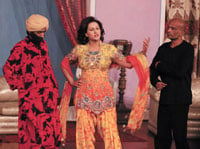 enjoy the amateur productions of schools and colleges and other private
theatre troupes such as Black Fish. The ones who want to see serious social
issue plays, like the ones Ajoka and Punjab Lok Rahs perform and the ones who
watch commercial theatre.
enjoy the amateur productions of schools and colleges and other private
theatre troupes such as Black Fish. The ones who want to see serious social
issue plays, like the ones Ajoka and Punjab Lok Rahs perform and the ones who
watch commercial theatre. from Argentina were, for the first time ever, brought to Pakistan due to the
efforts and interest of the Argentine ambassador to Pakistan, Mr. Rodolfo J.
Martin Saravia. The show, curated by Roxana Punta Avarez, offered a variety
of imagery, mediums and pictorial concerns. The work ranged from abstract
surfaces to recognisable imagery -- including human figures, landscapes and
still life.
from Argentina were, for the first time ever, brought to Pakistan due to the
efforts and interest of the Argentine ambassador to Pakistan, Mr. Rodolfo J.
Martin Saravia. The show, curated by Roxana Punta Avarez, offered a variety
of imagery, mediums and pictorial concerns. The work ranged from abstract
surfaces to recognisable imagery -- including human figures, landscapes and
still life.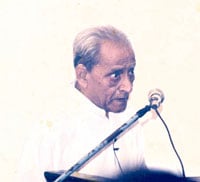 Malik is sorely missed. A rare scholar, whose area of interest was primarily
music, he almost single-handedly pursued his research work, and ended up
writing some of the best books on our music by an indigenous musicologist.
Malik is sorely missed. A rare scholar, whose area of interest was primarily
music, he almost single-handedly pursued his research work, and ended up
writing some of the best books on our music by an indigenous musicologist.
 play 'Mistaken: Annie Besant in India' is being staged in various parts of
Britain. It was pretty interesting to speak to her about the writing of the
script, and the portrayal of a character like Annie Besant, a woman who, in
the late 19th century, was working for labour rights, trade unions, women
rights and was arguing that the only way to pull the poor and downtrodden out
of their sorry state was to provide them with information about birth
control.
play 'Mistaken: Annie Besant in India' is being staged in various parts of
Britain. It was pretty interesting to speak to her about the writing of the
script, and the portrayal of a character like Annie Besant, a woman who, in
the late 19th century, was working for labour rights, trade unions, women
rights and was arguing that the only way to pull the poor and downtrodden out
of their sorry state was to provide them with information about birth
control. 